


VLSI Design Articles
Why Chips Fail: A Basic Guide to Chip Defects and IC Failure Analysis
Fun Facts About the Semiconductor Industry
Why Are Semiconductor Chips Expensive? Manufacturing Cost Explained
Instruction Set Architecture: How ISA Shapes Modern Chip Design


Get In Touch For Details! Request More Information
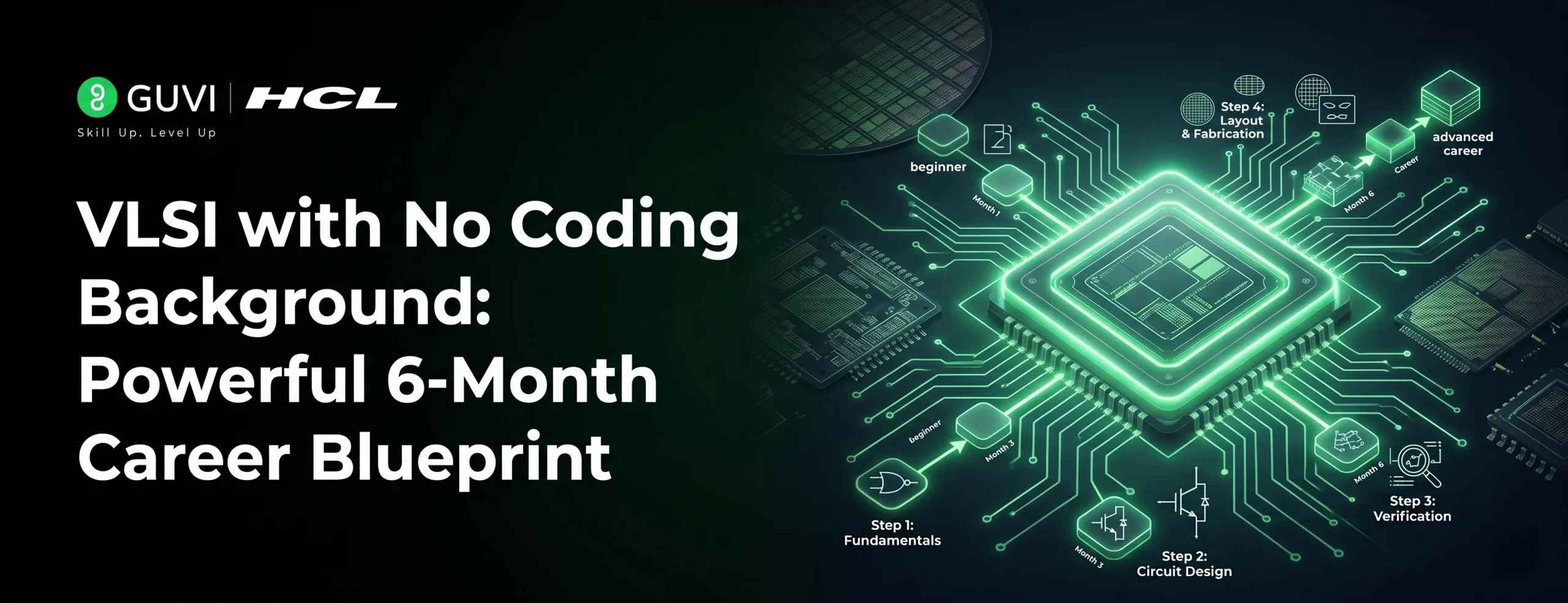
VLSI with No Coding Background: Clear 6-Month Career Blueprint
Apr 22, 2026 5 Min Read 1449 Views
(Last Updated)
Think you need coding skills to enter VLSI? That assumption is stopping thousands of engineers from exploring one of the highest-paying tech careers.
The truth is simple: you can absolutely start a career in VLSI with no coding background. Unlike software development, VLSI focuses on circuit behavior, hardware design, and system architecture, not writing algorithms.
If you understand logic, enjoy problem-solving, and are willing to learn how circuits work, VLSI is not only accessible, it might actually suit you better than programming.
In this guide, you’ll learn what VLSI really involves, what skills you need, and how to build a career step-by-step without coding.
Table of contents
- Can You Really Enter VLSI with No Coding Background?
- The Biggest Misconception About VLSI
- Why VLSI Is Different from Programming
- Skills You Need for VLSI
- Digital Logic Fundamentals (Essential)
- Verilog (HDL Basics)
- Circuit Theory Basics
- Problem-Solving & Debugging Mindset (Critical)
- Math Fundamentals (Important)
- Key Statistics
- Best VLSI Career Paths for Non-Coders
- Digital Design Engineer (Lowest Coding)
- Physical Design Engineer (Near-Zero Coding)
- Verification Engineer (Some Coding)
- Step-by-Step Roadmap to Enter VLSI with No Coding Background
- Month 1: Digital Logic Foundation
- Month 2: Verilog Fundamentals
- Month 3: Intermediate Verilog
- Month 4: CMOS Logic & Circuit Theory
- Month 5: Portfolio Project
- Month 6: Synthesis & Real-World Design
- Common Mistakes Beginners Must Avoid
- Don't Skip Digital Logic
- Don't Think HDL is Python
- Build a Portfolio Early
- Master Timing Concepts
- Your 6-Month VLSI Roadmap, Guided
- The Job Market is Booming
- Is VLSI a Good Career Without Coding Skills?
- Conclusion
- Frequently Asked Questions
- Can I enter VLSI without a coding background?
- Do I need programming languages like Python or C++ for VLSI?
- Is Verilog considered coding?
- Which VLSI roles require little or no coding?
- Which VLSI role requires the most coding?
- What should I learn first to enter VLSI?
- How long does it take to learn VLSI from scratch?
- Is VLSI harder than programming?
- Do I need advanced math to learn VLSI?
- Can ECE, EEE, or CSE students enter VLSI without coding?
- What projects should beginners build for VLSI?
- Is VLSI a good career choice in 2026 and beyond?
- Do companies hire VLSI engineers without coding skills?
- What is the biggest mistake beginners make in VLSI?
- Can I switch to VLSI from a non-coding career?
Can You Really Enter VLSI with No Coding Background?
The Biggest Misconception About VLSI
Most beginners assume VLSI = coding. That’s incorrect.
VLSI uses Hardware Description Languages (HDLs) like Verilog, which describe circuit behavior, not software logic. It’s closer to designing a blueprint than writing code.
Read: Top 8 VLSI Design Job Roles
Why VLSI Is Different from Programming
- Programming = sequential execution
- VLSI = parallel hardware behavior
- Programming = solving problems with steps
- VLSI = designing how circuits behave
This is why many engineers succeed in VLSI with no coding background.
Let me break down the core differences:
| Aspect | Traditional Coding | VLSI Design |
| What you build | Software algorithms | Physical circuit behavior |
| How it executes | Sequentially (one at a time) | Simultaneously (millions in parallel) |
| Primary language | Python, Java, C++ | Verilog, VHDL |
| Mindset required | “What steps to take?” | “How should circuits behave?” |
Here’s the fundamental truth: VLSI is closer to architecture than software. You’re designing blueprints for circuits, not writing step-by-step instructions for execution.
Ready to Start Your VLSI Career , With no Coding background ?
HCL GUVI VLSI course is built for engineers who think in circuits, not algorithms. Get hands-on with Verilog, physical design, and industry-standard EDA tools, from scratch.
Explore: Top Highest Paying Engineering Jobs in India
Skills You Need for VLSI
1. Digital Logic Fundamentals (Essential)
This is your bedrock. If you understand digital logic, you can learn VLSI. If you don’t, you’ll struggle. You need to grasp logic gates, truth tables, Boolean algebra, flip-flops, and basic sequential circuits.
Learning timeline: 2-3 weeks (10-15 hours)
2. Verilog (HDL Basics)
HDL is how you describe circuits. Think of it this way: Programming languages describe step-by-step problem solving. HDL describes what a circuit looks like. Start with Verilog (60% industry usage, easier to learn).
Learning timeline: 4-6 weeks (15-20 hours)
3. Circuit Theory Basics
You don’t need to be a physics expert, but understand Ohm’s Law, CMOS logic, timing concepts, power consumption basics, and clock signals. This knowledge helps you optimize for speed and power efficiently.
Learning timeline: 3-4 weeks (12-16 hours)
4. Problem-Solving & Debugging Mindset (Critical)
VLSI isn’t hard because concepts are complex, it’s hard because you’ll spend 80% of your time simulating circuits, debugging waveforms, and optimizing power/speed trade-offs. You need patience, attention to detail, and persistence.
5. Math Fundamentals (Important)
You don’t need calculus, but you should be comfortable with Boolean algebra, number systems (binary, hexadecimal), basic statistics, and logarithms. You DON’T need differential equations or advanced physics.
Read: How to learn the VLSI Course from Scratch? 12 Steps to Follow
Key Statistics
• 72% of VLSI engineers don’t have CS degrees
• Only 5% of VLSI roles require significant coding
• 3 out of 5 main VLSI roles require virtually no coding
Best VLSI Career Paths for Non-Coders
If you’re targeting VLSI with no coding background, these roles are ideal:
- Digital Design Engineer (minimal coding)
- Physical Design Engineer (near-zero coding)
- Verification Engineer (some scripting, not heavy programming)
These roles prove that you can build a semiconductor career without coding.
Digital Design Engineer (Lowest Coding)
Design digital circuits using Verilog/VHDL, simulate circuits, and optimize for timing and power. Coding involvement: less than 5%.
• Entry-level (0-2 years): ₹6–12 LPA
• Mid-level (3-7 years): ₹6–12 LPA
• Job growth: +5.2% annually
Physical Design Engineer (Near-Zero Coding)
Place gates on silicon dies, route signals, and optimize chip layout. This role is almost entirely design-focused with virtually no coding.
• Entry-level: ₹6–12 LPA
• Mid-level (3-7 years): ₹20–35 LPA
• Job growth: +6% annually (high demand)
Verification Engineer (Some Coding)
Write tests to verify circuit designs using Python and SystemVerilog. While this role has the most coding (20-30%), it’s mostly scripting, not algorithmic complexity.
• Entry-level: ₹5–7 LPA
• Mid-level (3-7 years): ₹10–15 LPA
• Job growth: +7% annually (highest growth)
Real salaries. Real path.
Physical Design Engineers earn ₹20–35 LPA. Verification roles are growing fast. These are achievable with the right foundation.
Start building it with HCL GUVI’s VLSI courses
Step-by-Step Roadmap to Enter VLSI with No Coding Background
If you’re wondering how to start a VLSI career without coding, follow this structured path:
- Month 1: Digital Logic
- Month 2–3: Verilog
- Month 4: Circuit Theory
- Month 5: Portfolio Project
- Month 6: Synthesis & Design Flow
Month 1: Digital Logic Foundation
Learn logic gates, truth tables, and flip-flops. 10-12 hours total. Difficulty: Easy.
Month 2: Verilog Fundamentals
Write your first HDL code. Code multiplexers and adders. 15-18 hours. Difficulty: Moderate.
Month 3: Intermediate Verilog
Design complex circuits like ALUs. Understand synthesis. 16-20 hours. Difficulty: Moderate.
Month 4: CMOS Logic & Circuit Theory
Learn transistor physics, timing, and power optimization. 14-16 hours. Difficulty: Moderate.
Month 5: Portfolio Project
Build an 8-bit RISC processor. Your job application starter. 20-25 hours. Difficulty: Challenging.
Month 6: Synthesis & Real-World Design
Learn logic synthesis and place-and-route basics. 12-15 hours. Difficulty: Challenging.
Common Mistakes Beginners Must Avoid
Don’t Skip Digital Logic
Jumping straight to Verilog without understanding digital logic is like learning French syntax without grammar. You’ll get lost immediately. Invest 3-4 weeks upfront.

Don’t Think HDL is Python
HDL describes parallel hardware behavior. Python describes sequential steps. Different mindsets required. Your circuits execute all operations simultaneously, not one at a time.
Build a Portfolio Early
VLSI is portfolio-driven. Companies want to see your designs. Build one portfolio project every two months of learning. By month 5, you should have a solid piece for job applications.
Master Timing Concepts
Timing is the #1 reason VLSI designs fail in production. Understanding setup time, hold time, critical path analysis, and timing closure separates professionals from hobbyists.
Your 6-Month VLSI Roadmap, Guided
We’ve laid out the roadmap. HCL GUVI VLSI course takes you through it step by step, month by month, concept by concept, project by project. No guesswork. No wasted time.
From digital logic to your first portfolio project, everything is structured for beginners entering VLSI with no coding background.
The Job Market is Booming
- The semiconductor industry needs VLSI engineers more than ever. The CHIPS Act allocated $52 billion for domestic semiconductor manufacturing, creating 100,000+ new jobs.
- The semiconductor workforce shortage could reach 59,000–146,000 workers by 2029.
- The semiconductor industry will need over 1 million skilled workers by 2030.
- The semiconductor industry directly employs 338,000 people in the US and supports 1.9 million+ additional jobs
- Demand for semiconductor engineers could exceed supply by nearly 50% in the coming years.
Is VLSI a Good Career Without Coding Skills?
Yes, especially now.
The semiconductor industry is growing rapidly, and companies need engineers who understand circuits, not just software. Many roles actively prefer candidates with strong hardware thinking over programming expertise.
Conclusion
You absolutely can enter VLSI without a coding background. What you need is circuit thinking, patience, and a willingness to invest 6 months in focused learning. The semiconductor industry is booming. Companies are desperately hiring VLSI engineers. The barrier to entry is lower than you think.
Your coding background doesn’t matter. Your circuit thinking does. If you’re curious, patient, and willing to learn, start today. The path is clearer than you imagine.
Start learning digital logic fundamentals this week. See if it clicks. Your
VLSI career awaits.
Frequently Asked Questions
1. Can I enter VLSI without a coding background?
Yes. You can enter VLSI without a coding background. Most roles focus on circuit design, logic understanding, and hardware behavior rather than software programming.
2. Do I need programming languages like Python or C++ for VLSI?
No. Core VLSI roles do not require traditional programming languages like Python or C++. Instead, you’ll use Hardware Description Languages (HDLs) like Verilog or VHDL, which describe circuits, not algorithms.
3. Is Verilog considered coding?
Not in the traditional sense. Verilog is a Hardware Description Language used to model circuit behavior. It’s VLSI with no coding back closer to designing hardware blueprints than writing step-by-step software code.
4. Which VLSI roles require little or no coding?
Roles with minimal coding include:
Digital Design Engineer
Physical Design Engineer
These roles focus more on circuit behavior,VLSI with no coding back layout, and optimization rather than programming.
5. Which VLSI role requires the most coding?
Verification Engineers use some coding (around 20–30%), mainly for writing testbenches and simulations. However, this is mostly scripting, not complex software development.
6. What should I learn first to enter VLSI?
Start with:
Digital Logic Fundamentals
Verilog (HDL basics)
Basic Circuit Theory
Timing and power concepts
Digital logic is the most important foundation.
7. How long does it take to learn VLSI from scratch?
You can build a strong foundation in 4 to 6 months with consistent effort (10–15 hours per week), including one solid portfolio project.
8. Is VLSI harder than programming?
Not necessarily. VLSI is different, not harder. It requires a circuit-based mindset instead of algorithmic thinking. Many non-coders find it more intuitive than programming.
9. Do I need advanced math to learn VLSI?
No. You only need:
Boolean algebra
Binary/hexadecimal number systems
Basic logic and reasoning
Advanced calculus is not required for most roles.
10. Can ECE, EEE, or CSE students enter VLSI without coding?
Yes. Students from ECE, EEE, and even CSE backgrounds can enter VLSI. In fact, many successful VLSI engineers come from non-programming backgrounds.
11. What projects should beginners build for VLSI?
Start with:
Logic gate simulations
Adders and multiplexers
ALU design
8-bit processor (portfolio project)
Projects are critical for getting hired.
12. Is VLSI a good career choice in 2026 and beyond?
Yes. The semiconductor industry is growing rapidly with high demand, strong salaries, and low unemployment. It’s one of the most stable and future-proof engineering careers.
13. Do companies hire VLSI engineers without coding skills?
Yes. Many companies prioritize circuit understanding, design skills, and practical projects over coding knowledge, especially for design and physical roles.
14. What is the biggest mistake beginners make in VLSI?
Skipping digital logic fundamentals. Without this base, learning HDL and advanced concepts becomes very difficult.
15. Can I switch to VLSI from a non-coding career?
Yes. If you’re willing to learn digital logic and HDL, you can transition into VLSI within 6 months, even without prior coding experience.
Success Stories

About the Author
Salini Balasubramaniam
A curious, information-savvy writer loves to turn deep insights into authentic and engaging content that connects. With experience in writing for brands and driving audience engagement, I believe that words can make a powerful difference.
View all posts by Salini Balasubramaniam
Connect with me @











Did you enjoy this article?