


Artificial Intelligence and Machine Learning Articles
Finance Manager to Data Analytics: Career Growth, Salary and Seniority
How to Evaluate LLM Outputs in Production Deployments
AI/ML Skills Gap 2026: Why Companies Can't Find Job-Ready Talent
20 AI/ML Interview Questions Recruiters Can Use Without a Tech Background - Best Guide


Get In Touch For Details! Request More Information
Vibe Coding Jobs: Skills, Roles, Salary & How to Get Started
Sep 03, 2026 4 Min Read 2476 Views
(Last Updated)
Quick Answer: Vibe coding jobs are AI-assisted software roles where developers build and ship products fast using tools like GitHub Copilot and ChatGPT instead of writing every line manually. They require strong coding fundamentals, AI collaboration, and product thinking. In India, salaries typically range from ₹7-₹10 LPA initially, scaling to ₹30 LPA+. Roles include AI engineers, prompt engineers, product engineers, and AI agent developers. To get started, focus on one language, learn AI tools, build real projects, and showcase your work.
What if the difference between getting hired and getting ignored wasn’t your degree, but how fast you can turn an idea into a working product using AI? That’s exactly what’s changing with vibe coding. Companies don’t just want coders anymore, they want builders who can think, ship, and solve real problems quickly.
If you want to stand out in this new wave, keep reading to discover the smartest ways to break into vibe coding jobs and get ahead faster.
- The vibe coding market is already valued at around $4.7 billion, growing rapidly as companies shift to AI-assisted development.
- Software development jobs are projected to grow by 17% by 2033, increasing demand for vibe coding skills.
- The global vibe coding market is expected to surge from USD 2.96 billion in 2025 to nearly USD 325 billion by 2040.
Table of contents
- What Is a Vibe Coding Job?
- Key Skills Required for Vibe Coding Jobs
- 1 Strong Fundamentals in Python / JavaScript
- 2 API Integration and Backend Logic
- 3 Understanding of LLMs and AI Workflows
- 1 Prompt Engineering
- 2 Debugging AI-Generated Code
- 3 Evaluating Output Quality
- 1 Problem-Solving Mindset
- 2 Rapid Prototyping
- 3 User-Centric Development
- Key Roles in Vibe Coding Jobs
- Tools to Master for Vibe Coding Jobs
- GitHub Copilot
- ChatGPT
- Cursor AI
- Vercel
- Salary Range for Vibe Coding Jobs (India)
- Experience-Based Salary Breakdown
- How to Get Started with Vibe Coding Jobs
- Step 1: Build Strong Coding Foundations
- Step 2: Learn to Work with AI, Not Against It
- Step 3: Build Real Projects (Fast)
- Step 4: Learn AI Workflows
- Step 5: Deploy Your Projects
- Step 6: Showcase Your Work
- Step 7: Apply Smartly
- Pro Tips to Break into Vibe Coding Jobs
- Build in Public
- Focus on Use-Case First, Not Tech
- Learn to Read AI Outputs Critically
- Stack Tools, Don’t Depend on One
- Think Like a Founder
- Optimize for Speed + Clarity
- Target Small Teams & Startups
- Conclusion
- FAQs
- Are vibe coding jobs suitable for beginners?
- Do you need advanced AI knowledge for vibe coding jobs?
- What kind of companies hire for vibe coding jobs?
What Is a Vibe Coding Job?
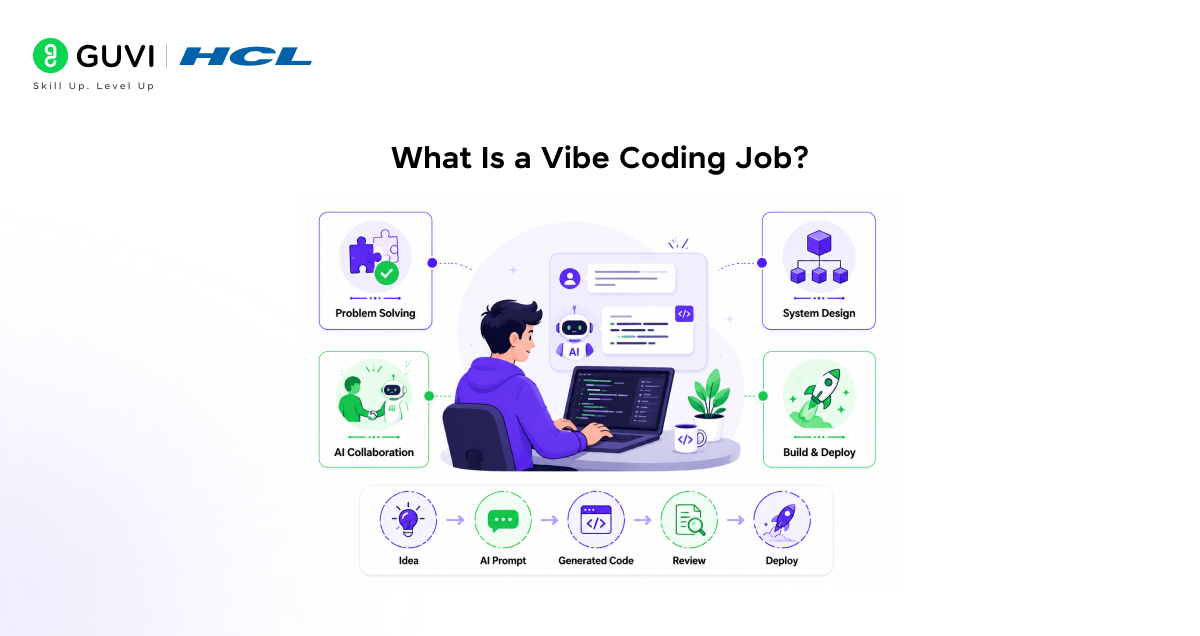
A vibe coding job is a modern software development role where engineers don’t just write code line by line, they guide AI to build it with them. Using tools like GitHub Copilot and ChatGPT, developers focus more on solving problems, designing systems, and shipping products faster. Instead of getting stuck in repetitive coding, they validate, refine, and integrate AI-generated code to create scalable, real-world applications efficiently.
Key Skills Required for Vibe Coding Jobs
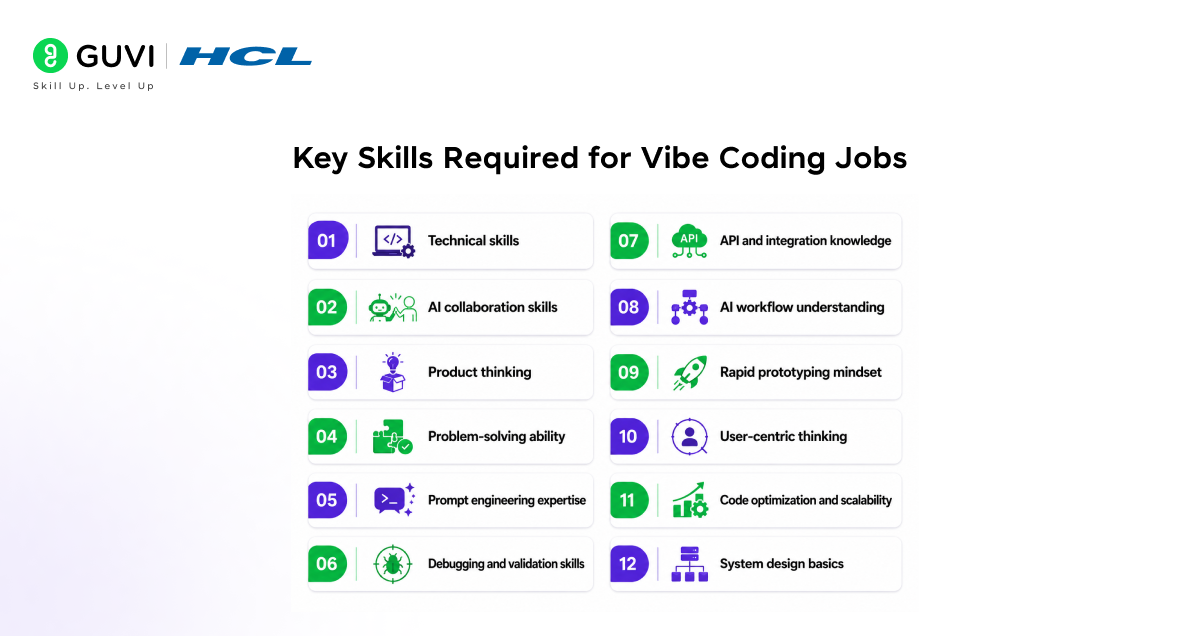
- Technical Skills
1.1 Strong Fundamentals in Python / JavaScript
- Core programming depth: Data structures (arrays, hash maps, trees), time-space complexity, and memory handling
- Language-specific mastery:
- Python: async programming, decorators, virtual environments, FastAPI/Django
- JavaScript: closures, event loop, promises, async/await, Node.js ecosystem
- Clean code practices: Modular architecture, reusable functions, readable naming conventions
- Why it matters: AI can generate code, but only strong fundamentals help you validate, optimize, and scale it
1.2 API Integration and Backend Logic
- REST & GraphQL APIs: Designing and consuming endpoints efficiently
- Authentication systems: OAuth, JWT, API keys, session handling
- Database integration: SQL (PostgreSQL, MySQL) and NoSQL (MongoDB, Redis)
- Server-side architecture: Middleware, routing, error handling, logging
- Real-world context: Most vibe coding workflows involve stitching multiple APIs into one working system
1.3 Understanding of LLMs and AI Workflows
- Core concepts: Tokens, context window, embeddings, temperature, latency
- Architectures: RAG (Retrieval-Augmented Generation), agent-based workflows, chaining
- Model usage: Prompt → Response → Validation → Iteration loop
- Framework exposure: LangChain, LlamaIndex, OpenAI APIs
- Why it matters: You are not just coding, you are designing intelligent systems
- AI Collaboration Skills
2.1 Prompt Engineering
- Structured prompting: Role prompting, few-shot prompting, chain-of-thought
- Instruction clarity: Writing deterministic prompts for consistent outputs
- Context control: Managing long inputs and avoiding hallucinations
- Iteration mindset: Refining prompts based on output behavior
- Outcome: Better prompts = better code = faster development
2.2 Debugging AI-Generated Code
- Error tracing: Identifying logical vs syntax errors in AI outputs
- Validation loops: Testing outputs in real environments
- Edge case handling: AI often misses production-level scenarios
- Security awareness: Prevent unsafe code, injection risks, poor practices
- Reality check: AI accelerates coding, but debugging still needs human expertise
Build the skills needed to succeed in modern AI-driven roles like vibe coding. Download HCL GUVI’s GenAI eBook to learn prompt engineering, real-world AI workflows, and practical strategies to turn ideas into working products faster.
2.3 Evaluating Output Quality
- Correctness: Does the code actually solve the problem?
- Efficiency: Is it optimized or unnecessarily complex?
- Scalability: Can this work in production systems?
- Maintainability: Readability, modularity, documentation
- Consistency: Stable outputs across repeated prompts
- Product Thinking
3.1 Problem-Solving Mindset
- First-principles thinking: Break problems into smaller components
- Outcome focus: Prioritize solving the user problem over perfect code
- Trade-off decisions: Speed vs scalability, MVP vs full product
- Why it matters: Vibe coding is about shipping solutions, not just writing code
3.2 Rapid Prototyping
- MVP building: Launch functional products in hours or days
- Iterative development: Build → Test → Improve cycles
- Tool leverage: Using AI + no-code + APIs to accelerate builds
- Startup relevance: Speed is a competitive advantage
3.3 User-Centric Development
- UX awareness: Simple interfaces, clear flows, minimal friction
- Feedback loops: Incorporating real user input quickly
- Feature prioritization: Build what users need, not what is complex
- Result: Products that actually get used, not just built
Explore: Top 10 Vibe Coding Courses Online
Key Roles in Vibe Coding Jobs
- AI-Assisted Software Engineer
- Builds applications using AI tools for faster development
- Focuses on architecture and logic validation
- Works with tools like GitHub Copilot to accelerate coding
- Prompt Engineer (Code-Focused)
- Designs structured prompts to generate accurate, production-ready code
- Optimizes outputs from tools like ChatGPT
- Bridges the gap between human intent and AI execution
- Product Engineer (AI-First)
- Combines coding + product thinking + user experience
- Builds and ships features end-to-end using AI-assisted workflows
- Prioritizes usability and real-world impact
- Automation Engineer (AI Workflows)
- Creates automated systems using APIs, AI agents, and integrations
- Builds workflows across tools like Slack, CRMs, and internal systems
- Focuses on efficiency and reducing manual operations
- Indie Hacker / Solo Builder
- Builds complete products independently using AI tools
- Launches MVPs quickly without large teams
- Uses platforms like Vercel to deploy and scale fast
- AI Agent Developer
- Designs and builds autonomous AI agents that can perform tasks
- Works with frameworks like LangChain
- Focuses on multi-step reasoning, tool usage, and decision-making systems

Tools to Master for Vibe Coding Jobs
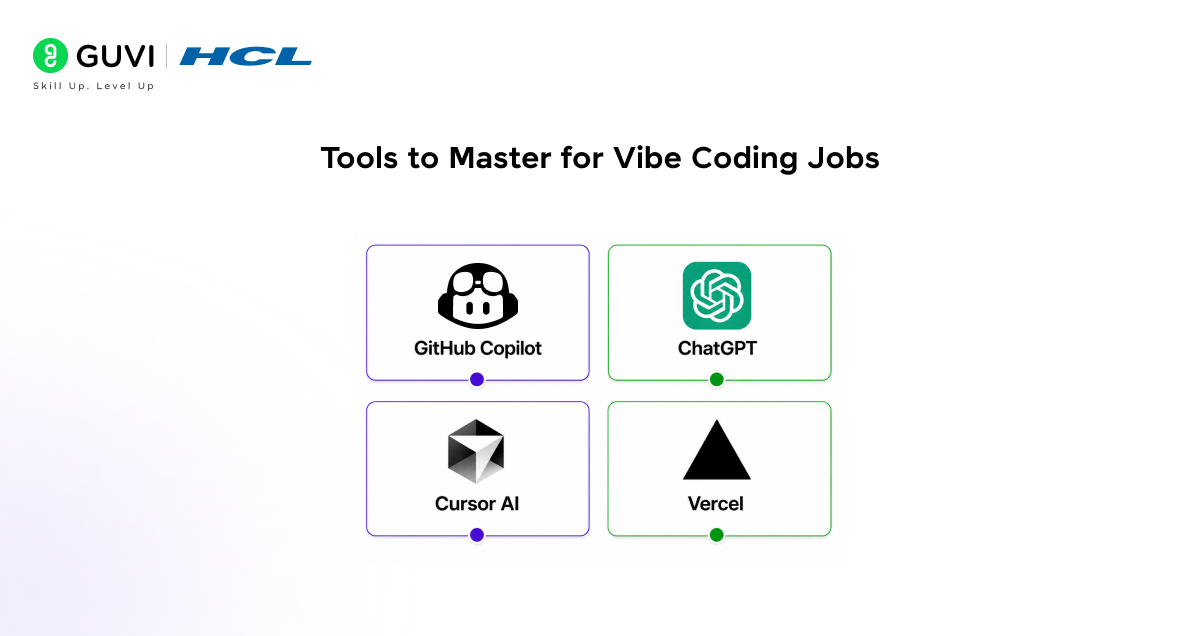
GitHub Copilot
- Real-time code suggestions inside IDEs
- Helps in boilerplate generation, refactoring, and faster coding
- Best for improving productivity during development
ChatGPT
- Used for debugging, architecture planning, and logic generation
- Acts as a thinking partner for developers
- Useful for explaining concepts and generating structured code
Cursor AI
- AI-first code editor with deep codebase understanding
- Enables editing entire files or projects using natural language
- Ideal for vibe coding workflows and rapid iteration
Vercel
- One-click deployment for frontend and full-stack apps
- Optimized for performance and serverless architecture
- Essential for shipping MVPs quickly
Salary Range for Vibe Coding Jobs (India)
- Average range: ₹7 LPA-₹10 LPA
Source: Glassdoor
Experience-Based Salary Breakdown
- Entry-level (0–2 years): ₹3 LPA- ₹7 LPA
- Mid-level (2–5 years): ₹7 LPA- ₹15 LPA
- Senior (5+ years): ₹15 LPA-₹30 LPA+
Source: Glassdoor
How to Get Started with Vibe Coding Jobs
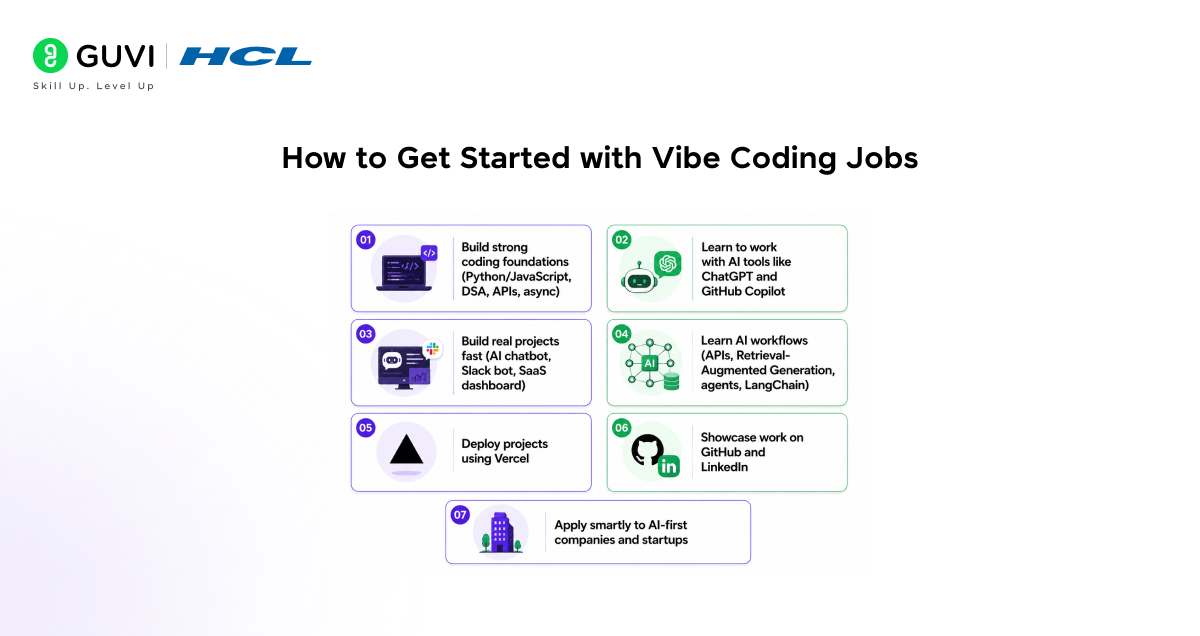
Breaking into vibe coding is less about chasing a title and more about building the ability to ship fast using AI + strong fundamentals. Here’s a practical, step-by-step path:
Step 1: Build Strong Coding Foundations
- Pick one language: Python or JavaScript
- Learn core concepts: data structures, APIs, async programming
- Focus on understanding code, not just writing it
Step 2: Learn to Work with AI, Not Against It
- Start using ChatGPT for debugging, explanations, and logic
- Use GitHub Copilot for real-time coding assistance
- Practice prompt engineering for better outputs
Step 3: Build Real Projects (Fast)
- Create small but useful apps:
- AI chatbot
- Slack automation bot
- Simple SaaS dashboard
- Focus on shipping, not perfection
Step 4: Learn AI Workflows
- Understand basics of:
- APIs and integrations
- RAG (Retrieval-Augmented Generation)
- AI agents and automation
- Explore frameworks like LangChain
Step 5: Deploy Your Projects
- Use Vercel to go live quickly
- Share live links, not just code
- Build a portfolio that shows working products
Step 6: Showcase Your Work
- Upload projects on GitHub with clear README
- Share builds on LinkedIn or Twitter
- Highlight speed, problem-solving, and real use cases
Step 7: Apply Smartly
- Target startups and AI-first companies
- Position yourself as:
- “AI-first developer”
- “Product-focused engineer”
- Emphasize how fast you can build and deliver outcomes
Break into high-paying vibe coding roles with the right AI and development skills. Join HCL GUVI’s Artificial Intelligence and Machine Learning Course to learn from industry experts and Intel engineers through live online classes, master in-demand skills like Python, ML, MLOps, Generative AI, and Agentic AI, and gain hands-on experience with 20+ industry-grade projects, 1:1 doubt sessions, and placement support with 1000+ hiring partners.
Pro Tips to Break into Vibe Coding Jobs
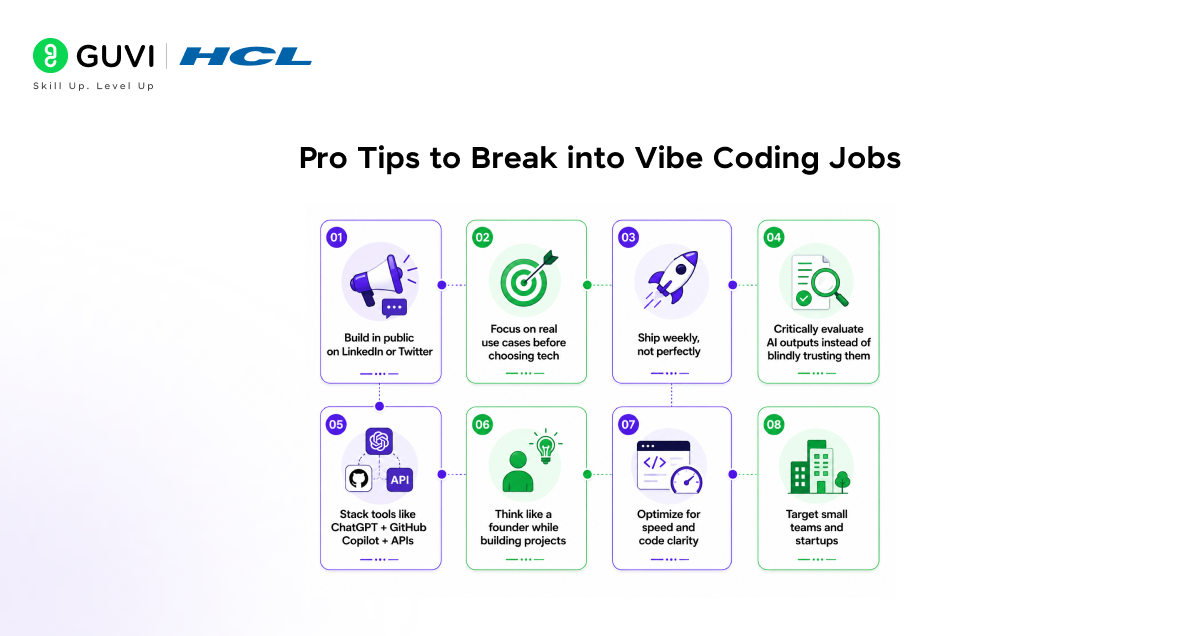
1. Build in Public
- Share your projects, learnings, and experiments on LinkedIn or X
- Document your journey from idea → build → launch
- Recruiters value visible proof of execution over resumes
2. Focus on Use-Case First, Not Tech
- Start with a real problem (automation, SaaS tool, workflow gap)
- Then use AI + code to solve it
- Strong use cases stand out more than generic projects
3. Ship Weekly, Not Perfectly
- Aim to launch 1 small project every 7-10 days
- Speed matters more than perfection in this space
- Iteration builds real-world skill faster than tutorials
4. Learn to Read AI Outputs Critically
- Don’t blindly trust generated code
- Validate logic, optimize performance, and fix edge cases
- Your value = judgment, not just generation
5. Stack Tools, Don’t Depend on One
- Combine multiple tools for better workflows
- Example: ChatGPT + GitHub Copilot + APIs
- The edge comes from tool orchestration
6. Think Like a Founder
- Treat every project like a product
- Ask: Who will use this? Why does it matter?
- This mindset separates developers from high-value builders
7. Optimize for Speed + Clarity
- Write simple, readable code even when using AI
- Avoid overengineering early
- Fast, clear builds win over complex ones
8. Target Small Teams & Startups
- Startups value output over experience
- They need builders who can move fast with limited resources
- Perfect entry point for vibe coding roles
Conclusion
Vibe coding jobs represent the next evolution of software development, where developers move from writing every line of code to guiding intelligent systems. The real advantage lies in combining strong fundamentals with AI leverage. Those who adapt early will not just get jobs, they will build products, companies, and entire ecosystems faster than ever before.
FAQs
1. Are vibe coding jobs suitable for beginners?
Yes, beginners can enter vibe coding jobs by focusing on one programming language, learning AI tools, and building small real-world projects quickly to demonstrate practical skills.
2. Do you need advanced AI knowledge for vibe coding jobs?
No, you don’t need deep AI research knowledge. A working understanding of AI tools, APIs, and workflows is enough to start and grow in vibe coding roles.
3. What kind of companies hire for vibe coding jobs?
AI-first startups, SaaS companies, and product-based firms actively hire vibe coders who can build, iterate, and ship solutions quickly using AI-assisted development.
Success Stories

About the Author
Vaishali
I'm a seasoned writer with four years of experience across technical, non-technical, and just about every genre or niche you can imagine. Adaptable and curious, I enjoy exploring new topics and making information engaging and easy to understand. Fueled by a steady stream of tea, I approach each project with creativity, reliability, and genuine enthusiasm for storytelling.
View all posts by Vaishali
Connect with me @






Did you enjoy this article?