


Artificial Intelligence and Machine Learning Articles
CI/CD Pipelines for Machine Learning Projects
A/B Testing for Machine Learning Models
Canary Deployment Strategies for ML Models
What is Model Drift Detection: Keeping Models Accurate in Production


Get In Touch For Details! Request More Information
How to Plan a Dungeons and Dragons Session with ChatGPT: A Complete Guide
Sep 03, 2026 4 Min Read 745 Views
(Last Updated)
Running a Dungeons and Dragons session sounds exciting, until you face hours of prep, world-building, and encounter design. Many Dungeon Masters struggle to balance creativity with time constraints, often leading to rushed or repetitive sessions.
This is where ChatGPT changes the game. Instead of starting from scratch, you can generate plots, characters, and entire campaign arcs with guided prompts. In this guide, you’ll learn how to plan a Dungeons and Dragons session using ChatGPT, from creating story hooks to building encounters and managing gameplay.
Quick Answer: Planning a Dungeons and Dragons session with ChatGPT helps Dungeon Masters quickly generate storylines, NPCs, encounters, and world-building elements. By using structured prompts, you can design immersive campaigns, balance combat, and create engaging narratives in minutes. ChatGPT acts as a creative assistant, streamlining session prep while allowing you to focus on storytelling and player experience.
.- An estimated 50 million people worldwide have played Dungeons & Dragons.
- North America alone has around 12–15 million active players of Dungeons & Dragons.
- Player demographics show that 48% are millennials, 19% are from Generation X, and 33% belong to Generation Z.
Table of contents
- Dungeons and Dragons: An Overview
- Why Use ChatGPT for D&D Session Planning
- How ChatGPT Helps Dungeon Masters
- Step-by-Step: Plan a D&D Session with ChatGPT
- Initial Setup (The Core Prompt)
- Generate NPCs & Lore
- Design Encounters & Traps
- Flesh Out Locations
- Review and Iterate
- Pro Tips to Get the Best Results from ChatGPT for D&D Planning
- Be Specific with Constraints
- Anchor Content to Player Backstories
- Control Tone and Theme Consistency
- Balance Creativity with Game Mechanics
- Focus on Player Agency
- Add Improvisation Hooks
- Keep Outputs Modular
- Validate and Customize Everything
- Save and Build a Prompt Library
- Conclusion
- FAQs
- How do you plan a Dungeons and Dragons session with ChatGPT?
- Can ChatGPT create balanced D&D encounters?
- Is ChatGPT good for beginner Dungeon Masters?
- Can ChatGPT generate NPCs and backstories for D&D?
- Does ChatGPT replace a Dungeon Master in D&D?
Dungeons and Dragons: An Overview
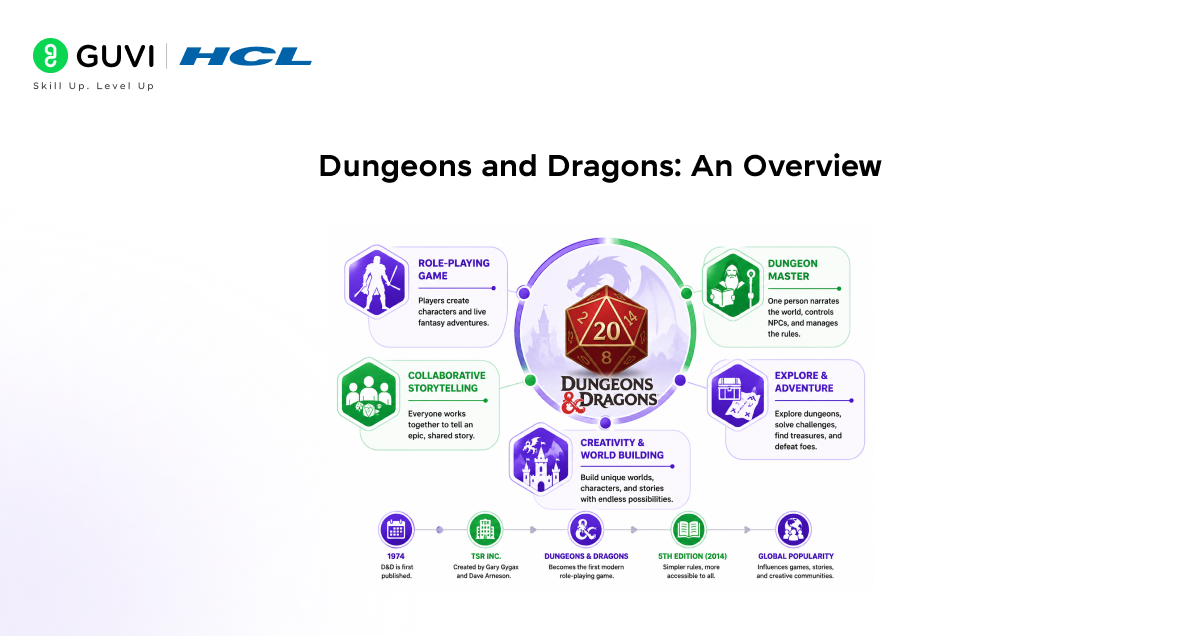
Dungeons & Dragons (D&D) is a tabletop role-playing game first published in 1974 by Gary Gygax and Dave Arneson under TSR Inc., widely regarded as the first modern role-playing game. It is a collaborative storytelling experience where players create characters and explore adventures guided by a Dungeon Master, who narrates the world, controls NPCs, and manages rules. Gameplay relies on dice-based mechanics, especially the 20-sided die (d20), to determine outcomes.
After being acquired by Wizards of the Coast in 1997, the game evolved through multiple editions, with 5th Edition (2014) making it more accessible and globally popular. Today, D&D influences video games, storytelling, and game design, and remains a powerful medium for creativity, collaboration, and immersive world-building.
Why Use ChatGPT for D&D Session Planning
ChatGPT acts as a powerful co-Dungeon Master, reducing prep time while boosting creativity. It quickly generates story ideas and world details, helping you avoid repetition and writer’s block. It also adapts to different campaign styles, making planning faster and more engaging.
How ChatGPT Helps Dungeon Masters
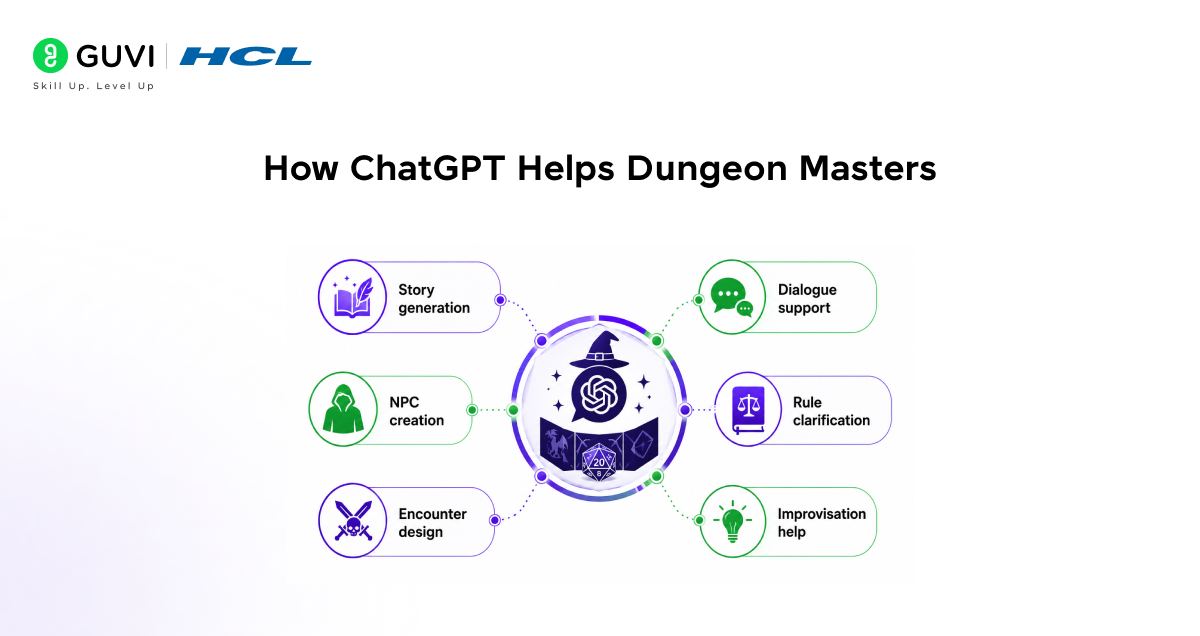
- Story generation: Creates dynamic plots with branching narratives
- NPC creation: Builds characters with backstories, traits, and motives
- Encounter design: Generates balanced combat and quest scenarios
- Dialogue support: Assists with realistic roleplay and conversations
- Rule clarification: Explains mechanics and edge cases quickly
- Improvisation help: Provides on-the-fly ideas during live sessions
Step-by-Step: Plan a D&D Session with ChatGPT
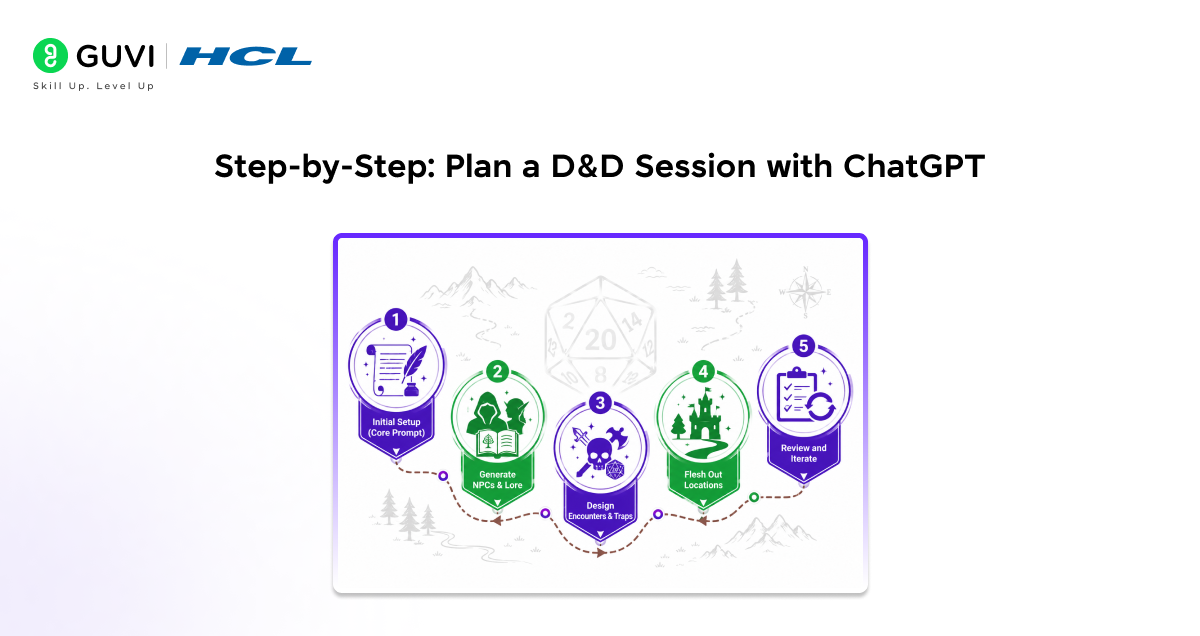
1. Initial Setup (The Core Prompt)
Start by clearly defining the role, constraints, tone, and expected output so ChatGPT can generate structured, usable content aligned with your session goals.
Prompt Example: “Act as an expert D&D 5e Dungeon Master. I am running a [one-shot/campaign] for [number] players of [level]. The theme is [horror/high-fantasy/intrigue]. Help me design a [type of adventure] set in [setting], including a compelling opening hook, key story beats, branching paths based on player choices, pacing for a [session length] game, and a strong climax with meaningful consequences.”
2. Generate NPCs & Lore
Well-designed NPCs should feel interconnected with the story and create roleplay depth through motives, secrets, and conflicts.
Prompt Example: “Create three detailed NPCs for a town obsessed with a prophecy, including their names, roles, motivations, relationships with each other, and hidden secrets. Provide distinct dialogue styles, one secret that players can uncover through interaction, and explain how each NPC connects to or manipulates the prophecy.”
Take your use of AI beyond creative planning and build real-world intelligent systems. Join HCL GUVI’s Artificial Intelligence and Machine Learning Course to learn from industry experts and Intel engineers through live online classes, master in-demand skills like Python, ML, MLOps, Generative AI, and Agentic AI, and gain hands-on experience with 20+ industry-grade projects, 1:1 doubt sessions, and placement support with 1000+ hiring partners.
3. Design Encounters & Traps
Encounters should combine mechanics, environment, and player decision-making rather than relying only on combat damage.
Prompt Example: “Design a unique trap for a 3rd-level dungeon that requires teamwork and creative problem-solving instead of just dealing damage. Include environmental interaction, skill checks, multiple possible solutions, scaling difficulty options, and consequences for failure that affect the story or party positioning.”
4. Flesh Out Locations
Strong environments use sensory detail and interactive elements to immerse players and drive exploration.
Prompt Example: “Describe an underwater tavern with rich sensory details including sounds, smells, lighting, and atmosphere. Include interactive elements players can engage with, NPC behavior in this setting, hidden clues or lore embedded in the environment, and any magical or unusual features that make the location memorable.”

5. Review and Iterate
Refining outputs ensures consistency with your world, tone, and gameplay balance.
Prompt Example: “Refine the previous output to better fit a [dark fantasy/steampunk/etc.] setting, align it with player backstories, adjust difficulty for a party of [number] optimized players, add unexpected twists or moral dilemmas, and ensure all elements connect cohesively to the main storyline.”
Pro Tips to Get the Best Results from ChatGPT for D&D Planning
1. Be Specific with Constraints
- Clearly define player level, party size, setting, and tone to avoid generic outputs
- Add constraints like session duration, difficulty level, and playstyle (combat vs roleplay)
- The tighter your inputs, the more usable and balanced the output
2. Use Iterative Prompting
- Don’t expect perfect results in one go; refine step-by-step
- Break prompts into stages: story → NPCs → encounters → details
- Ask follow-ups like “expand,” “simplify,” or “add twists” to improve quality
3. Anchor Content to Player Backstories
- Integrate player characters into the narrative for deeper engagement
- Ask ChatGPT to connect NPCs, quests, or conflicts directly to player histories
- This makes sessions feel personalized rather than generic
4. Control Tone and Theme Consistency
- Explicitly mention tone (dark, humorous, political, tragic) in every major prompt
- Recheck outputs to ensure consistency across NPCs, locations, and plot
- Use refinement prompts to fix tonal mismatches
5. Balance Creativity with Game Mechanics
- Ensure generated ideas follow D&D 5e rules and difficulty balance
- Ask for CR ratings, skill checks, and scaling options
- Avoid overpowered encounters or underwhelming challenges
6. Focus on Player Agency
- Design multiple paths instead of linear storytelling
- Encourage branching decisions, moral dilemmas, and open-ended outcomes
- Avoid railroading by giving players meaningful choices
7. Add Improvisation Hooks
- Ask for backup events, random encounters, or “if players go off-track” scenarios
- Prepare flexible story elements that can adapt in real time
- This helps maintain flow during unpredictable gameplay
8. Keep Outputs Modular
- Generate content in reusable chunks (NPCs, encounters, locations)
- This allows easy adjustment during the session
- Modular design helps in scaling from one-shot to full campaign
9. Validate and Customize Everything
- Use ChatGPT output as a draft, not final content
- Adjust lore, names, and mechanics to fit your world
- Ensure internal consistency before using it in-game
10. Save and Build a Prompt Library
- Store your best prompts for reuse across sessions
- Create templates for NPCs, encounters, and story hooks
- Over time, this speeds up prep and improves consistency
Conclusion
Planning a Dungeons and Dragons session no longer has to be time-consuming or overwhelming. With ChatGPT, you can generate ideas, structure sessions, and build immersive worlds faster while maintaining creative control. By combining AI assistance with your storytelling skills, you can create memorable adventures that keep players engaged and excited for every session.
FAQs
1. How do you plan a Dungeons and Dragons session with ChatGPT?
Use structured prompts to generate story hooks, NPCs, encounters, and locations, then refine outputs to fit your campaign and player level.
2. Can ChatGPT create balanced D&D encounters?
Yes, ChatGPT can design encounters based on player level and difficulty, but you should review CR balance and mechanics before using them.
3. Is ChatGPT good for beginner Dungeon Masters?
ChatGPT is ideal for beginners as it simplifies session planning, provides ideas, and helps structure campaigns with minimal experience.
4. Can ChatGPT generate NPCs and backstories for D&D?
Yes, it can create detailed NPCs with motivations, traits, dialogue, and secrets to enhance roleplay and storytelling.
5. Does ChatGPT replace a Dungeon Master in D&D?
No, ChatGPT acts as a creative assistant; the Dungeon Master still controls storytelling, decisions, and gameplay experience.
Success Stories

About the Author
Vaishali
I'm a seasoned writer with four years of experience across technical, non-technical, and just about every genre or niche you can imagine. Adaptable and curious, I enjoy exploring new topics and making information engaging and easy to understand. Fueled by a steady stream of tea, I approach each project with creativity, reliability, and genuine enthusiasm for storytelling.
View all posts by Vaishali
Connect with me @









Did you enjoy this article?