


Artificial Intelligence and Machine Learning Articles
Finance Manager to Data Analytics: Career Growth, Salary and Seniority
How to Evaluate LLM Outputs in Production Deployments
AI/ML Skills Gap 2026: Why Companies Can't Find Job-Ready Talent
20 AI/ML Interview Questions Recruiters Can Use Without a Tech Background - Best Guide

Get In Touch For Details! Request More Information
How to Build RAG Pipelines in AI Applications
May 28, 2026 5 Min Read 1348 Views
(Last Updated)
Most AI applications fail not due to weak models but due to lack of access to the right data at the right time. Even powerful models produce outdated or inconsistent responses. The issue is structural, as models rely on training data instead of live, domain-specific knowledge. RAG addresses this by connecting models to real-time data sources.
This guide explains how to build RAG pipelines in AI applications with a clear, production-focused approach. It covers system architecture, implementation steps, and practical considerations required to build AI systems that produce reliable and context-aware outputs at scale.
Quick Answer: RAG pipelines combine retrieval and generation to produce accurate, context-aware AI outputs. Building them involves data preparation, chunking, embeddings, vector databases, retrieval design, prompt structuring, and evaluation. This approach improves accuracy, supports real-time knowledge updates, and enables scalable, traceable AI systems across enterprise use cases.
Table of contents
- What Are RAG Pipelines in AI Applications?
- Key Components of a RAG Pipeline
- Step-by-Step Guide to Build RAG Pipelines in AI Applications
- Step 1: Define the Use Case and Retrieval Scope
- Step 2: Data Collection and Normalization
- Step 3: Text Chunking Strategy
- Step 4: Generate Embeddings
- Step 5: Store Data in a Vector Database
- Step 6: Design the Retrieval Layer
- Step 7: Construct Context-Aware Prompts
- Step 8: Generate Responses Using LLM
- Step 9: Evaluate and Validate Outputs
- Step 10: Optimize for Scale and Performance
- Top Benefits of RAG Pipelines in AI Applications
- Top Use Cases of RAG Pipelines in AI Applications
- Conclusion
- FAQs
- Is RAG better than fine-tuning?
- Which vector database is best for RAG?
- Can RAG eliminate hallucinations completely?
What Are RAG Pipelines in AI Applications?
Retrieval-Augmented Generation pipelines are a system design approach that improves the reliability of AI outputs by combining external knowledge retrieval with language model generation. Instead of relying only on pre-trained model knowledge, a RAG pipeline retrieves relevant data at query time and uses that context to produce grounded responses.
Key Components of a RAG Pipeline
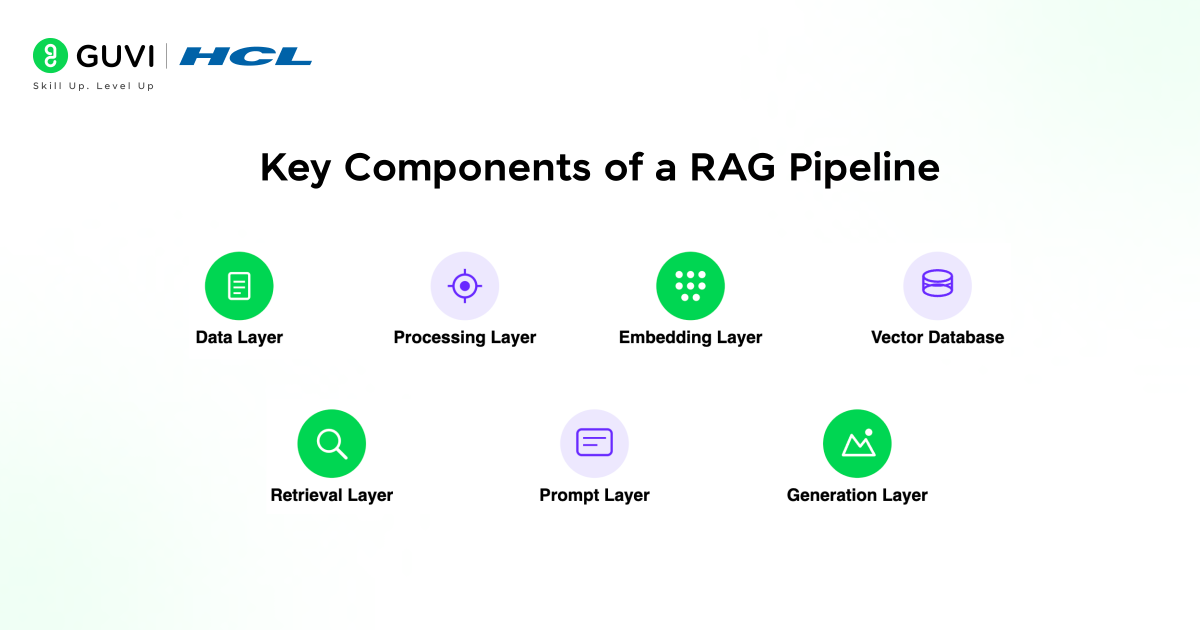
A RAG pipeline is composed of interconnected layers, each responsible for a specific function:
- Data Layer: Source documents such as PDFs, databases, or APIs
- Processing Layer: Cleaning, chunking, and preparing text
- Embedding Layer: Converting text into vector representations
- Vector Database: Storing and indexing embeddings for retrieval
- Retrieval Layer: Identifying relevant content based on query similarity
- Prompt Layer: Structuring retrieved data into model input
- Generation Layer: Producing the final response using an LLM
Step-by-Step Guide to Build RAG Pipelines in AI Applications
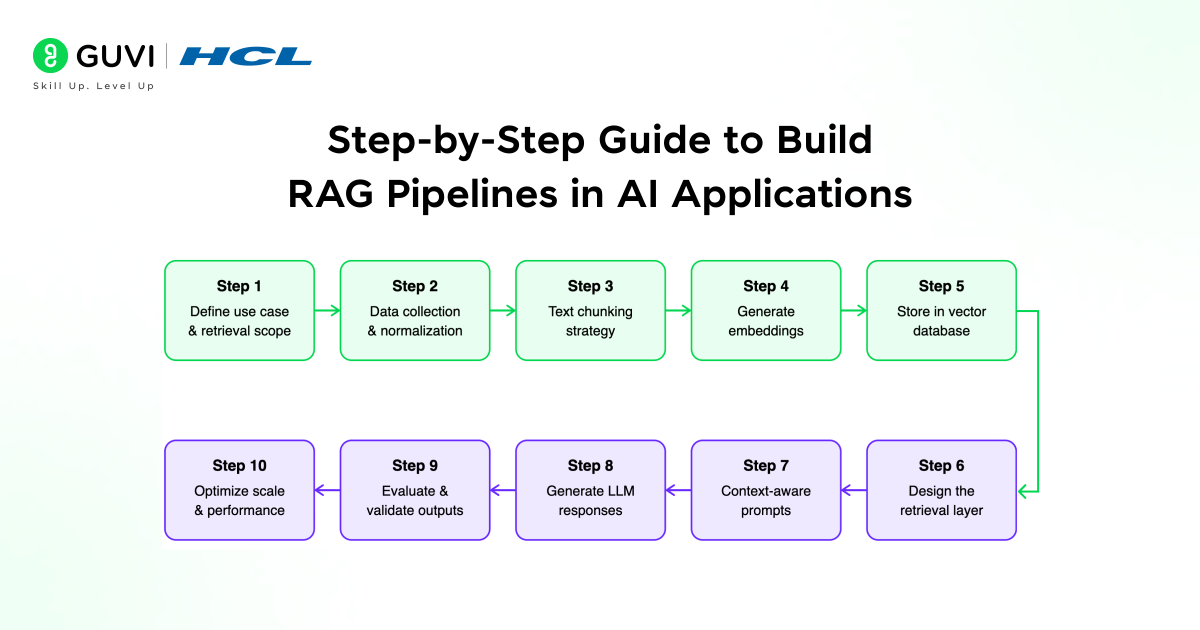
Building a Retrieval-Augmented Generation pipeline requires a structured approach that connects data engineering, information retrieval, and language model orchestration into one coherent system. Each step directly impacts response accuracy, latency, and system reliability.
The following guide outlines a production-oriented workflow grounded in real implementation practices.
Step 1: Define the Use Case and Retrieval Scope
A RAG system must begin with a clearly bounded problem. Without this, retrieval quality and evaluation become inconsistent.
Start by identifying:
- Type of queries: factual, analytical, or conversational
- Data domain: internal documents, product catalogs, legal records, or support tickets
- Freshness requirements: static knowledge vs frequently updated data
- Compliance requirements: data privacy, access control, auditability
A customer support assistant requires precise retrieval from FAQs and logs. A financial analyst tool requires structured data integration and traceable outputs.
Quick Tip: Define retrieval boundaries early. Poor scoping leads to irrelevant embeddings and weak ranking signals. It also creates evaluation ambiguity because relevance cannot be consistently measured.
Step 2: Data Collection and Normalization
RAG performance depends heavily on input data quality. Raw enterprise data often contains inconsistencies such as duplicated entries, incomplete records, or mixed formats.
Key actions:
- Extract data from sources such as PDFs, databases, APIs, and web content
- Normalize encoding formats like UTF-8
- Remove noise such as boilerplate text, headers, or irrelevant metadata
- Convert documents into clean, machine-readable text
- Maintain document versioning to track updates over time
For structured data, maintain schema consistency. For unstructured data, maintain semantic clarity.
Quick Tip: Retrieval systems depend on semantic similarity. Noise reduces embedding quality and retrieval precision. Versioning becomes critical in domains where knowledge changes frequently, such as pricing, policies, or product documentation.
Step 3: Text Chunking Strategy
Large documents must be divided into smaller segments before embedding. Chunking determines how well the system retrieves relevant context.
Core considerations:
- Chunk size: typically 200 to 800 tokens depending on model context limits
- Overlap: 10 to 20 percent overlap improves continuity across chunks
- Logical boundaries: split by headings, paragraphs, or sections rather than arbitrary length
- Context preservation: retain titles or section headers within chunks
Poor chunking leads to fragmented meaning or irrelevant retrieval.
Example: A legal contract split mid-clause reduces interpretability. Splitting by clauses maintains semantic coherence.
Quick Tip: Use adaptive chunking where document structure varies. Technical manuals and research papers often require different chunking strategies.
Step 4: Generate Embeddings
Embeddings convert text into numerical vectors that capture semantic meaning. These vectors form the basis of similarity search.
Process:
- Select an embedding model aligned with your domain
- Generate vector representations for each chunk
- Store embeddings alongside metadata such as document source and timestamp
- Periodically refresh embeddings when underlying data changes
Modern embedding models capture contextual similarity rather than keyword matching. This allows retrieval of conceptually related content.
Quick Tip: Embedding dimensionality and model quality directly influence retrieval accuracy and storage cost. Domain-specific embeddings often outperform general-purpose models in specialized use cases.
Step 5: Store Data in a Vector Database
A vector database indexes embeddings for efficient similarity search at scale.
Core functions:
- Index vectors using approximate nearest neighbor algorithms
- Support filtering based on metadata
- Enable fast retrieval with low latency
- Handle updates and deletions without full reindexing
Common systems include Pinecone, Weaviate, and FAISS. Each offers trade-offs between scalability, cost, and deployment flexibility.
Quick Tip: Use metadata filtering to restrict search scope. This improves both accuracy and performance. Partitioning data by domain or tenant further improves query efficiency.
Build real-world AI systems like RAG pipelines with structured, hands-on learning. Join HCL GUVI’s Artificial Intelligence and Machine Learning Course to master in-demand skills like Python, SQL, ML, MLOps, Generative AI, and Agentic AI through 20+ industry-grade projects, 1:1 doubt sessions with top SMEs, and placement support with 1000+ hiring partners.
Step 6: Design the Retrieval Layer
The retrieval layer determines how relevant information is selected for each query.
Key components:
- Query embedding generation
- Similarity search across indexed vectors
- Top-K selection based on relevance scores
- Metadata-based filtering for contextual narrowing
Advanced systems use hybrid retrieval:

- Semantic search for meaning
- Keyword search for precision
- Reranking models for final ordering
Quick Tip: Retrieval quality has a greater impact on output accuracy than the choice of language model. Reranking models such as cross-encoders improve precision by re-evaluating candidate results.
Step 7: Construct Context-Aware Prompts
Once relevant chunks are retrieved, they must be integrated into a structured prompt.
Prompt structure typically includes:
- System instruction defining behavior
- User query
- Retrieved context inserted as reference material
- Output format guidelines if structured responses are required
The model must treat retrieved data as the primary knowledge source.
Example structure:
- Instruction: Answer using only the provided context
- Context: Retrieved documents
- Query: User question
Quick Tip: Clear prompt constraints reduce hallucination and improve factual consistency. Explicit instructions for citation or reasoning improve traceability in enterprise applications.
Step 8: Generate Responses Using LLM
The language model processes the augmented prompt and produces the final output.
Considerations:
- Context window limits
- Response formatting requirements
- Latency constraints
- Deterministic vs creative response settings through temperature control
Models with longer context windows can process more retrieved data but may increase cost.
Quick Tip: Response quality depends on both retrieval relevance and prompt clarity, not just model capability. Lower temperature settings improve factual consistency in RAG systems.
Step 9: Evaluate and Validate Outputs
A production RAG system requires continuous evaluation.
Metrics to track:
- Retrieval precision and recall
- Answer correctness
- Latency per query
- Cost per request
- Grounding score, which measures how well responses align with retrieved context
Evaluation methods:
- Human review for critical systems
- Automated benchmarks using ground truth datasets
- A/B testing for retrieval strategies
- Synthetic query generation for stress testing
Quick Tip: Log queries and responses. Use failure cases to refine retrieval and prompt design. Maintain evaluation datasets that reflect real user behavior.
Step 10: Optimize for Scale and Performance
As usage grows, system bottlenecks emerge in retrieval latency, embedding generation, and model inference.
Optimization strategies:
- Cache frequent queries and responses
- Use batch embedding for large datasets
- Implement asynchronous pipelines
- Scale vector databases horizontally
- Use approximate search tuning for latency control
Quick Tip: Embedding generation and LLM inference are primary cost drivers. Efficient caching reduces repeated computation. Query routing based on complexity can reduce unnecessary use of large models.
Top Benefits of RAG Pipelines in AI Applications
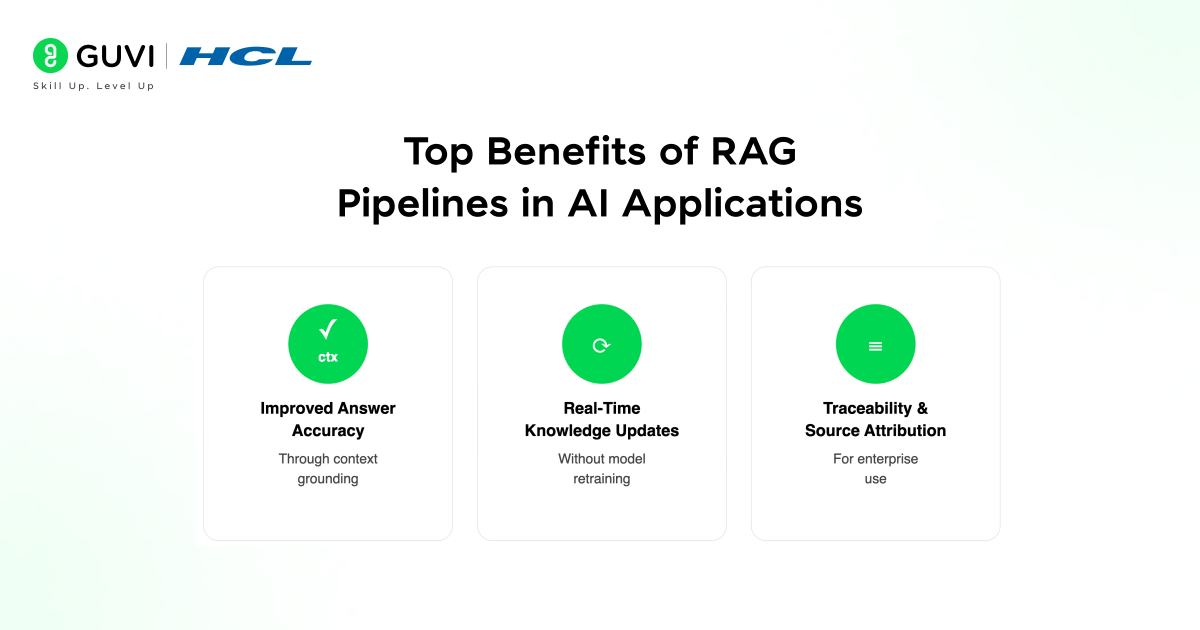
- Improved Answer Accuracy Through Context Grounding
RAG pipelines improve accuracy by grounding responses in retrieved data rather than model memory. This reduces incorrect outputs and increases reliability in domains such as legal, finance, and enterprise knowledge systems.
- Real-Time Knowledge Updates Without Model Retraining
RAG separates knowledge from the model, allowing systems to reflect new or updated data instantly. This is critical for use cases where information changes frequently, such as product documentation or compliance workflows.
- Traceability and Source Attribution for Enterprise Use
RAG enables responses to be linked to source documents, which supports verification and auditability. This strengthens trust and meets requirements in regulated environments where explainability is necessary.
Top Use Cases of RAG Pipelines in AI Applications
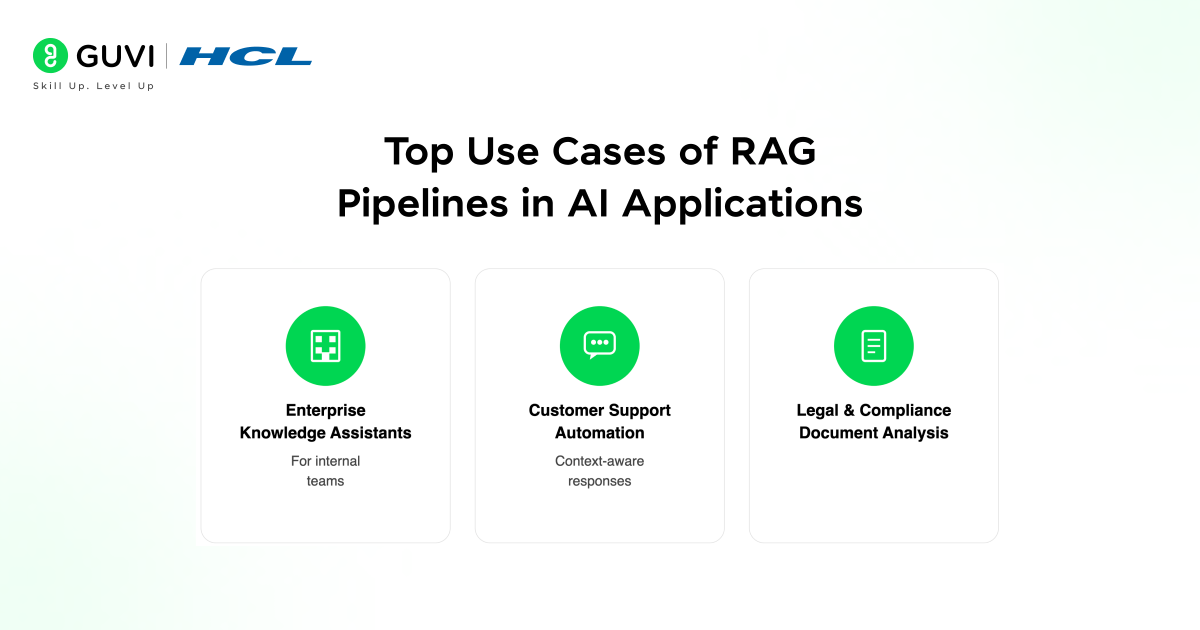
- Enterprise Knowledge Assistants for Internal Teams
RAG pipelines power internal AI systems that retrieve policies, technical documentation, and operational guidelines in real time. Employees receive precise, context-aware answers instead of searching across multiple tools, which reduces decision delays and improves consistency across teams.
- Customer Support Automation with Context-Aware Responses
RAG enables support systems to retrieve relevant help articles, past tickets, and product documentation before generating responses. This leads to accurate, issue-specific answers rather than generic replies, which improves resolution quality and reduces escalation rates.
- Legal and Compliance Document Analysis
RAG systems retrieve clauses, regulatory documents, and case references to support legal queries. This allows professionals to access grounded interpretations backed by source text, which is essential for maintaining accuracy and compliance in regulated environments.
Build practical RAG systems that connect LLMs with real-time data and improve accuracy in AI applications. Enroll in HCL GUVI’s Retrieval-Augmented Generation (RAG) course to learn core concepts, LLM integration, and hands-on implementation through self-paced modules with lifetime access and guided support.
Conclusion
A well-structured RAG pipeline integrates data processing, semantic retrieval, and controlled generation into a unified system. The effectiveness of the pipeline depends less on the language model and more on how accurately relevant information is retrieved and presented.
Organizations that treat retrieval as a core engineering problem rather than an add-on feature achieve higher accuracy, lower hallucination rates, and stronger trust in AI outputs.
FAQs
1. Is RAG better than fine-tuning?
RAG is better for dynamic knowledge, while fine-tuning suits static domain expertise.
2. Which vector database is best for RAG?
Pinecone, Weaviate, and FAISS are widely used depending on scale and use case.
3. Can RAG eliminate hallucinations completely?
No, but it significantly reduces them when implemented correctly.
Success Stories

About the Author
Vaishali
I'm a seasoned writer with four years of experience across technical, non-technical, and just about every genre or niche you can imagine. Adaptable and curious, I enjoy exploring new topics and making information engaging and easy to understand. Fueled by a steady stream of tea, I approach each project with creativity, reliability, and genuine enthusiasm for storytelling.
View all posts by Vaishali
Connect with me @








Did you enjoy this article?