


Artificial Intelligence and Machine Learning Articles
From IT Support to AI Engineer: A Realistic Career Switch Guide 2026
Is the HCL GUVI AI/ML Program Right for You? A Quick Self-Assessment
Inside the HCL GUVI AI/ML Curriculum: What You’ll Actually Build


Get In Touch For Details! Request More Information
LLM Data Security: 9 Best Practices That You Need to Know
Apr 02, 2026 5 Min Read 883 Views
(Last Updated)
Large language models are no longer a futuristic concept sitting on the edge of enterprise roadmaps. They are embedded in your customer support tools, your internal knowledge bases, your code assistants, and increasingly, your most sensitive workflows.
And with that deep integration comes a question you can no longer afford to defer: how secure is your data when an LLM is involved?
This article walks you through the core risks, the frameworks guiding the industry, and the practical steps your organization should take to ensure LLM data security — from training to deployment to daily use.
Quick Answer:
LLM data security best practices include minimizing sensitive data exposure, enforcing role-based access controls, defending against prompt injection, securing RAG pipelines, and maintaining comprehensive audit logs — ensuring your AI systems handle confidential information safely across every stage of the model lifecycle.
Table of contents
- Why LLM Data Security is a Different Problem?
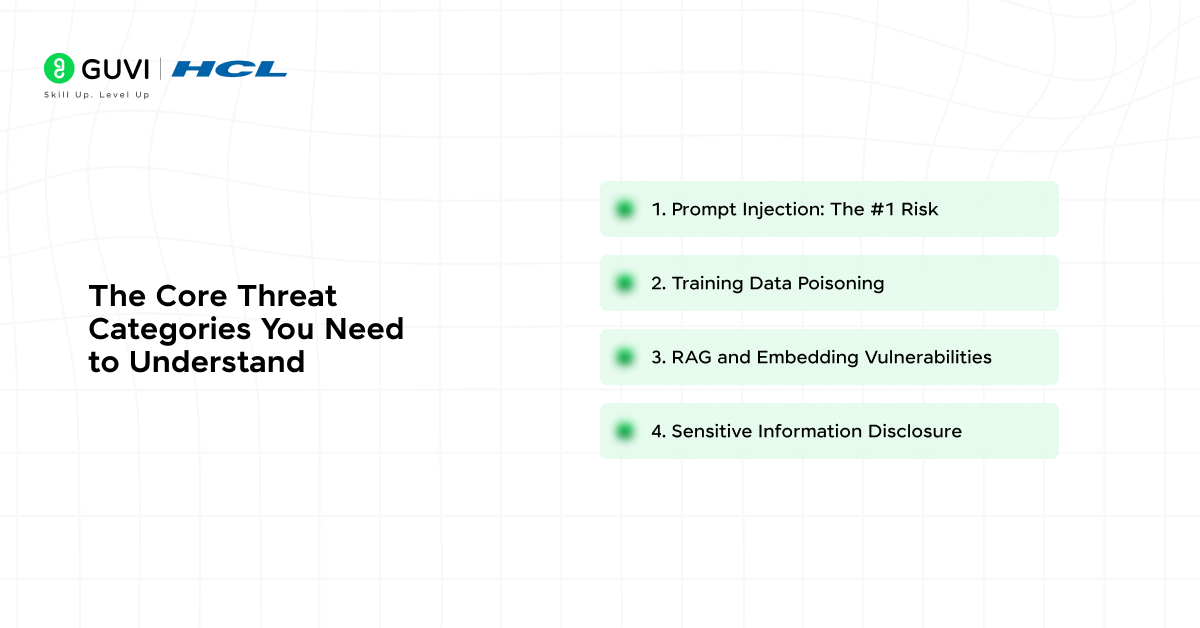
- The Core Threat Categories You Need to Understand
- Prompt Injection: The #1 Risk
- Training Data Poisoning
- RAG and Embedding Vulnerabilities
- Sensitive Information Disclosure
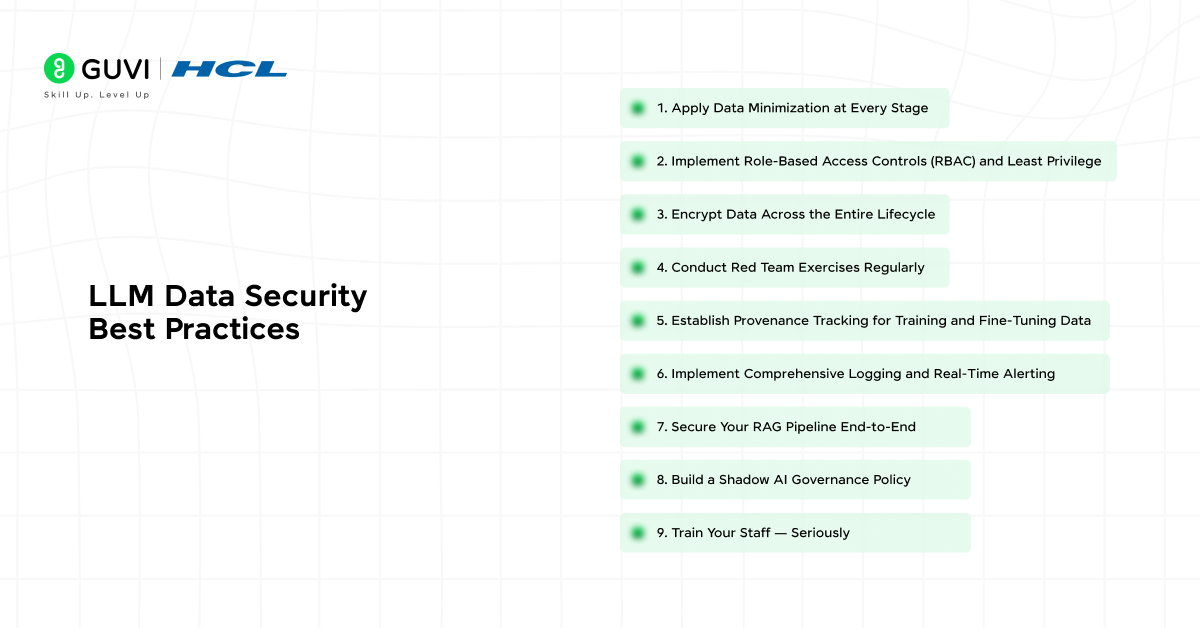
- LLM Data Security Best Practices
- Apply Data Minimization at Every Stage
- Implement Role-Based Access Controls (RBAC) and Least Privilege
- Encrypt Data Across the Entire Lifecycle
- Conduct Red Team Exercises Regularly
- Establish Provenance Tracking for Training and Fine-Tuning Data
- Implement Comprehensive Logging and Real-Time Alerting
- Secure Your RAG Pipeline End-to-End
- Build a Shadow AI Governance Policy
- Train Your Staff — Seriously
- The Financial Case for Getting This Right
- Wrapping Up
- FAQs
- What are the biggest security risks of using large language models (LLMs)?
- How do I prevent sensitive data from leaking through an LLM?
- Is it safe to use ChatGPT or other public LLMs with company data?
- What is prompt injection and how does it work?
- How do I make my RAG system secure?
Why LLM Data Security is a Different Problem?
You might be tempted to apply your existing cybersecurity playbook to LLM deployments. The reality is that won’t be enough.
Unlike traditional applications, LLMs can memorize and potentially reproduce sensitive data from their training sets — creating unprecedented risks for organizations handling personally identifiable information (PII), protected health information, financial records, and other confidential content.
Traditional perimeter defenses — firewalls, input validators, access logs — were designed for systems where the attack surface is a known boundary. Prompt injection attacks operate at the semantic layer, not the network or application layer, which is why traditional perimeter defenses fail against them. Understanding this difference is step one.
The Core Threat Categories You Need to Understand
1. Prompt Injection: The #1 Risk
According to OWASP’s 2025 Top 10 for LLM Applications, prompt injection ranks as the #1 critical vulnerability, appearing in over 73% of production AI deployments assessed during security audits.
So what exactly is it? Unlike traditional injection attacks that exploit code vulnerabilities, prompt injection exploits the LLM’s instruction-following nature.
There are two primary variants: direct injection, where attackers directly provide malicious prompts, and indirect injection, which is far more insidious — malicious instructions are embedded in external content like emails, documents, or websites that the LLM processes.
2. Training Data Poisoning
Training data poisoning involves attackers tampering with training or fine-tuning data to introduce backdoors or degrade performance. Poisoned data can result in biased outputs or hidden behaviors that activate under specific triggers.
For most organizations, this risk is most relevant in the context of fine-tuning and RAG knowledge bases rather than foundation model training. Modern LLMs like GPT-4 are trained on billions of data points — it’s hard for an attacker to subtly alter that training data.
A study found that 77% of enterprise employees who use AI have pasted company data into a chatbot query, and 22% of those instances included confidential personal or financial data. This phenomenon — called Shadow AI — is one of the most underappreciated risks in enterprise AI security today.
3. RAG and Embedding Vulnerabilities
Retrieval-Augmented Generation (RAG) is how most enterprise LLMs stay up-to-date and contextually aware. But it introduces a new attack surface that many teams haven’t fully accounted for.
Embeddings — the vectors that RAG systems use — introduce a new type of data leakage. Many assumed that because these vectors aren’t human-readable, they could be treated as safe proxies for the text. However, research has demonstrated that by analyzing embeddings, an attacker could reconstruct the original sentence or data that was embedded.
4. Sensitive Information Disclosure
According to a recent OWASP report, sensitive data has climbed to the second most pressing concern for security administrators. Sensitive information can affect both the LLM and its application context — this includes PII, financial details, health records, confidential business data, security credentials, and legal documents.
The disclosure risk isn’t always the result of an external attack. Sometimes it’s the model itself, surfacing content it was never meant to reveal.
A well-documented example: an internal chatbot, when asked a routine operational question, returned a detailed paragraph drawn from a vendor contract — including pricing and contact information — because the RAG index had no granular access controls over what it could retrieve.
LLM Data Security Best Practices
Now that you understand the threat landscape, here’s what you should actually be doing.
1. Apply Data Minimization at Every Stage
Minimization is the most effective risk reducer. Strip names, emails, phone numbers, account numbers, API keys, and geotags before a model sees them. Replace direct identifiers with deterministic tokens stored in a vault, keeping the mapping in a separate, access-controlled system.
Most LLM tasks don’t require raw identities to generate value. They need structure, language, and context. Build your data pipelines with this assumption baked in.
2. Implement Role-Based Access Controls (RBAC) and Least Privilege
Role-based access controls limit system access based on job responsibilities and business needs. The principle of least privilege ensures users receive only necessary permissions. AI systems require specialized roles that traditional IT systems may not address — organizations need new role definitions for AI developers, data scientists, and model operators.
This is especially important for agentic LLM systems, where the model can take actions — calling APIs, writing to databases, sending messages. Granting LLMs unchecked autonomy to take action can lead to unintended consequences, jeopardizing reliability, privacy, and trust.
3. Encrypt Data Across the Entire Lifecycle
Encryption protects sensitive data at rest and in transit throughout the LLM lifecycle. Organizations must encrypt training data, model parameters, and inference results, which requires comprehensive key management and secure key storage.
Don’t treat encryption as a one-time configuration. Revisit your key rotation policies, audit who has access to decryption capabilities, and ensure third-party LLM API calls go over secured, authenticated channels.
4. Conduct Red Team Exercises Regularly
Conduct red teaming exercises against your models: test your models with malicious prompts and validate whether responses meet security standards. This should be done before models are launched into production to minimize risk.
Red teaming for LLMs is fundamentally different from traditional penetration testing. You’re not just looking for exploits in code — you’re probing whether the model can be manipulated through language. Invest in teams (or vendors) that specialize specifically in adversarial AI testing.
5. Establish Provenance Tracking for Training and Fine-Tuning Data
Maintain a verifiable audit trail of where training and fine-tuning data comes from, including versioning and trust scores. This helps detect dataset poisoning attempts and proves due diligence during security reviews or audits.

If you can’t answer “where did this document in our RAG index come from and who approved it?”, your data governance has gaps that need addressing before they become incidents.
6. Implement Comprehensive Logging and Real-Time Alerting
Comprehensive logging strategies capture security-relevant events across LLM systems. Real-time alerting enables rapid response to potential security incidents. Organizations must balance comprehensive logging with storage costs and privacy requirements.
Your logs should capture not just API calls and errors, but behavioral anomalies — unusual query patterns, attempts to override system instructions, or outputs that suggest a model is being manipulated. Static rate limiting isn’t sufficient. Apply behavioral rate limiting based on prompt semantics — analyze prompt intent, and detect and throttle repeated instructions aimed at overriding model constraints, even if phrased differently.
7. Secure Your RAG Pipeline End-to-End
Protecting your RAG system deserves its own checklist:
- Validate and sanitize all documents before they are indexed
- Apply document-level access controls so the model only retrieves content a given user is authorized to see
- Treat your vector database with the same security standards as your production database
- Regularly audit what’s in your knowledge base — outdated or unauthorized documents are a persistent risk
8. Build a Shadow AI Governance Policy
Your security posture is only as strong as your weakest endpoint. If employees are freely using unvetted AI tools with company data, your carefully secured enterprise LLM deployment may be irrelevant. LLM security is not just a technical problem — it’s a systems, data, and culture problem.
This means establishing a clear policy on approved AI tools, educating employees on what data is appropriate to share with external AI systems, and creating an accessible channel for teams to request new AI tool approvals rather than going around the process.
9. Train Your Staff — Seriously
Staff should be educated on LLM security risk and best practices through a multistep approach: mandatory onboarding training covering basic LLM security principles, regular professional development workshops led by AI security experts, self-paced online learning modules, and simulated exercises that mirror LLM-specific security threats like prompt injection attempts to test employee vigilance.
The human layer is often where security breaks down. Your staff doesn’t need to become security engineers, but they do need to understand that the AI tools they use every day are not passive — they interact with data, and that interaction carries risk.
The Financial Case for Getting This Right
If the security argument alone isn’t enough to drive investment, consider the cost of getting it wrong. The IBM Cost of a Data Breach Report 2024 found that the average cost of a data breach reached an all-time high of $4.88 million.
Breaches involving AI systems can carry additional costs — regulatory fines, reputational damage, and loss of customer trust that is difficult to rebuild.
Conversely, proactive security pays measurable dividends. Proactive security measures reduce incident response costs by 60–70% compared to reactive approaches, according to 2025 industry benchmarks. Security investment in LLMs is not a cost center. Done well, it is a risk management multiplier.
If you’re serious about learning all about LLMs and want to apply them in real-world scenarios, don’t miss the chance to enroll in HCL GUVI’s Intel & IITM Pravartak Certified Artificial Intelligence & Machine Learning course, co-designed by Intel. It covers Python, Machine Learning, Deep Learning, Generative AI, Agentic AI, and MLOps through live online classes, 20+ industry-grade projects, and 1:1 doubt sessions, with placement support from 1000+ hiring partners.
Wrapping Up
LLM data security is not a one-time configuration — it’s an ongoing discipline that spans your data pipelines, your model architecture, your access controls, your employee behavior, and your compliance posture. The organizations that treat it with the same rigor they apply to traditional cybersecurity will be better positioned to deploy AI confidently and responsibly.
The technology moves fast. The threats move with it. Staying informed, building layered defenses, and embedding security thinking into every stage of your AI lifecycle is what separates organizations that use LLMs safely from those that eventually find out what unsafe looks like.
FAQs
1. What are the biggest security risks of using large language models (LLMs)?
The biggest risks include prompt injection attacks, training data poisoning, sensitive data leakage, insecure output handling, and supply chain vulnerabilities. These threats are unique to LLMs because they operate on natural language rather than structured code.
2. How do I prevent sensitive data from leaking through an LLM?
Start with data minimization — strip PII and confidential identifiers before they ever reach the model. Combine this with strict role-based access controls, encrypted data pipelines, and output filtering that flags sensitive content before it reaches the end user.
3. Is it safe to use ChatGPT or other public LLMs with company data?
Generally, no, not without a clear data handling agreement and usage policy in place. Public LLMs may use your inputs for model improvement unless explicitly opted out. Organizations should use enterprise-tier versions with data privacy guarantees or deploy private, self-hosted models for sensitive workflows.
4. What is prompt injection and how does it work?
Prompt injection is when a malicious instruction is hidden inside user input or an external document, tricking the LLM into ignoring its original instructions and doing something harmful.
5. How do I make my RAG system secure?
Secure your RAG pipeline by validating and sanitizing every document before indexing, applying document-level access controls so users only retrieve what they’re authorized to see, and treating your vector database with production-grade security standards.
Success Stories

About the Author
Lukesh S
A professional content writer who has experience in freelancing and now working as a Technical Content Writer at HCL GUVI having sound knowledge in Blog Writing and Creative Writing!
View all posts by Lukesh S
Connect with me @









Did you enjoy this article?