


Artificial Intelligence and Machine Learning Articles
Finance Manager to Data Analytics: Career Growth, Salary and Seniority
How to Evaluate LLM Outputs in Production Deployments
AI/ML Skills Gap 2026: Why Companies Can't Find Job-Ready Talent
20 AI/ML Interview Questions Recruiters Can Use Without a Tech Background - Best Guide

Get In Touch For Details! Request More Information
How to Build a Smart Q&A Bot using Haystack: RAG Made Easy
Apr 13, 2026 3 Min Read 1095 Views
(Last Updated)
The Q&A implementation has evolved a lot – so much so that you can now build your own Q&A bot and pull answers from your documents without needing any ML expertise. The sort of tech that was once limited to huge research teams is gone.
Through this guide, we will be using Haystack, an open-source framework, along with RAG (retrieval-augmented generation). Here, the AI first looks up information and then answers. It’s like placing a dictionary beside your bot before it starts speaking. Easy to set up, powerful, and surprisingly simple.
Quick Answer:
Creating a smart Q&A bot using Haystack is about linking three things: your documents, a retriever that can find the right chunks, and an AI model that can convert those chunks into a neat answer. With just a few lines of Python code, you can connect everything with Haystack’s ready-made components.
Table of contents
- Let’s Understand: Haystack & RAG
- Haystack
- RAG
- Prerequisites – What You Need Before Starting
- Step-by-Step Guide to Build a Smart Q&A Bot using Haystack
- Step 1: Project Setup – Set up everything
- Step 2: Add Data – Bring your data in
- Step 3: Store Data – Save it properly
- Step 4: Build Search – Find useful info
- Step 5: Generate Answers – Create responses
- Step 6: Connect Flow – Link everything
- Step 7: Test Bot – Try questions
- Step 8: Improve Results – Make it better
- Step 9: Deploy – Make it live
- Conclusion
- FAQs
- Do I need to know machine learning to build a Q&A bot with Haystack?
- Can I use my own documents instead of a public dataset?
- What if my bot gives wrong or incomplete answers?
Let’s Understand: Haystack & RAG
Haystack
Haystack is an open-source framework from DeepSet that helps in building AI apps easily. This can be used to build chatbots, search engines, document readers, and many other such tools.
It provides you with the building blocks that you can connect together based on what you want them to do. This also works with all popular AI services, including OpenAI and Hugging Face, so you are never stuck with one.
RAG
RAG (retrieval-augmented generation) basically refers to making AI’s answer accurate. Rather than answering from memory, ChatGPT first searches your documents, extracts the most relevant parts, and composes the answer from them.
“Imagine a student who always reads the right chapter before answering a test question. Obviously, the answer will be better than a guess.”
Also Read: RAG vs LLM: Key Technical Differences Explained
Start your AI journey the right way — join HCL GUVI’s free 5-day email course and go from curious to confident in AI & Machine Learning.
Retrieval-Augmented Generation (RAG) was introduced by Facebook AI Research in 2020.
Prerequisites – What You Need Before Starting
These are the following key things to consider before you start developing your first Q&A bot with Haystack:
- You should know basic Python so you can write and run a script without getting lost.
- Make sure you have Python 3.8 or higher installed; anything older will likely cause issues with Haystack.
- Get an API key from OpenAI or any other LLM provider you’re using. You will need this to generate answers.
- Make sure you have pip installed; it is usually included with Python.
- Be ready with your documents beforehand; these are what your bot will read from, so have them in one place before you start.
Step-by-Step Guide to Build a Smart Q&A Bot using Haystack
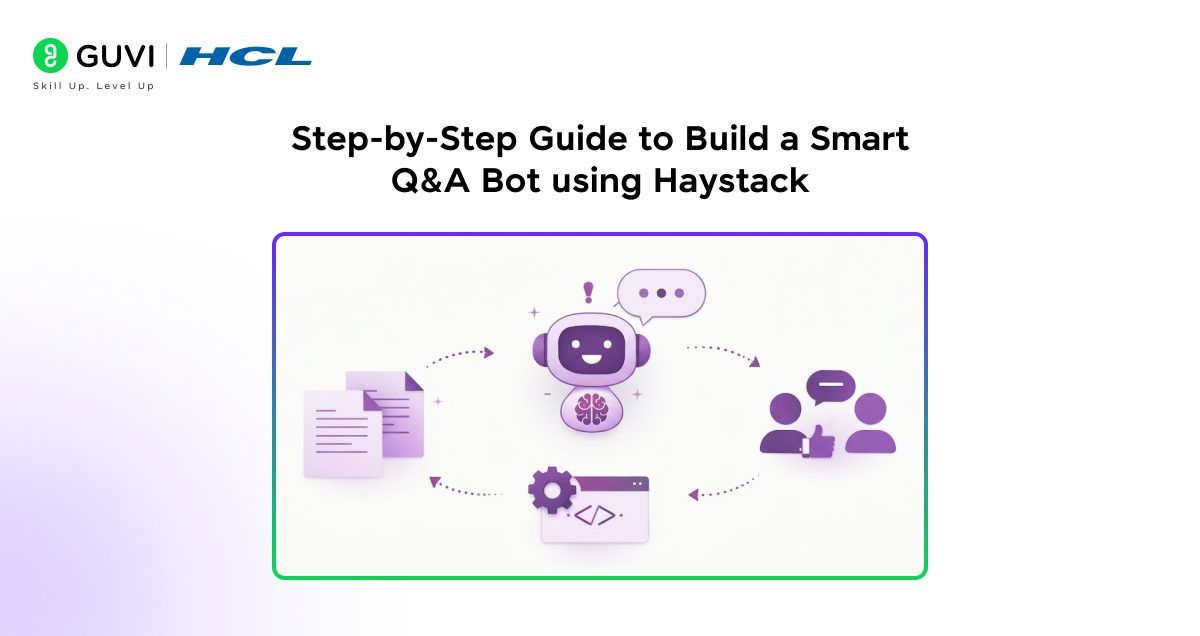
These are the following key steps to build your smart Q&A bot using Haystack and RAG:
Step 1: Project Setup – Set up everything
- Install Haystack by running this in your terminal.
pip install haystack-ai
- Create a new project folder and add your API key to the .env file.
- Make sure you have Python 3.8+ and pip installed and working.
Step 2: Add Data – Bring your data in
- Collect your documents – PDFs, text files, or Word docs.
- You can use Haystack’s built-in document loaders to bring them into the pipeline.
- Your bot uses the knowledge base created by the files.

Step 3: Store Data – Save it properly
- Selecting a document store, such as FAISS or Elasticsearch, is a good option.
- Transform your documents into embeddings and save them.
- This is where all the data lives and is prepared for searching.
Step 4: Build Search – Find useful info
- Create a retriever for scanning stored documents.
- It extracts the most relevant pieces according to the asked question.
- The RAG approach revolves around this idea.
Step 5: Generate Answers – Create responses
- Link an LLM such as GPT to the fetched pieces.
- The software reads the data and produces a clean response.
- This is where intelligence actually comes into play.
Step 6: Connect Flow – Link everything
- Combine the retriever and generator into a single Haystack pipeline.
- Everything will go in order – question goes in, answer comes out.
- Start by testing the connection first.
Step 7: Test Bot – Try questions
- Begin directing genuine inquiries to your bot.
- Make sure answers are correct and to the point.
- Keep track of any irregularities you notice.
Step 8: Improve Results – Make it better
- Refine the retriever settings for precise results.
- Shine up your documents if required.
- Refine your prompts to improve LLM (large language model) output.
Step 9: Deploy – Make it live
- FastAPI or Flask will help you wrap your pipeline in a simple API.
- You can deploy it to the cloud or to Hugging Face Spaces.
- Your bot is now live and ready to use!
Wait — before you close this tab. If AI is something you’re genuinely trying to get into, HCL GUVI’s Intel & IITM Pravartak Certified AI/ML course might just be the turning point you’ve been looking for. Real skills, Intel-backed certification, and a resume that actually gets noticed. Enroll today and transform the way you build, think, and compete in the world of AI.
Conclusion
Haystack and RAG together make building a smart Q&A bot much more approachable than most people expect. You don’t need a research background or fancy infrastructure — just a clear pipeline, clean documents, and a willingness to iterate. Follow the steps, test thoroughly, and your bot will keep getting better over time.
FAQs
Do I need to know machine learning to build a Q&A bot with Haystack?
Not really. Basic Python is enough — Haystack handles all the complex stuff for you.
Can I use my own documents instead of a public dataset?
Absolutely, that’s the whole point. Feed in your PDFs or text files, and the bot answers based on them.
What if my bot gives wrong or incomplete answers?
Usually, it’s messy documents or retriever settings. Clean your data and tweak your prompts — that fixes it.
Success Stories








Did you enjoy this article?