


Artificial Intelligence and Machine Learning Articles
AI/ML Skills Gap 2026: Why Companies Can't Find Job-Ready Talent
20 AI/ML Interview Questions Recruiters Can Use Without a Tech Background - Best Guide
How Industry-Backed AI/ML Bootcamps Are Changing the AI/ML Hiring Pipeline - Best Guide 2026
From IT Support to AI Engineer: A Realistic Career Switch Guide 2026


Get In Touch For Details! Request More Information

Anthropic Claude Opus 4.6: Is the Upgrade Worth It?
Apr 03, 2026 3 Min Read 1520 Views
(Last Updated)
Artificial intelligence is changing the way we work, create, and solve problems more than ever. Each new release of AI results in speculation, and the most recent AI uproar in technology is Claude Opus 4.6 by Anthropic. This upgrade also promises smarter responses, better performance, and a myriad of new features, and has attracted developers, businesses, and AI enthusiasts alike.
However, the question that lingers on everybody’s mind is: Does Claude Opus 4.6 really live up to the hype it is widely publicized to be, or is it just another update?
Quick Answer:
Claude Opus 4.6 is the most recent AI model from Anthropic, offering more intelligent, quicker responses. It can also follow complex instructions, generate text similar to that of humans, and assist with writing, research, and problem-solving.
Table of contents
- Anthropic Claude Opus 4.6 Explained: Purpose and Launch Reason
- Why It Was Launched
- Please Note:
- Performance Improvements and Features
- Larger Context Window
- Better Thinking and Conceptualization
- Adaptive Thinking
- Quicker and more Fluent Performance
- Increased Safety and Reliability
- Improved Multi-Tasking
- Real World applications
- Comparison with Other Versions
- a. Agentic Terminal Coding
- b. Agentic Coding
- c. Agentic Computer Use
- d. Agentic Tool Use
- e. Scaled Tool Use
- f. Agentic Search
- g. Multidisciplinary Reasoning
- Conclusion: Is the Upgrade Worth It?
- FAQs
- Can Claude Opus 4.6 handle extremely long documents?
- How does Claude Opus 4.6 “think” differently?
- Do I need Claude Code to use Claude Opus 4.6?
Anthropic Claude Opus 4.6 Explained: Purpose and Launch Reason
Anthropic Claude Opus 4.6 is the latest AI model developed by Anthropic that provides faster, smarter, and more accurate responses as compared to previous models like Sonnet or Opus 4.5. It is programmed to interpret more complex instructions, write human-like text, and perform a wide variety of tasks, and is useful for developers, businesses, and everyday users.
This version is aimed at enhancing reliability, performance, and usability. With a more advanced ability to reason and understand the situation, Claude Opus 4.6 can offer a more natural and efficient AI experience, enabling users to complete their tasks more quickly.
Also Read: How Google is Using Artificial Intelligence?
Why It Was Launched
These are the main reasons Anthropic launched Claude Opus 4.6:
- To advance safe and reliable AI, reducing risks of harmful or biased outputs compared to earlier Claude versions.
- To expand capabilities for developers and businesses, enabling more complex, real-world applications of AI.
- To stay competitive in the AI market by offering faster, more context-aware, and higher-quality language generation.
Claude Opus 4.6 can handle up to 1 million tokens — over 5× more than earlier versions — allowing it to process large documents or entire codebases at once.
Please Note:
A token is a small fragment of text that is comprehended by an AI. It may be a word, a part of a word, or even punctuation.
For example, the sentence:
“Artificial intelligence is everywhere.” can be broken into tokens like:
[“Artificial”, “intelligence”, “is”, “everywhere”, “.”] — Total 5 tokens.
A 1-million-token context window means that Claude Opus 4.6 can handle extremely short text segments of up to 1 million tokens simultaneously. This allows it to deal with very long documents or multiple files or large codebases within one conversation without losing previous information.
Performance Improvements and Features
Claude Opus 4.6 offers significant improvements, making it quicker, smarter, and more reliable than before. Whether it is dealing with longer documents or more complex instructions, this version is an enhancement across major areas.
The following is a closer examination of the main features and improvements that set it apart.
1. Larger Context Window

Claude Opus 4.6 has the capability of dealing with a much bigger context than the older ones. This implies that it is capable of handling long documents, multiple files, or even complete code bases in a single interaction.
This means more effective processing of complex tasks for users without necessarily having to repeat information or divide work into small pieces.
2. Better Thinking and Conceptualization

The reasoning skills of the model have been tremendously increased. It is able to adhere to complex directions more precisely and give answers that are logical and natural.
This applies to professional research, coding, and content creation, as well as to normal personal use cases.
3. Adaptive Thinking

A great addition in Claude Opus 4.6 is the possibility to modify the reactions according to the situation. It can understand the details of your instructions, adjust its tone and style, and deliver more personalized, smart results, making interactions feel more natural and personal.

4. Quicker and more Fluent Performance

Through performance optimization, Claude Opus 4.6 can provide answers at a faster rate, even with complex queries or massive data. Fast, stutter-free interaction is provided to the user, particularly during multitasking or on a more intricate and multi-step project.
5. Increased Safety and Reliability

A higher level of protection is provided in Claude Opus 4.6 to minimize the biased, harmful, or inappropriate outputs. The enhanced safety of these improvements puts more trust in interactions, and developers, businesses, and ordinary end users have confidence in the model’s response and recommendations.
6. Improved Multi-Tasking

The model is capable of managing various issues or activities within one session. Claude Opus 4.6 can be used by a broad range of users because it adapts to the context of any task, whether switching between research, writing, coding, or problem-solving.
7. Real World applications

With improved reasoning, adaptable thought, and a broader background, Claude Opus 4.6 can address real-world issues more efficiently. Whether it is summarizing long reports and analyzing data, supporting coding projects, or creating creative work, the model is more accurate and relevant across all tasks.
Comparison with Other Versions
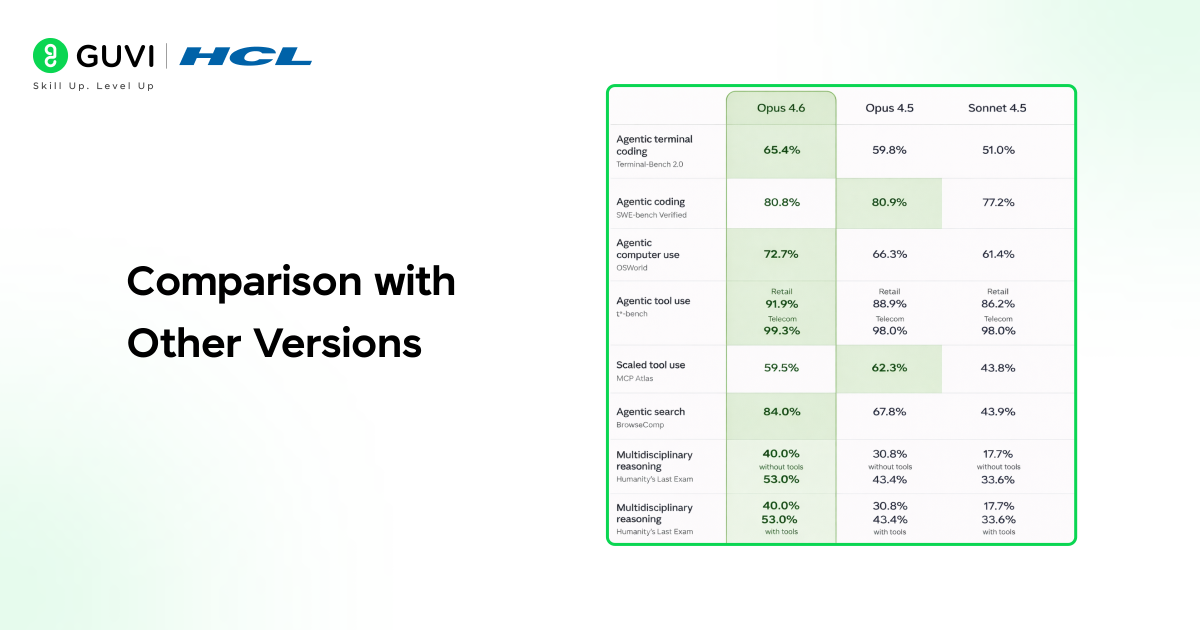
Source: Claude Opus 4.6
a. Agentic Terminal Coding
Claude Opus 4.6 can run commands and scripts in a terminal easily, making coding and technical tasks much simpler.
b. Agentic Coding
It helps with writing, debugging, and checking code reliably, making software development smoother.
c. Agentic Computer Use
Daily computer tasks like opening apps, managing files, and multitasking feel faster and more efficient.
d. Agentic Tool Use
It can accurately operate software used in stores or telecom, such as inventory systems, sales software, billing tools, and network monitors.
e. Scaled Tool Use
Opus 4.6 can handle multiple tools together, performing complex operations without errors.
f. Agentic Search
It can quickly and intelligently search the web and databases, finding the right information with context.
g. Multidisciplinary Reasoning
It can solve complex problems and think logically, especially when it can use tools to assist.
Build practical skills in data, automation, and intelligent systems with HCL GUVI’s Intel & IITM Pravartak Certified AI/ML course, covering Python, SQL, real-world projects, expert guidance, flexible classes, and placement support to help you move into high-demand roles. Join us today and transform your future!
Conclusion: Is the Upgrade Worth It?
Claude 4.6 is a major improvement over older versions: it’s faster, smarter, has a huge 1-million-token context window, and is safer. It manages complex tasks, lengthy documents, coding, and professional workflows more effectively. It is a worthwhile upgrade for anyone who has to work, research, or do creative work using AI, as it will make their interactions even easier, more precise, and more stable.
FAQs
Can Claude Opus 4.6 handle extremely long documents?
Yes! Its 1 million-token context window lets it process long reports or multiple files without losing context.
How does Claude Opus 4.6 “think” differently?
It uses adaptive thinking, giving quick answers for simple tasks and detailed reasoning for complex ones.
Do I need Claude Code to use Claude Opus 4.6?
No. Claude Code is only for developers. For writing, research, or general tasks, 4.6 works on its own.
Success Stories













Did you enjoy this article?