


Data Analysis Articles
How to Learn SQL Python Power BI While Working an Eight or Nine-Hour Job
Is Data Analytics a Good Career for BFSI Professionals?


Get In Touch For Details! Request More Information
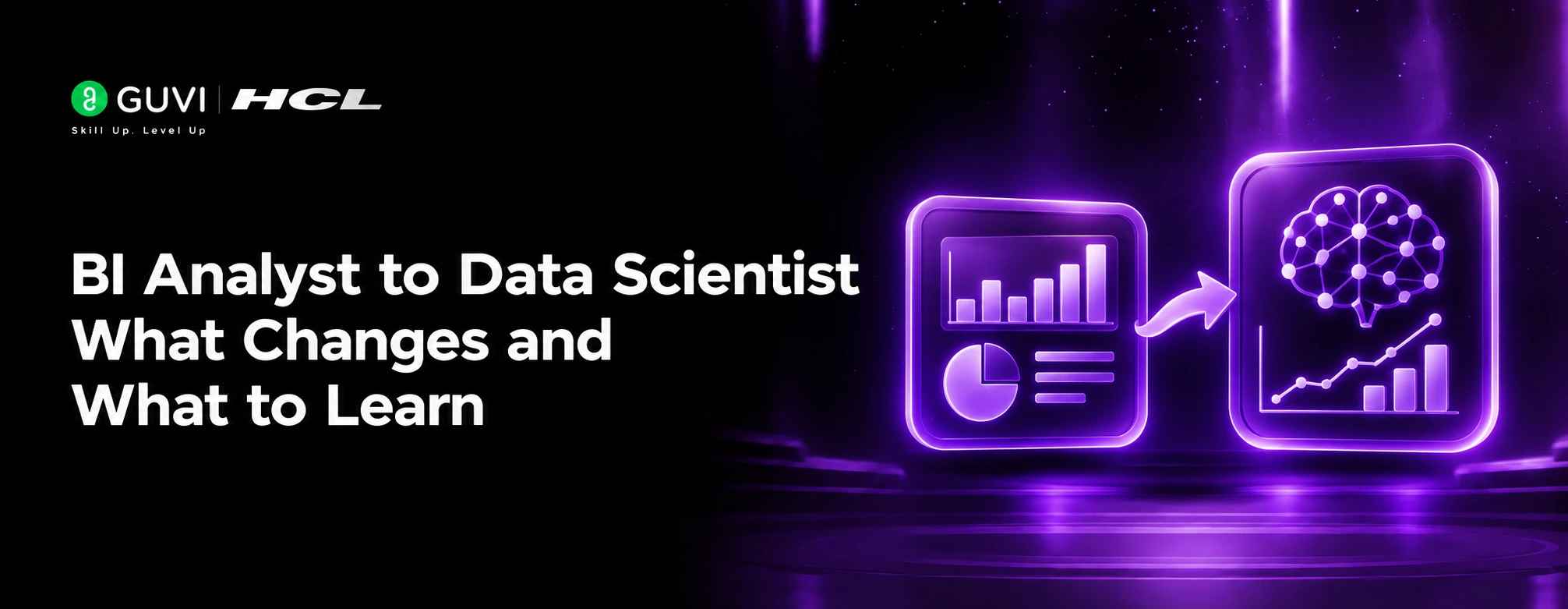
BI Analyst to Data Scientist What Changes and What to Learn – Best Guide
Oct 29, 2026 6 Min Read 21 Views
(Last Updated)
The move from BI Analyst to Data Scientist is a natural career step if you already work with business data and want to solve more predictive problems. You may know SQL, Power BI, dashboards, and reporting, but data science requires additional skills in programming, statistics, and machine learning. The good news is that your existing business knowledge gives you a useful starting point. The key is to build on it with practical modelling experience.
Table of contents
- TL;DR Summary
- What changes when you move from BI Analyst to Data Scientist?
- BI Analyst vs Data Scientist
- How does BI experience help in data science?
- Which Skills Should You Learn First to Become a Data Scientist?
- How does Power BI fit into machine learning?
- How Can You Follow a BI Analyst to Data Scientist Roadmap?
- Step 1: Strengthen Python and SQL (Weeks 1–4)
- Step 2: Learn statistics and exploratory analysis (Weeks 5–8)
- Step 3: Build machine learning fundamentals (Weeks 9–12)
- Step 4: Complete an end-to-end project (Weeks 13–16)
- Which Projects Can Help You Move to Data Scientist?
- How Can BI Analysts Apply Data Science Skills in Real-World Scenarios?
- Which Certifications Can Help You Move from BI Analyst to Data Scientist?
- What Salary Can You Expect as a Data Scientist After Working as a BI Analyst?
- What Challenges Should You Prepare for When Transitioning to Data Science?
- How Can HCL GUVI Help You Transition from BI Analyst to Data Scientist?
- Conclusion
- Frequently Asked Questions
- Can a BI Analyst become a Data Scientist?
- How long does it take to move from BI Analyst to Data Scientist?
- Is Python necessary for a BI Analyst who wants to become a Data Scientist?
- Do I need to learn machine learning after Power BI?
- Which projects are best for a BI Analyst moving into data science?
- Is certification enough to get a Data Scientist job?
- What is the difference between a BI Developer and a Data Scientist?
- Is the transition possible for someone working in BPO operations?
TL;DR Summary
- Moving from a BI Analyst to Data Scientist role means progressing from explaining business performance to building models that predict future outcomes.
- The transition is easier when you already understand SQL, dashboards, reporting, and business metrics.
- To make the move, strengthen Python, statistics, exploratory data analysis, machine learning, and model evaluation.
- Build projects that solve business problems, such as predicting customer churn or forecasting demand.
- Your BI experience remains valuable, but you must demonstrate that you can develop, evaluate, and explain predictive models—not just create reports.
What changes when you move from BI Analyst to Data Scientist?
A BI Analyst helps a business understand what happened and why. A Data Scientist also investigates patterns, tests hypotheses, and builds models that estimate what could happen next.
For example, a BI Analyst might identify a rise in customer cancellations using a Power BI dashboard. A Data Scientist might build a model that estimates which customers are likely to cancel and identifies the factors associated with that risk.
BI Analyst vs Data Scientist
| Area | BI Analyst | Data Scientist |
| Main objective | Explain business performance | Predict outcomes and discover patterns |
| Typical questions | What happened? Why did sales decline? | What may happen next? Which factors influence it? |
| Common tools | SQL, Excel, Power BI, Tableau | Python, SQL, pandas, scikit-learn |
| Core methods | Reporting, aggregation, KPI analysis | Statistics, experimentation, machine learning |
| Main outputs | Dashboards, reports, business insights | Predictive models, experiments, model insights |
| Evaluation | Accuracy of reporting and usefulness of insights | Model performance, generalisation, and business impact |
| Business value | Supports informed decisions | Supports decisions using predictions and evidence |
The distinction is not absolute. Some BI roles include forecasting and advanced analytics, while some Data Scientists spend considerable time preparing data and explaining results. Your actual responsibilities depend on the organisation.
If you want to understand how data analytics and data science differ in practice, explore this comparison of data analytics vs data science
How does BI experience help in data science?
Your existing experience is useful because you already understand how business data is collected, what KPIs mean, and why data quality matters.
You may already have experience with:
- SQL queries, joins, aggregations, and data validation.
- Power BI dashboards, data modelling, and business metrics.
- Explaining trends to managers and non-technical teams.
- Investigating reporting discrepancies and operational issues.
These skills can support your bi analyst to data scientist transition. The main gap is learning how to turn historical data into reliable predictions and evaluate whether those predictions are useful.
Which Skills Should You Learn First to Become a Data Scientist?
A successful transition does not require learning every data science technique at once. Focus on the skills that help you move from descriptive reporting to predictive analysis.
| Skill | What to learn | Why it matters |
| Python | Variables, functions, pandas, NumPy | Prepare and analyse data programmatically |
| Statistics | Probability, distributions, hypothesis testing | Understand uncertainty and test assumptions |
| Data preparation | Missing values, outliers, encoding, feature engineering | Make datasets suitable for modelling |
| Machine learning | Regression, classification, clustering | Build models that find patterns or predict outcomes |
| Model evaluation | Train/test splits, precision, recall, MAE | Check whether predictions are reliable |
| Communication | Explain assumptions, limitations, and results | Help stakeholders make informed decisions |
Before moving to advanced analysis, strengthen your spreadsheet skills with this guide on moving from Excel to data analytics
Since data scientists often need to retrieve, filter, join, and prepare data before analysis, use this SQL guide for data science to strengthen your querying skills.
If you are already comfortable with reporting tools and want to combine them with programming, this guide to SQL, Python, and Power BI offers a useful starting point.
How does Power BI fit into machine learning?
The journey from power bi to machine learning does not mean abandoning dashboards. Power BI remains useful for presenting model outputs, tracking predictions, and communicating results to stakeholders.
For example, you could build a Python model that predicts customer churn and display customer risk categories in Power BI. Python handles the predictive analysis, while Power BI helps business teams interpret the results.
If you want to identify which Power BI skills you can build on before learning machine learning, review this guide to Power BI developer skills
AI/ML hiring in India grew by 45% in FY 2025–26.
According to Naukri JobSpeak, AI/ML hiring in India recorded 45% year-on-year growth for the full financial year FY 2025–26. This points to growing demand for AI and machine learning skills, which BI analysts can begin building alongside their existing data analysis experience
How Can You Follow a BI Analyst to Data Scientist Roadmap?
Use this bi analyst to data scientist roadmap to organise your learning around practical outcomes rather than collecting tools without applying them.
Step 1: Strengthen Python and SQL (Weeks 1–4)
Practise Python fundamentals and data analysis with pandas and NumPy. Continue using SQL to extract, join, filter, and aggregate data.
Your goal: Take a business dataset, clean it, analyse it, and explain the key findings without relying entirely on a dashboard.
Step 2: Learn statistics and exploratory analysis (Weeks 5–8)
Study distributions, correlation, probability, sampling, and hypothesis testing. Learn to distinguish correlation from causation and identify when a result may be misleading.
Your goal: Investigate a business question and support your conclusions with appropriate statistical reasoning.
Step 3: Build machine learning fundamentals (Weeks 9–12)
Start with linear regression and logistic regression. Then learn classification, feature engineering, data leakage, and model evaluation.
Your goal: Train a model, compare it with a simple baseline, and explain its strengths and limitations.
Step 4: Complete an end-to-end project (Weeks 13–16)
Choose a problem related to your current industry. Prepare the data, train a model, evaluate its performance, and explain how the result could support a business decision.
Your goal: Publish a documented project with reproducible code, clear metrics, and practical recommendations.
These timeframes are a suggested study plan, not a guarantee of job readiness. Your progress will depend on your current programming knowledge, weekly study time, and project complexity.
Which Projects Can Help You Move to Data Scientist?
The strongest projects connect your existing BI experience with a new predictive capability. They show employers that you understand the business problem as well as the technical solution.
Consider these examples:
- Customer churn prediction: Use customer activity, service history, and complaint data to estimate churn risk. Explain how a business could use the results to prioritise retention efforts.
- Sales forecasting: Analyse historical sales, seasonality, and promotions to forecast future demand. Compare model predictions with actual results.
- BPO operations forecasting: Use historical call volumes, handling times, and staffing data to forecast workload and support workforce planning.
If you want to strengthen your current dashboard-building portfolio before moving to predictive projects, explore these Power BI project ideas

To explore how Python can be applied to practical problems, see these real-world applications of Python
How Can BI Analysts Apply Data Science Skills in Real-World Scenarios?
Imagine you work in a BPO reporting team and create weekly dashboards for customer complaints, average handling time, and repeat contacts.
To demonstrate the next step, use an appropriate anonymised or public dataset to build a model that predicts which cases may require repeat contact. Evaluate the model, identify the most influential features, and create a Power BI dashboard that summarises the findings.
This project demonstrates how a BI professional can combine domain knowledge, data preparation, machine learning, and business communication. Do not claim that the model improves operations unless you have measured that impact.
Which Certifications Can Help You Move from BI Analyst to Data Scientist?
Certifications can provide structure and demonstrate learning, but they do not replace practical projects or interview preparation.
Consider these options based on your learning needs:
- HCL GUVI Data Science and Analytics: Consider this learning path if you need to strengthen your foundations in data analysis before progressing into predictive modelling.
Before choosing a certification, check the syllabus, assessment format, project requirements, fees, and current availability. A certificate is most useful when you can demonstrate the skills behind it.
What Salary Can You Expect as a Data Scientist After Working as a BI Analyst?
Data Scientist salaries in India vary by experience, location, employer, technical skills, and the responsibilities attached to the role.
For a current reference point, Indeed India salary data can help you review reported pay, while individual job listings provide context about required skills and experience.
Do not assume that switching from BI to data science automatically increases your salary. Your next offer will depend on the role, your portfolio, interview performance, and how well your existing experience matches the employer’s requirements.
What Challenges Should You Prepare for When Transitioning to Data Science?
- Learning algorithms without statistics: Models can produce misleading results when you do not understand assumptions or uncertainty. Learn the statistical concepts behind each method before relying on its predictions.
- Treating Power BI as a complete data science skill set: Dashboards are valuable, but they do not demonstrate that you can train and evaluate a predictive model. Add Python-based modelling projects to your portfolio.
- Skipping model evaluation: A model that performs well on training data may fail on unseen data. Use suitable validation methods and metrics before drawing conclusions.
- Building projects without business context: A technically correct model may not solve a useful problem. Explain the business question, the decision your model supports, and its limitations.
- Assuming years of BI experience guarantee a data science role: Experience helps, but employers may still expect evidence of programming, statistical reasoning, and machine learning ability.
How Can HCL GUVI Help You Transition from BI Analyst to Data Scientist?
If you want a structured way to develop the skills needed for this career move, explore HCL GUVI’s Data Science Zen Program and Data Science and Analytics learning options. Compare their current curricula with your skill gaps, particularly Python, statistics, machine learning, and project work.
Choose a program that fits your experience level and gives you opportunities to practise what you learn. Your goal should be to build demonstrable skills and projects that connect your BI background with data science responsibilities.
Conclusion
The move from BI Analyst to Data Scientist is about expanding your ability to solve business problems, not discarding your existing experience. Your knowledge of SQL, Power BI, KPIs, and reporting gives you a strong foundation. To progress, learn Python, strengthen statistics, practise machine learning, and build projects that demonstrate reliable predictions. Follow a realistic bi analyst to data scientist roadmap, document your work, and learn to explain model results in business terms. Start with one familiar problem, build a complete solution, and use that experience to identify your next learning gap.
Frequently Asked Questions
Can a BI Analyst become a Data Scientist?
Yes. A BI Analyst can move into data science by building skills in Python, statistics, machine learning, and model evaluation. Existing SQL, reporting, and business knowledge can help, but practical modelling experience is essential.
How long does it take to move from BI Analyst to Data Scientist?
A focused learning plan may take several months, depending on your starting skills and study time. Becoming job-ready also requires projects, practice, and preparation for technical interviews.
Is Python necessary for a BI Analyst who wants to become a Data Scientist?
Python is important for many data science roles because it supports data preparation, statistical analysis, and machine learning. Some roles use other tools, but Python is a practical starting point.
Do I need to learn machine learning after Power BI?
If your goal is a Data Scientist role, you should learn machine learning in addition to Power BI. Power BI supports reporting and visualisation, while machine learning helps build models that identify patterns and predict outcomes.
Which projects are best for a BI Analyst moving into data science?
Customer churn prediction, sales forecasting, demand forecasting, and operational risk analysis are useful options. Choose a project that uses business knowledge you already have and adds measurable model evaluation.
Is certification enough to get a Data Scientist job?
No. Certifications can demonstrate structured learning, but employers may also assess Python, statistics, machine learning, problem-solving, and project experience. A strong portfolio helps show how you apply these skills.
What is the difference between a BI Developer and a Data Scientist?
A BI Developer typically builds and maintains data models, reporting systems, dashboards, and business intelligence solutions. A Data Scientist focuses more on statistical analysis, experimentation, and predictive modelling, although responsibilities can overlap.
Is the transition possible for someone working in BPO operations?
Yes. Experience with customer interactions, service metrics, quality monitoring, and operational reports can provide useful business context. You can build on that knowledge by learning Python, statistics, and predictive modelling using suitable datasets.
Success Stories

About the Author
Reemsha Khan
Always been a storyteller at heart. Now, I turn complex topics into simple, easy-to-understand stories through content. Hope you find it helpful.
View all posts by Reemsha Khan
Connect with me @











Did you enjoy this article?