


Artificial Intelligence and Machine Learning Articles
How to Use Claude Artifacts: Create, Share, and Remix AI Content in 2026
Create a Business Pitch Using ChatGPT: A Beginner-Friendly Guide
How to Use ChatGPT for Advanced Data Analysis?
How to Set Up a ChatGPT Account: A Complete Beginner's Guide (2026)

Get In Touch For Details! Request More Information
What is Vertex AI? A Simple Guide for Beginners
Feb 12, 2026 7 Min Read 3319 Views
(Last Updated)
Did you know that active gen AI projects on Vertex AI have grown more than 7x in recent times? If you’re curious about what Vertex AI is and why it’s gaining such popularity, you’ve come to the right place.
Essentially, Vertex AI is Google Cloud’s fully managed platform designed for building, deploying, and managing machine learning and generative AI models. First launched in May 2021, this powerful tool streamlines the entire machine learning workflow into a single, cohesive platform. What makes Vertex AI particularly valuable is how it simplifies the process of developing AI solutions, making it accessible even to users with limited machine learning expertise.
Furthermore, Vertex AI architecture harnesses the power of Google’s infrastructure to speed up model training and deployment. This guide will walk you through everything you need to know in simple, beginner-friendly terms. Let’s get started!
Table of contents
- What is Vertex AI?
- Who is it for?
- What makes it different from other AI platforms?
- Key Features of Vertex AI
- 1) AutoML for no-code model building
- 2) Custom model training with popular frameworks
- 3) Model monitoring and versioning
- 4) Vertex AI Pipelines for automation
- 5) Integration with Google Cloud tools
- Why Vertex AI Matters in 2026
- 1) Simplifies machine learning workflows
- 2) Supports both beginners and experts
- Helps businesses scale AI solutions
- What is Vertex AI Used For?
- 1) Customer service automation
- 2) Fraud detection and risk analysis
- 3) Forecasting and predictions
- 4) Content generation and personalization
- How to Use Vertex AI: A Beginner’s Workflow
- Prepare your data
- Choose AutoML or custom training
- Train and evaluate your model
- Deploy the model
- Monitor and improve
- Concluding Thoughts…
- FAQs
- Q1. What is Vertex AI and how does it simplify machine learning?
- Q2. Can beginners use Vertex AI without coding experience?
- Q3. What are some key features of Vertex AI?
- Q4. How is Vertex AI used in real-world applications?
- Q5. What is the basic workflow for using Vertex AI?
What is Vertex AI?
Vertex AI is Google Cloud’s centralized platform that streamlines the entire ML lifecycle – from data preparation to model deployment and monitoring.
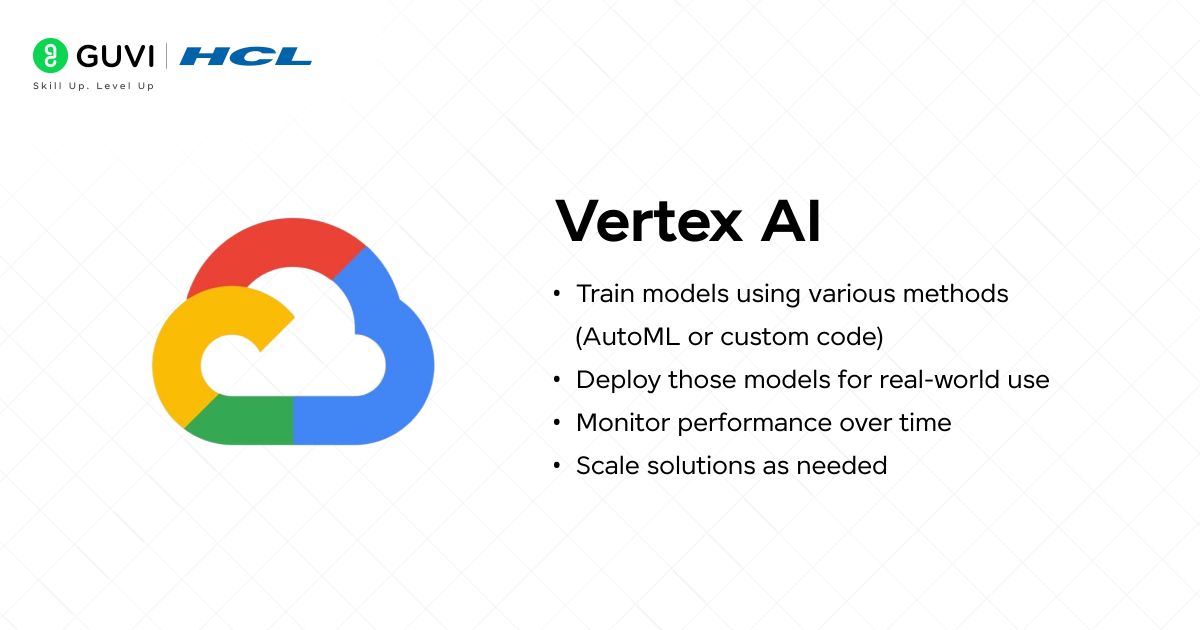
The platform brings together previously separate services, allowing you to handle the complete ML workflow in one place. First and foremost, it lets you:
- Train models using various methods (AutoML or custom code)
- Deploy those models for real-world use
- Monitor performance over time
- Scale solutions as needed
You can think of Vertex AI as your complete AI toolkit that eliminates the need to piece together separate services for different parts of the machine learning process.
Who is it for?
One of Vertex AI’s greatest strengths is its accessibility to users across different skill levels. Specifically, it serves:
- Beginners: Through AutoML capabilities, those with no coding experience can build high-quality models by simply feeding in data and letting the platform handle algorithm selection and hyperparameter tuning automatically.
- Experienced developers: Data scientists and ML engineers who prefer hands-on control can use custom training with frameworks like PyTorch, TensorFlow, or XGBoost.
- Business teams: Organizations looking to implement AI solutions without deep technical expertise will find Vertex AI’s streamlined processes valuable.
In addition, Vertex AI offers collaborative tools that enable teams to work together effectively, including Vertex AI Workbench (a Jupyter notebook-based development environment) and integration with Colab Enterprise.
What makes it different from other AI platforms?
Compared to alternatives, Vertex AI offers several distinct advantages:
- Unified experience: Unlike platforms requiring multiple tools, Vertex AI provides a single environment for the entire ML lifecycle.
- Model variety: Access to 200+ models, including Google’s proprietary models (Gemini, Imagen), third-party models (Anthropic’s Claude), and open-source options (Gemma, Llama 3.2).
- Advanced MLOps tools: Purpose-built tools for automating and standardizing ML projects throughout their lifecycle.
- Integration with Google Cloud: Seamless connection with BigQuery, Dataproc, and other Google Cloud services, creating a cohesive ecosystem.
- Feature richness: Among major cloud ML platforms, Vertex AI offers some of the most advanced ML tools and customization options.
Overall, Vertex AI represents a comprehensive approach to AI development that reduces complexity and accelerates the journey from idea to impact.
Key Features of Vertex AI
Let’s explore the powerful features that make Vertex AI a comprehensive platform for machine learning. These key components work together to provide a seamless ML experience from data preparation to deployment.


1) AutoML for no-code model building
Vertex AI’s AutoML capabilities enable you to create high-quality machine learning models without writing a single line of code. This feature makes AI development accessible even to those with limited ML expertise. Simply upload your data, and AutoML handles everything from data splitting to model selection automatically.
With AutoML, you can work with various data types:
- Tabular data for classification and regression
- Images for classification and object detection
- Text for analysis and categorization
- Video for action recognition and classification
After training, these models can be deployed directly for online predictions or used for batch predictions on large datasets, making the entire process remarkably straightforward.
2) Custom model training with popular frameworks
For more experienced ML practitioners who need complete control, Vertex AI supports custom model training with popular frameworks. You can bring your own code written in TensorFlow, PyTorch, scikit-learn, or XGBoost and run it on Google’s managed infrastructure.
Custom training gives you flexibility in several ways:
- Full control over model architecture and training code
- Options for hyperparameter tuning using Vertex AI Vizier
- Ability to use custom containers for specialized requirements
Importantly, Vertex AI handles the heavy lifting of provisioning GPU/TPU compute and managing distributed training while you focus on your model logic.
3) Model monitoring and versioning
Once your models are deployed, Vertex AI Model Monitoring keeps track of their performance. This feature watches incoming predictions for anomalies like data drift or training-serving skew, sending alerts when metrics surpass specified thresholds.
The Model Registry serves as a central catalog of all your ML models with versions, metadata, and evaluations. Model versioning enables you to:
- Create multiple versions of the same model
- Track changes and their effects
- Organize models in a navigable way
- View all versions in a single dashboard
This approach makes handoffs between data scientists and ML engineers smoother and more efficient.
4) Vertex AI Pipelines for automation
Vertex AI Pipelines allows you to automate, monitor, and govern your ML systems in a serverless manner. This feature orchestrates complex workflows—from data preparation to evaluation and deployment—in a reproducible way.
For instance, you might schedule a pipeline to:
- Ingest new training data
- Retrain a model
- Evaluate its performance
- Deploy it automatically if improvements are detected
Each pipeline is organized as a directed acyclic graph (DAG) of containerized tasks that are interconnected using input-output dependencies. This structured approach helps implement MLOps strategies for automating repeatable processes.
5) Integration with Google Cloud tools
- Vertex AI seamlessly integrates with other Google Cloud services, creating a cohesive ecosystem for your ML projects. The platform connects natively with BigQuery, providing a single surface across all data and AI workloads.
- Among other integrations, Vertex AI Feature Store allows you to serve features from a central repository and monitor feature health for online serving cases with tabular models. This integration enhances collaboration across teams and improves efficiency throughout the entire development lifecycle.
By combining these powerful features, Vertex AI offers a complete toolkit that addresses every stage of the ML workflow while making advanced AI capabilities accessible to users of all skill levels.
Here are some quick and fascinating facts about Google’s Vertex AI you might not know:
Vertex AI’s Name Origin: The word “Vertex” symbolizes the highest point—fitting for a platform designed to unify and elevate the entire AI lifecycle under one roof.
Launched in 2021: Vertex AI was officially introduced at Google I/O 2021 as a next-generation evolution of Google Cloud AI Platform, bringing together over 80 AI tools in one ecosystem.
Boosting Generative AI: Since its launch, active generative AI projects on Vertex AI have grown 7x, thanks to seamless integration with Gemini, Imagen, and other advanced models.
AI for Everyone: From no-code AutoML for beginners to custom TensorFlow and PyTorch pipelines for pros—Vertex AI truly makes AI democratic and scalable.
These facts show how Vertex AI bridges simplicity and sophistication, making cutting-edge AI accessible to developers, businesses, and innovators worldwide.
Why Vertex AI Matters in 2026
In the rapidly evolving AI landscape of 2026, Vertex AI has emerged as a game-changer for businesses seeking to implement machine learning solutions. According to recent industry reports, 70% of startups using AI tools have scaled their operations twice as fast as their competitors. Let’s explore why this platform has become increasingly significant for organizations in 2026.

1) Simplifies machine learning workflows
- Vertex AI fundamentally transforms how companies approach machine learning by consolidating what was once a fragmented process. The platform offers a seamless environment for the complete ML journey—from data preparation to deployment and monitoring.
- Notably, it provides a single, curated catalog where users can discover, test, and deploy the ideal model for their specific application. This integration eliminates the need to juggle multiple tools for different stages of development, consequently saving valuable time and resources.
- For teams struggling with complex ML pipelines, Vertex AI’s orchestration capabilities stand out. The platform allows organizations to go from model discovery to production with just a few clicks directly from the Model Garden console. This streamlined approach enables businesses to focus on building applications rather than managing infrastructure.
2) Supports both beginners and experts
- One of Vertex AI’s strongest attributes is its accessibility across different skill levels. For newcomers to AI, AutoML capabilities enable building high-quality models without deep knowledge of machine learning—simply provide the data, and Vertex AI handles the rest.
- Simultaneously, experienced data scientists can utilize custom training options with popular frameworks like TensorFlow, PyTorch, or Scikit-learn. This dual approach ensures that both coding experts and non-technical users can harness the power of AI.
- Google’s Agent Development Kit (ADK) within Vertex AI further democratizes AI development, allowing teams to build sophisticated agents and multi-agent systems with granular control. This means that in 2026, creating AI applications no longer requires a PhD or a large engineering team.
Helps businesses scale AI solutions
Perhaps most importantly, Vertex AI excels at helping companies scale their AI initiatives efficiently. Real-world success stories highlight its impact:
- Cost reduction: Warner Bros. Discovery built an AI captioning tool using Vertex AI and achieved a 50% reduction in overall costs while cutting production time by 80%
- Infrastructure efficiency: The platform provides enterprise-grade managed runtime through Agent Engine, allowing secure deployment of AI agents with memory management and evaluation tools
- Flexible scaling: Companies can optimize costs by scaling deployment to meet specific needs without dealing with artificial quota caps
- Additionally, Vertex AI runs on a pay-as-you-go model, primarily charging for text models based on tokens and image/video models based on compute time. This pricing structure makes advanced AI capabilities accessible even for smaller organizations with limited budgets.
Given these points, it’s clear why Vertex AI has become increasingly vital for businesses in 2026. The platform’s ability to simplify workflows, support diverse skill levels, and enable efficient scaling provides organizations with the tools needed to remain competitive in an increasingly AI-driven marketplace.
What is Vertex AI Used For?
Beyond its technical capabilities, Vertex AI shines through its practical applications across industries. Companies worldwide are implementing this platform to solve complex business challenges through AI.
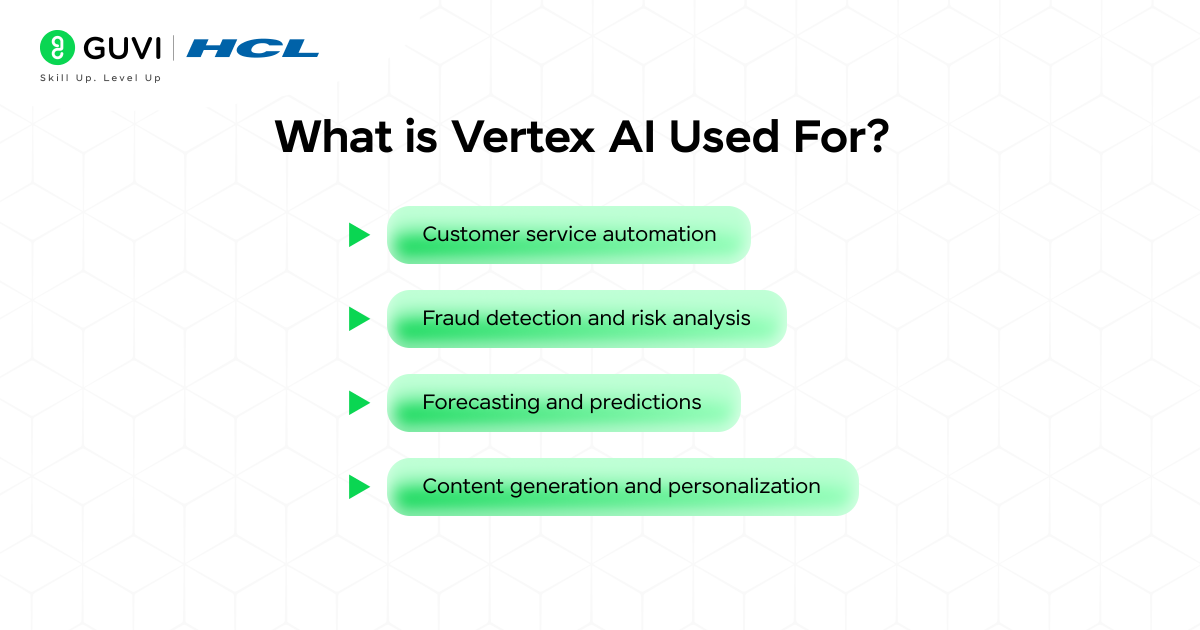
Here’s how organizations are leveraging Vertex AI in various domains:
1) Customer service automation
Vertex AI powers intelligent virtual assistants and chatbots that transform customer interactions. These AI agents handle customer inquiries 24/7, understand complex questions, and provide accurate responses while escalating issues when necessary.
Key benefits include:
- Round-the-clock support with virtual agents that never tire
- Personalized conversations tailored to individual customer preferences
- Multilingual capabilities serving global audiences effectively
2) Fraud detection and risk analysis
- In the financial sector, Vertex AI excels at identifying suspicious activities and managing risk. Financial institutions leverage the platform to train models that detect fraudulent transactions in real-time and automate compliance checks by analyzing regulatory documentation.
- Vertex AI’s fraud detection capabilities include real-time transaction monitoring, anomaly identification, and pattern recognition across vast datasets. The platform can process credit card transaction details and customer demographics to flag potential fraud within seconds, allowing for immediate intervention.
3) Forecasting and predictions
Vertex AI offers powerful forecasting tools that help businesses anticipate future trends and optimize operations. The platform recently introduced TimeSeries Dense Encoder (TiDE), a new model architecture that provides 10x training throughput improvement without compromising accuracy.
Businesses use these capabilities primarily for:
- Demand forecasting in retail to optimize inventory levels
- Predicting market trends to inform strategic decisions
- Financial projections to guide investment strategies
4) Content generation and personalization
- Marketing teams utilize Vertex AI to create engaging content at scale. By inputting key points or themes, companies can generate full-fledged marketing copy, blog posts, and social media content aligned with their brand voice.
- Moreover, Vertex AI enables personalized marketing campaigns by analyzing customer data to tailor offers and content to individual preferences. This capability significantly improves engagement rates and conversion metrics for businesses across sectors.
Through these diverse applications, Vertex AI demonstrates its versatility as a comprehensive AI solution that addresses real-world business challenges across multiple domains.
How to Use Vertex AI: A Beginner’s Workflow
Getting started with Vertex AI is straightforward once you understand the basic workflow. Here’s a step-by-step guide to help you begin your AI journey:

1. Prepare your data
First, gather and organize your data in the appropriate format for your use case. Vertex AI works with various data types, including tabular, image, text, and video data. Ensure your dataset is:
- Clean and properly labeled
- Split into training and validation sets
- Stored in a compatible location (Cloud Storage buckets work best)
2. Choose AutoML or custom training
Afterward, decide on your training approach:
- AutoML: Perfect for beginners with limited coding experience. Simply upload data and configure basic parameters.
- Custom training: Offers more control using frameworks like TensorFlow or PyTorch. Ideal if you have specific model requirements.
3. Train and evaluate your model
During this phase, Vertex AI handles the heavy computational lifting. The platform automatically:
- Processes your data through your chosen model architecture
- Tune hyperparameters for optimal performance
- Provides evaluation metrics to assess model quality
4. Deploy the model
Once trained, deploy your model to an endpoint for real-time predictions or batch processing. Vertex AI allows you to:
- Set compute resources based on expected traffic
- Configure autoscaling options
- Manage authentication and security settings
5. Monitor and improve
Finally, track your model’s performance over time using Vertex AI Monitoring. This helps you:
- Detect prediction drift or data skew
- Identify opportunities for retraining
- Make continuous improvements to accuracy and efficiency
Want to go beyond just reading about AI? The HCL GUVI + Intel AI/ML Certification Course helps you build, deploy, and scale real models with hands-on projects in generative AI, agentic systems, deep learning, and MLOps — all backed by industry partners and IITM Pravartak.
Concluding Thoughts…
Vertex AI stands out as a powerful yet accessible solution for organizations looking to implement AI without extensive technical expertise. Throughout this guide, you’ve seen how this unified platform simplifies the entire machine learning workflow—from data preparation to deployment and monitoring.
Google’s platform truly shines in its ability to serve both beginners and experienced developers alike. As AI continues to transform businesses, Vertex AI offers a balanced combination of power and usability.
You no longer need a large team of specialists or deep technical knowledge to implement effective AI solutions. Google has created a platform that democratizes artificial intelligence, making advanced capabilities available to organizations of all sizes and technical backgrounds.
FAQs
Q1. What is Vertex AI and how does it simplify machine learning?
Vertex AI is Google Cloud’s unified platform that streamlines the entire machine learning workflow. It combines data engineering, data science, and ML engineering into a single toolset, allowing users to build, train, deploy, and scale AI models efficiently.
Q2. Can beginners use Vertex AI without coding experience?
Yes, Vertex AI is accessible to beginners through its AutoML capabilities. Users can create high-quality machine learning models by simply uploading data and letting the platform handle algorithm selection and hyperparameter tuning automatically.
Q3. What are some key features of Vertex AI?
Key features of Vertex AI include AutoML for no-code model building, custom model training with popular frameworks, model monitoring and versioning, Vertex AI Pipelines for automation, and seamless integration with other Google Cloud tools.
Q4. How is Vertex AI used in real-world applications?
Vertex AI is used in various industries for applications such as customer service automation, fraud detection and risk analysis, forecasting and predictions, and content generation and personalization. It helps businesses solve complex challenges through AI implementation.
Q5. What is the basic workflow for using Vertex AI?
The basic workflow for using Vertex AI involves five steps: 1) Prepare your data, 2) Choose between AutoML or custom training, 3) Train and evaluate your model, 4) Deploy the model, and 5) Monitor and improve performance over time.
Success Stories

About the Author
Jaishree Tomar
A recent CS Graduate with a quirk for writing and coding, a Data Science and Machine Learning enthusiast trying to pave my own way with tech. I have worked as a freelancer with a UK-based Digital Marketing firm writing various tech blogs, articles, and code snippets. Now, working as a Technical Writer at GUVI writing to my heart’s content!
View all posts by Jaishree Tomar
Connect with me @













Did you enjoy this article?