


Javascript Articles
Arrow Functions in JavaScript: A Complete Guide
What Is Currying in JavaScript?
Lexical Scope in JavaScript: A Simple and Easy Guide
Is JavaScript Single-Threaded or Multi-threaded? A Clear Explanation


Get In Touch For Details! Request More Information
What is Higher Order Function in Javascript
Mar 18, 2026 4 Min Read 359 Views
(Last Updated)
Have you ever noticed how some JavaScript functions take other functions as input or even return a new function? This is not a special trick, but a core feature of JavaScript that helps developers write flexible and reusable code. This concept is known as a higher-order function.
This blog explains what a higher order function in JavaScript is in simple terms for beginners. It covers how higher order functions work, why they are commonly used in JavaScript, and where you will see them in everyday code, such as array methods and callbacks. By the end, you will clearly understand why this concept is important.
Quick Answer
A higher order function in JavaScript is a function that works with other functions. It can either take a function as an input or return a new function as output. This is useful because it allows you to reuse logic and write cleaner code instead of repeating the same steps again and again.
Table of contents
- What Is A Higher Order Function In JavaScript
- Why Higher Order Functions Are Used
- How Higher Order Functions Work
- Common Higher Order Function Examples In JavaScript
- map()
- filter()
- reduce()
- Real-Life Example Of Higher Order Function
- 💡 Did You Know?
- Conclusion
- FAQs
- When should I avoid using higher order functions in JavaScript?
- How do higher order functions impact performance in large applications?
- Can higher order functions make debugging harder for beginners?
- How are higher order functions used differently in frontend and backend JavaScript?
- What are common mistakes beginners make with higher order functions?
What Is A Higher Order Function In JavaScript
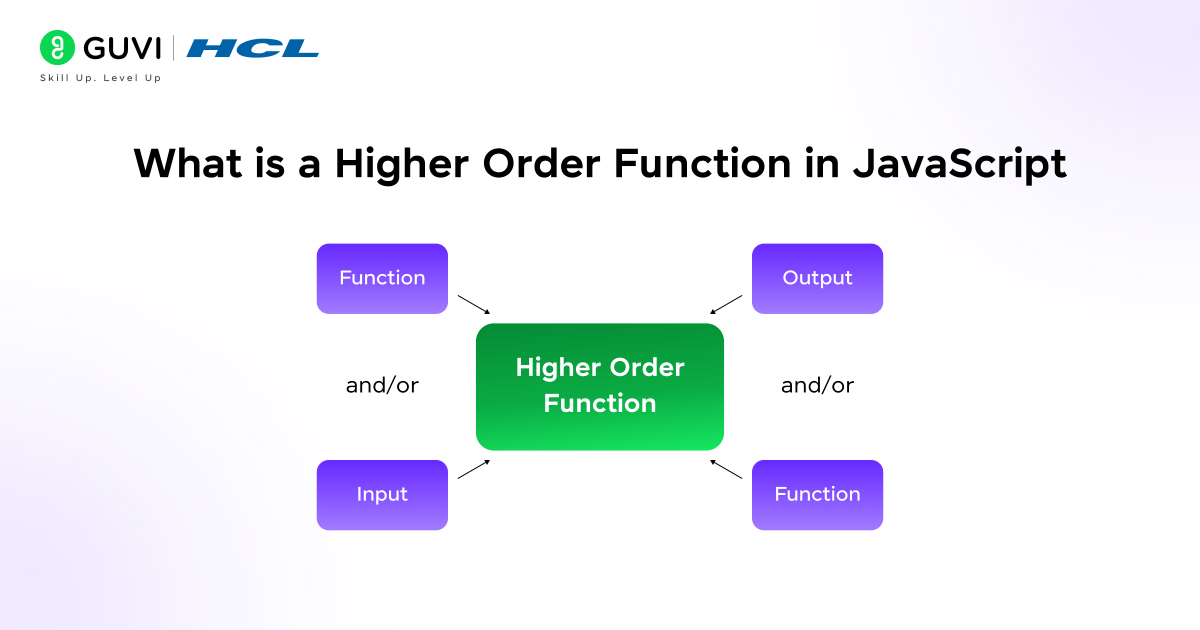
In JavaScript, functions are treated like normal values. This means you can store a function in a variable, pass it to another function, or return it from a function. Because of this behavior, JavaScript allows functions to work with other functions.
A function is called a higher order function in JavaScript when it takes another function as an argument or returns a function. For example, imagine you have a function that adds numbers, and another function that decides how that adding should happen. The second function is a higher order function because it uses the first function to do its job.
Think of it like this: you give instructions (a function) to someone, and another person decides when and how to use those instructions. That “deciding” function is the higher order function. This makes code easier to reuse and understand.
Do check out HCL GUVI’s JavaScript for Beginners course if you want a structured way to learn the fundamentals of JavaScript, including key concepts like higher order functions, explained in this blog. It’s designed to help beginners build strong basics and understand how JavaScript works in real applications.
Why Higher Order Functions Are Used
Higher order functions are used in JavaScript because they help developers write cleaner and more organised code. Instead of writing the same logic again and again, developers can reuse functions and control behavior by passing functions as inputs. This makes programs easier to understand, easier to change, and easier to maintain as they grow. That is why higher order functions appear so often in real JavaScript code.
- Avoids Code Repetition – Common logic can be written once and reused in many places.
- Makes Code Easier To Understand – Each function handles one task, which makes the code more readable.
- Improves Reusability – The same function can behave differently based on the function passed to it.
- Helps Manage Complex Logic – Large problems can be broken into smaller, simple functions.
- Used Widely In JavaScript – Many built-in methods and libraries rely on higher order functions.
How Higher Order Functions Work
A higher order function works by using another function to complete its task. Instead of working only with values like numbers or strings, it accepts a function and decides when and how that function should run. This makes the code flexible and reusable.
Let’s look at a very simple example:
function greet(name) {
  return "Hello " + name;
}

function welcomeUser(callback) {
  return callback("Alex");
}
Here, welcomeUser is a higher order function because it takes another function (greet) as an argument. When welcomeUser(greet) is called, it runs the greet function inside it and returns the result.
In simple terms, one function is doing the main work, and the other function is deciding how that work should happen. This is the basic idea behind higher order functions in JavaScript.
Do check out HCL GUVI’s JavaScript Hub if you want to explore more beginner-friendly lessons and guides that support topics like higher order functions and other core JavaScript concepts. It offers curated learning paths and practical resources to help you understand JavaScript step by step. This hub can be a useful companion as you continue building your foundational JavaScript skills.

Common Higher Order Function Examples In JavaScript
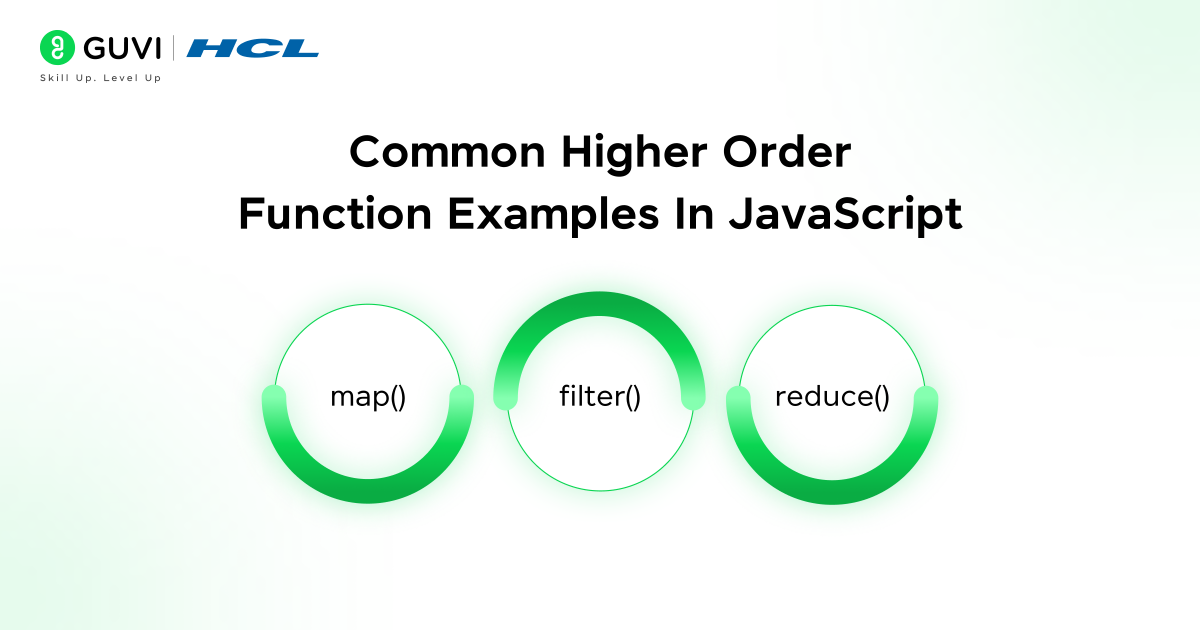
JavaScript provides some built-in higher order functions that you will use very often while working with arrays. These functions make it easier to process data without writing long loops again and again. Instead of telling JavaScript how to loop, you tell it what you want to do.
In this section, we’ll look at some commonly used higher order functions in JavaScript and understand how they work with easy examples. You’ll see how functions like map(), filter(), and reduce() help you work with arrays by passing functions as arguments, making your code cleaner and easier to read.
1. map()
The map() function is used when you want to change every item in an array and get a new array as the result. It takes a function and applies it to each element one by one.
Example:
const numbers = [1, 2, 3, 4];

const doubledNumbers = numbers.map(function (num) {
  return num * 2;
});
Here, map() is a higher order function because it takes another function as an argument. That function runs for each number in the array and returns a new value. The final output will be [2, 4, 6, 8].
2. filter()
The filter() function is used when you want to select only certain values from an array based on a condition. It returns a new array that contains only the items that match the rule.
Example:
const ages = [12, 18, 25, 10, 30];

const adults = ages.filter(function (age) {
  return age >= 18;
});
In this example, filter() checks each age and keeps only the values that are 18 or above. The result will be [18, 25, 30].
3. reduce()
The reduce() function is used when you want to combine all values in an array into a single result, such as a total or a sum.
Example:
const prices = [100, 200, 300];

const totalPrice = prices.reduce(function (total, price) {
  return total + price;
}, 0);
Here, reduce() adds all the values in the array and returns one final number, which is 600. It is a higher order function because it uses another function to decide how the values should be combined.
Do check out HCL GUVI’s JavaScript eBook if you want a clear and structured way to reinforce the JavaScript concepts discussed in this blog, including higher order functions and practical usage examples. This eBook breaks down core ideas into easy lessons that make learning faster and more intuitive for beginners. It’s a helpful resource to strengthen your fundamentals as you build real JavaScript skills.
Real-Life Example Of Higher Order Function
In this section, we’ll understand higher order function in JavaScript using a simple, everyday example before jumping into code. This will help beginners clearly see what is happening without getting confused by syntax.
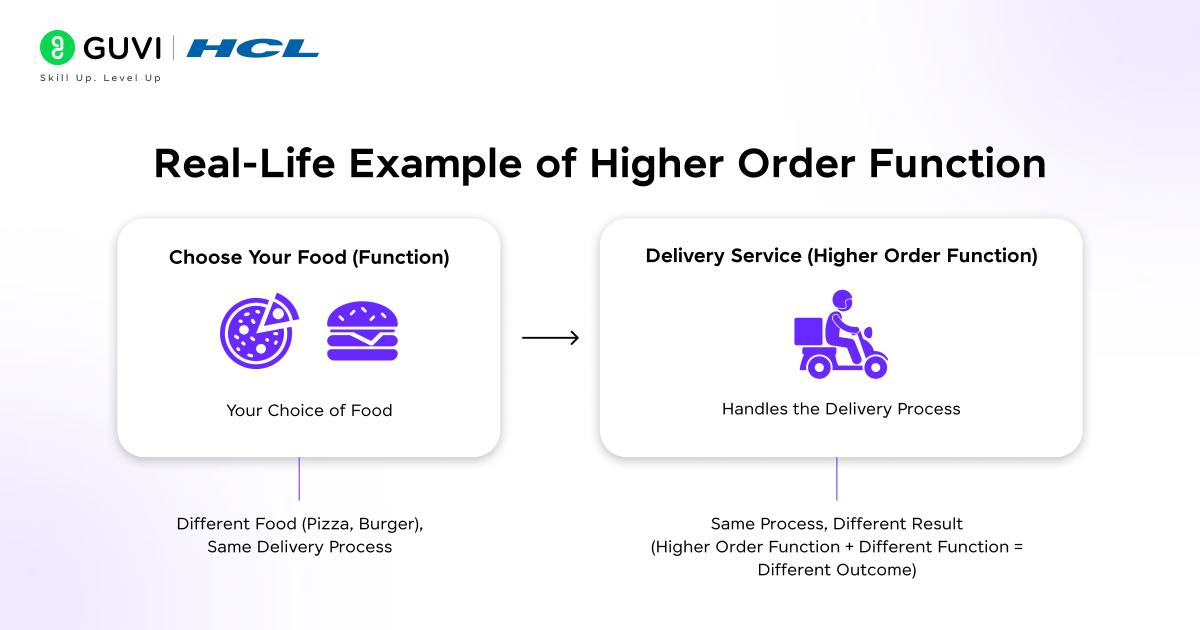
Imagine you order food from a restaurant. The restaurant doesn’t care what food you choose — it just handles the delivery. The food item you choose is like a function, and the delivery service is like a higher order function.
The delivery process stays the same every time, but the food can change. Similarly, a higher order function stays the same, but the function you pass to it can change the result.
This is exactly how JavaScript works. One function controls the flow, and another function defines the actual task. That’s why higher order functions make code flexible and reusable.
💡 Did You Know?
- JavaScript’s support for higher order functions comes from functional programming concepts that existed decades before JavaScript was created.
- The reason methods like map() and filter() feel so fast is because JavaScript engines heavily optimize higher order functions at runtime.
- Many popular JavaScript libraries internally use higher order functions to generate other functions dynamically, reducing memory usage and improving performance.
Conclusion
Higher order function in JavaScript that help developers write cleaner, more flexible code. By allowing functions to accept other functions or return them, JavaScript makes it easier to reinforce reusability and clarity in programs.
For beginners, understanding higher order function in JavaScript might feel confusing at first, but with real-life examples and simple practice, the concept becomes much easier. Once you start using them regularly, your code naturally becomes shorter, more readable, and easier to maintain. Mastering higher order functions is an important step toward writing modern JavaScript and understanding how popular frameworks and libraries work behind the scenes.
FAQs
1. When should I avoid using higher order functions in JavaScript?
You should avoid higher order functions when they make the code harder to read or understand, especially for very simple logic. In performance-critical sections with tight loops, a plain loop can sometimes be clearer and slightly faster.
2. How do higher order functions impact performance in large applications?
In most cases, the performance impact is negligible because JavaScript engines optimize them well. However, excessive nesting of higher order functions can affect readability and debugging, so they should be used thoughtfully.
3. Can higher order functions make debugging harder for beginners?
Yes, beginners may find stack traces confusing at first because multiple functions are involved. Using clear function names and avoiding deep nesting helps make debugging easier.
4. How are higher order functions used differently in frontend and backend JavaScript?
In frontend development, they are commonly used for event handling, state updates, and UI logic. In backend development, they are used in middleware, request handling, validation, and data processing.
5. What are common mistakes beginners make with higher order functions?
Beginners often overuse them for very simple tasks, write anonymous functions that reduce readability, or forget to return values correctly inside callback functions.
Success Stories

About the Author
Jebasta
I translate the language of data into stories that anyone can understand. As a writer with a data science background, I simplify analytics, AI, and decision-making so beginners and enthusiasts can confidently explore the world of data.
View all posts by Jebasta
Connect with me @












Did you enjoy this article?