


Artificial Intelligence and Machine Learning Articles
Finance Manager to Data Analytics: Career Growth, Salary and Seniority
How to Evaluate LLM Outputs in Production Deployments
AI/ML Skills Gap 2026: Why Companies Can't Find Job-Ready Talent
20 AI/ML Interview Questions Recruiters Can Use Without a Tech Background - Best Guide


Get In Touch For Details! Request More Information

What is AI Model Auditing: How It Works
Sep 07, 2026 4 Min Read 370 Views
(Last Updated)
AI models can produce inaccurate, biased, insecure, or unexpected results if they are not evaluated properly. AI Model Auditing provides a structured process for examining how an AI system is developed, trained, evaluated, and deployed. It helps organizations identify risks, assess model performance, and verify whether systems meet technical and organizational requirements. This guide explains AI Model Auditing, how the process works, what auditors examine, and why regular audits matter.
Table of contents
- TL;DR Summary
- Why AI Model Auditing Matters
- What Is AI Model Auditing?
- How AI Model Auditing Works
- Step 1: Define the Audit Scope
- Step 2: Review Data
- Step 3: Evaluate Model Performance
- Step 4: Assess Fairness
- Step 5: Examine Security and Privacy
- Step 6: Review Documentation
- Step 7: Report Findings
- Step 8: Monitor Remediation
- Key Areas of an AI Model Audit
- Data Quality
- Model Performance
- Fairness
- Security
- Explainability
- Governance
- AI Model Auditing Across the Lifecycle
- Benefits of AI Model Auditing
- Better Risk Detection
- Improved Model Reliability
- Stronger Accountability
- Continuous Improvement
- When Should You Conduct AI Model Auditing?
- Before Deployment
- After Major Model Updates
- High-Impact AI Systems
- Regular Monitoring
- Regulatory or Governance Requirements
- Key Concepts to Remember
- A Practical AI Model Audit Workflow
- Define Audit Objectives
- Review Training and Evaluation Data
- Test Model Performance
- Evaluate Fairness and Robustness
- Review Security and Privacy
- Examine Documentation
- Document Findings
- Follow Up
- Real-World Applications
- Healthcare
- Financial Services
- Human Resources
- Generative AI
- Best Practices
- Conclusion
- FAQs
- What is AI Model Auditing?
- When should an AI model be audited?
- What does an AI audit examine?
- Why is AI auditing important?
- Does AI auditing only focus on model accuracy?
- Who can conduct an AI model audit?
- Should AI models be audited after deployment?
TL;DR Summary
- AI Model Auditing evaluates an AI system systematically.
- Audits examine data, performance, fairness, security, and reliability.
- Testing can identify model weaknesses and risks.
- Documentation supports transparency and accountability.
- Auditing should continue after deployment.
Direct Answer
| AI Model Auditing is the systematic evaluation of an AI model’s data, development process, performance, fairness, security, and deployment practices. Auditors examine whether the model behaves as expected, meets defined requirements, and creates unacceptable risks. Regular audits can identify weaknesses before or after deployment, helping organizations improve model reliability, accountability, transparency, and overall AI governance. |
Why AI Model Auditing Matters
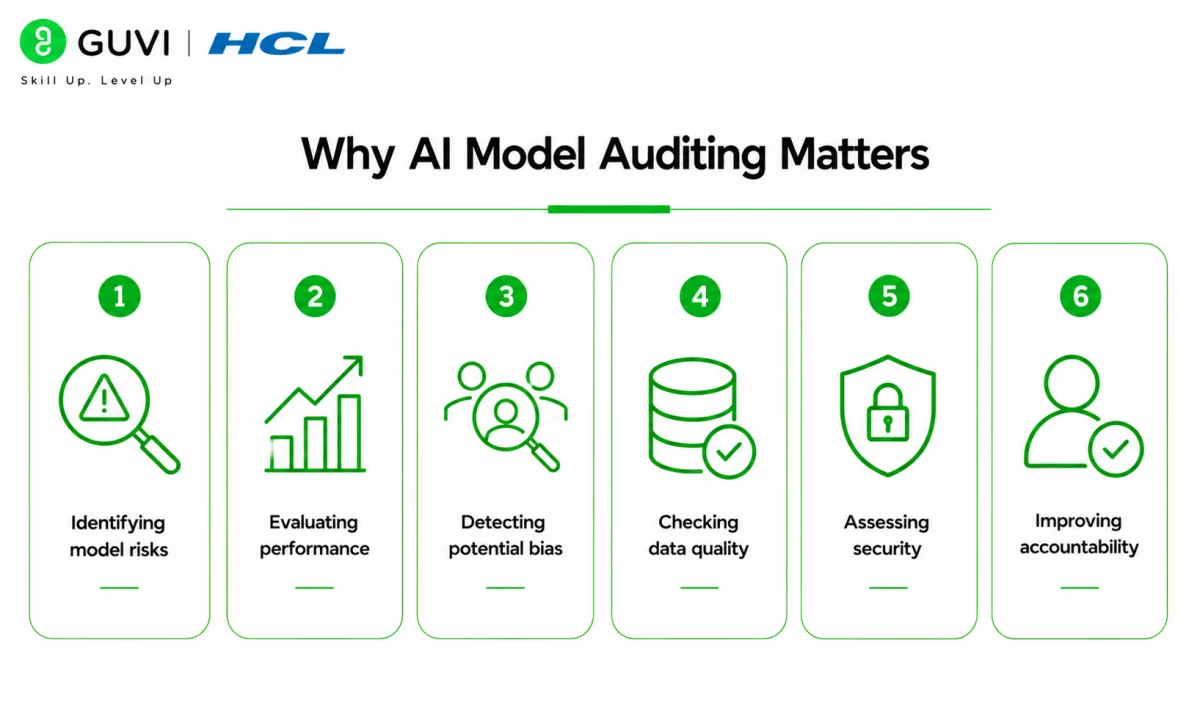
AI systems can behave differently depending on their training data, users, and operating environment. An audit provides an independent or structured assessment of whether the system continues to meet its intended requirements.
Key objectives include:
- Identifying model risks
- Evaluating performance
- Detecting potential bias
- Checking data quality
- Assessing security
- Improving accountability
What Is AI Model Auditing?
AI Model Auditing is the process of systematically reviewing an AI model and the processes surrounding it.
An audit can examine:
- Training data
- Model architecture
- Performance metrics
- Fairness
- Security
- Privacy
- Documentation
- Deployment practices
- Monitoring procedures
The scope depends on the model, industry, and potential impact of its decisions.
How AI Model Auditing Works
A typical audit follows several stages.
Step 1: Define the Audit Scope
Identify the model being audited, its purpose, users, deployment environment, and key risks.
Step 2: Review Data
Examine data sources, quality, representation, labeling processes, and relevant privacy considerations.
Step 3: Evaluate Model Performance
Test the model using appropriate datasets and metrics to determine whether it meets its intended performance requirements.
Step 4: Assess Fairness
Analyze whether model performance or outcomes differ significantly across relevant groups.
Step 5: Examine Security and Privacy
Review potential vulnerabilities, access controls, data handling, and other security or privacy risks.
Step 6: Review Documentation
Check whether important information about the model, data, limitations, evaluations, and deployment is properly documented.
Step 7: Report Findings
Document identified risks, weaknesses, evidence, and recommended corrective actions.
Step 8: Monitor Remediation
Follow up to determine whether identified issues have been addressed effectively.
Key Areas of an AI Model Audit
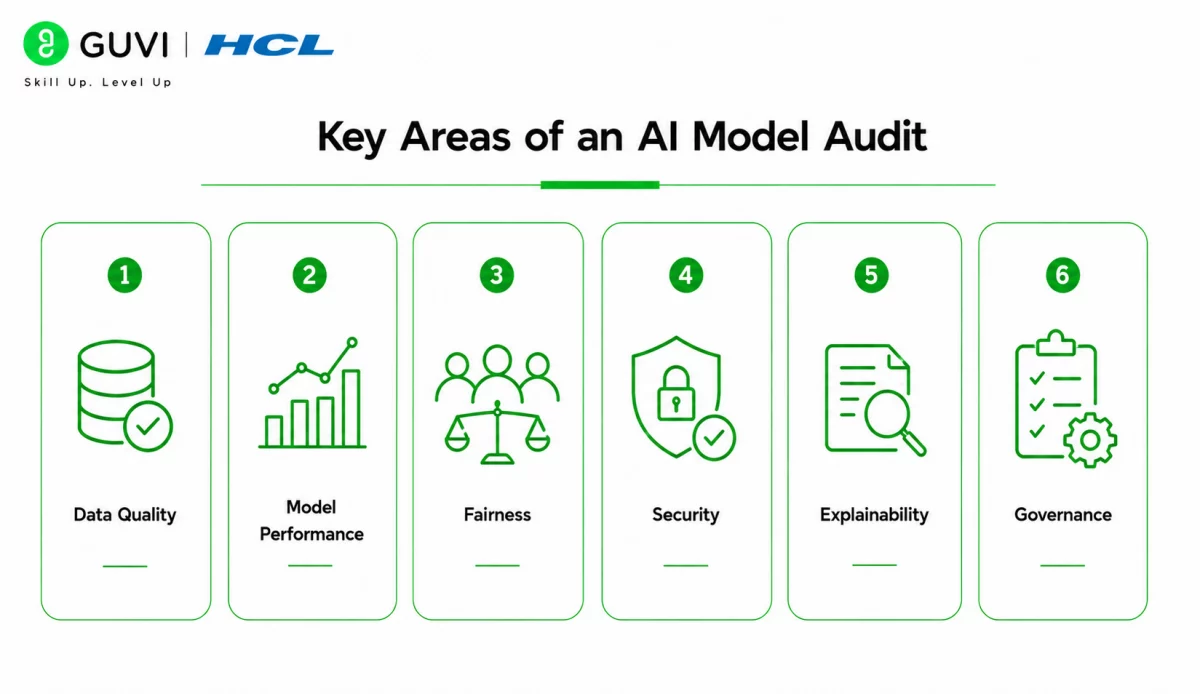
Data Quality
Auditors examine whether training and evaluation data is accurate, relevant, representative, and appropriate for the model’s intended use.
Model Performance
Metrics such as accuracy, precision, recall, F1-score, or task-specific measures can be evaluated depending on the application.
Fairness
Auditors can examine differences in model performance or outcomes across relevant groups.
Security
The audit may examine vulnerabilities, unauthorized access, adversarial risks, and weaknesses in the surrounding AI infrastructure.
Explainability
For applications where understanding model behavior is important, auditors may assess whether appropriate explanations or interpretability methods are available.
Governance
Auditors review whether responsibilities, documentation, approval processes, and monitoring procedures are clearly defined.
AI Model Auditing Across the Lifecycle
Auditing should not necessarily happen only after a model has been built.
Planning → Data → Development → Testing → Deployment → Monitoring
Evaluating the system at multiple stages can help identify problems earlier and reduce the risk of unexpected behavior in production.
Do not audit an AI model using one performance metric alone. A model can have strong overall accuracy while still showing weaknesses in fairness, robustness, security, or specific user groups. A useful audit evaluates the model against the risks and requirements of its actual use case.
Benefits of AI Model Auditing
Better Risk Detection
Audits can reveal weaknesses before they become larger operational problems.
Improved Model Reliability
Systematic evaluation helps identify performance issues and unexpected behavior.
Stronger Accountability
Documentation and clearly defined responsibilities make AI systems easier to govern.
Continuous Improvement
Audit findings provide actionable information for improving models and their surrounding processes.
Professionals interested in artificial intelligence, machine learning, AI governance, and responsible AI can strengthen their expertise through HCL GUVI’s Artificial Intelligence and Machine Learning Course.
When Should You Conduct AI Model Auditing?
AI Model Auditing is useful whenever an AI system needs systematic evaluation of its performance, risks, and compliance with defined requirements.
Before Deployment
Audit the model before it reaches production to identify performance issues, fairness concerns, security weaknesses, and other risks.
After Major Model Updates
Conduct an audit when the model, training data, architecture, or important configuration changes significantly.

High-Impact AI Systems
Auditing is especially important for AI used in areas such as healthcare, finance, hiring, education, and other consequential decisions.
Regular Monitoring
Periodic audits can identify performance degradation, changing data patterns, or new risks that emerge after deployment.
Regulatory or Governance Requirements
Organizations may conduct audits to demonstrate that AI systems follow internal policies, contractual requirements, or applicable governance standards.
Key Concepts to Remember
- Audit scope defines what the assessment covers.
- Data review examines the quality and suitability of model inputs.
- Performance evaluation measures whether the model meets its intended requirements.
- Fairness assessment looks for meaningful differences across relevant groups.
- Security review identifies potential vulnerabilities and risks.
- Documentation supports transparency and accountability.
- Remediation addresses problems identified during the audit.
A Practical AI Model Audit Workflow
A structured process makes auditing more consistent and actionable.
1. Define Audit Objectives
Establish what the model does, where it is deployed, who uses it, and which risks need to be evaluated.
2. Review Training and Evaluation Data
Examine data sources, labeling, quality, representation, and the datasets used to evaluate the model.
3. Test Model Performance
Use appropriate metrics and representative test data to determine whether the model meets its intended requirements.
4. Evaluate Fairness and Robustness
Check whether performance changes across relevant groups or under different operating conditions.
5. Review Security and Privacy
Assess access controls, data handling, vulnerabilities, and other relevant security or privacy concerns.
6. Examine Documentation
Verify that important information about the model, datasets, limitations, testing, and deployment is recorded.
7. Document Findings
Record identified issues, supporting evidence, severity, and recommended corrective actions.
8. Follow Up
Confirm that identified problems have been addressed and verify whether corrective measures actually improved the system.
Real-World Applications
Healthcare
Audit diagnostic and clinical AI systems for accuracy, reliability, fairness, privacy, and safety.
Financial Services
Evaluate AI used for credit decisions, fraud detection, risk assessment, and financial analysis.
Human Resources
Review automated recruitment and employee-management systems for performance, fairness, and appropriate governance.
Generative AI
Assess AI assistants and LLM applications for accuracy, safety, privacy, security, and inappropriate outputs.
The HCL GUVI’s Artificial Intelligence eBook introduces the fundamentals of artificial intelligence, machine learning, generative AI, and intelligent automation. It helps learners develop a broader understanding of AI technologies and responsible approaches to building intelligent systems.
Best Practices
- Define audit criteria before testing begins.
- Use representative evaluation data.
- Examine multiple performance and risk dimensions.
- Document assumptions, limitations, and findings.
- Keep audit evidence reproducible where possible.
- Assign clear ownership for remediation.
- Re-audit models after significant changes.
- Continue monitoring important models after deployment.
Conclusion
AI Model Auditing provides a structured way to evaluate whether an AI system performs as intended and manages the risks associated with its use. By examining data, performance, fairness, security, privacy, documentation, and governance, organizations can identify weaknesses and take corrective action. Regular auditing also supports continuous improvement, helping AI systems remain reliable as models, data, and operating environments change.
FAQs
1. What is AI Model Auditing?
AI Model Auditing is the systematic assessment of an AI model’s data, performance, fairness, security, documentation, and deployment practices.
2. When should an AI model be audited?
Models can be audited before deployment, after significant changes, periodically during production, or when governance and compliance requirements call for an assessment.
3. What does an AI audit examine?
An audit can examine training data, model performance, fairness, robustness, security, privacy, documentation, governance, and monitoring practices.
4. Why is AI auditing important?
AI auditing helps identify model weaknesses, potential risks, and unexpected behavior while providing evidence for improving reliability and accountability.
5. Does AI auditing only focus on model accuracy?
No. Accuracy is only one part of an audit. A comprehensive assessment can also examine fairness, security, privacy, robustness, explainability, and governance.
6. Who can conduct an AI model audit?
Depending on the organization’s requirements, audits may involve internal AI, data, security, compliance, or risk teams, as well as independent external auditors.
7. Should AI models be audited after deployment?
Yes. Post-deployment auditing can identify performance changes, data drift, emerging risks, and other issues that may not have been visible during initial testing.
Success Stories

About the Author
HCL GUVI
This article was selected and published as part of the HCL GUVI AI Blogathon 2026, an initiative designed to encourage students, AI enthusiasts, and aspiring tech writers to simplify complex AI concepts through impactful technical content. The contest recognized high-quality, original, and insightful AI-focused blogs, with selected authors receiving publication opportunities on the HCL GUVI blog platform along with official author credits and recognition.
View all posts by HCL GUVI
Connect with me @











Did you enjoy this article?