


Data Structure Articles
What is an Algorithm? A Simple Guide for Beginners
Difference between Algorithm and Program: What Sets Them Apart


Get In Touch For Details! Request More Information

What Are the Characteristics of an Algorithm? Definition, Features, and Examples
Jan 17, 2026 6 Min Read 3184 Views
(Last Updated)
Algorithms play a major role in computer science and are used in everything from mobile apps to artificial intelligence systems. They provide clear, step-by-step instructions that help computers solve problems quickly and correctly. Whether you are sorting data, searching for information, or building a smart application, algorithms make the process smooth and reliable.
For beginners, understanding the characteristics of an algorithm is extremely important because it helps you learn how to design solutions that are efficient, accurate, and easy for computers to run. Knowing these characteristics also improves logical thinking and problem-solving skills, which are essential in programming.
In this blog, you will learn what an algorithm is, the important characteristics that define a good algorithm, and simple real-world examples that make the concept easy to understand. This guide is ideal for students, freshers, and anyone curious about how algorithms work or how they are used in technology.
Quick Answer
An algorithm is a clear, step-by-step method used to solve a problem or complete a task. The main characteristics of an algorithm include clarity, finiteness, defined inputs and outputs, effectiveness, and efficiency. A good algorithm always follows a logical order and produces results reliably and predictably. Simple examples include a recipe for making tea or instructions for sorting a list of numbers, where both follow a fixed sequence of steps to reach the final result.
Table of contents
- Definition of an Algorithm
- Features of an Algorithm
- Finiteness
- Input
- Output
- Definiteness
- Effectiveness
- Generality
- Efficiency
- Examples of Algorithms in Real Life
- Importance of Understanding Algorithm Features
- Conclusion
- FAQs
- What is an algorithm in simple words?
- Why are features of an algorithm important?
- Can algorithms have multiple outputs?
- Are all steps in an algorithm necessary?
- Where are algorithms used in daily life?
Definition of an Algorithm
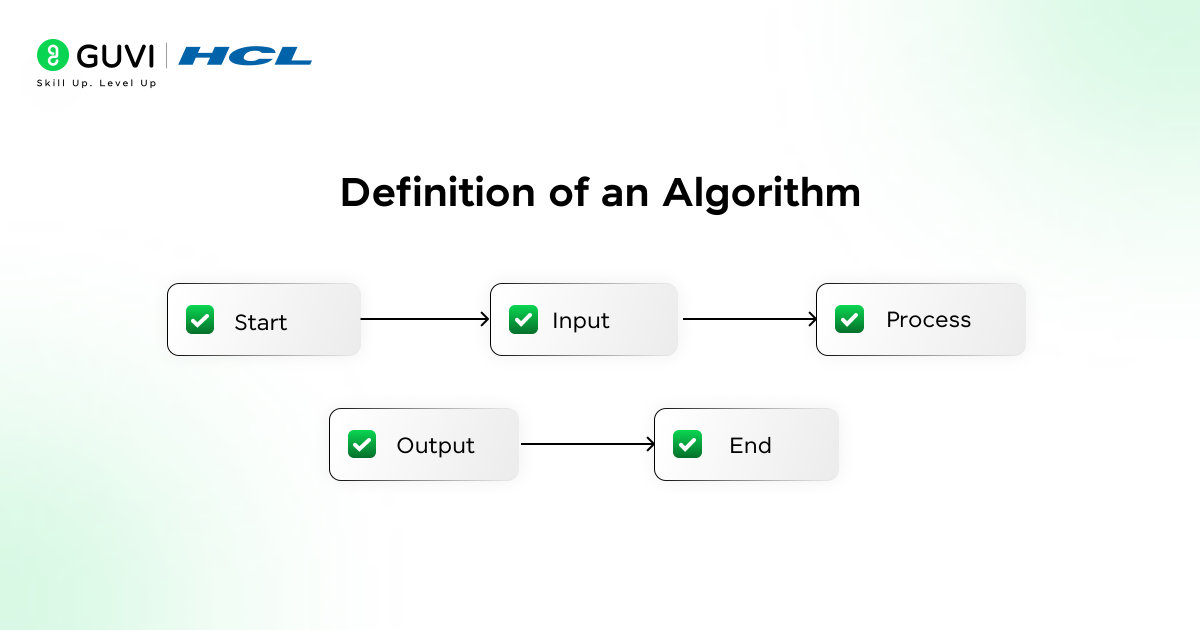
An algorithm is a step-by-step set of clear instructions used to solve a problem or complete a task. It does not depend on any specific programming language and can be written using pseudocode, flowcharts, or even plain sentences. A good algorithm always follows a logical sequence and leads to a predictable result.
Key Points:
- Provides a Systematic Solution: Follows a clear sequence of steps.
- Language-Independent: Can be written in any form such as pseudocode, flowchart, or natural language.
- Predictable Output: Always produces the expected result when followed correctly.
Example:
Sorting a list of student marks in ascending order using a simple bubble-sort method.
Features of an Algorithm
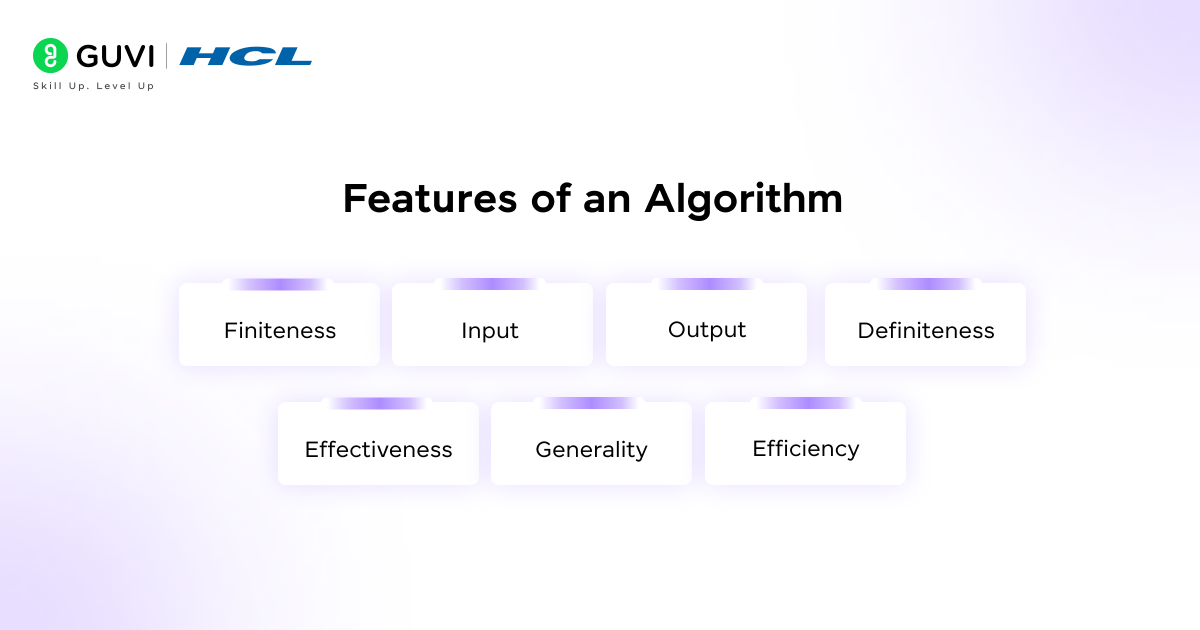
Algorithms are the backbone of problem-solving in computer science, and their quality directly affects the performance, accuracy, and reliability of software systems. Whether you are sorting numbers, searching for information, building a mobile app, or designing an AI model, every solution depends on a well-designed algorithm.
To help beginners clearly understand what makes an algorithm effective, we will explore seven essential features that define a good algorithm. These are:
- Finiteness
- Input
- Output
- Definiteness
- Effectiveness
- Generality
- Efficiency
Each of these characteristics ensures that the algorithm works correctly, can be implemented in any programming language, and is capable of producing meaningful results. Let’s understand each feature in detail with simple explanations, key points, and examples.
1. Finiteness
Finiteness means that an algorithm must always come to an end after completing a specific number of steps. No matter how complex the process is, it cannot run indefinitely. This characteristic ensures that the algorithm can produce a result within a reasonable time and doesn’t get stuck in endless loops.
Key Points:
- Has a clearly defined stopping point
- Prevents infinite or repeating cycles
- Ensures predictability and usable results
Example:
A program that counts the number of vowels in a sentence stops once it reaches the last character. It does not continue checking after the sentence ends.

2. Input
An algorithm must accept zero or more inputs. These inputs provide the raw data the algorithm needs to process. Without input, the algorithm has nothing to work on, and its purpose becomes meaningless. Inputs can be values, datasets, codes, or signals depending on the problem.
Key Points:
- Inputs guide the algorithm’s behaviour
- Can be simple (like one number) or complex (like a large dataset)
- Makes the algorithm flexible for different scenarios
Example:
A temperature-conversion algorithm takes a Celsius value as input before converting it to Fahrenheit.
3. Output
Every algorithm must produce at least one output that represents the result of its computation. The output is proof that the algorithm has completed its task successfully. It can be a number, a message, a structured list, or even a decision.
Key Points:
- The result must be clearly defined and meaningful
- Helps verify whether the algorithm worked correctly
- Without output, the algorithm serves no purpose
Example:
A login-verification algorithm outputs “Access Granted” or “Access Denied” after checking the credentials.
4. Definiteness
Definiteness means that every step in the algorithm must be clear, precise, and unambiguous. There should be no scope for confusion or multiple interpretations. Anyone reading the algorithm should understand exactly what to do at each step.
Key Points:
- Steps must be detailed and specific
- Removes confusion during implementation
- Ensures consistent results no matter who executes it
Example:
Instead of saying “arrange these items properly,” a definite algorithm states:
“Compare each pair of adjacent numbers and swap them if the first is greater.”
5. Effectiveness
An algorithm must consist of simple, basic operations that can be executed easily and within a limited amount of time. This means every step should be practical and achievable using standard computing capabilities.
Key Points:
- Steps must be realistic, not overly complex
- Does not rely on assumptions
- Each operation must be possible to perform exactly as it is
Example:
A step like “add two numbers” is effective, but a vague instruction like “find the best possible number instantly” is not.
6. Generality
Generality ensures that an algorithm can solve a broad range of problems within the same category, not just one specific case. This makes the algorithm reusable and adaptable to different inputs and situations.
Key Points:
- Works for multiple inputs and variations
- Not tied to a single example
- Makes algorithms more powerful and practical
Example:
A sorting algorithm works for any list of numbers, whether the list contains 5 elements or 5000 elements.
7. Efficiency
Efficiency refers to how well an algorithm uses time and memory. A highly efficient algorithm runs faster and uses fewer resources, making it ideal for large datasets or real-time applications.
Key Points:
- Saves time (low time complexity)
- Saves memory (low space complexity)
- Crucial for performance-heavy applications
Example:
Searching for an item using Binary Search is more efficient than checking every item one by one, especially in large lists.
Examples of Algorithms in Real Life
Algorithms are not just code; they are clear step-by-step plans we follow to solve problems. Below are four everyday examples explained in detail so you can see how algorithmic thinking maps to real tasks and to programming.
1. Making Tea Or Coffee
This is a simple everyday algorithm: a sequence of ordered, repeatable steps that always produces the same result when followed correctly.
- Steps: heat water, add tea leaves or coffee powder, steep or brew for a fixed time, strain or pour, add milk or sugar if needed, serve.
- Why it is an algorithm: each step is definite and unambiguous, it always ends (finiteness), and it turns raw inputs (water, tea, heat) into a useful output (a drink).
- How it maps to code: you can model each action as a function or command. A loop might be used to stir for a fixed number of seconds. Error checks (for example, “is the kettle empty?”) act like input validation.
- Key idea: repeatability and clear order make it reliable. If you skip or rearrange steps, the result changes.
2. Finding the Maximum in a List
This is a basic data algorithm used in many programs to locate the largest value in a collection.
- Steps: start with the first item as the current maximum, compare the next item to the current maximum; if it is larger, replace the current maximum, repeat until the end of the list, and return the maximum.
- Why it is an algorithm: it has a clear start, a fixed sequence of comparisons, and a definite end after the last item (finiteness).
- How it maps to code: usually a single loop that visits each element once, so the time cost grows linearly with list size. In pseudocode, it looks like:
max = list[0]; for each item in list: if item > max then max = item; return max - Key idea: simple, effective, and predictable; useful building block for more complex tasks.
3. Sorting Names Alphabetically
Sorting is a classic algorithm problem with many methods that trade simplicity, speed, and memory use.
- Common approaches: bubble sort (simple but slow), insertion sort (good for small or nearly sorted lists), quicksort and mergesort (fast on large lists).
- Why it is an algorithm: sorting specifies a precise sequence of comparisons and swaps that transform an unsorted list into an ordered list. Each method has clear steps and ends after a finite number of operations.
- How it maps to code: each sorting method follows a different strategy. For example, bubble sort repeatedly compares adjacent items and swaps them until the list is ordered; quicksort picks a pivot and partitions the list recursively.
- Key idea: different algorithms solve the same problem with different efficiency; choosing the right one matters for large datasets.
4. Navigation Systems (GPS Routing)
Route finding uses algorithms to compute the best path from A to B, often under changing conditions like traffic.
- Typical steps: model the road network as nodes and edges, assign weights (distance, time, traffic delay), run a pathfinding algorithm such as Dijkstra or A* to find the shortest or fastest route, update if conditions change.
- Why it is an algorithm: it transforms raw map data and constraints into a deterministic route using well-defined mathematical steps and finishes with a usable path.
- How it maps to code and systems: the map becomes a graph data structure; search algorithms explore possible paths and compute costs; heuristics (estimates) speed up search for A*. Real systems also re-run algorithms frequently to adapt to new traffic data.
- Key idea: combining a clear model (graph) with an efficient search strategy gives fast, reliable directions even on huge networks.
Importance of Understanding Algorithm Features

Understanding the characteristics of an algorithm is important because it helps you build stronger problem-solving skills and write better programs. When you know what makes an algorithm clear, efficient, and reliable, you can design solutions that work smoothly in real projects.
- Designing Efficient Programs:
Helps you create algorithms that run faster, use less memory, and handle large amounts of data without slowing down. - Debugging And Optimizing Code:
Makes it easier to find errors in your logic and improve the steps of your program so it performs better. - Selecting The Right Problem-Solving Approach:
Enables you to choose the best algorithm for tasks like searching, sorting, or data processing based on its performance and structure. - Understanding Advanced Technologies:
Builds a strong foundation for learning machine learning, artificial intelligence, and data science, since all these fields rely heavily on algorithmic thinking.
To deepen your understanding of algorithm characteristics and start applying them, you can enroll in HCL GUVI’s Data Structures & Algorithms using Python Course. This program teaches how to design efficient algorithms, optimize for speed and memory, and build real coding solutions, helping you move from theory to practical mastery.
Conclusion
Algorithms are much more than lines of code; they are clear logical steps that guide how problems are solved in both daily life and modern technology. In this blog, you explored what an algorithm is, understood the characteristics of an algorithm, and learned practical examples that show how they work in real situations. This gives you a strong foundation to think logically, break down problems, and design efficient solutions.
Now that you understand how algorithms function and what makes them effective, the next step is to apply this knowledge. You can start practicing with simple algorithmic problems, experiment with pseudocode, or try implementing algorithms in a programming language of your choice. As you grow comfortable, you can move on to more advanced areas like data structures, optimization techniques, or even machine learning as they are the fields that rely deeply on strong algorithmic thinking.
FAQs
1. What is an algorithm in simple words?
An algorithm is a step-by-step procedure to solve a problem or perform a task.
2. Why are features of an algorithm important?
They ensure the algorithm is reliable, efficient, and can be followed without confusion.
3. Can algorithms have multiple outputs?
Yes, depending on the problem, an algorithm can produce one or more outputs.
4. Are all steps in an algorithm necessary?
Yes, every step must be well-defined and contribute to the solution.
5. Where are algorithms used in daily life?
In cooking recipes, navigation apps, online searches, banking transactions, and more.
Success Stories

About the Author
Jebasta
I translate the language of data into stories that anyone can understand. As a writer with a data science background, I simplify analytics, AI, and decision-making so beginners and enthusiasts can confidently explore the world of data.
View all posts by Jebasta
Connect with me @
















Did you enjoy this article?