


Web Development Articles
How to Use Firebase Firestore for Real-Time Data in Web Apps
Web Designing Roadmap 2026: Best Guide to Become a Successful Web Designer


Get In Touch For Details! Request More Information
Node.js to FastAPI in 2026: A Career Guide for Backend Developers Ready to Upskill
Aug 24, 2026 7 Min Read 2969 Views
(Last Updated)
What if the backend stack you mastered so well is quietly becoming a comfort zone rather than a growth engine? For many backend developers, Node.js has been the default choice for years, fast, scalable, and backed by a massive ecosystem.
But as modern systems increasingly intersect with AI and data pipelines, staying purely in Node.js may not be enough anymore.
Moving from Node.js to FastAPI means adding Python’s async framework to your backend skillset, not replacing what you already know. Node.js remains strong for real-time and I/O-heavy systems, while FastAPI adds value in data-driven, AI-integrated, and validation-critical APIs, and together they expand your career scope well beyond either stack alone.
This guide covers how the Node.js to FastAPI transition impacts performance, career growth, and real-world backend use cases, plus real salary data and a practical learning path.
Table of contents
- TL;DR Summary
- Why Are Backend Developers Rethinking Single-Stack Careers?
- Node.js Backend Development: Strengths and Limitations
- Event-Driven and Non-Blocking I/O Architecture
- Strong Performance for I/O-Heavy Applications
- Unified Language Across Frontend and Backend
- Mature Ecosystem and Production Tooling
- Limitations
- What Is FastAPI, and Why Is Node.js to FastAPI Such a Common Move?
- High Performance Through Async Architecture
- Strong Type Safety With Python Type Hints
- Automatic API Documentation and Schema Generation
- Faster Development and Lower Boilerplate
- Production Readiness and Cloud Compatibility
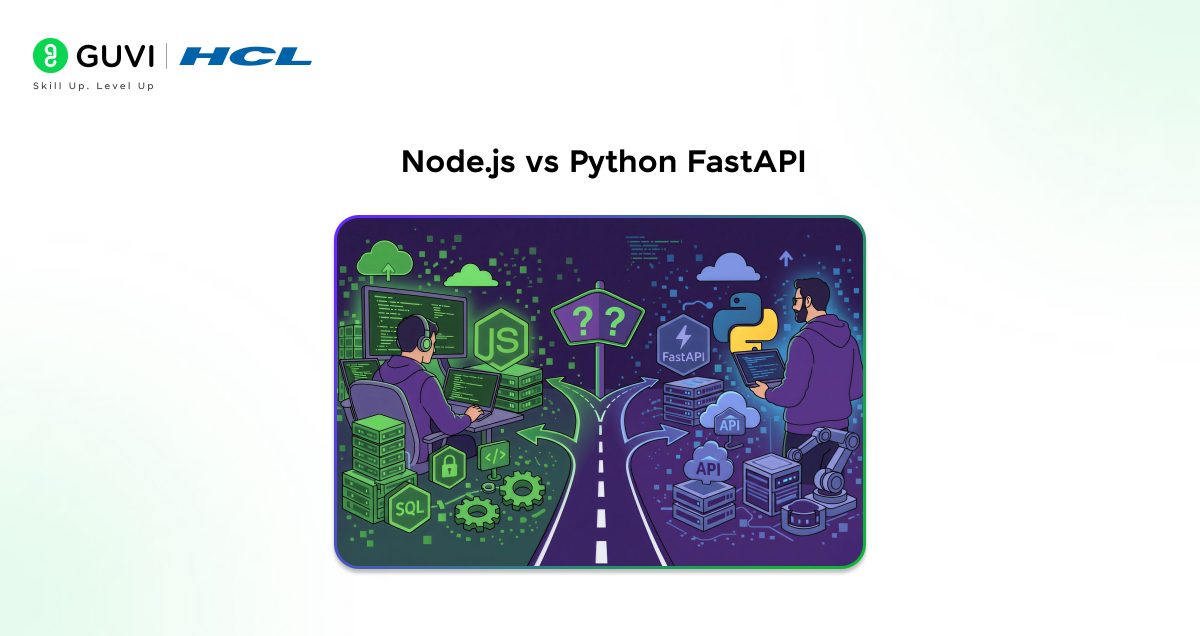
- Node.js vs Python FastAPI: A Backend Developer Comparison Before You Make the Switch
- Runtime Model and Execution Behavior
- Performance Characteristics
- Language and Type System
- API Design and Validation
- Documentation and Developer Experience
- Ecosystem Alignment and Use Cases
- Scalability and Architecture Patterns
- Node.js vs Python FastAPI: Key Backend Differences at a Glance
- Node.js vs FastAPI Salary Comparison in India (2026)
- Career Impact: Does the Node.js to FastAPI Move Actually Increase Your Market Value?
- Python Backend Demand Is Rising Behind the Node.js to FastAPI Trend
- FastAPI Signals Higher-Responsibility Roles Post Node.js to FastAPI
- Node.js to FastAPI Multi-Stack Engineers Reduce Hiring Risk
- The Node.js to FastAPI Salary Gap Pulls Ahead at Senior Level
- When the Node.js to FastAPI Upskilling Move Makes Strategic Sense
- When Skipping the Node.js to FastAPI Move Still Makes Sense
- Best Node.js to FastAPI Upskilling Path for Indian Developers (2026)
- Learning Path: How to Make the Node.js to FastAPI Transition Step by Step
- Concepts You Already Know for the Node.js to FastAPI Transition
- New Skills to Focus On for Node.js to FastAPI
- Suggested Node.js to FastAPI Learning Timeline
- Common Myths About the Node.js to FastAPI Switch
- Final Verdict
- FAQs
- Can Node.js and FastAPI coexist in the same backend architecture?
- Does learning FastAPI require deep Python expertise upfront?
- Will FastAPI replace Node.js roles in the backend job market?
TL;DR Summary
- Node.js to FastAPI is an expansion of backend capability, not a replacement of your existing skills.
- Node.js remains the stronger choice for real-time, I/O-heavy, and JavaScript-centric systems.
- FastAPI pulls ahead for data-driven, AI-integrated, and validation-critical APIs.
- Salaries are comparable at entry and mid-level; Python pulls ahead at senior levels, especially with AI/ML specialization.
- A focused Node.js to FastAPI transition takes about 4 weeks for developers who already know backend fundamentals.
- Over 45% of AI and ML teams using Python prefer FastAPI for its speed and async-first design.
- Companies like Uber, Netflix, and Microsoft use FastAPI for high-performance backend services.
- With 95,000+ GitHub stars, FastAPI is one of the most loved backend frameworks today.
Why Are Backend Developers Rethinking Single-Stack Careers?
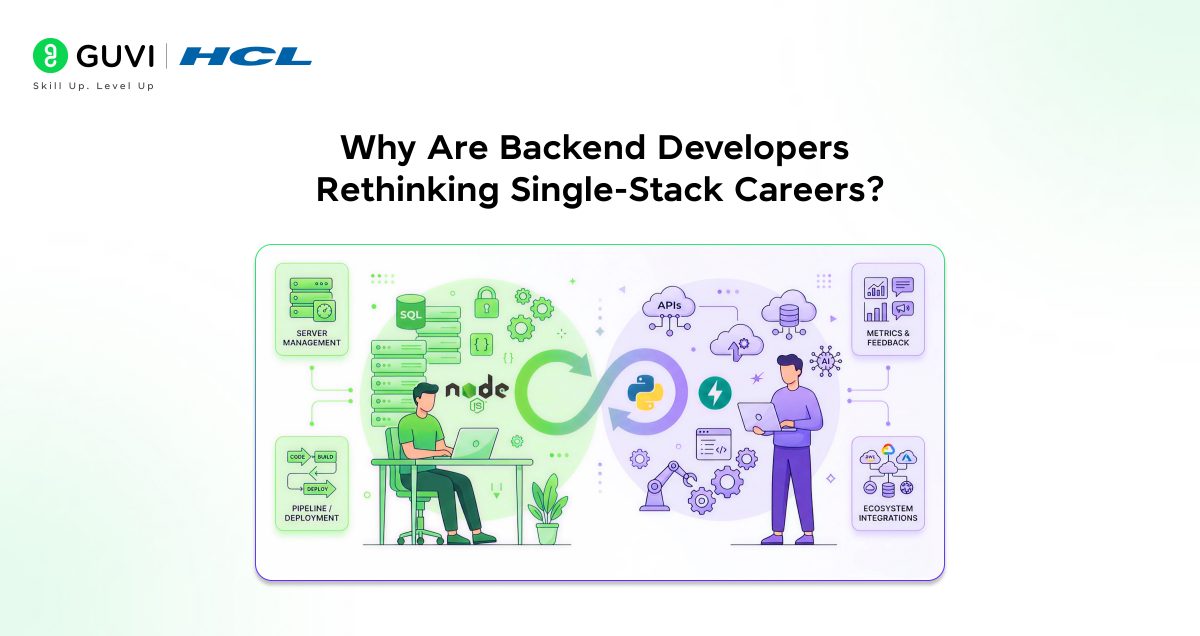
Backend development and engineering has moved from framework loyalty to problem-driven stack selection as systems now demand different runtimes for different workloads. This shift has increased demand for polyglot backend engineers who evaluate latency, data volume, and execution patterns before choosing a stack.
Backend roles increasingly intersect with AI and ML pipelines, data engineering workflows, and high-performance APIs that handle computation-heavy tasks.
Relying only on Node.js can limit long-term opportunities because many emerging backend systems extend beyond I/O orchestration into data processing and model-serving domains where Python-based stacks dominate.
Node.js Backend Development: Strengths and Limitations
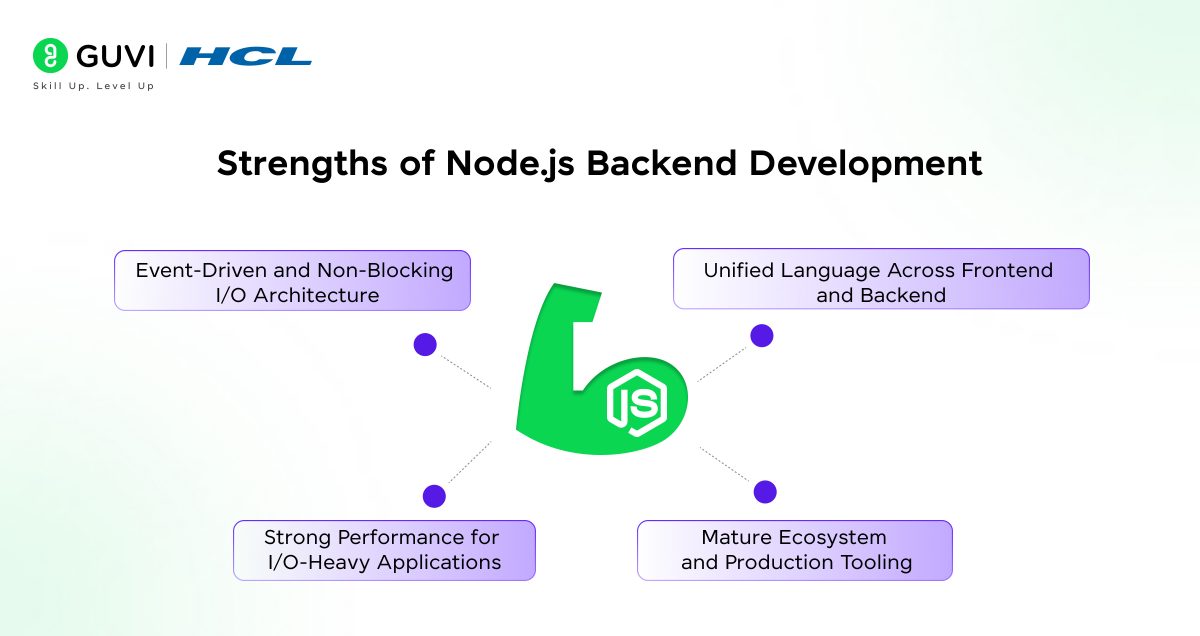
1. Event-Driven and Non-Blocking I/O Architecture
Node.js is built on a single-threaded, event-driven architecture that processes I/O operations asynchronously. This design allows the runtime to handle thousands of concurrent connections without blocking the main execution thread. Network calls, file system access, and database queries are delegated to the event loop, which improves throughput under high concurrency. Backend development systems that rely on frequent I/O operations benefit from predictable latency and efficient resource utilization.
2. Strong Performance for I/O-Heavy Applications
Node.js uses the V8 JavaScript engine, which compiles JavaScript directly into optimized machine code. This compilation model reduces execution overhead and improves response times for API workloads dominated by network communication.
API gateways, real-time dashboards, and streaming services perform efficiently because requests are processed quickly while waiting operations remain non-blocking.
3. Unified Language Across Frontend and Backend
Node.js allows JavaScript to run consistently across client and server layers. Development teams benefit from shared data models, validation logic, and utility libraries across the full stack. Knowledge transfer between frontend and backend roles becomes easier, which reduces onboarding time and collaboration friction.
4. Mature Ecosystem and Production Tooling
The Node.js ecosystem provides a wide range of battle-tested libraries and frameworks such as Express, NestJS, and Fastify. Package management through npm simplifies dependency control and versioning. Enterprise systems rely on this ecosystem to ship features quickly while maintaining operational stability.
Limitations
- CPU-intensive workloads block the single event loop, which can degrade performance for tasks such as data aggregation, encryption, or complex numerical computation
- Asynchronous code patterns increase cognitive load in large codebases; promise chains and callback flows make debugging harder as execution paths deepen
- Memory consumption rises under heavy concurrency because each request holds context until completion, which stresses long-running services
- Type safety depends heavily on TypeScript discipline; runtime errors still surface when contracts are weak or validation layers are incomplete
Thinking of moving from Node.js to Python and FastAPI? Download HCL GUVI’s Python eBook to build strong Python fundamentals and make your backend upskilling smoother and more confident.
Explore: Building a Future-Proof Backend Career With Python
What Is FastAPI, and Why Is Node.js to FastAPI Such a Common Move?
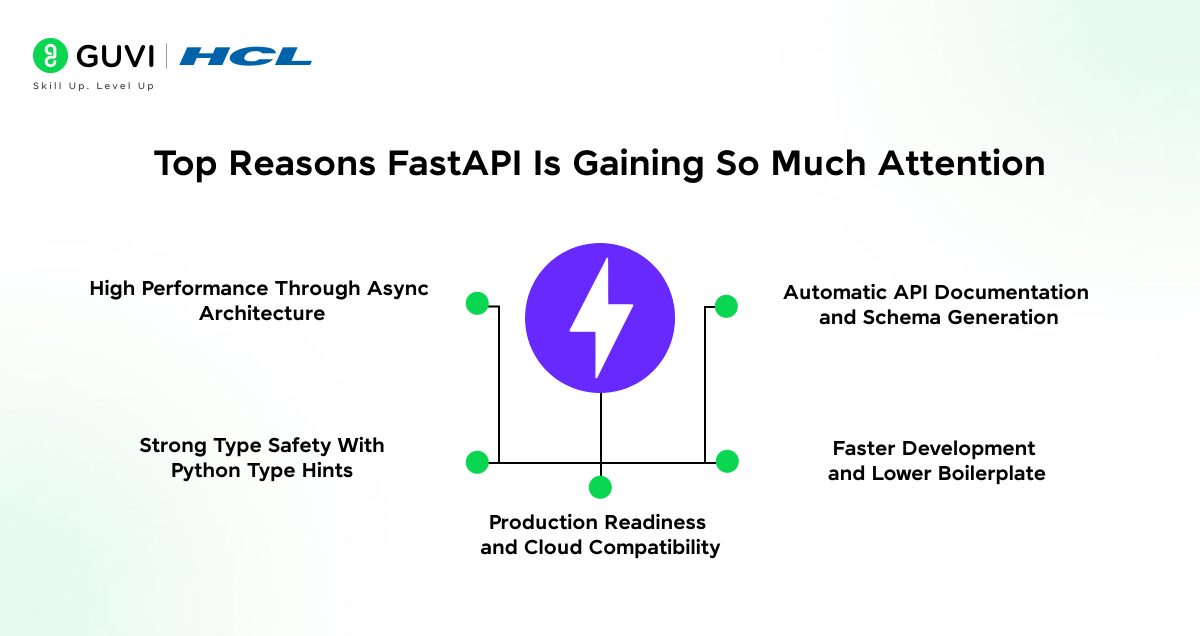
Backend development has moved toward clearer contracts, predictable performance, and tighter alignment with data-driven systems. FastAPI answers these expectations through a modern Python framework designed specifically for building APIs with high reliability and speed.
1. High Performance Through Async Architecture
FastAPI is built on Starlette and uses asynchronous execution to handle concurrent requests efficiently. The framework processes I/O-bound operations without blocking the main execution flow, which improves throughput under load.
Performance benchmarks often place FastAPI close to Node.js and Go for common API workloads.
2. Strong Type Safety With Python Type Hints
FastAPI relies heavily on Python type hints to define request and response schemas. These types are validated at runtime through Pydantic models, which reduces ambiguity between client and server contracts. Backend systems benefit from predictable behavior because invalid data is rejected early in the request lifecycle.
3. Automatic API Documentation and Schema Generation
FastAPI generates OpenAPI specifications automatically based on declared routes and data models. Interactive documentation through Swagger UI and ReDoc stays synchronized with the codebase. Documentation accuracy improves because schema definitions are derived directly from application logic.
4. Faster Development and Lower Boilerplate
FastAPI reduces repetitive code through dependency injection and declarative request handling. Developers define validation rules, authentication logic, and dependencies in a structured manner. Development velocity improves because common backend concerns are handled consistently across endpoints.
5. Production Readiness and Cloud Compatibility
FastAPI works seamlessly with ASGI servers such as Uvicorn and Hypercorn. Containerized deployments integrate cleanly with modern cloud platforms and orchestration systems. Production teams adopt FastAPI confidently because it supports scalable and maintainable architectures.
Node.js vs Python FastAPI: A Backend Developer Comparison Before You Make the Switch
1. Runtime Model and Execution Behavior
Node.js operates on a single-threaded event loop that handles asynchronous tasks through non-blocking I/O. This model performs well when requests spend most of their time waiting on external systems such as databases or network calls.
FastAPI runs on an ASGI-based asynchronous model that supports concurrent request handling with async coroutines, offering clearer separation between sync and async workloads.
2. Performance Characteristics
Node.js delivers strong throughput for I/O-heavy APIs due to the V8 engine and its efficient event loop. FastAPI achieves comparable performance for API workloads by leveraging asynchronous execution and optimized data validation, especially when paired with optimized ASGI servers.
3. Language and Type System
Node.js relies on JavaScript, with TypeScript added to improve type safety during development, though enforcement remains a compile-time feature dependent on disciplined usage.
FastAPI uses Python with first-class type hints enforced at runtime through schema validation, reducing ambiguity and runtime failures during integration.
4. API Design and Validation
Node.js frameworks require explicit middleware and third-party libraries for request validation and schema enforcement, often living separately from route definitions.
FastAPI integrates validation directly into endpoint definitions through Pydantic models, rejecting invalid payloads before business logic executes.
5. Documentation and Developer Experience
Node.js ecosystems rely on manual OpenAPI definitions or external tooling to maintain API documentation. FastAPI generates OpenAPI schemas automatically from code, keeping interactive documentation aligned as routes and models evolve.
6. Ecosystem Alignment and Use Cases
Node.js aligns strongly with real-time systems, event-driven architectures, and full-stack JavaScript teams. FastAPI aligns naturally with data platforms, AI services, and backend systems that integrate analytics or machine learning models.
7. Scalability and Architecture Patterns
Node.js scales effectively through horizontal scaling and stateless service design, commonly using clustering and load balancing. FastAPI scales well in microservice architectures where services remain lightweight and focused, with async execution supporting predictable scaling in distributed systems.
Node.js vs Python FastAPI: Key Backend Differences at a Glance
| Area | Node.js | Python FastAPI |
|---|---|---|
| Execution model | Single-threaded event loop with async I/O | ASGI-based async execution |
| Concurrency | Optimized for high I/O concurrency | Optimized for async I/O workloads |
| API performance | High throughput for network-heavy APIs | Comparable performance with async handling |
| CPU-heavy tasks | Event loop blocking under load | Better isolation through worker patterns |
| Language | JavaScript with optional TypeScript | Python with runtime-enforced type hints |
| Type safety | Compile-time through TypeScript | Runtime validation through Pydantic |
| Request validation | External middleware and libraries | Built into route definitions |
| API documentation | Manual OpenAPI configuration | Auto-generated OpenAPI and Swagger UI |
| Primary use cases | Real-time systems and JS-centric stacks | Data, AI, and API-first backends |
| Scaling pattern | Horizontal scaling with clustering | Horizontal scaling with lightweight services |
| Career positioning | Web and platform-focused roles | Data-oriented and modern backend roles |
Node.js vs FastAPI Salary Comparison in India (2026)
Career impact talk means little without real numbers, so here’s what the Node.js to FastAPI salary data actually shows, pulled from current 2026 sources.
| Experience Level | Node.js (India) | Python/FastAPI Backend (India) | What Drives the Gap |
|---|---|---|---|
| Fresher (0-2 yrs) | ₹3L to ₹6L | ₹4L to ₹9L | Roughly comparable; company type matters more than stack |
| Mid-level (3-5 yrs) | ₹10L to ₹18L | ₹11.5L to ₹18.3L | Close parity; both benefit from cloud and system design skills |
| Senior (5+ yrs) | ₹18L to ₹25L+ | ₹25L to ₹50L+ | Python pulls ahead, especially with AI/ML specialization |
The pattern across multiple sources is consistent: Node.js and FastAPI developers earn similarly at entry and mid-level, but Python-based backend roles pull ahead at the senior level, largely because they’re more often paired with AI, data, and ML-adjacent work that commands its own premium.

Career Impact: Does the Node.js to FastAPI Move Actually Increase Your Market Value?
Yes. The Node.js to FastAPI move genuinely pays off, and here’s exactly why, broken down into the four things actually driving that value up.
1. Python Backend Demand Is Rising Behind the Node.js to FastAPI Trend
Python backend demand continues to grow as many backend systems now extend into analytics, automation, and internal tooling. Companies increasingly prefer backend engineers who can work close to data workflows rather than limiting services to request routing.
2. FastAPI Signals Higher-Responsibility Roles Post Node.js to FastAPI
FastAPI adoption signals a shift toward contract-driven backend development, where APIs expose strongly validated inputs and predictable outputs.
Roles listing FastAPI often align with broader responsibility scopes, including API ownership, service design, and system reliability, not just endpoint maintenance.
3. Node.js to FastAPI Multi-Stack Engineers Reduce Hiring Risk
Employers value engineers who can choose Node.js or Python based on workload constraints rather than personal preference. This is why recruiters increasingly favor Node.js plus Python profiles: the combination supports real-time services, data APIs, and internal platforms without needing a separate hire for each.
4. The Node.js to FastAPI Salary Gap Pulls Ahead at Senior Level
As the salary table above shows, this gap isn’t uniform across experience levels. It’s most pronounced at the senior end, where AI and data-adjacent specialization compounds the base salary premium.
When the Node.js to FastAPI Upskilling Move Makes Strategic Sense
- You work with AI, machine learning, or data pipelines: Backend APIs that serve models or preprocess data align naturally with Python ecosystems, reducing translation layers between data logic and service endpoints.
- You want to move into backend plus data roles: Python allows backend engineers to contribute directly to feature computation, aggregation services, and analytical pipelines without context switching across languages.
- You target startups or global remote roles: Many startups choose Python for backend services due to faster prototyping and broader hiring pools; FastAPI supports rapid iteration while maintaining clear API contracts.
- You prefer cleaner APIs with strong validation and documentation: Schema-driven endpoints reduce ambiguity between producers and consumers, and documentation generated from code improves onboarding speed.
Thinking of moving beyond Node.js into Python and FastAPI for modern backend development? Explore HCL GUVI’s Python Hub to understand core Python concepts, backend-ready patterns, and how Python fits into scalable, API-driven architectures.
When Skipping the Node.js to FastAPI Move Still Makes Sense
- You specialize in real-time systems such as WebSockets and streaming: Event-driven architectures built around persistent connections benefit from Node.js’s mature ecosystem and proven concurrency patterns.
- Your organization relies heavily on a JavaScript-only stack: Shared language usage across frontend and backend improves development speed and reduces coordination overhead.
- Your role focuses on frontend and backend full-stack JavaScript ownership: Product teams building customer-facing platforms often prefer a unified JavaScript workflow for faster feature delivery and tighter UI integration.
Best Node.js to FastAPI Upskilling Path for Indian Developers (2026)
If you’re planning this transition specifically from within India, here’s what actually shapes the smartest path forward.
| Factor in the Node.js to FastAPI Move | What to Know |
|---|---|
| Where demand concentrates | Bengaluru, Hyderabad, and Chennai lead in job volume for Python/FastAPI backend roles, with Bengaluru alone accounting for the largest single share of current openings. Pune, Mumbai, and Delhi follow, and Tier 2 cities are increasingly represented for remote-friendly product companies. |
| Which companies to target | GCCs and AI-first product companies tend to pay the strongest premium for the Node.js plus Python combination, since they’re actively building data and AI-adjacent services that need exactly this hybrid skill set. Fintech and analytics-heavy startups are close behind. |
| Why certifications help | A recognised, project-based Python or FastAPI course tends to clear resume filters faster than self-taught familiarity alone, particularly when you’re pivoting from a different primary stack. |
Learning Path: How to Make the Node.js to FastAPI Transition Step by Step
1. Concepts You Already Know for the Node.js to FastAPI Transition
- REST APIs: API design principles such as resource-based endpoints, stateless communication, and standard HTTP verbs already transfer directly.
- HTTP lifecycle: Request parsing, response construction, status codes, and headers follow the same lifecycle patterns across frameworks.
- Middleware: Cross-cutting concerns such as logging, request tracing, and authentication hooks exist in both ecosystems.
- Authentication and authorization: Token-based authentication, role checks, and permission layers remain conceptually consistent.
2. New Skills to Focus On for Node.js to FastAPI
- Python async and await: Asynchronous execution in Python relies on coroutines and event loops; understanding how async functions coexist with synchronous code improves performance and avoids blocking behavior.
- Pydantic models: Request and response schemas are defined through typed models, with runtime validation enforcing correctness.
- Dependency injection in FastAPI: Shared logic such as database sessions and authentication context is managed through declarative dependencies, improving testability.
- Background tasks and workers: Long-running operations move outside the request lifecycle through background tasks or worker queues, keeping APIs responsive under load.
3. Suggested Node.js to FastAPI Learning Timeline
- Week 1: Focus on Python syntax, standard libraries, and async execution fundamentals. Practice writing asynchronous functions and understanding event loop behavior.
- Week 2: Learn FastAPI routing, request handling, response models, and automatic documentation generation. Build simple APIs with schema validation.
- Week 3: Add authentication flows, database integration, and error handling patterns. Work with relational or document databases using async drivers.
- Week 4: Build and deploy a production-ready API, including containerization, environment configuration, and basic observability to mirror real-world usage.
For a broader Node.js to FastAPI foundation, also read: From Python Basics to Web Frameworks: Your Beginner Roadmap (2-3 Months)
Common Myths About the Node.js to FastAPI Switch
- “Python is slow”: Modern async frameworks and optimized runtimes deliver strong API performance. Bottlenecks typically come from architecture choices rather than language speed.
- “FastAPI is only for AI projects”: General-purpose APIs, internal services, and public platforms use FastAPI due to its validation model and documentation features.
- “Learning another backend stack wastes time”: Career growth accelerates when engineers expand architectural range beyond a single stack, which is the whole point of the Node.js to FastAPI move. Limiting skills to one runtime narrows long-term opportunity scope.
Thinking of moving from Node.js to Python/FastAPI for faster development and scalable backend systems? Upskill with HCL GUVI’s Python Course and build strong Python fundamentals that power modern APIs, data-driven backends, and production-ready services.
Final Verdict
The Node.js to FastAPI move represents an expansion of backend capability rather than a replacement of existing Node.js expertise. Node.js and FastAPI together create a high-leverage skill set that supports real-time systems as well as data-driven and computation-heavy services.
Backend engineers who complete the Node.js to FastAPI move comfortably, without abandoning either stack, demonstrate architectural range and stronger decision-making, because technology choices align with system requirements rather than framework loyalty.
FAQs
Can Node.js and FastAPI coexist in the same backend architecture?
Yes. Many systems use Node.js for real-time services and edge-facing APIs, while FastAPI handles data-heavy, analytical, or validation-critical services. This separation allows each runtime to operate where it performs best without architectural conflict.
Does learning FastAPI require deep Python expertise upfront?
Core FastAPI usage relies on Python fundamentals, async concepts, and typed models rather than advanced language features. Backend developers can become productive quickly because API design principles remain consistent across stacks.
Will FastAPI replace Node.js roles in the backend job market?
FastAPI expands backend roles rather than displacing Node.js. Companies continue to hire Node.js engineers for real-time and JavaScript-centric systems, while FastAPI roles grow around data platforms and API-first services.
Success Stories

About the Author
Jebasta
I translate the language of data into stories that anyone can understand. As a writer with a data science background, I simplify analytics, AI, and decision-making so beginners and enthusiasts can confidently explore the world of data.
View all posts by Jebasta
Connect with me @


































Did you enjoy this article?