


DevOps Articles
Claude for IT Help Desks: Reducing Ticket Volume
From Beginner to DevOps Engineer: How HCL GUVI Zen Class Helps You Get There

Get In Touch For Details! Request More Information

The Role of DevOps in Full Stack Development: A Complete Guide for 2026
Jul 24, 2026 10 Min Read 14312 Views
(Last Updated)
Software development in 2026 is faster, more distributed, and more complex than ever before. Companies no longer have the luxury of slow release cycles or siloed teams where developers write code and operations teams figure out deployment weeks later. This is exactly why the role of DevOps in full stack development has become one of the most important conversations in modern tech. When DevOps principles are woven into full stack workflows, teams ship better products faster, with fewer incidents and more confidence at every stage.
This guide breaks down the role of DevOps in full stack development from the ground up, covering what DevOps actually changes in a full stack workflow, which tools power modern DevOps pipelines, the best practices every full stack developer needs to follow in 2026, and what career paths and salary expectations look like for those who master this combination. Whether you are a student building your first project or a working developer looking to level up, this blog covers everything you need.
Quick Answer
The role of DevOps in full stack development is to bridge the gap between writing code and running it reliably in production. DevOps brings CI/CD pipelines, automation, containerization, Infrastructure as Code, and monitoring into the full stack workflow, allowing teams to deploy faster, collaborate better, and maintain higher software quality throughout the development lifecycle.
Table of contents
- DevOps Vs Full Stack Development?
- The Role of DevOps in Full Stack Development
- Team Collaboration
- Continuous Integration and Continuous Deployment
- Automation of Repetitive Tasks
- Higher Code Quality Through Automated Testing
- Faster Time to Market
- Security Integration (DevSecOps)
- Scalability and Reliability Through Containerization
- DevOps Best Practices for Full Stack Developers
- Implementing CI/CD Pipelines
- Using Infrastructure as Code (IaC) for Environment Management
- Monitoring, Logging, and Observability
- Version Control Discipline and GitOps
- Top DevOps Tools for Full Stack Development in 2026
- Core Pipeline and Version Control Tools
- Containerization and Orchestration Tools
- Infrastructure as Code Tools
- Monitoring and Observability Tools
- The Role of DevOps in Full Stack Development: Real-World Impact by Team Size
- Solo Developers and Freelancers
- Startups and Small Teams
- Enterprise and Large Teams
- DevOps and Full Stack Developer Salary in India in 2026
- How to Learn DevOps as a Full Stack Developer
- Start With What You Already Use
- Learn Containerization Next
- Add Infrastructure as Code and Cloud
- Build Monitoring Into Everything
- Tips to Excel at the Role of DevOps in Full Stack Development
- 💡 Did You Know?
- Conclusion
- FAQs
- What is the role of DevOps in full stack development and why does it matter?
- Do full stack developers need to learn DevOps in 2026?
- What is the difference between a DevOps engineer and a full stack developer?
- Which DevOps tools are most important for full stack developers to learn first?
- Is DevOps suitable for small teams and startups in full stack development?
DevOps Vs Full Stack Development?
Before diving into the role of DevOps in full stack development, it helps to understand what separates these two disciplines and where they overlap. Many developers confuse the two or assume they are mutually exclusive career tracks.
Full stack development refers to building both the frontend (what users see) and the backend (the server, database, and APIs) of a web application. DevOps refers to the set of practices, tools, and cultural philosophies that automate and integrate the work of software development and IT operations. The table below captures the key differences and important similarities between the two.
| Area | DevOps | Full Stack Development | Similarities |
|---|---|---|---|
| Core Focus | Development pipeline and operations | Frontend and backend feature development | Both involve end-to-end product ownership |
| Primary Tools | Jenkins, Docker, Kubernetes, Terraform, Ansible | HTML, CSS, JavaScript, Node.js, databases, REST APIs | Both require Git for version control |
| Key Practices | CI/CD, IaC, containerization, monitoring | MVC architecture, API design, UI/UX implementation | Both use Agile and Scrum frameworks |
| Ongoing Work | System reliability, deployment automation, performance | Feature development, bug fixes, UI iteration | Both benefit from automation |
| Career Scope | DevOps Engineer, SRE, Cloud Engineer | Frontend, Backend, Full Stack Developer | Both are in high demand in 2026 |
The reality in modern teams is that this line has blurred significantly. Full stack developers are increasingly expected to understand DevOps and infrastructure fundamentals because the same person writing the code is often the one deploying and monitoring it.
The Role of DevOps in Full Stack Development
The role of DevOps in full stack development goes beyond just automating deployments. It touches every stage of how software is built, tested, shipped, and maintained. Here are the seven core areas where DevOps fundamentally changes full stack workflows.
1. Team Collaboration
One of the most significant aspects of the role of DevOps in full stack development is how it dismantles the wall between development and operations teams. Full stack development already requires coordination between frontend developers, backend developers, database administrators, and QA engineers. DevOps adds a cultural layer that makes this collaboration systematic rather than accidental.
- Project management methodologies like Agile and Scrum, which are central to DevOps culture, give every team a shared cadence and visible backlog so no one is working in isolation.
- Shared responsibility for deployments means developers think about how their code will run in production from day one, not after a feature is complete.
- Customer feedback loops built into Agile sprints ensure the product evolves in the right direction without large wasted development cycles.
2. Continuous Integration and Continuous Deployment
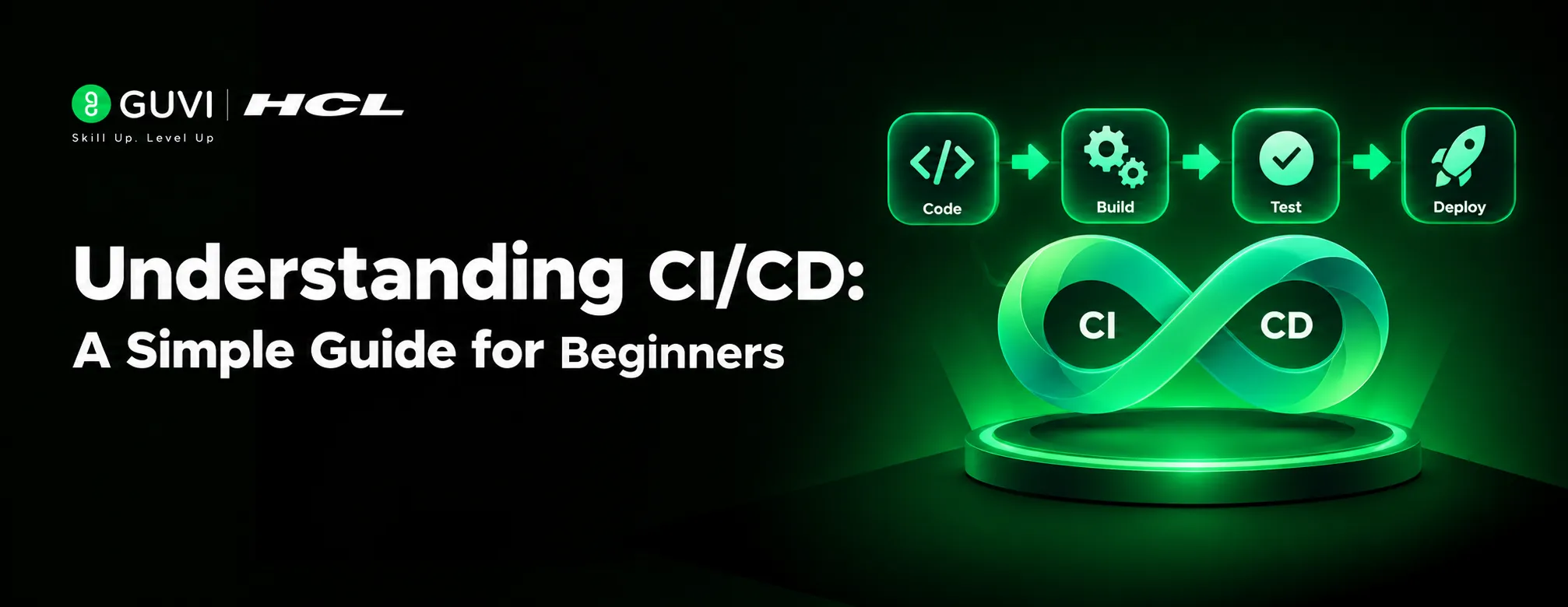
CI/CD pipelines are the backbone of the role of DevOps in full stack development. Continuous Integration means every code change is automatically built and tested as soon as a developer pushes it to the repository. Continuous Deployment means that once code passes all tests, it can be automatically deployed to staging or production without manual intervention.
This matters enormously for full stack projects because both the frontend and backend need to be tested together, and any breaking change in one layer can silently break the other. CI/CD pipelines catch these issues within minutes rather than weeks.
- DevOps tools like Jenkins, GitLab CI, and GitHub Actions trigger automated builds and tests on every commit, catching regressions before they ever reach a user.
- Faster feedback cycles mean developers spend more time building features and less time hunting down bugs introduced by someone else weeks ago.
- Deployment strategies like blue-green deployments and canary releases, both standard in DevOps pipelines, reduce downtime and allow risky releases to be rolled back instantly.
3. Automation of Repetitive Tasks
Automation is at the heart of the role of DevOps in full stack development. Without automation, full stack teams spend significant time on work that adds no direct user value: provisioning environments, running manual tests, copying files, sending deployment notifications, and resetting configurations. DevOps replaces all of this with scripts and pipelines that run reliably every time.
- Automated testing covers unit tests, integration tests, and end-to-end tests for both the frontend and backend, giving developers confidence that a change does not break existing functionality.
- Environment provisioning through tools like Terraform and Ansible means spinning up a replica of production takes minutes instead of days.
- Automated notifications and rollback triggers ensure that if a deployment fails, the team is alerted immediately and the system can revert to the last stable state without human intervention.
4. Higher Code Quality Through Automated Testing
Automated testing is a direct output of DevOps tooling and one of the clearest ways the role of DevOps in full stack development improves the product itself. When tests run on every commit, code quality becomes a continuous concern rather than something checked at the end of a sprint.
Full stack applications are especially vulnerable to bugs that appear at the boundary between the frontend and backend: an API response format that changes slightly, a database query that returns null unexpectedly, or a state management edge case in the UI. DevOps-driven test automation covers all of these layers and flags problems before they reach production.
- Unit tests verify individual functions and components in isolation on both the frontend and backend.
- Integration tests verify that different parts of the full stack communicate correctly, including API calls, authentication flows, and database reads and writes.
- End-to-end tests simulate real user interactions in a browser and validate that the entire application works as expected from the user’s perspective.
5. Faster Time to Market
By implementing CI/CD pipelines, full stack development projects can move from concept to production much quicker. This is one of the most commercially valuable aspects of the role of DevOps in full stack development. In competitive markets, the team that ships a working feature first often wins, and DevOps practices are specifically designed to compress the time between writing code and putting it in front of users.
Automation removes manual delays, parallel testing reduces wait times, and Infrastructure as Code eliminates the slow back-and-forth with operations teams for environment setup. The result is a development cycle that is measured in hours and days rather than weeks and months.
Interested in starting your career as a DevOps engineer? Enroll in HCL Guvi’s FREE E-book on DevOps for Beginners – A step by step guide. This provides you with a detailed overview of the important features of DevOps such as version control, CI/CD, Infrastructure as Code (IaC), Automation, Containerization, Orchestration, monitoring and many more.
6. Security Integration (DevSecOps)
In 2026, the role of DevOps in full stack development increasingly includes security as a first-class concern. DevSecOps is the practice of embedding security checks directly into the CI/CD pipeline rather than treating security as a final gate before release. For full stack developers, this means vulnerabilities in npm packages, exposed API keys, insecure database configurations, and authentication flaws are caught automatically during the build process.
- Static Application Security Testing (SAST) tools scan source code for known vulnerability patterns on every commit.
- Dependency scanning tools like Snyk or Dependabot flag outdated or vulnerable packages in both frontend and backend dependency trees.
- Secrets management tools like HashiCorp Vault and AWS Secrets Manager ensure that API keys, database passwords, and tokens are never hardcoded into the codebase.
7. Scalability and Reliability Through Containerization
Containerization is one of the most transformative aspects of the role of DevOps in full stack development. Docker allows developers to package a full stack application and all its dependencies into a portable container that runs identically in development, testing, and production. Kubernetes then manages these containers at scale, handling traffic spikes, rolling updates, and automatic restarts without manual involvement.
- Containers eliminate environment inconsistency, the classic situation where code works on a developer’s laptop but fails in production because of a library version difference.
- Kubernetes orchestration allows a full stack application to scale horizontally when user traffic increases and scale down automatically when traffic drops, controlling infrastructure costs.
- Microservices architecture, which is closely tied to containerization, allows different parts of a full stack application to be deployed, scaled, and updated independently, reducing the blast radius of any single failure.
DevOps Best Practices for Full Stack Developers
The role of DevOps in full stack development is most effectively realized when developers actively adopt these practices in their daily work. Knowing the theory is not enough. Here is what implementing DevOps looks like in practice for a full stack team.
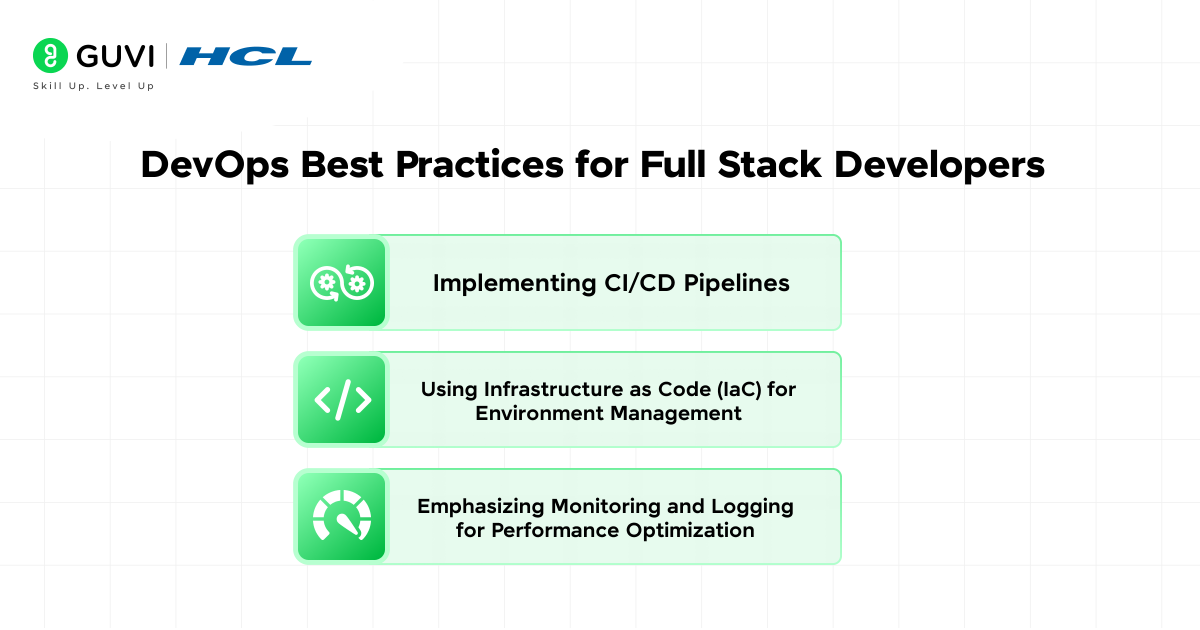
Here’s a closer look at some of the DevOps best practices for Full Stack Developers:
1. Implementing CI/CD Pipelines
Setting up a CI/CD pipeline is the foundational step every full stack developer should take when starting a new project. Integrating your pipeline with a version control system like Git ensures that every push to the main branch triggers an automatic build, runs the full test suite, and either deploys the code or reports exactly what failed.
- Connect the pipeline to Git repositories using tools like GitHub Actions, GitLab CI, or Jenkins so that builds trigger automatically on every commit or pull request.
- Include automated unit, integration, and end-to-end tests in the pipeline. A build that passes without running tests offers no protection against regressions.
- Use deployment strategies such as blue-green deployments or canary releases for production pushes so that a failing release can be rolled back within seconds rather than requiring a hotfix cycle.
Find Out More About Continuous Integration vs Continuous Deployment in DevOps (A Comprehensive Guide)
2. Using Infrastructure as Code (IaC) for Environment Management
Infrastructure as Code means treating your server configurations, cloud resources, and environment setups the same way you treat application code: version-controlled, reviewed, and automated. This is a core part of the role of DevOps in full stack development because it guarantees that every developer on the team works in an environment that exactly mirrors production.
- Store all IaC configurations in the same Git repository as your application code so that environment changes go through the same review and approval process as feature changes.
- Use tools like Terraform for provisioning cloud infrastructure and Ansible for configuring the software running on those machines. Both are industry standard in 2026 and covered in HCL GUVI’s DevOps career roadmap.
- Automate the teardown of staging environments after testing completes to avoid unnecessary cloud costs, which is a real concern for startups and lean engineering teams.
3. Monitoring, Logging, and Observability
Deploying code is only half the job. The role of DevOps in full stack development also demands that teams know exactly what is happening in their applications after they go live. Monitoring and logging give you the visibility to catch performance issues, user-facing errors, and infrastructure anomalies before they become outages.
- Use Prometheus and Grafana together to track application performance metrics like response time, error rate, and throughput in real time. These are open-source and widely adopted across the industry.
- Implement centralized logging with the ELK Stack (Elasticsearch, Logstash, Kibana) or an equivalent like Datadog to aggregate logs from every component of the full stack in one searchable place.
- Configure alerting thresholds so that on-call developers are notified immediately when error rates spike, latency increases, or a service goes down, rather than finding out from a user complaint.
4. Version Control Discipline and GitOps
Every full stack developer already uses Git, but DevOps introduces a more rigorous version control culture called GitOps, where Git is the single source of truth not just for code but for the entire desired state of the system including infrastructure and configuration. Changes to production happen only through Git commits, not through manual SSH sessions or console clicks.
- Use branching strategies like GitFlow or trunk-based development so the main branch always represents a deployable state of the application.
- Require pull request reviews before merging to protect the main branch and catch both code quality issues and potential security problems before they reach production.
- Tag releases in Git and link them to deployment logs so you always know exactly which version of the code is running in each environment.
By adopting these DevOps best practices, Full Stack Developers can significantly improve the development lifecycle, from initial coding to deployment and beyond, ensuring faster delivery times, higher quality products, and more reliable and maintainable applications.

Kickstart your full-stack development journey by enrolling in HCL GUVI’s certified Full-stack development course that not only teaches you the basics but also gives you practical experience through real-life full-stack development projects
Top DevOps Tools for Full Stack Development in 2026
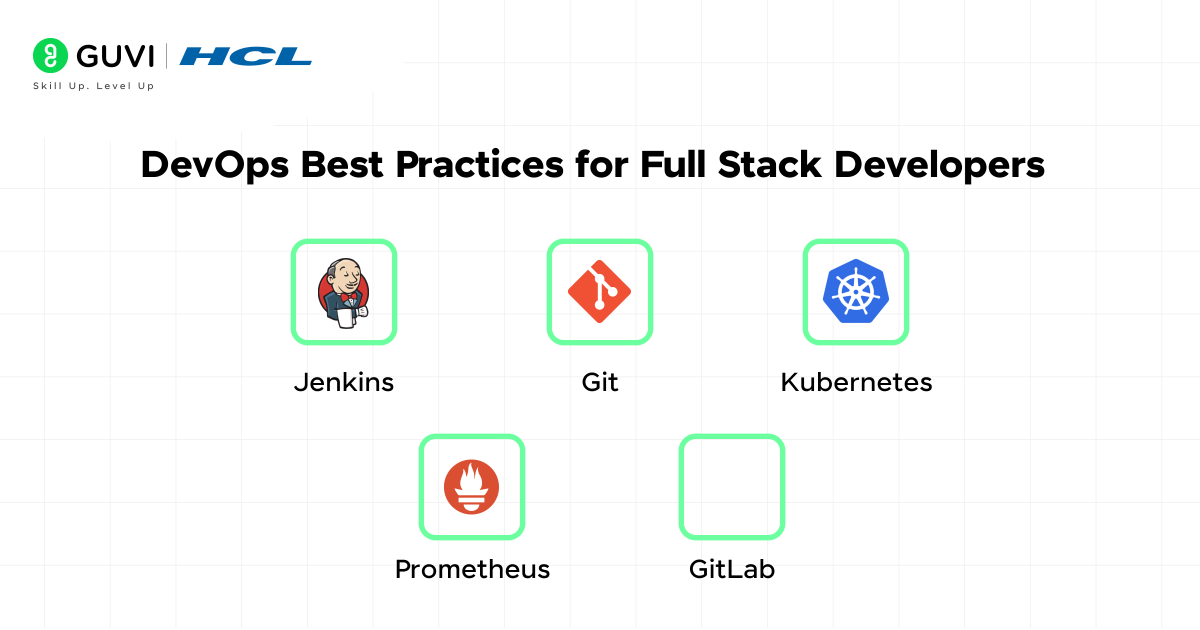
The role of DevOps in full stack development is enabled by a specific set of DevOps tools that every developer in this space should be familiar with. Here is an updated overview of the most important ones.
1. Core Pipeline and Version Control Tools
These tools form the foundation of any DevOps workflow integrated with full stack development. Understanding how they connect is essential.
- Jenkins: An open-source automation server used to build and run CI/CD pipelines. Jenkins integrates with virtually every other DevOps tool and is still the most widely used CI server in enterprise environments in 2026.
- Git and GitLab: Git tracks every change in your codebase across the frontend and backend. GitLab combines a Git repository with a built-in CI/CD engine, issue tracking, container registry, and security scanning in one platform, making it a popular all-in-one choice for full stack DevOps workflows.
- GitHub Actions: A CI/CD platform built directly into GitHub that allows developers to automate build, test, and deployment workflows using YAML configuration files stored in the repository.
2. Containerization and Orchestration Tools
Containers are now a standard part of how full stack applications are deployed and scaled, and these two tools are central to that workflow.
- Docker: Docker packages an application and all its dependencies into a portable container that runs identically regardless of the environment. For full stack developers, this means a Node.js backend and a React frontend can each run in their own container with consistent behavior across every developer’s machine and every deployment environment. HCL GUVI has a dedicated guide on containerization using Docker worth reading alongside this blog.
- Kubernetes: Kubernetes manages Docker containers at scale, handling deployment, auto-scaling, load balancing, and self-healing (automatically restarting failed containers). For full stack applications running as microservices, Kubernetes is the standard orchestration layer in production environments.
3. Infrastructure as Code Tools
- Terraform: An open-source tool that lets you define cloud infrastructure (servers, networks, storage, load balancers) in code and provision it automatically across AWS, Azure, or Google Cloud.
- Ansible: A configuration management tool that automates software installation and configuration on servers. Ansible is widely used alongside Terraform: Terraform provisions the infrastructure, and Ansible configures the software running on it.
4. Monitoring and Observability Tools
- Prometheus: An open-source monitoring tool that collects and stores metrics from applications and infrastructure. It is the standard time-series database used in cloud-native monitoring stacks.
- Grafana: A visualization platform that connects to Prometheus (and many other data sources) to display dashboards showing application health, performance trends, and infrastructure utilization in real time.
- ELK Stack: Elasticsearch, Logstash, and Kibana together form the most widely used centralized logging solution. Logstash collects and transforms logs, Elasticsearch indexes and stores them, and Kibana provides a visual interface for searching and analyzing log data.
The Role of DevOps in Full Stack Development: Real-World Impact by Team Size
One of the most common questions about the role of DevOps in full stack development is whether it only applies to large engineering teams. The answer is no. DevOps principles scale down to small teams and solo developers just as effectively.
1. Solo Developers and Freelancers
A single developer building a full stack SaaS product benefits enormously from DevOps practices. Setting up a GitHub Actions pipeline that automatically runs tests and deploys to a cloud provider like AWS or Vercel on every push takes a few hours to configure and saves hundreds of hours over the lifetime of a project. Using Docker means the developer never has to debug environment-specific issues. Terraform means infrastructure can be recreated in minutes if something goes wrong.
2. Startups and Small Teams
Small teams of two to ten developers benefit most visibly from the role of DevOps in full stack development. CI/CD prevents the all-too-common situation where one developer’s unreviewed code breaks the main branch the day before a product demo. Infrastructure as Code means a new engineer can onboard and run the full application locally on their first day. Monitoring means the team knows about production issues before customers report them in live chat.
3. Enterprise and Large Teams
At scale, the role of DevOps in full stack development becomes critical for reliability. Large applications with dozens of microservices, hundreds of daily deployments, and millions of users require Kubernetes orchestration, advanced GitOps workflows, service mesh tools like Istio, and comprehensive observability stacks just to maintain acceptable uptime and deployment velocity.
DevOps and Full Stack Developer Salary in India in 2026
Knowing the salary landscape helps you understand the career value of adding DevOps skills to a full stack background. Developers who combine full stack knowledge with DevOps practices consistently command higher packages than those who focus on only one side. The data below is sourced from Glassdoor and AmbitionBox.
| Role | Average Annual Salary (India) | Source |
|---|---|---|
| Full Stack Developer (all levels) | ₹7,20,000 | Glassdoor |
| DevOps Engineer (all levels) | ₹7,00,000 | Glassdoor |
| Senior DevOps Engineer | ₹14,00,000 | Glassdoor |
| DevOps Engineer (India avg) | ₹9,00,000 | AmbitionBox |
| Full Stack + DevOps (cloud-skilled) | ₹12,00,000 to ₹20,00,000+ | Glassdoor / AmbitionBox |
Professionals who master both full stack development and DevOps practices, particularly those with cloud certifications (AWS, Azure, or GCP), consistently land in the higher salary brackets. HCL GUVI’s dedicated guide on career opportunities for DevOps engineers covers this in more detail including city-wise breakdowns and role-wise growth paths.
How to Learn DevOps as a Full Stack Developer
Understanding the role of DevOps in full stack development is one thing. Building the skills to practise it is another. Here is a realistic learning path for full stack developers who want to integrate DevOps into their workflow.
1. Start With What You Already Use
Most full stack developers already use Git. The next step is to go deeper into Git workflows and set up a basic CI/CD pipeline using GitHub Actions or GitLab CI. This alone will make an immediate difference in how you work and is the foundation everything else builds on.
2. Learn Containerization Next
Docker is the single most impactful DevOps skill a full stack developer can add after CI/CD. Once you can containerize your application, you unlock a large part of what makes modern DevOps workflows function. Kubernetes comes after Docker and adds orchestration, auto-scaling, and production-grade deployment capabilities.
3. Add Infrastructure as Code and Cloud
Terraform and a cloud platform (AWS is the most widely used) are the next layer. Being able to define and provision your own cloud infrastructure in code is what separates a developer who deploys on managed hosting from one who owns the full production stack. HCL GUVI’s skills required to become a DevOps engineer guide covers this progression in detail.
4. Build Monitoring Into Everything
Prometheus, Grafana, and centralized logging should go into every project you build from this point forward. The habit of making your applications observable from day one is what distinguishes senior developers from junior ones in production environments.
Tips to Excel at the Role of DevOps in Full Stack Development
The following tips come directly from what top-performing full stack DevOps developers do differently in real teams.
- Treat your pipeline like production code. A broken CI/CD pipeline blocks the entire team. Write pipeline configurations carefully, test them on branches before merging, and document what each stage does so the whole team can maintain it.
- Never hardcode secrets. API keys, database credentials, and tokens must live in a secrets manager, not in code. A single accidental commit of a secret to a public repository can compromise an entire application.
- Automate environment teardown, not just creation. It is easy to remember to spin up a staging environment. It is just as important to tear it down automatically after testing completes so cloud costs do not accumulate unnoticed.
- Learn to read logs before you need them. Developers who build logging into their applications from the start and regularly review logs in staging are far better equipped to diagnose production incidents quickly.
- Follow the future and scope of DevOps to stay current. GitOps, platform engineering, AI-assisted pipeline optimization, and eBPF-based observability are the directions DevOps is moving in 2026 and beyond.
💡 Did You Know?
- The DevOps tools market is projected to reach USD 40.91 billion by 2026, with AIOps and MLOps becoming key drivers of automation and machine learning operations.
- Docker has achieved 42.77% adoption among developers worldwide, making containerization one of the most valuable DevOps skills in modern full stack development.
- According to the DORA report, high-performing DevOps teams deploy code 973 times more frequently and recover from failures 6,570 times faster than low-performing teams, while GitOps has become a standard practice at companies like Google, Spotify, and Shopify.
Conclusion
The role of DevOps in full stack development is no longer optional knowledge for developers who want to stay competitive in 2026. Companies are hiring for the overlap, and developers who can write code AND own the deployment pipeline AND monitor the system they built are the ones landing the highest-paying roles
By embracing these practices, developers, and organizations can stay ahead in the competitive tech industry, delivering innovative, high-quality software solutions at a pace that meets the ever-increasing demands of users and markets around the world.
FAQs
1. What is the role of DevOps in full stack development and why does it matter?
The role of DevOps in full stack development is to connect the process of writing code with the process of running it reliably in production. DevOps brings CI/CD, automation, containerization, monitoring, and Infrastructure as Code into the full stack workflow so teams can ship software faster, with fewer bugs, and with greater confidence at every stage of the lifecycle.
2. Do full stack developers need to learn DevOps in 2026?
Yes. The role of DevOps in full stack development has made DevOps skills a practical requirement rather than a bonus in most modern engineering teams. Companies increasingly expect full stack developers to understand CI/CD pipelines, Docker, cloud deployment, and monitoring as part of the core job, not just as optional extras.
3. What is the difference between a DevOps engineer and a full stack developer?
A full stack developer writes the frontend and backend code that makes an application work. A DevOps engineer builds and maintains the pipelines, infrastructure, and automation that deploys and monitors that application. The role of DevOps in full stack development is to bring these two responsibilities closer together, and many modern teams expect full stack developers to handle both.
4. Which DevOps tools are most important for full stack developers to learn first?
Start with Git and CI/CD pipelines using GitHub Actions or GitLab CI, then move to Docker for containerization. After that, add Terraform for Infrastructure as Code and Prometheus plus Grafana for monitoring. This sequence gives you the most practical coverage of the role of DevOps in full stack development in the shortest time.
5. Is DevOps suitable for small teams and startups in full stack development?
Absolutely. The role of DevOps in full stack development scales to any team size. A solo developer or a two-person startup benefits just as much from automated testing, CI/CD, and Docker as a large enterprise does, and the tools required are either free or very low cost at that scale.
Success Stories

About the Author
Jebasta
I translate the language of data into stories that anyone can understand. As a writer with a data science background, I simplify analytics, AI, and decision-making so beginners and enthusiasts can confidently explore the world of data.
View all posts by Jebasta
Connect with me @























Did you enjoy this article?