


Artificial Intelligence and Machine Learning Articles
AI/ML Skills Gap 2026: Why Companies Can't Find Job-Ready Talent
20 AI/ML Interview Questions Recruiters Can Use Without a Tech Background - Best Guide
How Industry-Backed AI/ML Bootcamps Are Changing the AI/ML Hiring Pipeline - Best Guide 2026
From IT Support to AI Engineer: A Realistic Career Switch Guide 2026


Get In Touch For Details! Request More Information

Testing and Evaluating Claude Prompt Performance
Aug 07, 2026 3 Min Read 350 Views
(Last Updated)
Testing and evaluating Claude prompt performance is essential for building accurate, reliable, and production-ready Artificial Intelligence applications. By systematically assessing prompt quality, developers can improve response accuracy, consistency, and safety while reducing hallucinations.
Table of contents
- TL;DR
- Direct Answer Box
- Why Is Prompt Evaluation Important?
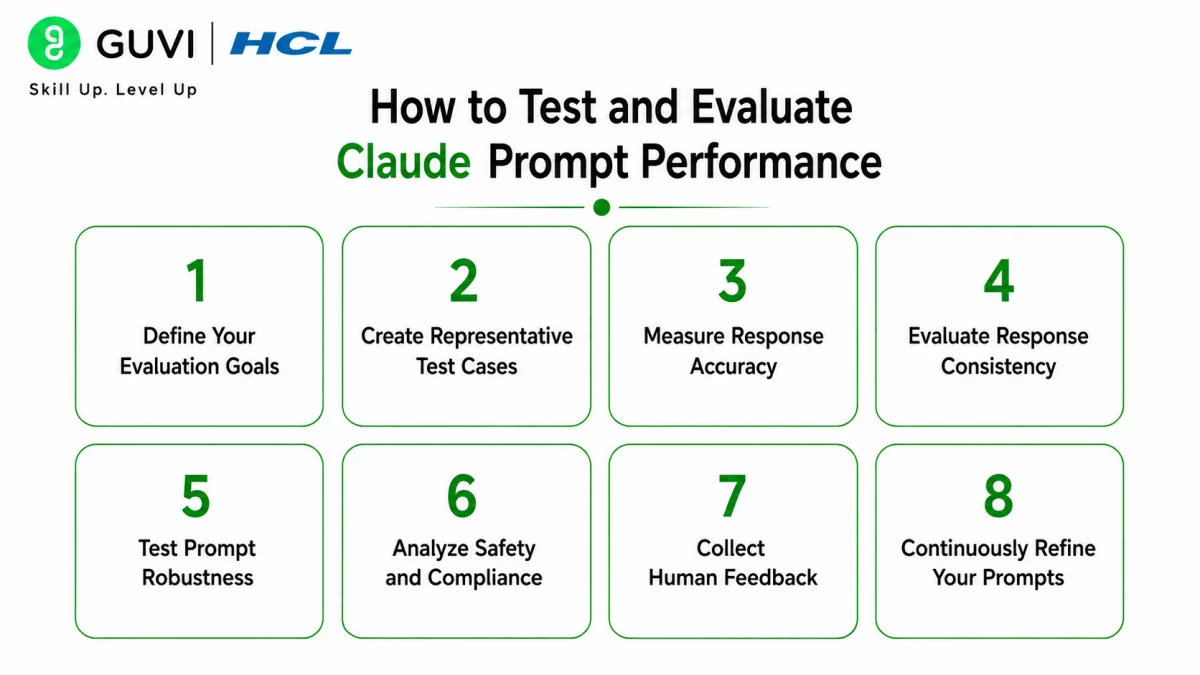
- How to Test and Evaluate Claude Prompt Performance
- Step 1: Define Your Evaluation Goals
- Step 2: Create Representative Test Cases
- Step 3: Measure Response Accuracy
- Step 4: Evaluate Response Consistency
- Step 5: Test Prompt Robustness
- Step 6: Analyze Safety and Compliance
- Step 7: Collect Human Feedback
- Step 8: Continuously Refine Your Prompts
- Claude Prompt Evaluation Tasks You Can Automate
- Tasks Claude Should Not Replace
- Best Practices for Testing and Evaluating Claude Prompt Performance
- Conclusion
- FAQs
- What is Claude's prompt evaluation?
- Why is prompt evaluation important?
- How do developers evaluate Claude prompts?
- What metrics are commonly used to evaluate prompts?
- Can Claude automatically improve prompts?
- How often should prompts be evaluated?
- What are the best practices for testing Claude prompt performance?
TL;DR
- Prompt evaluation measures how effectively Claude responds to different inputs.
- Testing helps improve response accuracy, consistency, and reliability.
- Developers should use realistic test cases, performance metrics, and human feedback.
- Continuous prompt refinement reduces hallucinations and improves AI quality.
- Prompt evaluation is essential for production-ready Artificial Intelligence applications.
📚Data Point: Prompt evaluation has become a standard practice in Generative AI development. Organizations use automated benchmarks and human reviewers to assess response quality, factual accuracy, safety, and instruction following before deploying AI applications.
Source: Anthropic Documentation
Direct Answer Box
| Testing and evaluating Claude prompt performance is the process of measuring how well prompts generate accurate, relevant, consistent, and safe responses. Developers use structured testing, performance metrics, and continuous refinement to optimize prompt quality and improve the reliability of AI applications. |
Why Is Prompt Evaluation Important?
Even carefully designed prompts may perform differently when users phrase questions in unexpected ways. Regular evaluation helps identify weaknesses, improve response quality, and ensure Claude performs reliably across real-world scenarios.
Some key benefits include:
- Improving response accuracy
- Reducing hallucinations
- Increasing consistency
- Identifying prompt weaknesses
- Enhancing user experience
- Supporting responsible AI development
- Optimizing prompt engineering workflows
- Improving production reliability
How to Test and Evaluate Claude Prompt Performance
Step 1: Define Your Evaluation Goals
Start by identifying what your prompt should achieve. Depending on your application, your priorities may include factual accuracy, reasoning, creativity, instruction following, or safety. Clear goals make evaluation more focused and measurable.
Step 2: Create Representative Test Cases
Build a diverse set of prompts that reflects real user interactions. Include common questions alongside edge cases to understand how Claude performs across different situations.
Your test set should include:
- Simple prompts
- Multi-step instructions
- Ambiguous queries
- Long-context inputs
- Domain-specific questions
- Safety-related scenarios
Step 3: Measure Response Accuracy
Review whether Claude provides correct, complete, and relevant responses. Compare outputs against trusted references or expected answers to verify factual accuracy and instruction adherence.
Evaluate responses based on:
- Accuracy
- Completeness
- Relevance
- Logical reasoning
- Instruction following
Step 4: Evaluate Response Consistency
Run identical prompts multiple times to determine whether Claude delivers stable and reliable responses. While wording may vary, important facts and conclusions should remain consistent.
Focus on:
- Consistent facts
- Stable reasoning
- Reliable formatting
- Predictable output quality
Step 5: Test Prompt Robustness
Evaluate how Claude responds when prompts are reworded or contain spelling mistakes, incomplete instructions, or unexpected variations. Robust prompts should perform well across different input styles.
Examples include:
- Typographical errors
- Rephrased prompts
- Short inputs
- Long prompts
- Follow-up questions
Step 6: Analyze Safety and Compliance
Verify that Claude responds responsibly to sensitive or potentially harmful requests. Review outputs for policy compliance, privacy protection, bias reduction, and appropriate handling of uncertain information.
Check for:
- Safe responses
- Policy compliance
- Privacy protection
- Bias reduction
- Responsible uncertainty
Step 7: Collect Human Feedback
Combine automated evaluation with human review to assess clarity, usefulness, tone, and overall response quality. Feedback from developers, domain experts, or end users often reveals issues that automated metrics can miss.
Review factors such as:
- Readability
- Helpfulness
- Natural language quality
- User satisfaction
- Overall usefulness
Step 8: Continuously Refine Your Prompts
Prompt evaluation is an ongoing process rather than a one-time task. Review evaluation results regularly and refine prompts based on user feedback, testing outcomes, and changing requirements. Even small improvements to wording, examples, or instructions can significantly improve response quality.
Continue monitoring metrics such as accuracy, relevance, consistency, and safety to keep your AI application performing reliably. Professionals looking to master prompt engineering, AI evaluation, and production-ready AI systems can strengthen these skills through HCL GUVI’s Artificial Intelligence and Machine Learning Course.
Many organizations evaluate hundreds or even thousands of prompts before deploying AI applications. They combine automated benchmarks with human reviews to measure response quality, detect hallucinations, and compare different prompt versions, helping build more reliable and trustworthy AI systems.

Claude Prompt Evaluation Tasks You Can Automate
Claude can assist developers throughout the prompt evaluation and optimization process.
It can help with:
- Generating evaluation datasets
- Comparing prompt versions
- Reviewing response quality
- Identifying inconsistent outputs
- Detecting hallucinations
- Measuring prompt performance
- Summarizing evaluation results
- Suggesting prompt improvements
- Creating benchmark questions
- Automating regression testing
- Documenting evaluation findings
- Streamlining prompt engineering workflows
The HCL GUVI’s Artificial Intelligence eBook is an excellent starting point for learning practical Artificial Intelligence concepts, prompt engineering techniques, evaluation strategies, and real-world business applications. It helps learners understand how developers optimize prompts to build accurate, reliable, and production-ready AI systems.
Tasks Claude Should Not Replace
Claude is a valuable assistant for prompt evaluation, but certain responsibilities should remain with developers and business stakeholders.
Claude should not replace:
- Final evaluation decisions
- Human quality assurance
- Security assessments
- Regulatory compliance reviews
- Business requirement validation
- Risk assessment
- Ethical decision-making
- Production deployment approvals
- Performance acceptance testing
While Claude can evaluate responses, compare prompt variations, and recommend improvements, humans should make the final decisions regarding production readiness, compliance, and business-critical AI systems.
⚠️ Warning: Prompt evaluation improves AI performance but does not eliminate every error. Claude may still generate inaccurate, incomplete, or misleading responses under certain conditions. Always validate AI-generated outputs, monitor production performance, and continue refining prompts to maintain reliable and trustworthy Artificial Intelligence applications.
Best Practices for Testing and Evaluating Claude Prompt Performance
Follow these best practices to improve prompt evaluation results:
- Define clear evaluation objectives.
- Test prompts using diverse scenarios.
- Include real-world and edge-case inputs.
- Measure accuracy, consistency, and relevance.
- Collect human feedback alongside automated metrics.
- Monitor prompt performance regularly.
- Refine prompts based on evaluation results.
- Validate AI-generated responses before deployment.
- Treat prompt evaluation as a continuous improvement process.
Conclusion
Testing and evaluating Claude’s prompt performance is essential for building accurate, consistent, and trustworthy Artificial Intelligence applications. By using structured evaluation methods, realistic test cases, and continuous prompt refinement, developers can improve response quality while reducing hallucinations and inconsistencies. Combining automated testing with human oversight helps ensure AI systems remain reliable, safe, and ready for real-world deployment.
FAQs
1. What is Claude’s prompt evaluation?
Claude’s prompt evaluation is the process of testing prompts to measure response accuracy, consistency, relevance, safety, and overall performance. It helps developers optimize prompts before deploying AI applications.
2. Why is prompt evaluation important?
Prompt evaluation helps identify weaknesses, improve response quality, reduce hallucinations, and ensure Claude performs reliably across different user scenarios.
3. How do developers evaluate Claude prompts?
Developers evaluate prompts using benchmark datasets, real-world test cases, automated metrics, human reviews, and repeated testing to measure performance and identify areas for improvement.
4. What metrics are commonly used to evaluate prompts?
Common metrics include accuracy, relevance, consistency, completeness, instruction following, safety, response quality, and user satisfaction.
5. Can Claude automatically improve prompts?
Claude can recommend prompt improvements, compare prompt variations, identify inconsistencies, and suggest optimizations. However, developers should review and validate all recommended changes before implementation.
6. How often should prompts be evaluated?
Prompts should be evaluated regularly, especially after updating workflows, datasets, user requirements, or application features. Continuous evaluation helps maintain consistent AI performance over time.
7. What are the best practices for testing Claude prompt performance?
Define clear goals, create representative test cases, measure multiple performance metrics, include edge cases, gather human feedback, refine prompts iteratively, validate AI-generated responses, and maintain human oversight throughout the evaluation process.
Success Stories

About the Author
Vishalini Devarajan
An Aerospace Engineer turned content writer, I focus on making complex concepts easy to understand through well-structured, reader-friendly blogs. Whether it’s a technical topic or a non-technical one, I love creating content that is clear, engaging, and impactful.
View all posts by Vishalini Devarajan
Connect with me @









Did you enjoy this article?