


Artificial Intelligence and Machine Learning Articles
Finance Manager to Data Analytics: Career Growth, Salary and Seniority
How to Evaluate LLM Outputs in Production Deployments
AI/ML Skills Gap 2026: Why Companies Can't Find Job-Ready Talent
20 AI/ML Interview Questions Recruiters Can Use Without a Tech Background - Best Guide


Get In Touch For Details! Request More Information
Stochastic Gradient Descent: Powering Deep Learning AI
Aug 18, 2026 6 Min Read 917 Views
(Last Updated)
Every time a neural network learns to recognise a face, translate a sentence, or predict the next word you type, an optimisation algorithm is working behind the scenes. It is making thousands of tiny adjustments nudging parameters in the right direction until the model performs well.
That algorithm, in most cases, is Stochastic Gradient Descent.
SGD is not a new idea. Its foundations date back to the 1950s. But it has become the backbone of modern machine learning and deep learning because it scales. It works when datasets have millions of examples. It runs on hardware ranging from laptops to distributed GPU clusters. And it remains competitive with far more complex optimisers.
This article breaks down exactly how SGD works, why it matters, and how it compares to the alternatives.
Table of contents
- TL;DR
- The Problem SGD Solves: Minimising the Loss Function
- Batch Gradient Descent vs. Stochastic Gradient Descent
- Full-Batch Gradient Descent
- Stochastic Gradient Descent (SGD)
- Mini-Batch Gradient Descent
- How the SGD Weight Update Works
- The Learning Rate: The Most Critical Hyperparameter
- Learning Rate Too High
- Learning Rate Too Low
- Learning Rate Scheduling
- SGD and Backpropagation: How They Work Together
- Convergence: How SGD Reaches a Solution
- SGD with Momentum
- SGD Variants and Modern Optimisers
- Practical Considerations When Using SGD
- Conclusion
- FAQs
- What is the difference between SGD and gradient descent?
- Why is SGD called "stochastic"?
- What batch size should I use for mini-batch SGD?
- Is Adam better than SGD?
- What happens if the learning rate is set too high in SGD?
TL;DR
- SGD updates model weights using one (or a small batch of) training example(s) per step, not the full dataset.
- It is faster and more memory-efficient than full-batch gradient descent.
- The learning rate controls how large each weight update is and is critical to performance.
- Mini-batch SGD is the most widely used form in practice.
- SGD is the foundation for optimisers like Adam, RMSProp, and AdaGrad.
What Is Stochastic Gradient Descent?
Stochastic Gradient Descent (SGD) is an iterative optimization algorithm used to minimize a loss function by updating model parameters using the gradient calculated from a single randomly selected training example or a small mini-batch at each step, instead of processing the entire dataset at once.
The Problem SGD Solves: Minimising the Loss Function
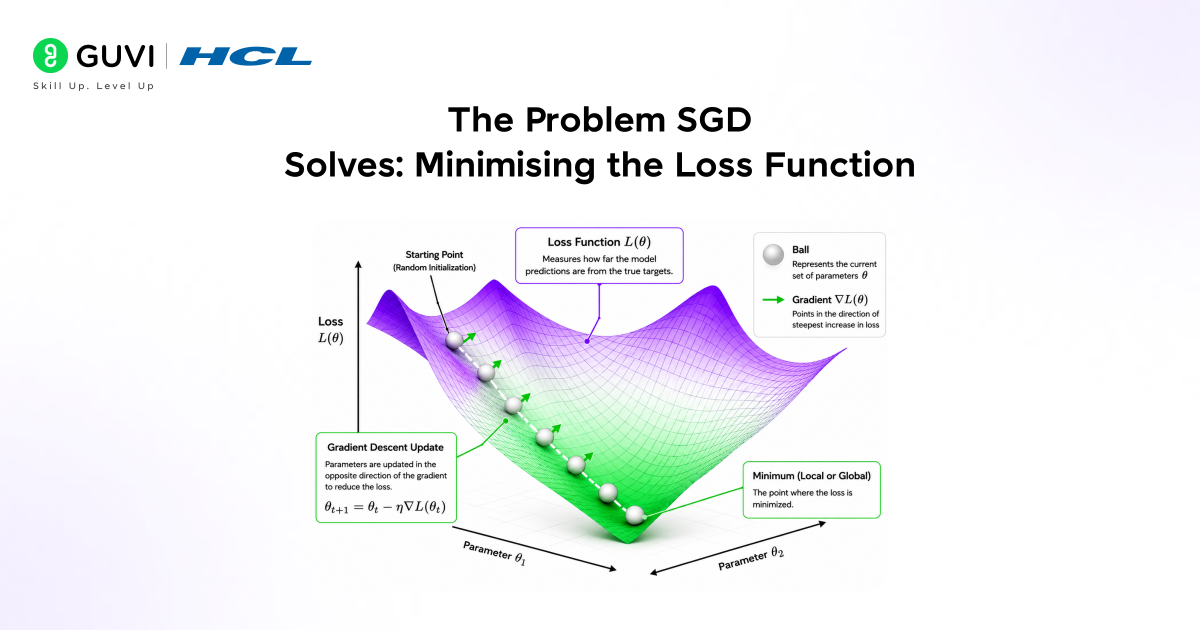
Before understanding SGD, it helps to understand what it is optimising.
A machine learning model has parameters, weights and biases that determine its predictions. During training, the model makes predictions on input data, and those predictions are compared to the actual targets. The difference is measured by a loss function.
The goal of training is to find the set of parameters that minimises the loss function. This is an optimisation problem. The loss function defines a high-dimensional surface, a landscape of possible parameter values and the model needs to find the lowest point.
Gradient descent is the general strategy: compute the gradient of the loss with respect to the parameters, then take a small step in the direction that reduces the loss.
The gradient tells the model which way is “uphill.” Moving in the opposite direction, downhill, reduces the loss.
Batch Gradient Descent vs. Stochastic Gradient Descent
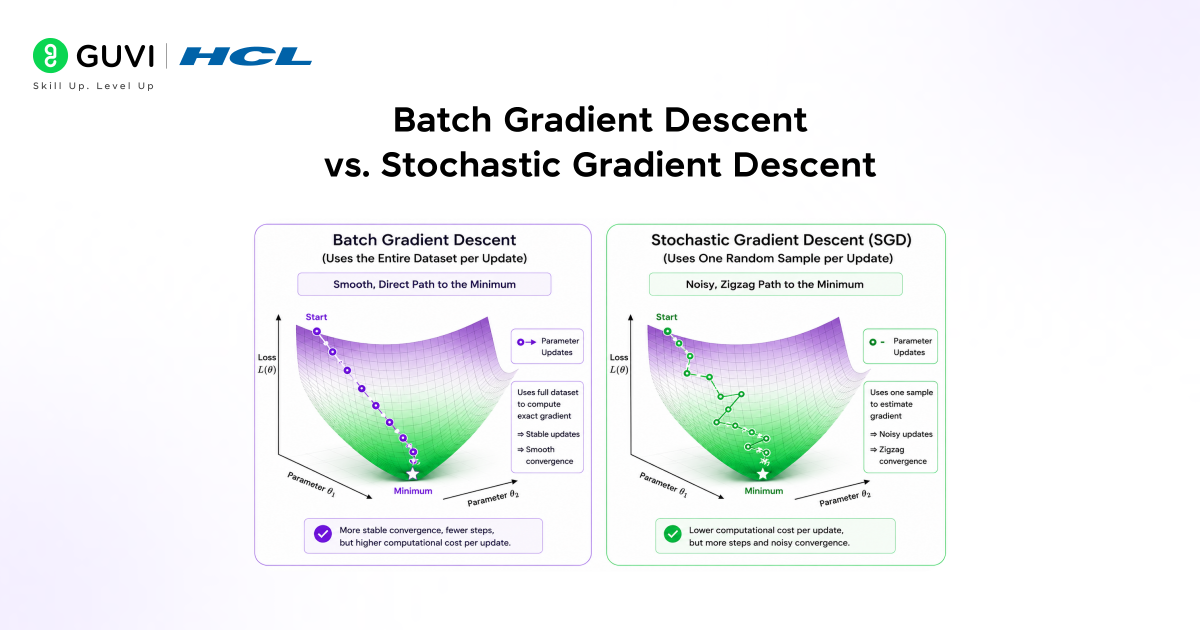
To understand what makes SGD “stochastic,” it is useful to compare it with the standard version of gradient descent.
Full-Batch Gradient Descent
In full-batch gradient descent, the gradient is computed using the entire training dataset before each parameter update. This gives an accurate estimate of the true gradient, but it is computationally expensive. For a dataset with ten million examples, the model must process all ten million before a single update can occur.
This approach does not scale. It is slow, memory-intensive, and impractical for large modern datasets.
Stochastic Gradient Descent (SGD)
SGD solves this by using just one randomly selected training example per update. The gradient is noisy; it is an estimate based on a single data point, but updates happen far more frequently. The model is constantly learning, even if each step is less precise.
This noise is actually useful. It helps the model escape shallow local minima and saddle points that trap full-batch methods.
Mini-Batch Gradient Descent
In practice, the most common approach is mini-batch gradient descent — a hybrid between the two. Instead of one example or all examples, a small random subset (typically 32 to 256 examples) is used per update.
• More stable than pure SGD due to averaging across multiple examples.
• Much faster than full-batch gradient descent.
• Fits naturally into GPU parallelism, where batches are processed simultaneously.
Mini-batch SGD is what most practitioners mean when they refer to “SGD” in the context of deep learning.
How the SGD Weight Update Works
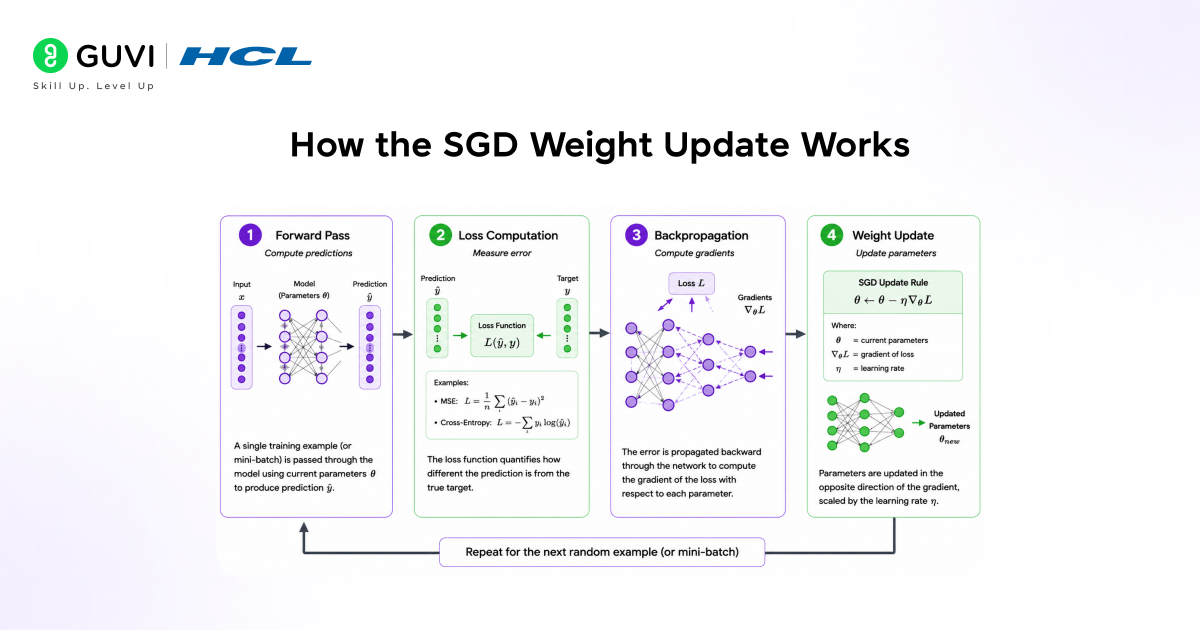
At each training step, SGD follows a clear sequence:
- Forward pass: The model receives a mini-batch of inputs and generates predictions.
- Loss computation: The loss function compares predictions to targets and produces a scalar error value.
- Backpropagation: The gradient of the loss is computed with respect to every parameter using the chain rule.
- Weight update: Each parameter is adjusted by subtracting the learning rate multiplied by its gradient.
The weight update rule is expressed as:
w = w − η · ∇L(w)
Where:
• w is the current weight.
• η (eta) is the learning rate.
• ∇L(w) is the gradient of the loss with respect to the weight.
This step is repeated for every mini-batch, across every epoch of training.
The Learning Rate: The Most Critical Hyperparameter
The learning rate η determines the size of each weight update. It is the single most important hyperparameter in SGD, and getting it wrong leads to failure in either direction.
Learning Rate Too High
• Updates overshoot the minimum.
• The loss oscillates or diverges instead of converging.
• The model fails to learn.
Learning Rate Too Low
• Updates are tiny, and training is extremely slow.
• The model may get stuck in a local minimum or plateau.
• Compute resources are wasted on minimal progress.
Learning Rate Scheduling
Most modern training pipelines do not use a fixed learning rate. They use a schedule that changes the rate during training:
- Step decay: Reduces the learning rate by a fixed factor every N epochs.
- Cosine annealing: Smoothly reduces the learning rate following a cosine curve.
- Warmup: Starts with a very small learning rate and increases it gradually at the start of training.
- Cyclical learning rates: Oscillate between a minimum and maximum rate to escape local minima.
The concept of stochastic approximation, which forms the mathematical foundation of Stochastic Gradient Descent (SGD), was introduced by Herbert Robbins and Sutton Monro in 1951, decades before modern deep learning existed. Despite the enormous evolution of AI architectures since then, SGD and its variants remain the dominant optimization methods used to train neural networks today, showing how a mid-20th-century mathematical idea became central to 21st-century artificial intelligence.
SGD and Backpropagation: How They Work Together
SGD does not operate in isolation. It relies on backpropagation to compute the gradients it needs to perform weight updates.
Backpropagation is the algorithm that calculates how much each weight in the network contributed to the final loss. Using the chain rule of calculus, it propagates the error signal backward through every layer of the network — from the output back to the input.
Once backpropagation has computed the gradient for each weight, SGD uses those gradients to perform the weight update. The two algorithms are inseparable in practice: backpropagation computes the direction, SGD takes the step.

This cycle forward pass, loss computation, backpropagation, and weight update repeat for every mini-batch until the model converges.
Convergence: How SGD Reaches a Solution
Convergence refers to the point at which the model’s parameters stabilise and the loss function stops improving meaningfully. For full-batch gradient descent, convergence is relatively smooth. For SGD, it is noisier.
Because each update is based on a mini-batch rather than the full dataset, the loss fluctuates around the true minimum rather than descending smoothly into it. This is expected behaviour — not a failure.
Several factors influence how quickly and reliably SGD converges:
- Learning rate: Too high causes oscillation; too low causes stagnation.
- Batch size: Larger batches reduce noise but require more memory per step.
- Weight initialisation: Poor initialisation can cause vanishing or exploding gradients.
- Momentum: Accumulates past gradients to smooth updates and accelerate convergence.
SGD with Momentum
Standard SGD treats each update independently. Momentum modifies this by incorporating a fraction of the previous update into the current one — effectively giving the optimiser memory of recent directions.
This allows SGD to build speed in consistent directions and dampen oscillations in directions where the gradient keeps changing sign. It is one of the simplest and most effective improvements to vanilla SGD.
SGD Variants and Modern Optimisers
SGD is the foundation on which most modern optimisers are built. Understanding the variants helps clarify when each is appropriate.
- SGD with Momentum: Adds a velocity term that accumulates gradients over time. Reduces oscillation and speeds convergence, especially in regions where the gradient is small.
- AdaGrad: Adapts the learning rate individually for each parameter based on the sum of past squared gradients. Useful for sparse data, but can cause the learning rate to decay too aggressively over time.
- RMSProp: Addresses AdaGrad’s decay problem by using an exponential moving average of squared gradients. Widely used for recurrent neural networks.
- Adam (Adaptive Moment Estimation): Combines momentum and RMSProp. Maintains per-parameter learning rates and adapts them based on first and second moments of the gradient. The most widely used optimiser in practice today.
Despite the popularity of Adam, SGD with momentum often achieves better generalisation on tasks like image classification when properly tuned. Many state-of-the-art results in computer vision still use SGD.
Practical Considerations When Using SGD
Getting SGD to work well in practice requires more than knowing the formula. Here are the most important considerations:
- Shuffle training data: Always shuffle the dataset at the start of each epoch. Without shuffling, the model may learn biases introduced by the data order.
- Normalise inputs: Features on different scales cause uneven gradient magnitudes. Normalising or standardising inputs before training stabilises the optimisation process.
- Use learning rate scheduling: A fixed learning rate rarely performs as well as a scheduled one. Start with a reasonable value and decay it as training progresses.
- Apply gradient clipping: In deep networks and recurrent models, gradients can explode. Clipping limits the gradient magnitude to prevent instability.
- Monitor the loss curve: If the training loss is not decreasing, the learning rate may be too low. If it oscillates wildly, it may be too high. The loss curve is your primary diagnostic tool.
If you want to learn more about building skills for Claude Code and automating your procedural knowledge, do not miss the chance to enrol in HCL GUVI’s Intel & IITM Pravartak Certified Artificial Intelligence & Machine Learning courses. Endorsed with Intel certification, this course adds a globally recognised credential to your resume, a powerful edge that sets you apart in the competitive AI job market.
Conclusion
Stochastic Gradient Descent is one of the most important algorithms in machine learning. Its simplicity is deceptive beneath the straightforward weight update rule lies a powerful, scalable optimisation engine that has driven some of the most significant advances in artificial intelligence.
From recognising speech to generating images to training large language models, SGD and its variants are the mechanisms by which machines learn. Understanding how it works how the loss function, gradient, learning rate, and backpropagation all fit together is foundational knowledge for anyone working in deep learning.
Whether you are training a small neural network on a single GPU or scaling to thousands of parameters across a distributed cluster, the principles of SGD remain the same. Master them, and you will have a clear mental model of what is happening every time a model trains.
FAQs
1. What is the difference between SGD and gradient descent?
Full-batch gradient descent computes the gradient using the entire dataset before each update. SGD uses a single randomly chosen example (or a small mini-batch), making updates far more frequent. SGD is noisier but much faster and more scalable.
2. Why is SGD called “stochastic”?
“Stochastic” means random. In SGD, each training example (or mini-batch) is selected randomly before computing the gradient. This randomness introduces noise into the update process — which, counterintuitively, helps the model generalise better and escape poor local minima.
3. What batch size should I use for mini-batch SGD?
A batch size of 32 to 256 works well for most tasks. Smaller batches introduce more noise and update more frequently; larger batches are more stable but require more memory and may generalise less well. The optimal batch size depends on the dataset, model architecture, and available hardware.
4. Is Adam better than SGD?
Adam converges faster and requires less learning rate tuning, making it popular for many tasks. However, SGD with momentum often achieves better final accuracy on tasks like image classification when the learning rate is carefully scheduled. The best choice depends on the problem; many practitioners try both.
5. What happens if the learning rate is set too high in SGD?
If the learning rate is too high, weight updates will overshoot the minimum of the loss function. The training loss will oscillate or increase rather than decrease, and the model will fail to converge. Learning rate scheduling and warmup strategies are commonly used to avoid this problem.
Success Stories

About the Author
Vishalini Devarajan
An Aerospace Engineer turned content writer, I focus on making complex concepts easy to understand through well-structured, reader-friendly blogs. Whether it’s a technical topic or a non-technical one, I love creating content that is clear, engaging, and impactful.
View all posts by Vishalini Devarajan
Connect with me @











Did you enjoy this article?