


Career Articles
AI/ML Upskilling: Build In-House or Partner? Best Guide for TA Teams 2026
Is the HCL GUVI AI/ML Program Right for You? A Quick Self-Assessment
Inside the HCL GUVI AI/ML Curriculum: What You’ll Actually Build
Cognizant GenC Hiring Process 2026: Eligibility, Registration Link, Prep & More - Best Guide


Get In Touch For Details! Request More Information
Top Reasons Why You Fail The AWS Certification Exam and How to Overcome Them
Aug 16, 2026 6 Min Read 24649 Views
(Last Updated)
The AWS Certification Exam is a globally recognized credential that validates your knowledge and skills in Amazon Web Services (AWS).
Thousands of professionals prepare for AWS certifications in hopes of advancing their careers, yet many walk away disappointed after seeing their results. The surprising part is that failure often has less to do with technical ability and more to do with preparation mistakes that are easy to overlook.
Missing important exam patterns, relying on the wrong study methods, or underestimating certain topics can quietly reduce your chances of success. Understanding these common pitfalls could be the difference between another failed attempt and finally earning your AWS certification.
Table of contents
- TL;DR Summary
- Most Popular AWS Certification Exams
- Top 7 Reasons People Fail the AWS Certification Exam (and How to Avoid Them)
- Memorization-Based Preparation
- Overdependence on Exam Dumps
- Weak Understanding of Core AWS Services
- Struggles with Scenario-Based Questions
- Unstructured Study Approach
- Lack of Hands-On Experience
- Poor Time Management During the Exam
- 4-Week AWS Certification Study Plan: What to Focus on Each Week
- Week 1: Build Your Foundation
- Week 2: Explore Core Services in Depth
- Week 3: Gain Hands-On Experience
- Week 4: Practice and Revise
- Does AWS Certification Exam Increase Your Salary? What the Data Says
- Free AWS Practice Exams: Best Resources in 2026
- AWS Certification Salary Impact: Before vs. After the Data
- Conclusion
- FAQs
- How many times can I retake an AWS certification exam?
- Does AWS certification expire?
- How many hours should I study for an AWS certification?
- Which AWS certification should beginners start with?
- Is hands-on experience important for AWS certifications?
- Are practice tests enough to pass an AWS certification?
TL;DR Summary
- Passing the AWS Certification Exam depends more on preparation strategy and practical understanding than memorizing service names and definitions.
- The most common reasons candidates fail the AWS Certification Exam include overreliance on exam dumps, weak knowledge of core services, lack of hands-on practice, and poor time management.
- Building experience with services such as Amazon EC2, Amazon S3, Amazon RDS, IAM, and VPC can significantly improve exam performance.
- A structured 4-week study plan covering fundamentals, core services, practical labs, and mock tests can increase your chances of clearing the AWS Certification Exam.
- Certifications can improve career opportunities and salary potential, but the strongest results come from combining certification with real-world skills gained while preparing for the AWS Certification Exam.
Most Popular AWS Certification Exams
Before discussing the reasons behind failed attempts, let’s take a quick look at some of the most popular AWS certification exams professionals pursue to validate their cloud expertise:
| Name of Exam | Difficulty | Short Description | Pass Rate | Salary Boost | Exam Cost |
|---|---|---|---|---|---|
| AWS Certified Solutions Architect – Associate | Intermediate | Cloud architecture and solution design. | 60-68% | 20-30% | $150 |
| AWS Certified Cloud Practitioner | Beginner | AWS fundamentals and cloud concepts. | 72-78% | 10-15% | $100 |
| AWS Certified Developer – Associate | Intermediate | Application development on AWS. | 62-70% | 20-30% | $150 |
| AWS Certified SysOps Administrator – Associate | Intermediate to Advanced | AWS operations and administration. | 55-63% | 20-30% | $150 |
| AWS Certified Solutions Architect – Professional | Advanced | Advanced architecture and migration design. | 38-48% | 30-40% | $300 |
| AWS Certified DevOps Engineer – Professional | Advanced | DevOps automation and CI/CD on AWS. | 40-50% | 30-40% | $300 |
| AWS Certified Security – Specialty | Advanced | AWS security and compliance practices. | 45-55% | 25-35% | $300 |
If you want to explore AWS infrastructure through a Self-paced course, try HCL GUVI’s AWS Infrastructure for Beginners certification course.
Top 7 Reasons People Fail the AWS Certification Exam (and How to Avoid Them)
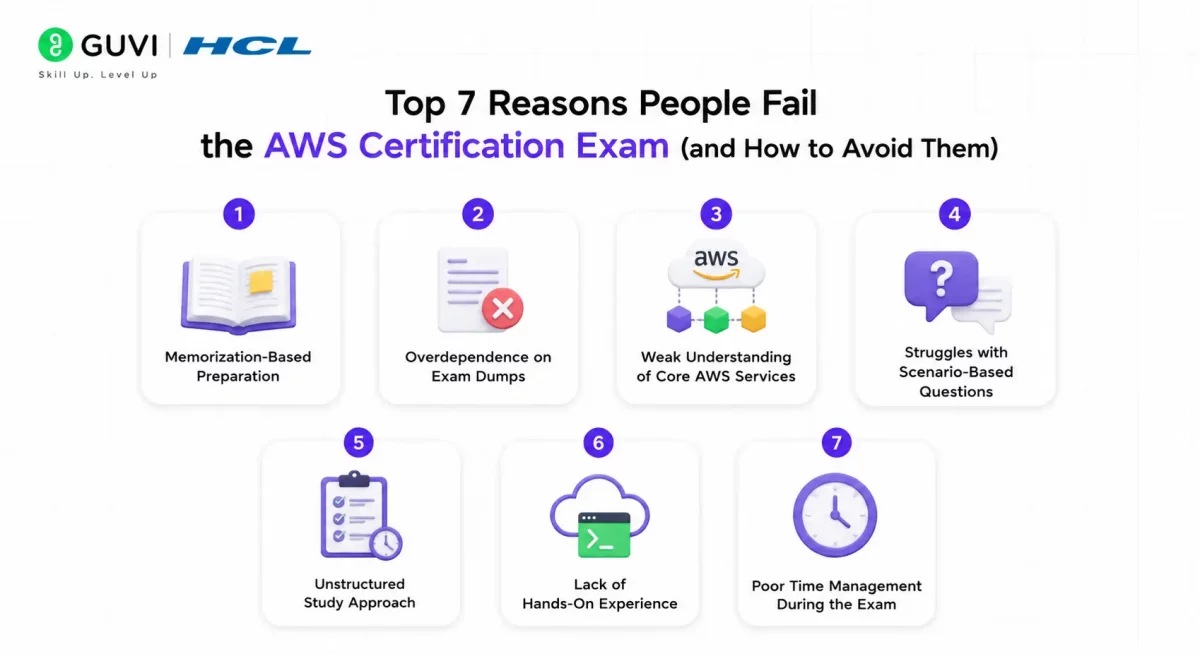
Several factors contribute to failed AWS certification attempts, and most of them have little to do with intelligence or experience. Below are the most common reasons candidates struggle to clear the exam on their first attempt:
1. Memorization-Based Preparation
Many candidates approach the AWS Certification Exam as a memorization exercise, focusing on service names, definitions, and practice question answers instead of understanding how AWS services work together.
Since AWS exams are heavily scenario-based, simply remembering facts is often not enough to choose the correct answer in real-world situations.
How to Avoid This
- Focus on understanding the purpose and use cases of AWS services rather than memorizing definitions.
- Learn how services such as Amazon EC2, Amazon S3, Amazon RDS, and AWS Lambda interact with each other.
- Spend time understanding architecture diagrams and solution design scenarios.
- Ask yourself why a particular service is the best choice for a given requirement.
- Use hands-on labs and practical exercises to strengthen your understanding of concepts.
2. Overdependence on Exam Dumps
Many candidates rely heavily on exam dumps and try to memorize answers without understanding the concepts behind them.
While this approach may help with a few repeated questions, AWS certification exams frequently test your ability to apply knowledge to new scenarios and choose the best solution among multiple valid options.
How to Avoid This
- Use exam dumps only to understand the question pattern, not as your primary study material.
- Focus on learning the reasoning behind each answer choice.
- Study official AWS documentation and recommended learning resources.
- Practice explaining why one AWS service is more suitable than another in a given scenario.
- Use practice exams to identify knowledge gaps instead of memorizing answers.
3. Weak Understanding of Core AWS Services
AWS certification exams expect candidates to have a strong understanding of core services such as Amazon EC2, Amazon S3, Amazon RDS, Amazon VPC, and IAM.
Many candidates spend too much time on advanced topics while overlooking these fundamentals, which appear repeatedly throughout the exam.
How to Avoid This
- Build a strong understanding of the most commonly used AWS core services.
- Learn the primary use cases, limitations, and advantages of each service.
- Understand when to choose one service over another in different scenarios.
- Pay special attention to security, networking, and storage concepts.
- Use the AWS Free Tier to gain practical experience with these services.
4. Struggles with Scenario-Based Questions
Most AWS certification exams are built around real-world scenarios rather than direct questions. Candidates often know what an AWS service does but struggle to identify the most cost-effective, highly available, or best-performing solution for a specific business requirement.
How to Avoid This
- Practice answering scenario-based questions regularly.
- Pay attention to keywords such as cost optimization, high availability, fault tolerance, and scalability.
- Learn the strengths and limitations of commonly used AWS services.
- Understand AWS’s Well-Architected Framework principles.
- Focus on selecting the best answer, not just a technically correct one.
5. Unstructured Study Approach
Many candidates jump between YouTube videos, courses, blogs, and practice tests without following a clear study plan. This often leads to knowledge gaps and confusion, especially when preparing for associate or professional-level certifications.
How to Avoid This
- Choose one primary learning path and follow it consistently.
- Use the official AWS exam guide to track important topics.
- Create a realistic study schedule and stick to it.
- Review weak areas regularly instead of studying only favorite topics.
- Take practice exams to measure progress and identify missing concepts.
6. Lack of Hands-On Experience
Reading study guides and watching courses can help you understand AWS concepts, but they cannot fully replace practical experience. Many AWS exam questions are designed around real-world situations, and candidates who have never worked with AWS services often find it difficult to identify the most suitable solution.
How to Avoid This
- Use the AWS Free Tier to explore services in a real environment.
- Practice creating and managing resources such as EC2, S3, and RDS.
- Spend time working with IAM users, roles, and permissions.
- Build simple projects to understand how different services connect with each other.
- Make hands-on practice a regular part of your preparation.
7. Poor Time Management During the Exam
The AWS Certification Exam is not just a test of knowledge but also a test of decision-making under time pressure. Some candidates spend too long on difficult questions and end up rushing through the final section of the exam, which can significantly affect their overall score.
How to Avoid This
- Set a rough time limit for each question.
- Move on if a question takes too long and return to it later.
- Use the flag for review option for uncertain answers.
- Take multiple practice tests to improve your speed.
- Leave a few minutes at the end to review marked questions.
Also, Know About The Role of Continuous Learning in Tech Hiring
4-Week AWS Certification Study Plan: What to Focus on Each Week
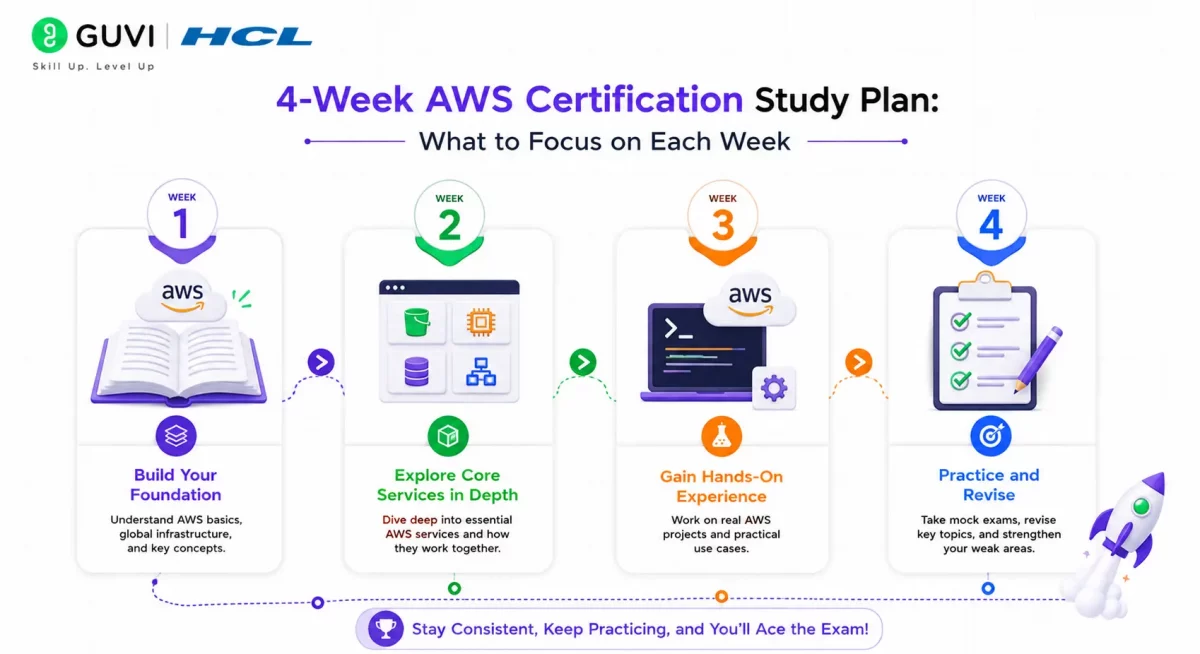
Preparing for an AWS certification can feel overwhelming at first, especially with the number of services and concepts involved. A structured plan helps you stay focused, avoid burnout, and cover the topics that matter most for the AWS Certification Exam.
Week 1: Build Your Foundation
Focus on understanding the fundamentals of cloud computing and the core AWS services.
- Learn the basics of cloud concepts and the AWS global infrastructure.
- Study services such as Amazon EC2, Amazon S3, Amazon RDS, and Amazon VPC.
- Understand the purpose of IAM users, groups, roles, and policies.
- Spend time learning common AWS terminology and pricing models.
Week 2: Explore Core Services in Depth
This week should focus on how AWS services interact with one another in real-world environments.
- Learn about networking concepts including subnets, route tables, and security groups.
- Study storage and database services in greater detail.
- Understand high availability, scalability, and fault tolerance.
- Begin solving scenario-based questions commonly seen in the AWS Certification Exam.

Week 3: Gain Hands-On Experience
Theory alone is rarely enough to clear AWS certifications confidently.
- Use the AWS Free Tier to create and manage resources.
- Launch EC2 instances and configure S3 buckets.
- Practice working with IAM permissions and policies.
- Build small projects that combine multiple AWS services.
- Review areas where you feel less confident.
Week 4: Practice and Revise
The final week should focus on improving confidence and exam readiness.
- Take multiple full-length practice tests.
- Analyze incorrect answers and understand the reasoning behind them.
- Revise important services, architectures, and security concepts.
- Practice time management while answering questions.
- Simulate the actual AWS Certification Exam environment whenever possible.
Following a consistent study schedule is often more effective than studying for long hours without direction. With the right balance of theory, hands-on practice, and revision, you’ll be in a much stronger position to succeed in the AWS Certification Exam.
Also, Find Out Does AWS Require Coding?
Does AWS Certification Exam Increase Your Salary? What the Data Says
The short answer is yes, but not in the way many people expect. An AWS certification alone does not automatically result in a salary hike. Instead, it often helps professionals qualify for better-paying roles, stand out during hiring, and move into specialized cloud positions with higher compensation.
Industry surveys consistently show that AWS-certified professionals earn more than their non-certified peers, especially when certifications are combined with hands-on experience, real-world projects, and cloud skills. The biggest salary gains are typically seen with Professional and Specialty certifications rather than entry-level ones.
| Certification Level | Typical Career Stage | Average Salary Impact | Notes |
|---|---|---|---|
| Foundational | Entry Level | 5-10% | Helps candidates enter the cloud industry and clear HR screening. |
| Associate | Early to Mid Career | 10-20% | Often leads to better cloud engineering and architect opportunities. |
| Professional | Mid to Senior Career | 20-30% | Frequently associated with senior cloud and architecture roles. |
| Specialty | Senior and Specialized Roles | 20-35% | Strong demand in areas such as security and advanced cloud infrastructure. |
| Factor | Impact on Salary |
|---|---|
| AWS Certification | Medium to High |
| Hands-On Experience | Very High |
| Project Experience | Very High |
| Location | High |
| Job Role | Very High |
| Multiple Certifications | Medium |
A widely cited trend across industry surveys is that AWS-certified professionals earn approximately 10-30% more than comparable professionals without certifications.
However, the certification itself is rarely the sole reason for the increase; the combination of certification and practical experience is what creates the strongest salary impact.
Also Read: AWS vs Azure vs Google Cloud: Comparing the Top Cloud Service Providers
Building real-world skills is just as important as passing the certification exam. If you’re looking for structured learning with practical exposure, HCL GUVI’s DevOps Course can be a valuable option. The program emphasizes hands-on learning through real-world projects and covers essential technologies such as Agile, Scrum, Linux, Git, Bash Scripting, Docker, Containers, and AWS infrastructure.
Free AWS Practice Exams: Best Resources in 2026
Free AWS practice tests vary wildly in quality — some are official, some are community-built, and many are outdated dumps recycled from years ago. Here are the ones actually worth your time in 2026.
AWS Skill Builder (Official) — Amazon’s own platform offers free official practice question sets for most certifications, including a handful of sample questions per exam. These are the closest in tone and difficulty to the real thing, though the free tier is limited in volume.
Tutorials Dojo — run by Jon Bonso — is widely regarded as the gold standard for AWS practice exams, especially for SAA-C03 and DVA-C02.
Students report that their actual exam scores track closely with their Tutorials Dojo timed practice scores. Most of the content is paid, but they offer free sample questions and cheat sheets to test the waters.
ExamCert — Offers thousands of free practice questions covering CLF-C02, SAA-C03, DVA-C02, and other AWS certifications, with detailed explanations, and is updated regularly to match exam changes. Good for volume, but cross-check tricky answers since community-run banks can drift from the real exam wording.
OpenExamPrep — Provides thousands of free AWS practice questions with explanations and timed practice, with no signup required. A solid no-friction option if you just want to jump in and start testing yourself.
Udemy Free Practice Tests — Several instructors (including Tutorials Dojo itself) offer smaller free question sets on Udemy as previews to their paid courses. Useful for a quick gut-check before committing to a full paid set.
A word of caution: avoid unofficial “exam dump” sites claiming to have real exam questions — these violate AWS’s certification agreement and can get your certification revoked if traced back to you.
AWS Certification Salary Impact: Before vs. After the Data
Passing the AWS Certification Exam does more than earn you a badge — it shows up directly in your paycheck. Here’s a grounded before-vs-after comparison based on 2026 industry salary data.
| Certification Level | Avg. Salary Before Cert | Avg. Salary After Cert | Increase |
|---|---|---|---|
| Cloud Practitioner (CLF-C02) | ~$70,000 | ~$85,000–$105,000 | ~24–30% |
| Solutions Architect Associate (SAA-C03) | ~$95,000–$110,000 | ~$125,000–$144,000 | ~25–30% |
| Developer Associate (DVA-C02) | ~$90,000–$100,000 | ~$110,000–$120,000 | ~12–18% |
| Solutions Architect Professional (SAP-C02) | ~$120,000–$130,000 | ~$155,000–$162,000 | ~20–30% |
On average, professionals who clear the AWS Certification Exam see roughly a 26% salary bump over non-certified peers, with the jump steepest at entry level and largest in absolute dollar terms for experienced professionals moving to Professional-level certs. The data makes one thing clear: investing time in an AWS Certification Exam pays for itself within weeks of certifying.
Conclusion
Success in AWS certification is rarely about intelligence or luck; it usually comes down to preparation, consistency, and practical experience. Approaching the AWS Certification Exam with a clear study plan, hands-on practice, and a strong understanding of core concepts can significantly improve your chances of earning the certification and advancing your cloud career.
Also Explore: Code to Cloud Using Terraform and AWS: The Epic Guide to Automated Deployment
FAQs
1. How many times can I retake an AWS certification exam?
Candidates can retake the AWS Certification Exam after a 14-day waiting period. Also, AWS currently does not impose a limit on the number of attempts.
2. Does AWS certification expire?
AWS certifications remain valid for three years from the date of certification. Recertification helps professionals stay aligned with the latest AWS services and best practices.
3. How many hours should I study for an AWS certification?
Preparation time varies by experience level, but most candidates spend between 60 and 120 hours preparing for the AWS Certification Exam.
4. Which AWS certification should beginners start with?
Most beginners start with the AWS Certified Cloud Practitioner certification before moving to associate-level certifications.
5. Is hands-on experience important for AWS certifications?
Practical experience with AWS services makes it easier to understand architectures, scenarios, and service selection questions.
6. Are practice tests enough to pass an AWS certification?
Practice tests work best when combined with hands-on labs, documentation review, and a solid understanding of concepts tested in the AWS Certification Exam.
Success Stories

Did you enjoy this article?
Comments












Yes! i enjoyed this article