


Ethical Hacking Articles
What Is a VPN and How Does It Protect Your Privacy?


Get In Touch For Details! Request More Information
Programming Languages For Ethical Hacking: Top Picks for 2026
Aug 26, 2026 8 Min Read 24947 Views
(Last Updated)
Curious about the programming languages required for Ethical Hacking and why certain languages recur in cybersecurity discussions? Behind security tools, vulnerability testing, automation, and web security, programming often plays a bigger role than many beginners expect.
Programming languages for ethical hacking are the tools that let security professionals automate tasks, analyze systems, and test applications for weaknesses. No single language covers everything; different languages serve different parts of the job.
This guide covers the programming languages for ethical hacking that actually matter, which ones to prioritize, a specialization-based comparison, and where to practice them for free.
Table of contents
- TL;DR Summary
- Programming Languages For Ethical Hacking: Quick Overview
- Best Programming Languages For Ethical Hacking by Specialization
- Programming Languages For Ethical Hacking
- Python: The Default Choice for Automation
- HTML: Reading the Skeleton of Every Website
- JavaScript: Understanding What Happens in the Browser
- Ruby: The Scripting Language Behind Metasploit
- PERL: The Old Guard of Text Processing
- Bash: The Language You Can't Avoid
- PHP: Decoding How Half the Web Actually Runs
- C: Understanding What's Actually Happening in Memory
- Java: Making Sense of Enterprise and Mobile Targets
- SQL: Speaking the Language of Every Database
- PowerShell: The Native Language of Windows Attacks
- Python vs C vs Bash: Which Should You Master First?
- Start With Python, the Most Common of the Programming Languages For Ethical Hacking
- Learn Bash Alongside Python; Both Are Core Programming Languages For Ethical Hacking
- Add C, One of the Deeper Programming Languages For Ethical Hacking Work
- How Much Programming Do You Actually Need to Know?
- To Get Started at All
- To Be Effective Once You Know the Basics of These Programming Languages For Ethical Hacking
- To Specialize Deeply in Any One of These Languages
- Common Mistakes When Learning Programming Languages For Ethical Hacking
- Trying to Learn All the Programming Languages For Ethical Hacking at Once
- Learning Syntax Without Touching Real Security Tools
- Skipping Bash Because It "Isn't a Real Language"
- Picking Tools Before Deciding What Problem You're Solving
- Where to Practice These Languages for Free
- TryHackMe
- OverTheWire
- HackerRank
- Conclusion
- FAQs
- How long does it take to learn programming for Ethical Hacking?
- Which programming language should beginners start with for Ethical Hacking?
- Should I learn multiple programming languages at the same time?
- Can I practice Ethical Hacking programming without expensive tools?
- Does learning programming make Ethical Hacking easier?
- Is Linux knowledge useful while learning Ethical Hacking languages?
TL;DR Summary
- The programming languages required for Ethical Hacking help professionals work with automation, scripting, web applications, databases, and system analysis.
- Different languages serve different purposes, from building security scripts and testing applications to understanding how systems and websites function.
- Learning the programming languages required for Ethical Hacking becomes easier when you start with beginner-friendly options and gradually move toward advanced concepts.
- Choosing the right language depends on security tasks, tools, platforms, and the cybersecurity areas you want to work with.
Cyberattacks happen roughly every 39 seconds, and studies suggest nearly 31% of breaches start from software vulnerabilities, showing why programming knowledge has become increasingly valuable in Ethical Hacking.
Programming Languages For Ethical Hacking: Quick Overview
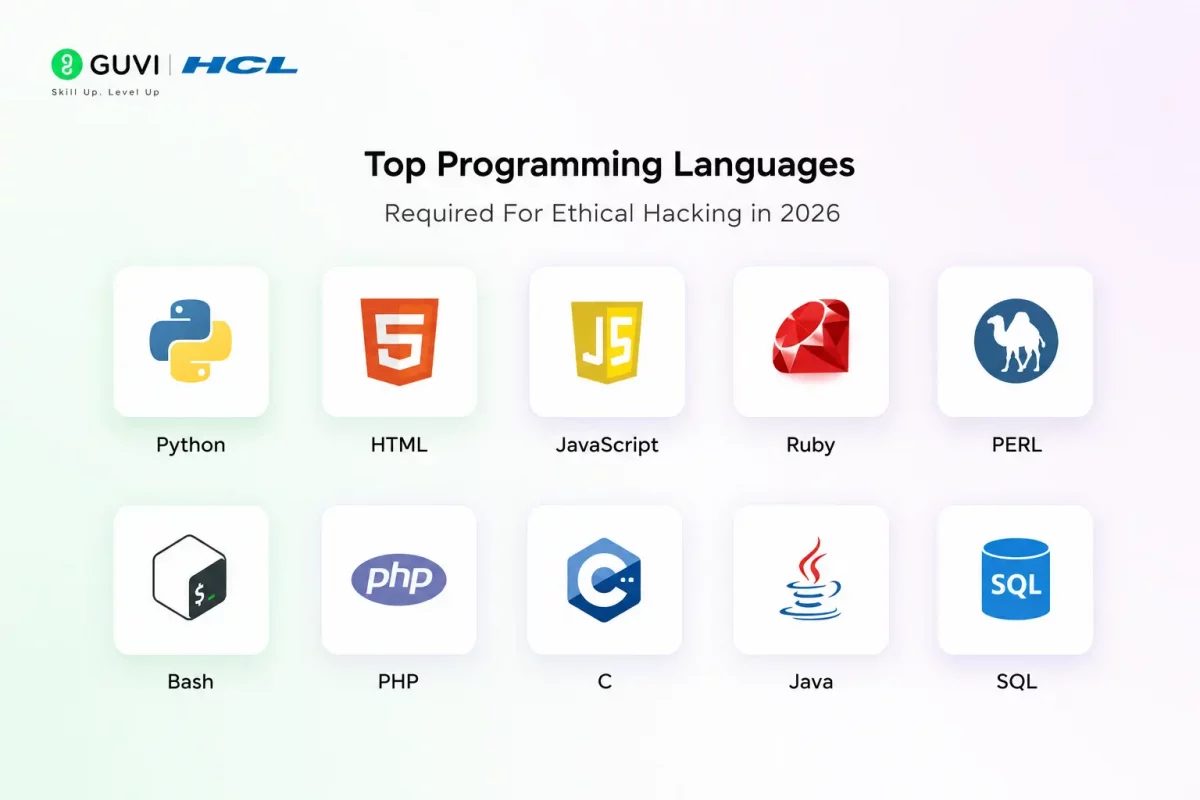
| # | Programming Language | Primary Use in Ethical Hacking |
|---|---|---|
| 1 | Python | Automation, scripting, and security tool development |
| 2 | HTML | Understanding website structures and web applications |
| 3 | JavaScript | Web application testing and browser-side security analysis |
| 4 | Ruby | Scripting, automation, and security tool customization |
| 5 | PERL | Text processing, scripting, and automation tasks |
| 6 | Bash | Linux operations, command execution, and automation |
| 7 | PHP | Server-side web application analysis and testing |
| 8 | C | System-level programming and low-level security analysis |
| 9 | Java | Application analysis and cross-platform development |
| 10 | SQL | Database management, testing, and security analysis |
| 11 | PowerShell | Windows and Active Directory enumeration, exploitation, and automation |
Also Read: Top 7 Skill Requirements Needed to Become an Ethical Hacker
Best Programming Languages For Ethical Hacking by Specialization
The table above tells you which programming languages for ethical hacking are used where. This next one flips that around, showing which specialization actually needs which languages, useful once you’ve decided which part of ethical hacking you want to focus on.
| # | Specialization | Primary Languages | Why These Languages |
|---|---|---|---|
| 1 | Web Application Security | JavaScript, PHP, SQL, HTML | Covers how websites render, process input, and query data, the full attack surface of a web app |
| 2 | Network and Systems Security | Python, Bash, C | Python and Bash handle scanning and automation; C explains how the OS and network stack actually behave |
| 3 | Malware Analysis and Reverse Engineering | C, Assembly, Rust | Understanding memory, low-level execution, and how modern evasive malware is increasingly written |
| 4 | Automation and Tool Development | Python, Ruby, Bash | Fast to write, widely supported, and the backbone of most custom security tooling |
| 5 | Modern Security Tooling (2026 trend) | Go, Rust | Go powers fast scanners (like Naabu); Rust is gaining ground in malware research for its performance and anti-analysis properties |
| 6 | Windows and Active Directory Security | PowerShell, C | PowerShell is native to Windows and drives most AD enumeration and post-exploitation tooling; C helps with deeper Windows internals work |
Programming Languages For Ethical Hacking
No single language does everything in this field. Some let you write a scanner in ten minutes; others exist mainly so you understand how the systems you’re testing actually work underneath. Here’s what each one is actually for.
1. Python: The Default Choice for Automation
Among all programming languages for ethical hacking, Python is where most professionals will point you first, and for good reason. Its syntax reads almost like plain English, which means less time fighting the language and more time solving the actual security problem in front of you.
What makes it stick in this field is the sheer volume of ready-made security libraries. Need to scan a network range, parse a suspicious log file, or bolt together a quick proof-of-concept exploit? Someone has probably already built a Python library for a piece of it, and you’re extending rather than starting from zero.
Where it shows up in practice:
- Writing automation scripts that replace hours of manual, repetitive testing
- Building and customizing network scanners and vulnerability checks
- Gluing together penetration testing tools and custom exploit scripts
Why it’s worth your time first: almost every free security tool, tutorial, and open-source project assumes you can at least read Python, even if you never touch another language. That alone makes it the highest-leverage first investment on this entire list.
2. HTML: Reading the Skeleton of Every Website
HTML isn’t one of the programming languages for ethical hacking you’d use to write an exploit in, but you can’t meaningfully test a website without reading it fluently. It’s the raw structure underneath every page, the forms, buttons, hidden fields, and input elements that eventually become attack surface.
Where it shows up in practice:
- Spotting form fields and hidden inputs that a browser doesn’t obviously display
- Understanding how a page’s structure maps to what a scanner or manual tester actually probes
- Recognizing outdated or misconfigured page elements that hint at deeper issues
Why it’s worth learning: it’s the fastest, lowest-effort language on this list to pick up, and skipping it means testing web applications half-blind.
3. JavaScript: Understanding What Happens in the Browser
JavaScript is one of the programming languages for ethical hacking work that’s easy to underestimate. Nearly every modern website runs meaningful logic directly in the user’s browser, not just on the server. That client-side code validates forms, fetches data, and often reveals far more about how an application works than its server ever intended to expose. If you’re starting from scratch, GUVI’s JavaScript hub is a solid place to build the fundamentals first.
Where it shows up in practice:
- Reading how a site validates input before it ever reaches the server, and finding where that validation can be bypassed
- Testing browser-based attacks like cross-site scripting
- Understanding how a page communicates with its backend through API calls
Why it’s worth learning: so much of the modern web attack surface lives in JavaScript that skipping it leaves a genuine blind spot in web application testing specifically.
4. Ruby: The Scripting Language Behind Metasploit
Ruby doesn’t get the attention Python does among programming languages for ethical hacking, but it earns its place here for one big reason: Metasploit, one of the most widely used penetration testing frameworks in the world, is built in it.
If you ever want to write your own Metasploit modules, Ruby is non-negotiable.
Where it shows up in practice:
- Writing and modifying exploit modules inside Metasploit-style frameworks
- Building quick automation scripts with less boilerplate than some alternatives
- Customizing existing open-source security tools that were originally written in Ruby
Why it’s worth learning: less as a first language, more as a second one once you’re ready to go deeper into a specific, widely used tool ecosystem.
Whether you start with Python for automation, C for system-level analysis, or SQL for database security, none of it sticks without practice. HCL GUVI’s Code Kata gives you real coding problems across languages, with hints along the way, so you build the practical skills this list only introduces.
5. PERL: The Old Guard of Text Processing
Among older programming languages for ethical hacking, PERL has fallen out of mainstream fashion, but it hasn’t disappeared from security work.
It still earns its keep anywhere large volumes of raw text need to be sliced, filtered, and searched fast: log files, packet captures, and legacy scripts still running in production environments you might be asked to audit.
Where it shows up in practice:
- Chewing through massive log files looking for patterns a human would miss
- Maintaining or auditing older security scripts and utilities still in active use
- Automating repetitive text-based tasks across different operating systems
Why it’s worth knowing: you’re far more likely to read someone else’s PERL than to write fresh PERL yourself, but that reading skill matters when you inherit an older environment.
6. Bash: The Language You Can’t Avoid
Among all programming languages for ethical hacking, this one isn’t really optional. If your work touches Linux, and most security tooling does, Bash is how you actually operate. It’s less a specialized skill and more the baseline fluency everything else sits on top of.
Where it shows up in practice:
- Navigating a target system and moving through directories and files efficiently
- Chaining multiple commands and tools together into a single automated workflow
- Running the huge share of security tools that are themselves just command-line programs
Why it’s worth learning immediately: you’ll be using it constantly, often without even thinking of it as “programming,” from your very first day of hands-on practice.
7. PHP: Decoding How Half the Web Actually Runs
One of the more overlooked programming languages for ethical hacking work: a huge share of the internet, including most WordPress sites, still runs on PHP behind the scenes. That server-side code decides how user input gets handled, how sessions work, and, frequently, where security gets sloppy.
Where it shows up in practice:
- Reading how a server processes and validates the data a user submits
- Spotting logic flaws in how PHP applications manage sessions and authentication
- Understanding the backend half of a web application, not just what the browser shows you
Why it’s worth learning: if web application testing is your focus, PHP fluency lets you see the half of the application that JavaScript alone can’t show you.
8. C: Understanding What’s Actually Happening in Memory
Of all the programming languages for ethical hacking on this list, C sits closest to the hardware. Learning it means understanding memory addresses, pointers, and exactly how a program behaves once it’s compiled, not just what its source code says it should do.
Where it shows up in practice:
- Understanding classic vulnerability classes like buffer overflows at the level they actually occur
- Reading and reasoning about how compiled software behaves, not just interpreted scripts
- Building high-performance security tools where speed genuinely matters
Why it’s worth learning: it’s the foundation underneath reverse engineering and deep vulnerability research; you don’t need it to start, but you can’t go far into those specializations without it.

9. Java: Making Sense of Enterprise and Mobile Targets
Java doesn’t always make the shortlist of programming languages for ethical hacking beginners think of, but large enterprise systems, backend services, and a huge share of Android apps are written in Java. If your work ever touches a corporate environment or a mobile app’s internals, Java literacy stops being optional.
Where it shows up in practice:
- Analyzing how enterprise applications are structured and where they might mismanage data
- Reading Android app internals during mobile security assessments
- Understanding cross-platform software that runs identically across very different environments
Why it’s worth learning: it broadens which environments you can actually test, well beyond websites and Linux servers alone.
Getting comfortable with C, Java, and the deeper system-level concepts among these programming languages for ethical hacking is exactly what HCL GUVI’s Cyber Security and Ethical Hacking Beginner course is structured to build, alongside guided, hands-on practice.
10. SQL: Speaking the Language of Every Database
SQL rounds out the core programming languages for ethical hacking: behind almost every login form, e-commerce cart, and user dashboard sits a database, and SQL is how you talk to it.
Understanding SQL, one of the essential programming languages for ethical hacking, means understanding exactly how an application stores and retrieves the data attackers actually want.
Where it shows up in practice:
- Recognizing how an application constructs and executes database queries
- Identifying classic database security weaknesses, including injection-style flaws
- Understanding what data an application actually holds and how it’s structured
Why it’s worth learning: databases hold the data that makes an attack worth attempting in the first place, which makes SQL one of the highest-value languages on this entire list.
11. PowerShell: The Native Language of Windows Attacks
The newest addition to this list of programming languages for ethical hacking: if your work ever touches a corporate Windows environment, PowerShell stops being optional fast.
It’s built into every modern Windows machine, which means attackers and defenders alike use it constantly, often without installing a single external tool.
This is also why PowerShell, one of the more recently emphasized programming languages for ethical hacking, is central to “living off the land” techniques.
Since it’s already trusted and present on the system, using it to enumerate or move through a network draws far less attention than dropping in unfamiliar malware.
Where it shows up in practice:
- Enumerating Active Directory users, groups, and permissions using tools built entirely in PowerShell, like PowerView
- Running post-exploitation actions over WinRM once valid credentials are obtained
- Automating credential and privilege-escalation checks across a Windows domain
Why it’s worth learning: most real-world corporate penetration tests eventually touch a Windows domain, and PowerShell is how that entire ecosystem, from initial enumeration to post-exploitation, actually gets tested.
If you want to begin learning Ethical Hacking and Cybersecurity through a self-paced approach, HCL GUVI’s Cyber Security and Ethical Hacking Beginner course can help you build foundational knowledge while learning concepts at your own pace. It can be a useful starting point for understanding cybersecurity basics and practical security concepts.
Python vs C vs Bash: Which Should You Master First?
Among all programming languages for ethical hacking, these three come up more than any other combination when beginners ask where to start. Here’s how to actually decide.
1. Start With Python, the Most Common of the Programming Languages For Ethical Hacking
It’s the most beginner-friendly of the three, has the largest library ecosystem for security tasks, and is what most tutorials and tools assume you already know.
2. Learn Bash Alongside Python; Both Are Core Programming Languages For Ethical Hacking
Nearly every cybersecurity tool and environment runs on Linux, so basic Bash fluency (navigating, chaining commands, writing small scripts) becomes necessary almost immediately, even if it’s not your primary language.
3. Add C, One of the Deeper Programming Languages For Ethical Hacking Work
C teaches you what’s actually happening in memory, why buffer overflows work, and how compiled programs behave, the foundation for reverse engineering and lower-level vulnerability research. Most beginners don’t need it on day one, but it becomes valuable once you move past scripting into deeper technical analysis.
How Much Programming Do You Actually Need to Know?
How much you actually need to know of these programming languages for ethical hacking worries a lot of beginners more than it should. You don’t need to be a software engineer to start in ethical hacking.
1. To Get Started at All
Basic scripting comfort in two of the core programming languages for ethical hacking, Python and Bash, is enough to navigate Linux confidently. That’s genuinely enough to begin hands-on practice.
2. To Be Effective Once You Know the Basics of These Programming Languages For Ethical Hacking
Reading code well enough to spot logic flaws, even in languages you don’t write daily (PHP, JavaScript, Java), matters more than mastering every language on this list.
3. To Specialize Deeply in Any One of These Languages
Roles like malware analysis or exploit development do require serious depth in C and increasingly Rust, but that’s a later-stage skill, not a starting requirement.
Across all of these programming languages for ethical hacking, depth matters less than breadth of reading comprehension early on. You’ll write far more scripts than you’ll ever compile production software.
Common Mistakes When Learning Programming Languages For Ethical Hacking
1. Trying to Learn All the Programming Languages For Ethical Hacking at Once
Spreading effort this thin across all these programming languages for ethical hacking means none of them reach a useful depth. Pick one primary scripting language and one shell, and go deep before adding more.
2. Learning Syntax Without Touching Real Security Tools
Knowing Python syntax and actually applying it, one of the more common gaps in learning programming languages for ethical hacking, are different skills. Practice with real tasks, not just tutorials.
3. Skipping Bash Because It “Isn’t a Real Language”
Skipping it isn’t a realistic option among programming languages for ethical hacking, since most tools you’ll actually use assume comfortable command-line fluency.
4. Picking Tools Before Deciding What Problem You’re Solving
Picking up one of these programming languages for ethical hacking because it sounds impressive, rather than because a specific task needs it, wastes time. Let the specialization you’re aiming for decide the language, not the other way around.
Where to Practice These Languages for Free
Reading about them and being able to use them under pressure are different things. A few genuinely useful, free starting points for practicing programming languages for ethical hacking:
1. TryHackMe
- Organizes content into guided “rooms” that walk you through a specific tool or vulnerability step by step
- Its free tier covers beginner-level networking, Linux, and web security content
- Python and Bash scripting are built directly into many exercises, not taught separately
2. OverTheWire
- The “Bandit” wargame hides each level’s password somewhere on the server for you to find
- Forces genuine command-line fluency using Bash and basic Linux tools
- No modern UI or hand-holding, just a terminal and a series of clever puzzles
3. HackerRank
- Not security-specific, but builds raw fluency in several of the core programming languages for ethical hacking, including Python, C, and Java
- Uses structured coding challenges to build fluency in these programming languages for ethical hacking rather than open-ended projects
- Good for fixing weak language fundamentals before applying them to security tasks
For more on applying programming languages for ethical hacking in real projects, also read: Top 10 Ethical Hacking Project Ideas for Beginners in 2026 to Build Job-Ready Skills, which pairs well with this list once you’re ready to build something with what you’ve learned.
Conclusion
Choosing the right programming languages for ethical hacking is less about learning everything and more about understanding what each one actually helps you achieve. Building knowledge step by step can make learning automation, web security, scripting, and system analysis much easier over time.
FAQs
1. How long does it take to learn programming for Ethical Hacking?
The learning time depends on consistency, practice, and the number of languages being learned.
2. Which programming language should beginners start with for Ethical Hacking?
Starting with beginner-friendly languages (such as JavaScript or Python) and gradually moving to advanced topics makes learning easier.
3. Should I learn multiple programming languages at the same time?
Learning one language properly before moving to another can make concepts easier to understand.
4. Can I practice Ethical Hacking programming without expensive tools?
Many learners practice using free resources, open-source tools, and personal learning environments.
5. Does learning programming make Ethical Hacking easier?
Programming knowledge can help automate tasks, better understand systems, and improve practical skills.
6. Is Linux knowledge useful while learning Ethical Hacking languages?
Many cybersecurity tools and workflows run in Linux environments, making familiarity helpful.
Success Stories

About the Author
Jebasta
I translate the language of data into stories that anyone can understand. As a writer with a data science background, I simplify analytics, AI, and decision-making so beginners and enthusiasts can confidently explore the world of data.
View all posts by Jebasta
Connect with me @

Did you enjoy this article?
Comments











Tool security