


Career Articles
Finance Managers: Could Data Science Be Your Next Career Move?
Insurance Claims Executive to Data Analyst: Is It a Good Switch?
Banking Executive (Loans, KYC) to Data Analyst: Skills and Career Path
BPO Fresher: Switch to Data Analytics Now or Gain More Experience First?

Get In Touch For Details! Request More Information

Mechanical Engineering to Software Engineering in 2026: Roadmap, Skills & Salary
Sep 08, 2026 8 Min Read 31094 Views
(Last Updated)
Table of contents
- TL;DR
- What is Software Engineering?
- Can Mechanical Engineers Become Software Engineers?
- What skills from mechanical engineering can help?
- Mechanical Engineering vs Software Engineering: What Changes?
- 5 Steps to Go from Mechanical Engineering to Software Engineering Job
- Step 1: Select Your Niche
- Step 2: Learn the Basics of Programming
- If you're completely new to coding
- Programming concepts to learn
- Step 3: Build Real-World Projects
- Step 4: Learn Industry-Ready Skills
- Step 5: Apply and Prepare for Job Interviews
- Success stories
- Gowtham Thiyada
- Sudhakar Mirjeli
- Vivek Bansal
- Best Software Engineering Paths for Mechanical Engineers in India 2026
- Which Software Engineering Field Is Best for Mechanical Engineers?
- How Long Does It Take to Become a Software Engineer From Mechanical Engineering?
- Do Mechanical Engineers Need a Computer Science Degree to Become Software Engineers?
- 90-Day Roadmap from Mechanical Engineering to Software Engineering
- Month 1: Build the Foundation
- Weeks 1-2
- Weeks 3-4
- Month 2: Build Technical Skills
- Weeks 5-6
- Weeks 7-8
- Month 3: Build Your Job Profile
- Weeks 9-10
- Weeks 11-12
- How to Explain Your Mechanical-to-Software Career Switch in an Interview
- Software Engineer Salary in India in 2026
- Conclusion
- FAQ
- Can mechanical engineers become software engineers?
- Do mechanical engineers need a computer science degree to become software engineers?
- Which software engineering field is best for mechanical engineers?
- How long does it take to switch from mechanical engineering to software engineering?
- What skills should mechanical engineers learn to get software jobs?
- Can a mechanical engineer get a software job without experience?
- Is software engineering a good career switch for mechanical engineers?
TL;DR
- Yes, mechanical engineers can become software engineers in 2026. A mechanical engineering degree does not automatically prevent you from entering software development.
- You generally do not need another four-year computer science degree, but you do need to build software-specific skills such as programming, data structures and algorithms, databases, Git, APIs, debugging, testing, and software development practices.
- The most important proof of your transition is your skills and practical work: projects, GitHub repositories, internships, freelance work, or relevant professional experience.
- A practical transition can follow this sequence: choose a software path → learn one programming language → build CS fundamentals → create projects → prepare for interviews → apply for jobs.
- The time required varies by your existing coding knowledge, learning schedule, target role, and interview requirements.
Are you a mechanical engineer who wants to shift your career towards software engineering? We’ve got you covered!
Shifting a career from a non-technical background to technical roles might be daunting sometimes. But with the right guidance and roadmap you can achieve it easily. In this blog, we will present you with 5 steps to go from a mechanical engineering to software engineering job. Along with the detailed roadmap, we will provide you some of the success stories of the engineers who made their way towards software engineering from mechanical. So, let’s get started!
What is Software Engineering?
Software engineering is a process of designing, developing, testing and maintaining software applications in a systematic way. Software engineering purely focuses on building digital products such as mobile applications, websites, operating systems, and other tools instead of building a physical machine that a mechanical engineer built.
Software engineers take responsibility for the product throughout its life cycle from designing, developing, testing, deploying, and maintaining. These tasks can be easy and manageable using various software tools.
Can Mechanical Engineers Become Software Engineers?
Yes, mechanical engineers can become software engineers.
You do not necessarily need another four-year degree in computer science to make the transition. However, you do need to develop software-specific skills and demonstrate them through practical projects, GitHub work, internships, freelance work, or relevant professional experience.
Mechanical engineers already bring several transferable skills to the table:
- Problem-solving
- Analytical thinking
- Mathematical reasoning
- Systems thinking
- Technical documentation
- Attention to detail
- Engineering discipline
- Project management
- Understanding of complex systems
These skills can give you a strong foundation, but they don’t replace programming knowledge.
You still need to learn programming, data structures and algorithms, databases, Git, software development practices, testing, and the technologies required for your chosen role.
What skills from mechanical engineering can help?
Your engineering background can give you a head start in areas such as:
- Problem-solving
- Analytical thinking
- Mathematical reasoning
- Systems thinking
- Attention to detail
- Technical documentation
- Project management
- Understanding complex systems
- Structured decision-making
However, these transferable skills do not replace software engineering fundamentals.
Think of the transition this way:
You are not starting your engineering career from zero. You are adding a new technical skill set to an existing engineering foundation.
Mechanical Engineering vs Software Engineering: What Changes?
Before making the switch, understand what you’re actually changing.
| Factor | Mechanical Engineering | Software Engineering |
| Primary output | Physical products, machines, systems | Software, applications, platforms |
| Core skills | CAD, mechanics, thermodynamics, manufacturing | Programming, algorithms, databases, system design |
| Common tools | AutoCAD, SolidWorks, CATIA, ANSYS | Git, VS Code, IDEs, frameworks, cloud platforms |
| Programming requirement | Depends on role | Essential for most engineering roles |
| Portfolio | Designs, projects, prototypes | Applications, APIs, GitHub projects |
| Interview focus | Engineering concepts, design, technical knowledge | Coding, DSA, system design, debugging |
| Career transition | Stay within mechanical domain | Move into software/IT/product development |
| Entry barrier | Engineering fundamentals | Programming and software fundamentals |
| Portfolio | CAD/design/projects | GitHub/projects/apps |
| Key interview skills | Core mechanical concepts | Coding, DSA and problem solving |
| Upskilling required | Depends on role | Usually significant for career switchers |
| Transferable advantage | Systems and analytical thinking | Same skills applied to digital systems |
The important point is this: you are not starting from zero.
You’re transferring your engineering mindset into a new technical domain.
In the next section, we will dive into the 5 necessary steps that a mechanical engineer should follow to become a successful software engineer.
5 Steps to Go from Mechanical Engineering to Software Engineering Job
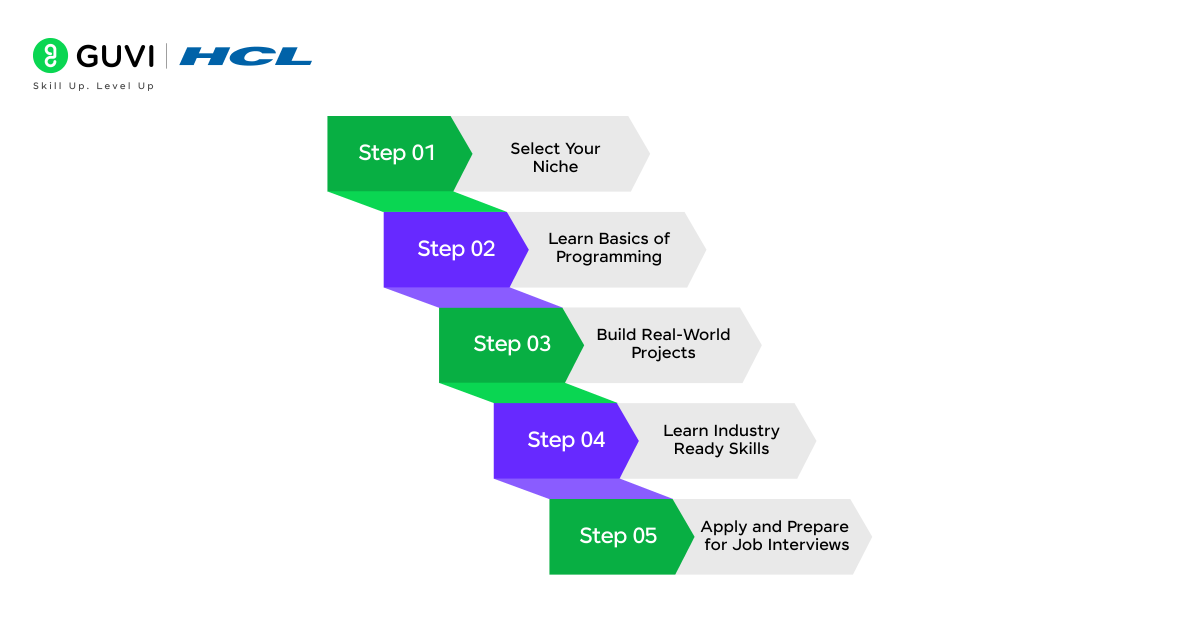
This section summarizes the entire process of shifting from mechanical engineering to software engineering in a simple 5 step process. Lets jump into it without wasting any time.
Step 1: Select Your Niche
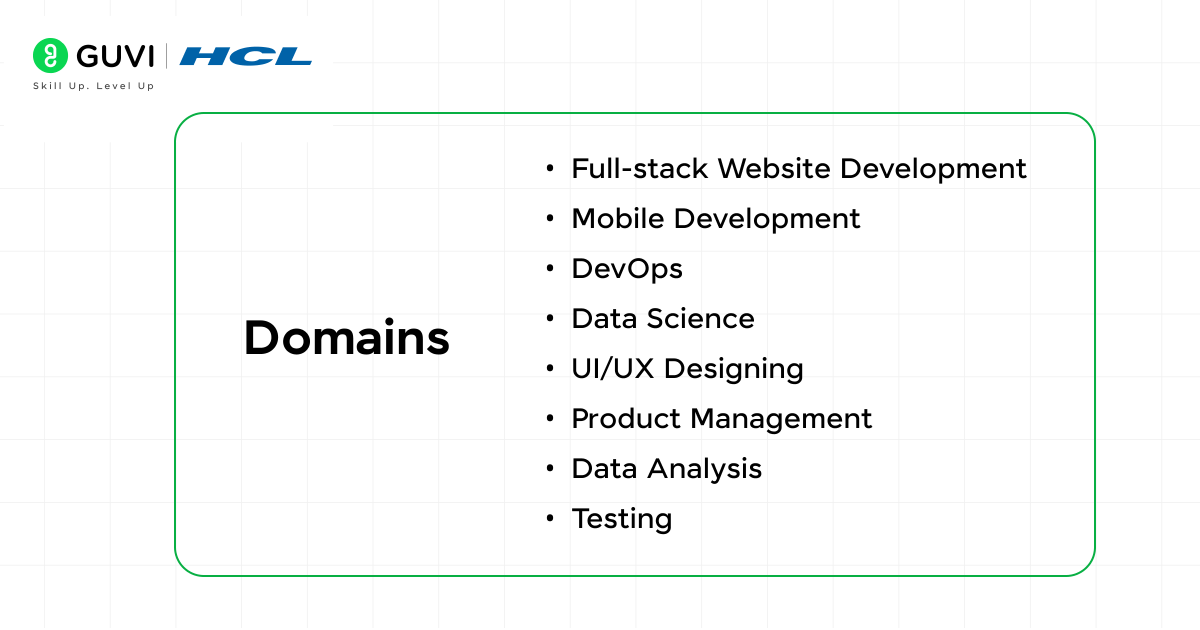
The first step of the process is to select your niche. There are various domains in the software engineering field, such as full-stack development, UI/UX design, product management, and so on.
You have to ask yourself which niche suits you the best. One way to find out is to spend some time understanding each domain and see which excites you the most, or go with the hottest trend.
For example, if you are interested in diving deep into more technical things, then full-stack development, DevOps, mobile development, or Data Science might be the best for you.
Or if you are a person who doesn’t want to go in-depth on the technicalities, then UI/UX designing, product management, data analysis, or testing might suit you the best. We have explained each domain in simpler terms to make you understand better.
- Full-stack Website Development: It is used to build both the frontend (user interface) and backend (server) of websites.
- Mobile Development: Creates applications for mobile devices such as smartphones, tablets with operating systems like iOS and Android.
- DevOps: It is used to automate and streamline the process of software development and IT operations to enable faster, more efficient, and reliable release of software.
- Data Science: It is used to extract insights and predictions from large data sets using statistics and machine learning algorithms.
- UI/UX Designing: Creates a user interface (UI) and user experience (UX) of digital products to ensure they are both visually appealing and comfortable to use for the end users.
- Product Management: Overseeing the development and lifecycle of a product by aligning business goals, user needs, and technical requirements.
- Data Analysis: It is used to interpret the data to support decision making and identify the trends and patterns using visualization techniques.
- Testing: It is used to check the software for bugs, performance issues, and functionality to ensure it works correctly before release.
Choosing the right niche is really important because each is different from the others. Our advice for you would be to choose one and focus in-depth on that domain to become an expert.
If you are interested in getting started with Data Science and love to learn by reading, you can use HCL Guvi’s FREE E-book on Master the Art of Data Science – A Complete Guide. This e-book is an overall roadmap and explains in detail each step towards a career in data science.
Step 2: Learn the Basics of Programming
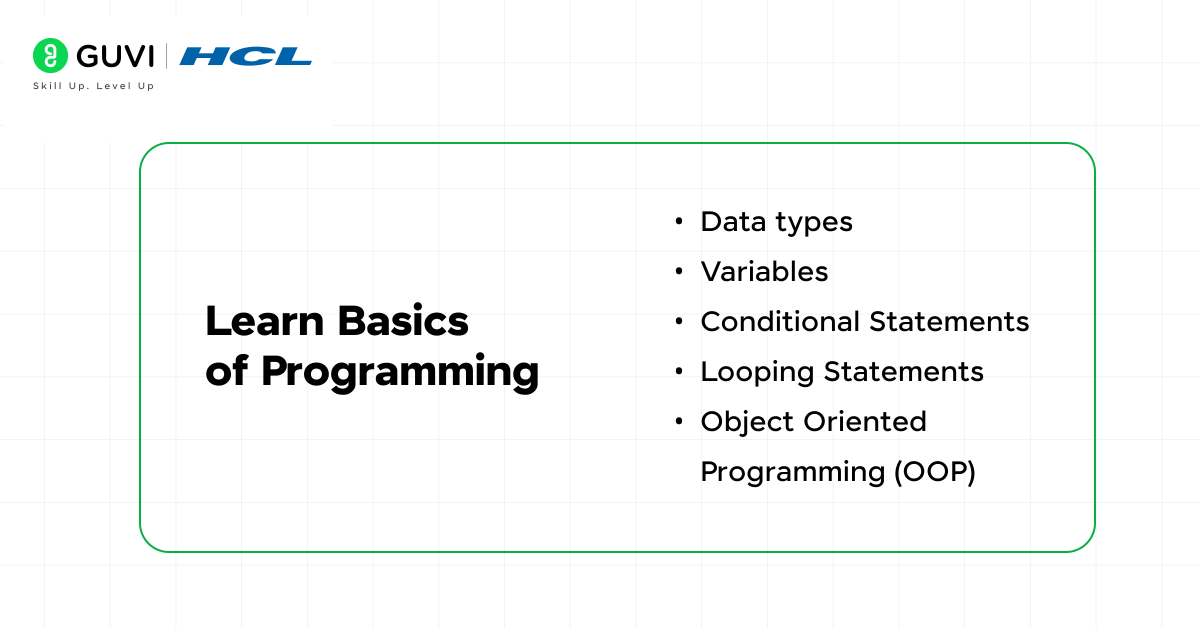
The second step of this process is to learn the basics of programming. When it comes to software engineering, it is mandatory to learn at least the basics of programming.
There are various programming languages such as C, C++, Java, Python, Go, JavaScript, etc. You can choose any one of these and start learning it.
Start with the basics such as syntax, data types, variable declarations, conditional statements such as if..else, if…else if…else, switch cases.
Later, move to learn classes, objects, polymorphism, inheritance, encapsulation, abstraction, and other object-oriented programming concepts. These concepts are essential for a software developer role.
If you’re completely new to coding
You can consider one of these learning paths:
Path 1: General programming/data
Python → Git → SQL → DSA → Backend/Data basics → Projects
Path 2: Java backend
Java → OOP → DSA → SQL → Spring Boot → Projects
Path 3: Web development
JavaScript → HTML/CSS → React → Node.js → SQL → Projects
The important point is not which language you choose first. It is whether you learn one language deeply enough to solve problems and build applications.
Programming concepts to learn
Start with:
- Variables
- Data types
- Operators
- Conditional statements
- Loops
- Functions
- Arrays and strings
- Exception handling
- File handling
- Classes and objects
- Inheritance
- Polymorphism
- Encapsulation
- Abstraction
Then move into data structures and algorithms.
Step 3: Build Real-World Projects
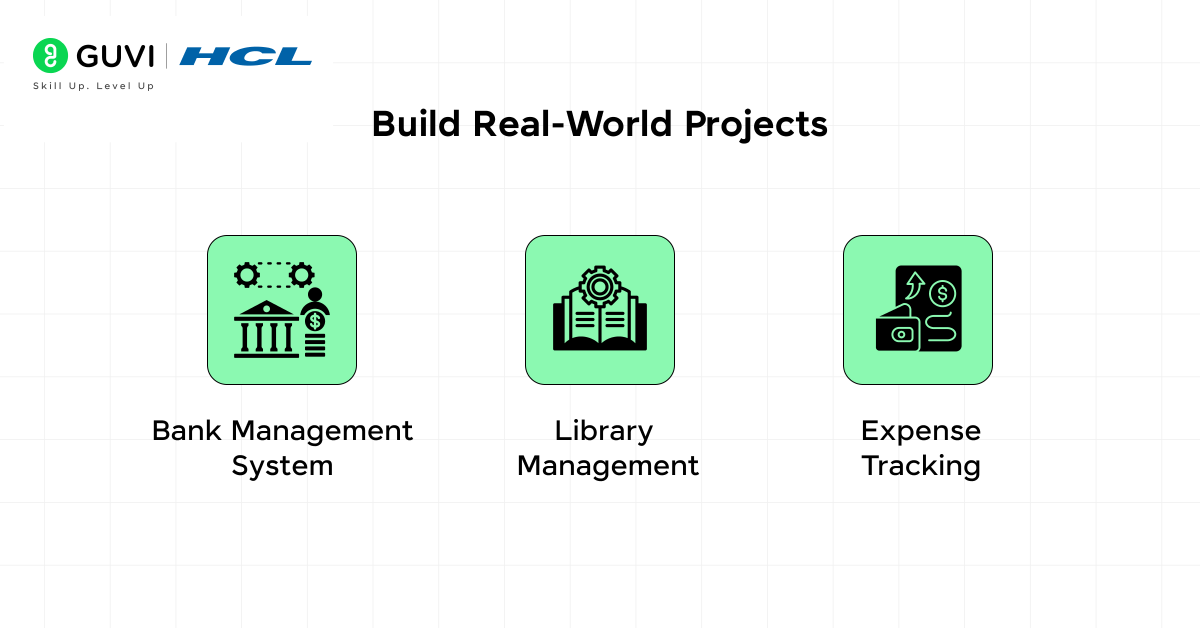
The third step is to build real-world projects using the concepts you’ve learned in step 2. As a beginner, you will tend to get confused about what project you need to build and how to build. There are various blogs, videos, and courses available online to guide you in building your first project.
Some of your first project ideas include a bank management system, a library management system, expense tracking, and much more. These use object-oriented programming concepts to handle the debit, credit, view balance, book details, balance sheet, and expense sheet processes.
If you are confused about picking the project idea, then check out HCL Guvi’s blog on the best project ideas for beginners.
Step 4: Learn Industry-Ready Skills
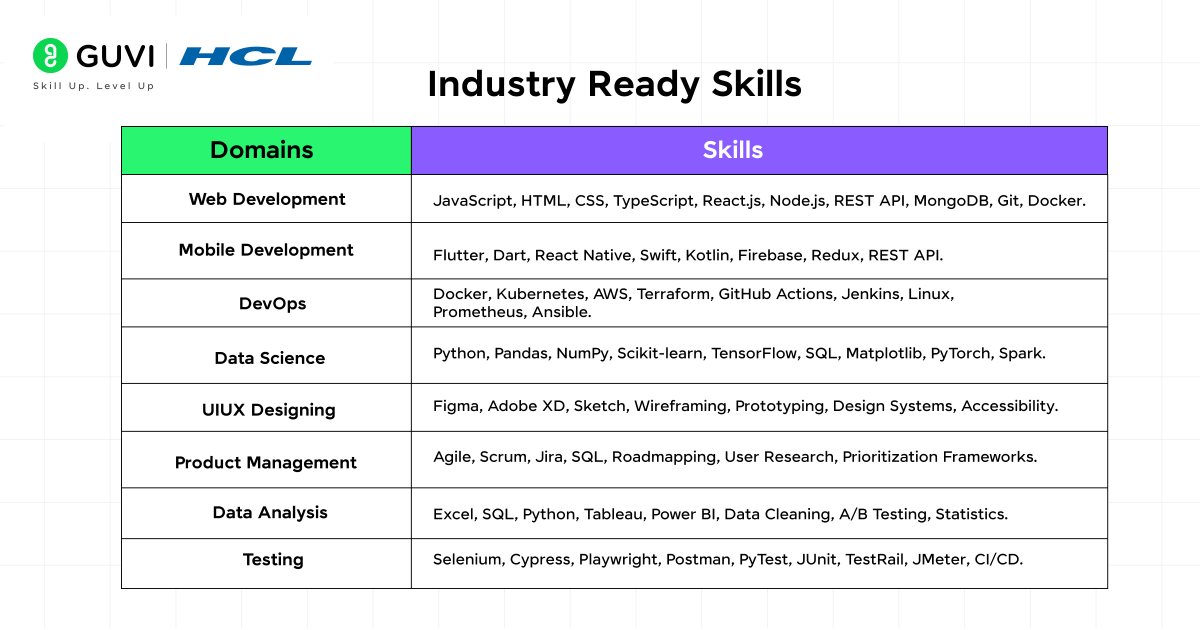
The fourth step is to learn industry-ready skills. The software engineering field is growing rapidly, and every month there new skills are introduced. You have to stay updated on the recent trends and learn the skills without any second thought, then only you will be able to survive in this competitive environment. To make it easy, we have listed the hottest skills for each domain.
- Web Development: JavaScript, HTML, CSS, TypeScript, React.js, Node.js, REST API, MongoDB, Git, Docker.
- Mobile Development: Flutter, Dart, React Native, Swift, Kotlin, Firebase, Redux, REST API.
- DevOps: Docker, Kubernetes, AWS, Terraform, GitHub Actions, Jenkins, Linux, Prometheus, Ansible.
- Data Science: Python, Pandas, NumPy, Scikit-learn, TensorFlow, SQL, Matplotlib, PyTorch, Spark.
- UI/UX Designing: Figma, Adobe XD, Sketch, Wireframing, Prototyping, Design Systems, Accessibility.
- Product Management: Agile, Scrum, Jira, SQL, Roadmapping, User Research, Prioritization Frameworks.
- Data Analysis: Excel, SQL, Python, Tableau, Power BI, Data Cleaning, A/B Testing, Statistics.
- Testing: Selenium, Cypress, Playwright, Postman, PyTest, JUnit, TestRail, JMeter, CI/CD.
Based on the domain you choose, you can learn the skills mentioned above and start experimenting with it by building projects.
2026 tool update: React 19.2 is the current React release, Python 3.14.7 is the latest Python 3.14 maintenance release, Node.js 24.19.0 is the current LTS release, and Kubernetes 1.36.2 is the latest release listed by the Kubernetes project.
If you want to learn the necessary skills required for full-stack development starting from scratch to advance in a single course from India’s top Industry Instructors.
Consider enrolling in HCL GUVI’s Full Stack Development course that not only teaches you everything about full-stack development from scratch, but also provides you with hands-on project experience and industry-grade certificate!
Step 5: Apply and Prepare for Job Interviews
The last step in this process is to apply for the job opportunities and prepare for your upcoming interviews.

The entire interview process for a software engineer is to test your coding and behavioural skills. So, you have to be so good in data structures and algorithms to ace the interview. Concepts like stacks, queue, string manipulation, trees, graphs, and other popular algorithms are really important.
Once you have learned the necessary skills, you can start applying to both internships and full-time opportunities through various hiring platforms such as LinkedIn, Naukri, and respected companies’ careers page. These are the five crucial steps for you to go from mechanical engineering to software engineering.
In the next section, we will look into some of the success stories of engineers from LinkedIn who went from mechanical engineering to software engineering.
Success stories
In this section, let’s look into some of the mechanical engineers like you who successfully switched their career from mechanical engineering to software engineering. If others can do it easily, then you can also do it!
1. Gowtham Thiyada
Gowtham started as a mechanical design engineer but soon realized he wanted a different path. He moved to Bangalore with no coding background and joined a Java course.
The journey was tough because he faced multiple interview rejections and had to work hard on both his coding and communication skills.
His persistence paid off when he landed his first job as a software developer. Today, he encourages others to believe in themselves and stay consistent, even when things get hard.
2. Sudhakar Mirjeli
Sudhakar Mirjeli began his professional life as a mechanical engineer. Over time, he felt drawn to the world of software and decided to leap.
The transition wasn’t easy, it was filled with challenges, learning curves, and big changes but he embraced the journey. Through dedication and continuous growth, he successfully became a software developer.
Sudhakar’s story is a powerful example of how determination and adaptability can lead to a fulfilling career transformation.
3. Vivek Bansal
Vivek Bansal studied mechanical engineering at NIT Allahabad but carved out an entirely different path for himself in tech.
Through consistent hard work, dedication, and smart preparation, he made the switch and now works as a Senior Software Engineer at Uber.
He’s passionate about sharing his learnings from cracking LeetCode problems to investing and growing beyond just a day job. His journey proves that with the right mindset, even a complete career shift is possible.
Similar to these engineers, there are tons of people who successfully transferred their career from mechanical engineering to software engineering. So, when will we hear your story?
Best Software Engineering Paths for Mechanical Engineers in India 2026
Mechanical engineers can explore several software-related career paths in India in 2026. The most suitable option depends on your interests and the amount of programming you want to do.
- Full-Stack Development: Suitable if you want to build websites and complete web applications.
- Backend Development: Suitable if you enjoy programming, databases, APIs and application logic.
- Data Science: Suitable if you enjoy mathematics, statistics, programming and working with data.
- DevOps: Suitable if you are interested in automation, cloud platforms and software infrastructure.
- Testing: Suitable if you enjoy finding bugs, testing applications and improving software quality.
- Embedded Systems: Suitable if you want to combine your mechanical engineering background with programming, electronics and hardware.
For mechanical engineers, embedded systems, automation and software roles connected to manufacturing, automotive and robotics can also provide an opportunity to combine existing engineering knowledge with software skills.
Which Software Engineering Field Is Best for Mechanical Engineers?
| Career path | Coding level | Difficulty | Mechanical background relevance |
| Full-stack | High | Medium | Low |
| Backend | High | Medium–High | Low |
| Data Science | High | High | Medium |
| DevOps | Medium–High | High | Low |
| Testing | Medium | Medium | Low |
| Embedded Systems | High | High | High |
| Robotics/Automation | High | High | Very High |
How Long Does It Take to Become a Software Engineer From Mechanical Engineering?
| Stage | Approximate time |
| Programming fundamentals | 4-8 weeks |
| DSA and CS fundamentals | 6-12 weeks |
| Framework/stack | 6-10 weeks |
| Projects | 4-8 weeks |
| Interview preparation | 4-8 weeks |
The timeline depends heavily on your existing coding knowledge, available study time, chosen role, and interview requirements.
Do Mechanical Engineers Need a Computer Science Degree to Become Software Engineers?
No, not necessarily.
- degree requirements vary by employer
- some companies filter candidates by degree
- skills and projects matter
- internships can help
- DSA/interview preparation matters
- relevant experience becomes increasingly valuable
90-Day Roadmap from Mechanical Engineering to Software Engineering
If you want a simple starting plan, use this 90-day framework.
Month 1: Build the Foundation
Weeks 1-2
- Choose your target software role
- Select one programming language
- Learn syntax and basic programming
- Practice simple coding problems
Weeks 3-4
- Learn OOP
- Start Git and GitHub
- Learn SQL fundamentals
- Build one small project
Goal: Become comfortable writing basic programs independently.
Month 2: Build Technical Skills
Weeks 5-6
- Learn data structures
- Practice algorithms
- Solve coding problems regularly
Weeks 7-8
- Start your target framework or technology
- Learn APIs
- Build a medium-sized project
Goal: Move from isolated coding exercises to practical software development.
Month 3: Build Your Job Profile
Weeks 9-10
- Complete a major project
- Upload projects to GitHub
- Improve README files
- Document your technical decisions
Weeks 11-12
- Create a software-focused resume
- Practice technical interviews
- Practice explaining your career transition
- Start applying for relevant roles
- Network with developers and recruiters
Goal: Have a portfolio and resume that demonstrate your software capabilities.
How to Explain Your Mechanical-to-Software Career Switch in an Interview
One of the first questions you may receive is:
“Why did you switch from mechanical engineering to software?”
Avoid saying:
“Mechanical engineering has no scope.”
Instead, explain the transition positively.
A strong structure is:
Interest → Learning → Projects → Transferable skills → Career goal
For example:
“My mechanical engineering background helped me develop analytical and problem-solving skills, but during my engineering journey I became increasingly interested in programming and software development.
I started learning programming, built projects, worked with databases and APIs, and realized that software engineering was the direction I wanted to pursue professionally.
I’m now looking to apply both my engineering problem-solving approach and my software development skills in a software role.”
The exact answer should reflect your real experience.
Software Engineer Salary in India in 2026
The salary you can expect after moving from mechanical engineering to software engineering depends on your skills, experience, company, location and role.
Current 2026 salary data shows that software engineering compensation in India varies widely, with recent Glassdoor salary submissions showing software engineers earning anywhere from around ₹4 LPA to ₹28 LPA across different experience levels and locations.
As a career switcher, your first software role may be closer to an entry-level software engineering salary rather than being based entirely on your previous mechanical engineering experience.
| Experience level | Indicative salary range in India, 2026 |
| Entry-level / career switcher | ₹10-11 LPA |
| Junior software engineer | ₹4.3-4.8 LPA |
| Mid-level software engineer | ₹15.4-17.8+ LPA |
| Senior software engineer | ₹16.6-18.4+ LPA |
These are indicative ranges and can vary significantly depending on the company, location, technical skills and interview performance.
Conclusion
In conclusion, there are only 5 simple steps to achieve your dream transition from mechanical engineering to software engineering.
From choosing the right niche, learning the necessary and trending skills, and building projects you can also become one of the successful engineers who transferred their career towards technology.
Throughout this journey, consistency, resilience and motivation plays a major role in reaching a successful end. After achieving a successful career in technology, share your journey with us through comments!
FAQ
Can mechanical engineers become software engineers?
Yes. Mechanical engineers can transition into software engineering by learning programming, computer science fundamentals, software development tools, and job-specific technologies. Building practical projects and preparing for technical interviews are also important.
Do mechanical engineers need a computer science degree to become software engineers?
No, not necessarily. Some employers accept candidates from different engineering backgrounds, while others have specific degree requirements. Always check the education criteria in the job description.
Which software engineering field is best for mechanical engineers?
There is no single best field. Embedded systems, robotics, and automation can make strong use of a mechanical engineering background, while full-stack, backend, testing, DevOps, and data-related roles can be suitable if you want to move further into software.
How long does it take to switch from mechanical engineering to software engineering?
The timeline varies. A focused learner may become job-ready in several months, while part-time learners may need longer. Your target role, existing coding knowledge, learning schedule, projects, and interview preparation all affect the timeline.
What skills should mechanical engineers learn to get software jobs?
Start with one programming language, OOP, DSA, SQL, Git/GitHub, APIs, debugging, testing, and software development fundamentals. Then learn the technologies required for your chosen role.
Can a mechanical engineer get a software job without experience?
Yes, but the first job can be challenging. Build 2–3 strong projects, maintain a GitHub portfolio, practice coding interviews, apply for internships and entry-level positions, and demonstrate your software skills clearly on your resume.
Is software engineering a good career switch for mechanical engineers?
It can be a good option for mechanical engineers who genuinely enjoy programming and are willing to learn software development. It should be viewed as a skill-building career transition rather than a quick way to change industries.
Success Stories

About the Author
Hashmithaa
Hi, I’m Hashmithaa — a content writer with a love for words. Writing isn’t just what I do; it’s how I connect, communicate, and create meaning in a noisy digital world. And if my words help someone make a better decision, learn something new, or feel more confident, then I’ve done my job well.
View all posts by Hashmithaa
Connect with me @

Did you enjoy this article?
Comments
















Excellent for mechanical engineering candidates who want to be career in software engineering.