


Mechanical Engineering Articles
CAD Designer Resume Examples & Tips to Land Your Dream Job
CAD Designer Career in India: Salary, Job Roles & Skills
CAD vs CAM: Key Differences & Why It Matters in Design and Manufacturing

Get In Touch For Details! Request More Information
How to Prepare for Mechanical Engineering Technical Interview Questions: A Practical Guide
Feb 06, 2026 6 Min Read 1522 Views
(Last Updated)
Are you preparing for a Mechanical Engineering interview but not quite sure where to begin? The competition for Mechanical Engineering positions has grown, and evolving industry expectations, knowing what to study and how to prepare can feel overwhelming. This blog will help simplify how to prepare for your Mechanical Engineering Technical Interview by breaking down the structure and skills that Companies are looking for, and the subject areas you need to be an expert in.
In this book, you will find practical tips and problem-solving methods, as well as actual interview questions to help you walk into your interview feeling confident and well-prepared.
Quick answer:
Preparing for a mechanical engineering technical interview involves strengthening core mechanical concepts, practising real-world problem-solving, revising formulas, working on past interview questions, improving communication skills, and building strong project explanations.
Table of contents
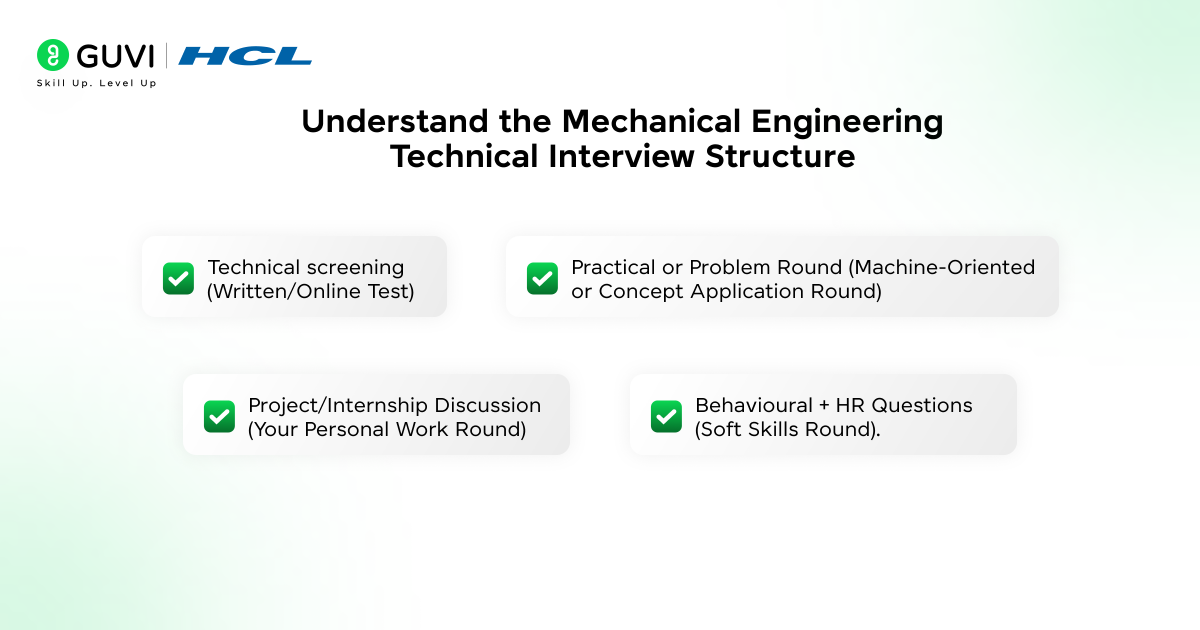
- Understand the Mechanical Engineering Technical Interview Structure
- Technical screening (Written/Online Test)
- Practical or Problem Round (Machine-Oriented or Concept Application Round)
- Project/Internship Discussion (Your Personal Work Round)
- Behavioural + HR Questions (Soft Skills Round).
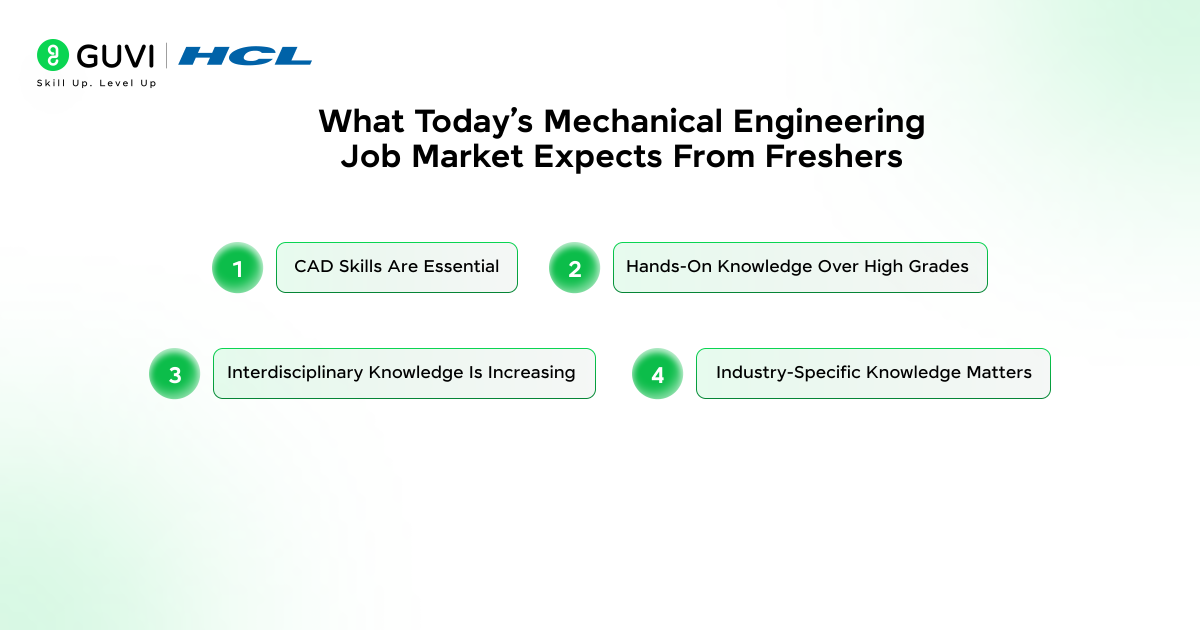
- What Today’s Mechanical Engineering Job Market Expects From Freshers
- CAD Skills Are Essential
- Hands-On Knowledge Over High Grades
- Interdisciplinary Knowledge Is Increasing
- Industry-Specific Knowledge Matters
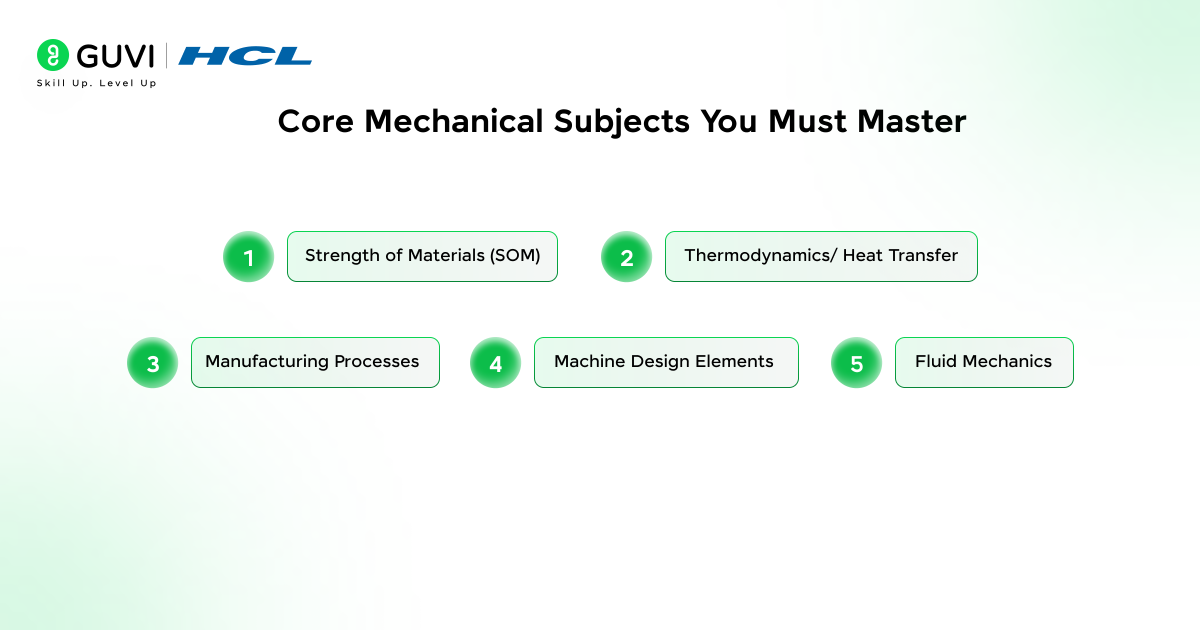
- Core Mechanical Subjects You Must Master (Most Asked Topics in Interviews)
- Strength of Materials (SOM)
- Thermodynamics/ Heat Transfer.
- Manufacturing Processes
- Machine Design Elements
- Fluid Mechanics
- Strengthen Your Problem-Solving Approach
- Build Strong Knowledge of Mechanical Software Tools
- Learn Practical Mechanical Engineering Application
- Improve Communication Skills
- Practice Mock Interviews
- Most Common Mechanical Engineering Interview Questions (With Answers)
- Wrapping it up:
- FAQs
- How do I start preparing for a mechanical engineering technical interview?
- Are CAD skills necessary for mechanical engineering jobs?
- How should I prepare my academic project for the interview?
- Which subjects are most commonly asked in interviews?
1. Understand the Mechanical Engineering Technical Interview Structure
To prepare to take your mechanical engineering technical interview, the first thing you need is to know the way companies organise their interview. Nearly all the engineering companies in the field of manufacturing, automotive, aerospace, HVAC, power plants, and design have the same structure. Knowing the structure will make you ready to prepare the appropriate topics and approach every round with no fear.
Technical screening (Written/Online Test)
This is normally the initial stage in the interview. This round aims at testing the strength of your basics. You can expect:
- Engineering basics: SOM questions: Thermodynamics, Fluid Mechanics, Manufacturing, Kinematics, Heat Transfer, and Engineering Drawing.
- Application-based reasoning: These questions are used to test whether you have understood concepts or you have memorised them.
- Mathematical and analytical skills: You can be asked to find the solution to numerical problems on stress, heat, flowing fluid, or machine parts.
- Speed and accuracy: As MCQs or short problems are given by many companies, you are required to respond to technical interview questions in mechanical engineering swiftly and accurately.
In this round, weak applicants get filtered, and hence, a solid ground is very crucial.
Also read: Promising Scope of Mechanical Engineering in India in 2026
Practical or Problem Round (Machine-Oriented or Concept Application Round)
Once you have passed your fundamental tests, companies would like to test your ability to think like a real engineer. Here, the focus is on:
- Numerical: You might have to calculate stress, strain, torque, efficiency, force of friction, heat transfer, etc.
- Diagram interpretation: They can provide machine parts, engineering drawings, flow diagrams or thermodynamic cycle graphs to which you can be asked to provide a description.
- Machine component analysis: You can expect questions on gears, bearings, shafts, springs, valves, pumps, compressors, and engines.
- Calculation of stress and strain: It allows them to know whether you can design or analyse actual components.
- Explanation of thermodynamic cycles: Otto cycle, Diesel cycle, refrigeration cycle, Brayton cycle- all these are highly abundant.
This round evaluates the level of knowledge that you have acquired about the operation of machines, your ability to interpret a problem quickly and to relate theory to practical engineering.
Also read: 6 Proven Steps in Mechanical Engineering Career Roadmap
Project/Internship Discussion (Your Personal Work Round)
This is among the key aspects of a mechanical engineering interview. Here, interviewers test:
- Why you selected your project: They are interested in knowing why you selected it.
- Practical implementation: They verify that your project involves a real-life engineering problem.
- Technologies involved: CAD tools, simulation tools or mechanical concepts used.
- Difficulties encountered: Interviewers desire to know how you go about solving problems.
- What you learnt: This demonstrates your growth mentality and technical maturity.
Project-based questions are found in the majority of mechanical engineering interviews since your project is the representation of your actual skills in engineering. Thus, in your mechanical engineering technical interview preparation, you will have to revise your project extensively.

Behavioural + HR Questions (Soft Skills Round).
Although mechanical engineering is a technical course, employers are also concerned with your character and capacity to work as a team. HR questions test:
- Communication: Are you able to break down complex things into simple ones?
- Teamwork: Mechanical engineers usually do their work in teams of design, production or maintenance.
- Decision making: How well you make decisions when it counts.
- Flexibility: How flexible you are to new machines, tools, environments and responsibilities.
This round will make sure you are a person who can perform at work in a company, not a paper.
Also read: 8 Important Skills Required for Mechanical Engineering
2. What Today’s Mechanical Engineering Job Market Expects From Freshers
You have to know what companies really want in 2026 before practising mechanical engineering technical interview questions.
1. CAD Skills Are Essential
Almost every fresher reports the same experience:
The skills expected by companies are:
- SolidWorks
- AutoCAD
- CATIA or Fusion 360
- Drawing interpretation engineering.
- GD&T basics
Speed, precision and design reasoning are more important than software expertise.
2. Hands-On Knowledge Over High Grades
It will not matter that you have a CGPA when you fail to explain:
- Why did a component fail
- Effects of design change on manufacturability.
- The reason why you have chosen a particular material.
Those freshers who have experience in a workshop or mini-projects, or internships have definite advantages.
3. Interdisciplinary Knowledge Is Increasing
As automation, electric vehicles and mechatronics become more popular every day, employers seek an applicant familiar with:
- Basic electronics
- Arduino-level programming
- Sensors & control systems
You do not have to be an expert, but just enough to facilitate cross-functional teams.
4. Industry-Specific Knowledge Matters
The expectation of each sector is different:
- Automotive: tolerance stack up, GD & T, sheet metal basics.
- Production: DFM, manufacturing, quality controls.
- HVAC: principles of heat loads, refrigerant cycles.
- Energy: thermodynamic cycles, material durability.
Also read: Mechanical Engineering Careers in 2026: The Top Jobs
3. Core Mechanical Subjects You Must Master (Most Asked Topics in Interviews)
Companies test your fundamentals and your ability to apply them. Here are the most important technical areas:
1. Strength of Materials (SOM)
Interviewers would want to know:
- Stress–strain behaviour
- Bending moment & shear force
- Failure theories of von Mises, in particular
- Factor of safety
- Torsional analysis
Real interview example:
Determine the area of greatest stress in this cantilever and discuss why.
2.Thermodynamics/ Heat Transfer.
You must understand:
- Laws of thermodynamics
- Entropy, enthalpy
- Cycles of refrigeration and air-conditioning.
- Radiation, convection, conduction.
- Heat exchanger basics
Real interview example:
Why do fins increase the transfer of heat? In what areas would you not use them?
Also read: 12 Best Books to Learn Mechanical Engineering
3. Manufacturing Processes
Business requires you to be able to connect theory with practical production.
Know about:
- Machining, casting, and welding
- CNC basics
- Additive manufacturing
- DFM (Design for Manufacturing)
Real interview example:
What is the most appropriate manufacturing process in the case of high-volume production of this part?
4. Machine Design Elements
Topics you must revise:
- Gears
- Bearings & lubrication
- Springs
- Shaft design
- Bolted joints
Interview questions favouring multi-comparative design options are popular.
5. Fluid Mechanics
Frequently asked areas:
- Bernoulli’s principle
- Pump selection
- Hydraulic circuits
- Pressure drop
- Flow regimes
Also read: 9 Impressive Real-world Applications of Mechanical Engineering
4. Strengthen Your Problem-Solving Approach
Mechanical engineering interviews are not just about answering correctly; they’re about showing how you think. Interviewers are more interested in your problem-solving process than just the final numerical output.
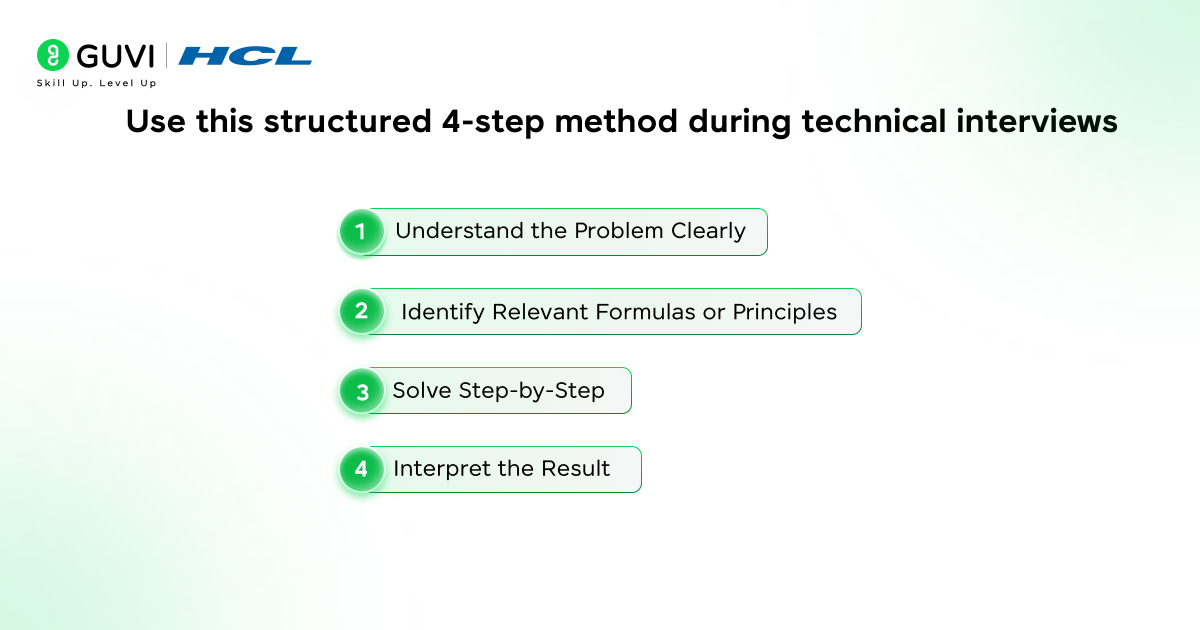
Step 1: Understand the Problem Clearly
- Read the question carefully.
- Determine what is needed and what is given.
- Clarify assumptions where necessary.
This eliminates unnecessary errors.
Step 2: Identify Relevant Formulas or Principles
- Select the easiest and most appropriate formula.
- Relate the problem to the appropriate mechanical concept (SOM, Thermodynamics, FM, etc.).
This shows effective underlying knowledge.
Step 3: Solve Step-by-Step
- Write formulae and then replace values.
- Indicate unit conversions.
- Make your calculations tidy and organised.
The interviewers like systematic thinking.
Step 4: Interpret the Result
Explain what the final number means. For example:
- The value of this stress is less than the allowable limit, and as such, the design is safe.
- The number of Reynolds is used to indicate turbulent flow, meaning the level of friction losses will be increased.
Using this technique greatly improves your mechanical engineering technical interview preparation and makes you stand out as a clear thinker.
Also read: Best Way to Learn Mechanical Engineering
5. Build Strong Knowledge of Mechanical Software Tools
Today’s mechanical engineering jobs are heavily software-driven. Companies expect freshers to know at least one CAD software and one simulation or analysis tool..
Software tools that are frequently used:
- AutoCAD
- SolidWorks
- CATIA
- Siemens NX
- Fusion 360
- ANSYS (FEA + CFD)
- MATLAB (Math & simulation)
6. Learn Practical Mechanical Engineering Application
Mechanical engineering is a practical field. Companies prefer candidates who understand how machines work, not just formulas.
Try relating everything you study to real system,s such as:
- Automobiles: brake systems, transmissions, cooling systems
- Manufacturing lines: conveyors, jigs, fixtures, automation.
- Turbines: steam turbines, gas turbines.
- Compressors: rotary and reciprocating.
- Boilers: energy cycles, heat transfer.
- Engines: efficiency, combustion.
- Pumps: centrifugal and positive displacement.
- CNC machines: machining fundamentals, tolerances.
7. Improve Communication Skills
Communication is one of the key strengths in a mechanical engineering interview. Your technical abilities might be good but feebly explained remarks may decrease your prospects.
Mechanical Engineering Interview Tips for Better Communication:
- Keep answers short but clear
- Do not use too technical terms unless necessary.
- Talk slowly but with confidence.
- Eye contact should be natural.
- Expound mechanisms using simple illustrations.
- Think it through before responding.
- Arguing is not a good thing; talk nicely.
Effective communication is the way to explain the questions of the mechanical engineering technical interview and the project description clearly.
- Over 65% of mechanical engineering interview questions come from just five core subjects: SOM, Thermodynamics, Machine Design, Manufacturing, and Fluid Mechanics.
- Many companies now include a 30-minute CAD test because it reveals far more about a fresher’s practical skills than their résumé does.
- A study of Indian engineering placements shows that project explanation skills influence selection decisions more than CGPA for mechanical roles.
8. Practice Mock Interviews
Mocked interviews are very critical as they:
- Reduce nervousness
- Better your explanatory powers.
- Help identify weak areas
- Gain confidence in actual interviewing.
You can practise with:
- Friends
- Seniors
- College faculty
- Mock interview Websites.
- Blogging or video conferencing on phone or laptop.
Also read: 6 Mechanical Engineering Webinars and Workshops That You Should Know
Focus on improving:
- Problem-solving speed
- Formula recall
- Numerical calculations
- Explaining your project
- Body language and voice control.
Confidence and interview preparation are achieved through practice.
Most Common Mechanical Engineering Interview Questions (With Answers)
They are some of the most commonly used mechanical engineering technical interview questions,, particularly for freshers who are applying in the field of automotive, manufacturing, HVAC, design, and production.
1. Why is the Otto cycle more effective than the Diesel cycle?
Otto cycle is more efficient due to constant-volume heat addition, a higher increase of temperature, and, consequently, a higher thermal efficiency, at the same compression ratio. Constant pressure heat addition in the Diesel cycle decreases efficiency.
2. What is the difference between strain and stress?
- Stress: Internal force per unit area in a material (σ = F/A).
- Strain: Deformation per unit length (ε = ΔL/L).
Stress determines the force exerted upon something; strain determines the change that results due to the force exerted.
3. Can you explain the working of a four-stroke engine?
- Intake: Air fuel mixture enters the cylinder.
- Compression: It is a compressed mixture.
- Power: Spark produces fire, igniting the mixture, and pushes the piston down.
- Exhaust: Burnt gases exit the cylinder.
One complete cycle = four strokes.
4. What is the Reynolds number, and why is it important?
Reynolds number identifies the laminar or turbulent fluid flow.
- Re < 2000 → Laminar
- Re > 4000 → Turbulent
It helps engineers to create efficient piping, pump systems and aerodynamic parts.
5. What is the reason that different metals have different thermal conductivity?
Metals with higher numbers of free electrons have better conductivity to heat. Copper and silver are readily conductive conductors, since the electrons are free to move and conduct thermal energy. In conductivity, impurities and atomic structure also play a role.
Also read: Best Websites to Learn Mechanical Engineering
6. What are the most common types of gears?
- Spur Gear → Parallel shafts
- Spiral Gear → Silent and smooth transmission.
- Bevel Gear → Shifting shafts.
- Worm Gear → Large reduction ratios.
- Rack and Pinion → Converts Linear to Rotation.
- Planetary Gear → High torque, automotive systems.
7. What is tolerancing, and why is it significant to design?
Tolerancing is used to define the amount of variation that should be provided in the dimensions of a part. It provides the correct fit, minimises rejects, enhances manufacturability, and ensures uniform quality during large-scale manufacturing.
8. Explain Bernoulli’s theorem in simple terms.
According to Bernoulli’s theorem, the higher the velocity of the fluid in question, the lower the pressure, and the other way around.
It is applied in the design of aircraft wings, carburettors, pumps and venturi meters.
9. What is the difference between conduction, convection and radiation?
- Conduction: heat transfer through Solid transfer (vibrations).
- Convection: The process by which heat can be moved through fluids by movement.
- Radiation: The transfer of heat using electromagnetic waves; a medium was not required.
Example:
- Heat pan touched by hand, conduction.
- Rising water is caused by water convection.
- Radiation is the heat that the sun sends to the Earth.
10. What factors do you consider when selecting a material for a mechanical part?
- Engineers usually consider:
- Strength
- Hardness
- Toughness
- Corrosion resistance
- Cost
- Availability
- Machinability
- Weight
For example, lightweight items are selected to be made of aluminium; high-strength items are selected to be made of steel.
Ready to ace your Mechanical Engineering Technical Interview? Join HCL GUVI’s Interview Mastery Course and step confidently into your dream engineering career!
Wrapping it up:
So, how do you ensure you’re truly ready for a mechanical engineering technical interview? Focus on strong fundamentals, clear explanations, practical examples, and consistent practice. Revise key subjects, build your CAD skills, prepare your projects well, and rehearse mock interviews to increase confidence. With the right strategy and steady preparation, you’ll be able to answer mechanical engineering technical interview questions confidently and impress recruiters with both your knowledge and clarity.
FAQs
1. How do I start preparing for a mechanical engineering technical interview?
Study your core subjects, review key formulas, practice typical technical interview questions, and develop your problem-solving abilities.
2. Are CAD skills necessary for mechanical engineering jobs?
Yes, most employers expect candidates to have experience using SolidWorks, AutoCAD, CATIA, and/or Fusion 360 CAD programs.
3. How should I prepare my academic project for the interview?
You should know the purpose of the project, the tools/analyses used, the calculations performed, the final results obtained, and how your project relates to the real world.
4. Which subjects are most commonly asked in interviews?
SOM, Thermodynamics, Fluid Mechanics, Machine Design, Manufacturing, and Heat Transfer.
Success Stories

About the Author
Vishalini Devarajan
An Aerospace Engineer turned content writer, I focus on making complex concepts easy to understand through well-structured, reader-friendly blogs. Whether it’s a technical topic or a non-technical one, I love creating content that is clear, engaging, and impactful.
View all posts by Vishalini Devarajan
Connect with me @











Did you enjoy this article?