


Software Development Articles
How to Read and Understand System Design Diagrams?
System Engineer Roles and Responsibilities: 12 Proven Duties for Growth
SAP Consultant Roles and Responsibilities: 12 Proven Duties for Growth and Success
Network Engineer Roles and Responsibilities: 12 Essential Duties for Success


Get In Touch For Details! Request More Information

Load Balancing Strategies Every Developer Should Know
Jul 23, 2026 4 Min Read 616 Views
(Last Updated)
Many developers build applications that work perfectly under low traffic but collapse the moment user numbers spike. Load balancing strategies solve exactly this problem by spreading requests intelligently across multiple servers, keeping your application fast and available under any load. Understanding load balancing is essential not just for system design interviews but for building production-grade applications that scale reliably in the real world.
Table of contents
- Quick TL;DR
- What Is Load Balancing?
- Why Load Balancing Strategies Matter
- Types of Load Balancing Strategies
- Load Balancing Strategy Comparison
- Hardware vs Software Load Balancers
- Load Balancing in the Cloud
- Common Mistakes When Implementing Load Balancing
- Conclusion
- FAQs
- What is load balancing in simple terms?
- What are the most common load balancing strategies?
- What is the difference between Round Robin and Least Connections load balancing?
- What is sticky session?
- What is the difference between Layer 4 and Layer 7 load balancing?
- Which AWS load balancer for web apps?
- How do health checks work?
- Can load balancing help with DDoS protection?
Quick TL;DR
- Load balancing strategies are methods used to distribute incoming network traffic across multiple servers to ensure no single server is overwhelmed.
- Common strategies include Round Robin, Least Connections, IP Hash, Weighted Round Robin, and Random.
- Choosing the right load balancing strategy depends on your traffic patterns, server capacity, and session requirements.
- Load balancing is a core concept in system design interviews and a critical component of every scalable, high-availability application in production.
Want to master system design, cloud architecture, and scalable application patterns used in real production systems? Explore HCL GUVI’s Software Development Engineer Course, designed for developers who want to build strong backend and system design skills from the ground up.
What Is Load Balancing?
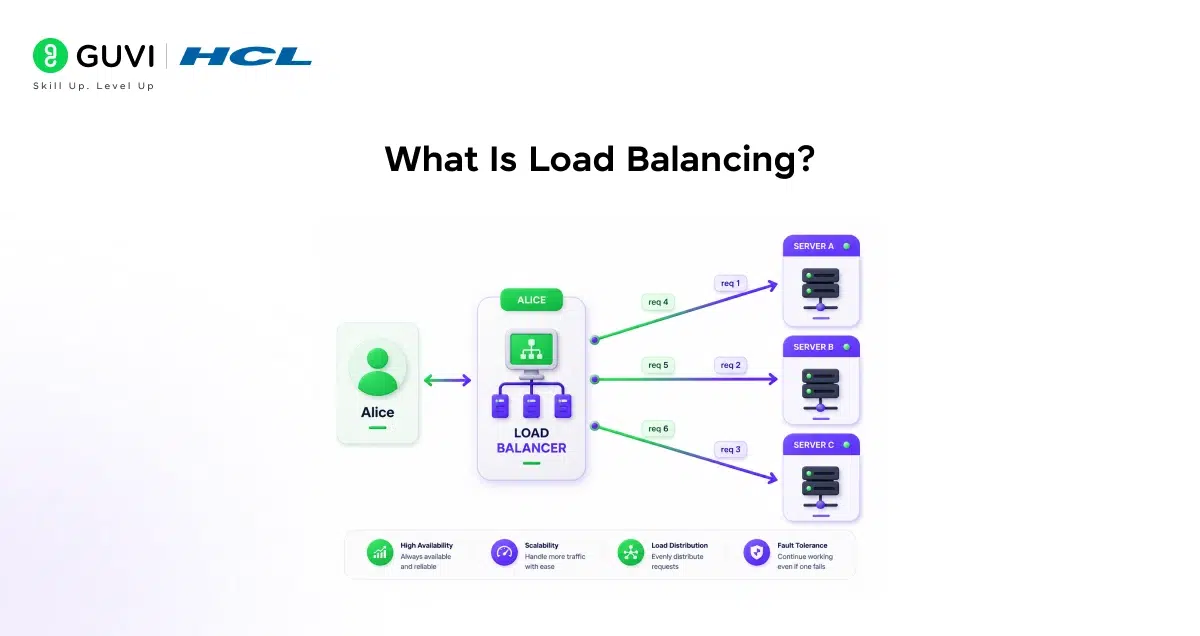
Load balancing is the process of distributing incoming client requests across multiple backend servers to ensure no single server bears too much load. A load balancer sits between the client and the server pool, receiving all incoming requests and forwarding them based on a chosen strategy.
A load balancer provides:
- High availability by routing traffic away from failed servers
- Scalability by distributing load across multiple instances
- Improved performance by preventing any one server from becoming a bottleneck
- Health monitoring by removing unhealthy servers from the pool automatically
Read More: Job-Focused System Design Roadmap (2026)
Why Load Balancing Strategies Matter
Not all load balancing strategies work equally well for every application. A strategy that works perfectly for a stateless API may cause session errors in a stateful web application. A strategy optimised for equal traffic may be inefficient when servers have different processing capacities.
Choosing the wrong strategy leads to:
- Uneven resource utilisation across servers
- Session loss for logged-in users
- Increased latency during traffic spikes
- Cascading failures when one server gets overwhelmed
Understanding each strategy and when to apply it is what separates a well-architected system from one that breaks under pressure.
Types of Load Balancing Strategies
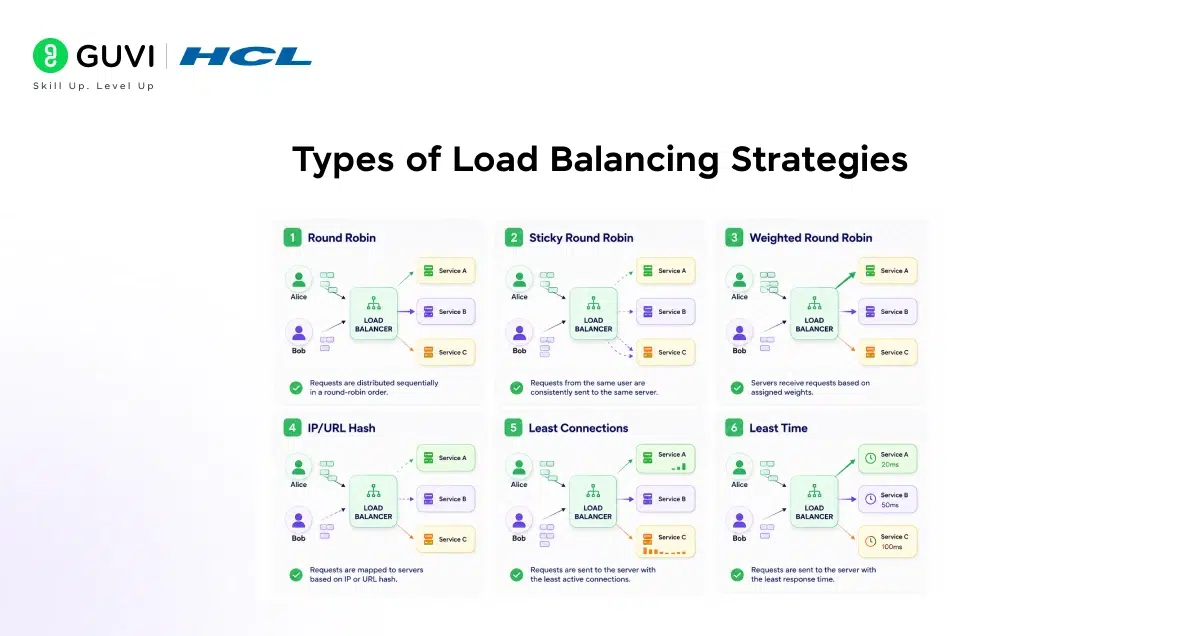
- Round Robin
Round Robin is the simplest load balancing strategy. Requests are distributed to each server in a fixed cyclic order. Server 1 gets the first request, Server 2 gets the second, Server 3 gets the third, and then the cycle repeats.
Best for: Servers with equal capacity handling stateless requests of similar processing time.
- Weighted Round Robin
Weighted Round Robin extends Round Robin by assigning a weight to each server based on its capacity. A server with a weight of 3 receives three requests for every one request sent to a server with a weight of
Best for: Server pools with mixed hardware where some servers are more powerful than others.
- Least Connections
The load balancer tracks the number of active connections to each server and routes each new request to the server with the fewest current connections. This is more dynamic than Round Robin because it accounts for the actual state of each server.
Best for: Applications where requests have variable processing times, such as APIs with mixed lightweight and heavy operations.
- Least Response Time
This strategy combines connection count with server response time. The load balancer sends requests to the server with the fewest active connections and the lowest average response time, selecting the most available and fastest server at any given moment.
Best for: Latency-sensitive applications like real-time dashboards, trading platforms, and live-streaming services.
- IP Hash
IP Hash uses the client’s IP address to compute a hash value that determines which server handles the request. The same client IP always maps to the same server as long as the server is available.
Best for: Applications that require session persistence, such as shopping carts, login sessions, and user-specific caching.
- Random
Requests are assigned to servers chosen at random. Random load balancing is simple to implement and works well when servers are homogeneous and traffic is evenly distributed over time.
Best for: Simple stateless services where predictability is not required.
Want to master system design, cloud architecture, and scalable application patterns used in real production systems? Explore HCL GUVI’s Software Development Engineer Course, designed for developers who want to build strong backend and system design skills from the ground up.
Load Balancing Strategy Comparison
| Strategy | Accounts for Server Load | Session Persistence | Best Use Case |
| Round Robin | No | No | Equal servers, stateless APIs |
| Weighted Round Robin | Partially | No | Mixed capacity server pools |
| Least Connections | Yes | No | Variable request processing time |
| Least Response Time | Yes | No | Latency-sensitive applications |
| IP Hash | No | Yes | Session-based applications |
| Random | No | No | Simple stateless services |
According to industry reports from NGINX, a significant share of the world’s busiest websites rely on NGINX as a load balancer and reverse proxy. Among the various load-balancing algorithms available, Round Robin and Least Connections remain the most widely used in production environments. Round Robin distributes requests evenly across servers in sequence, making it simple and effective for servers with similar capacity. In contrast, Least Connections dynamically routes traffic to the server handling the fewest active connections, making it particularly well suited for API-driven and variable-workload architectures where request processing times can differ significantly. Choosing the right load-balancing strategy can have a major impact on application performance, scalability, and resource utilization.

Hardware vs Software Load Balancers
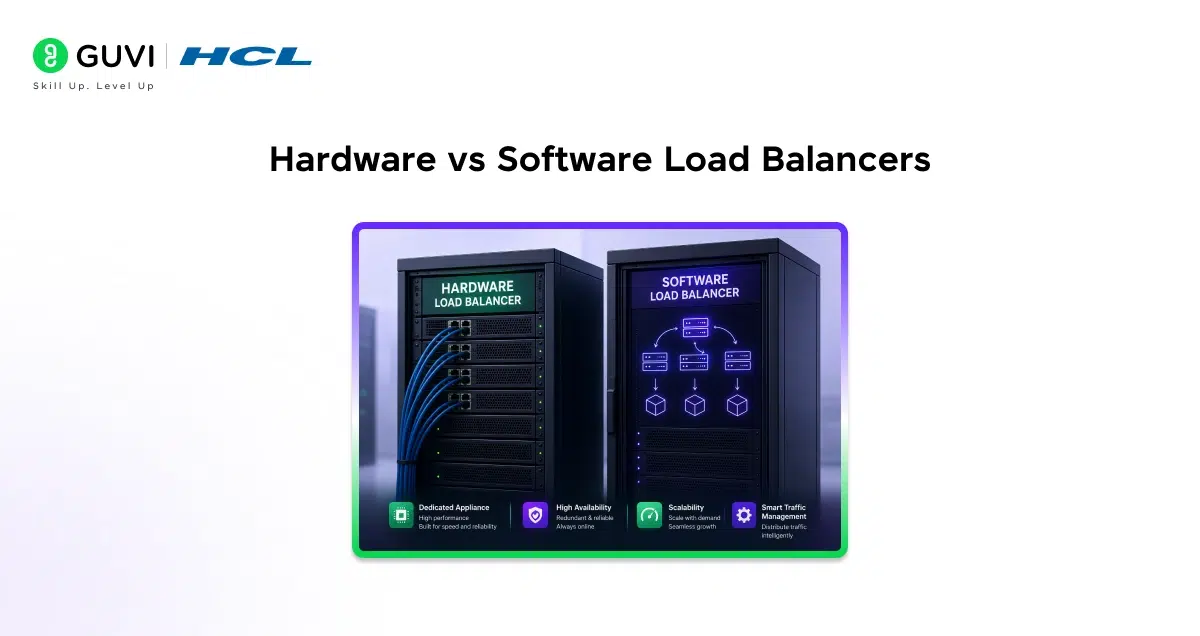
Load balancers come in two forms: hardware and software.
- Hardware load balancers: They are physical appliances dedicated to traffic distribution. They offer very high throughput and low latency but are expensive, difficult to scale, and require specialist configuration. They are typically used in large enterprise data centres.
- Software load balancers: They run on standard servers or virtual machines and are far more flexible and cost-effective. Popular software load balancers include NGINX, HAProxy, and AWS Elastic Load Balancer. Most modern applications use software or cloud-based load balancers because they integrate easily with auto-scaling and infrastructure-as-code tools.
Load Balancing in the Cloud
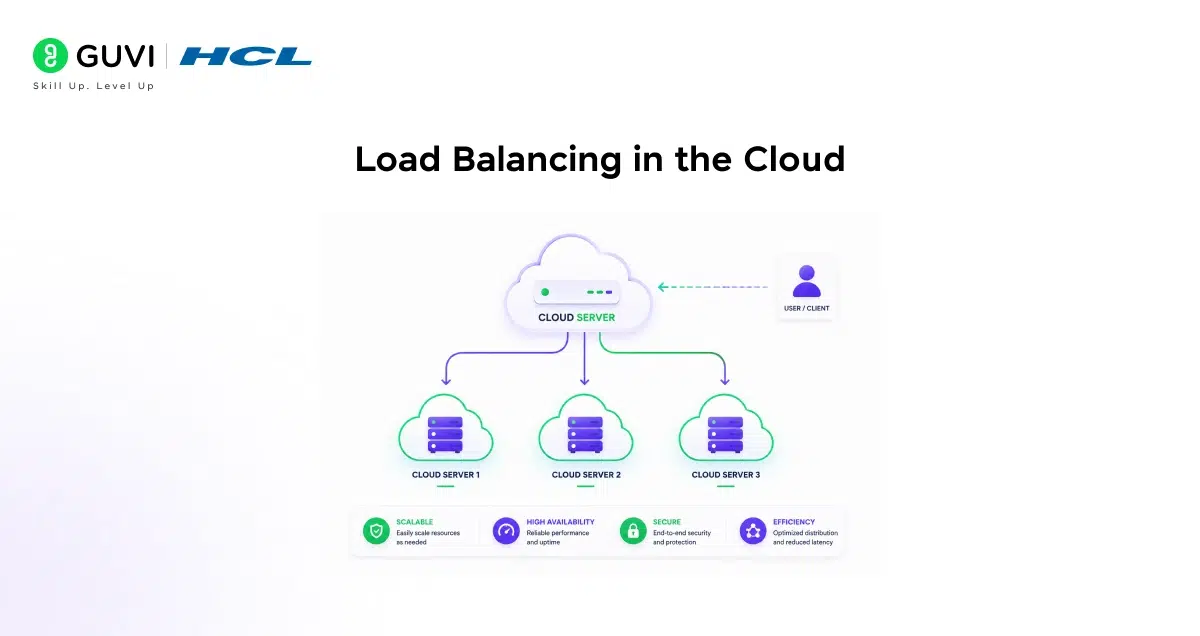
Cloud providers offer managed load balancing services that handle configuration, health checks, and scaling automatically.
AWS provides three types of load balancers through its Elastic Load Balancing service:
- Application Load Balancer (ALB): Operates at Layer 7, routes based on HTTP content such as URL paths and headers. Best for web applications and microservices.
- Network Load Balancer (NLB): Operates at Layer 4, handles millions of requests per second with ultra-low latency. Best for TCP and UDP traffic.
- Gateway Load Balancer (GWLB): Used for deploying and scaling third-party virtual network appliances like firewalls and intrusion detection systems.
Google Cloud and Azure offer equivalent managed load balancing services with similar capabilities.
AWS Elastic Load Balancer (ELB) automatically distributes incoming application traffic across multiple targets, including EC2 instances, containers, and IP addresses spread across one or more Availability Zones. To maintain high availability, ELB continuously performs health checks on registered targets and automatically stops routing requests to any target that fails those checks. Once a target recovers, it can be returned to service without manual intervention. This combination of intelligent traffic distribution, automated failover, and seamless integration with other AWS services makes ELB a foundational component of many highly available, cloud-native architectures.
Common Mistakes When Implementing Load Balancing
1. Round Robin for Stateful Apps: Round Robin sends each request to a different server, breaking session continuity. Use IP hash or sticky sessions instead.
2. No Health Checks: Without them, the load balancer keeps sending traffic to failed or slow servers. Configure health endpoints and failure thresholds to remove unhealthy servers fast.
3. Missing Connection Draining: Abruptly removing a server kills in-progress requests. Enable connection draining (deregistration delay in AWS) to let existing connections finish.
4. Load Balancing Alone ≠ High Availability: Balancing only distributes traffic. True High Availability also requires database replication, multi-region deployment, and proper failover mechanisms.
5. SSL Termination Overhead: LB decrypting and re-encrypting all traffic adds latency. Offload SSL to the LB, use plain HTTP internally to reduce processing overhead.
Conclusion
As applications scale to serve millions of users, load balancing strategies become one of the most critical architectural decisions a developer makes. Choosing the right strategy based on your traffic patterns, session requirements, and server capacity directly impacts your application’s performance, availability, and user experience.
Start by understanding Round Robin and Least Connections, experiment with AWS Elastic Load Balancer on a simple project, and gradually explore advanced configurations like weighted routing and session persistence.
FAQs
What is load balancing in simple terms?
Distributes incoming requests across multiple servers so no single server overloads. Improves performance, availability, and reliability.
What are the most common load balancing strategies?
Round Robin (cyclic order), Weighted Round Robin (by capacity), Least Connections (fewest active), Least Response Time (fastest), IP Hash (sticky), Random.
What is the difference between Round Robin and Least Connections load balancing?
Round Robin distributes cyclically without checking server load. Least Connections routes to the server with fewest active connections more dynamic for variable processing times.
What is sticky session?
Session persistence ensures all requests from the same client go to the same backend server. Required for stateful apps storing session data locally.
What is the difference between Layer 4 and Layer 7 load balancing?
Layer 4 (transport) routes by IP/port. Layer 7 (application) routes by HTTP content like URL paths, headers, and cookies—more intelligent but higher overhead.
Which AWS load balancer for web apps?
Application Load Balancer (ALB) for web/microservices with Layer 7 routing. Network Load Balancer (NLB) for ultra-low latency TCP/UDP traffic.
How do health checks work?
LB sends periodic requests to a health endpoint. Failed responses mark the server unhealthy and remove it from rotation until recovery.
Can load balancing help with DDoS protection?
Provides basic volumetric protection by distributing traffic, but it’s not a dedicated solution. Combine with AWS Shield or Cloudflare for comprehensive protection.
Success Stories

About the Author
Vishalini Devarajan
An Aerospace Engineer turned content writer, I focus on making complex concepts easy to understand through well-structured, reader-friendly blogs. Whether it’s a technical topic or a non-technical one, I love creating content that is clear, engaging, and impactful.
View all posts by Vishalini Devarajan
Connect with me @














Did you enjoy this article?