


Artificial Intelligence and Machine Learning Articles
AI/ML Skills Gap 2026: Why Companies Can't Find Job-Ready Talent
20 AI/ML Interview Questions Recruiters Can Use Without a Tech Background - Best Guide
How Industry-Backed AI/ML Bootcamps Are Changing the AI/ML Hiring Pipeline - Best Guide 2026
From IT Support to AI Engineer: A Realistic Career Switch Guide 2026


Get In Touch For Details! Request More Information

How to Use Claude for Academic Research
Aug 05, 2026 3 Min Read 323 Views
(Last Updated)
Academic research involves reading numerous papers, organizing information, and identifying key insights. Claude’s academic research AI simplifies these tasks by assisting with literature review, research summarization, and acting as a reliable research assistant. This helps researchers save time while improving productivity.
Table of contents
- TL;DR
- 📊 Data Point
- Why Use Claude for Academic Research?
- How to Use Claude for Academic Research
- Step 1: Gather Research Papers
- Step 2: Summarize Research Papers
- Step 3: Organize Your Literature Review
- Step 4: Compare Multiple Studies
- Step 5: Generate Research Notes
- Step 6: Brainstorm Research Ideas
- Step 7: Verify Information with Original Sources
- Step 8: Refine Research Continuously
- Academic Research Tasks Claude Can Assist With
- Research Tasks Claude Cannot Replace
- ⚠️ Warning
- Best Practice
- Conclusion
- FAQs
- What is Claude's academic research AI?
- Can Claude summarize research papers?
- How does Claude help with literature reviews?
- Can Claude replace academic researchers?
- Is Claude suitable for students and researchers?
- Does Claude provide accurate research summaries?
- What are the best practices for using Claude in academic research?
TL;DR
- Claude helps researchers summarize academic papers, organize research findings, and streamline literature reviews.
- It can assist with note-taking, brainstorming research ideas, and explaining complex concepts.
- Researchers can use Claude as an AI-powered research assistant while maintaining academic integrity.
- AI improves productivity, but should not replace critical thinking or source verification.
- Human review is essential to ensure research accuracy and proper citations.
HCL GUVI’s Data Science Course equips learners with analytical and AI skills needed for modern research and data-driven problem-solving.
📊 Data Point
Anthropic states that Claude can analyze lengthy documents, summarize information, assist with writing, and support knowledge-intensive workflows, making it valuable for academic and research-related tasks.
Source: Anthropic Documentation
Why Use Claude for Academic Research?
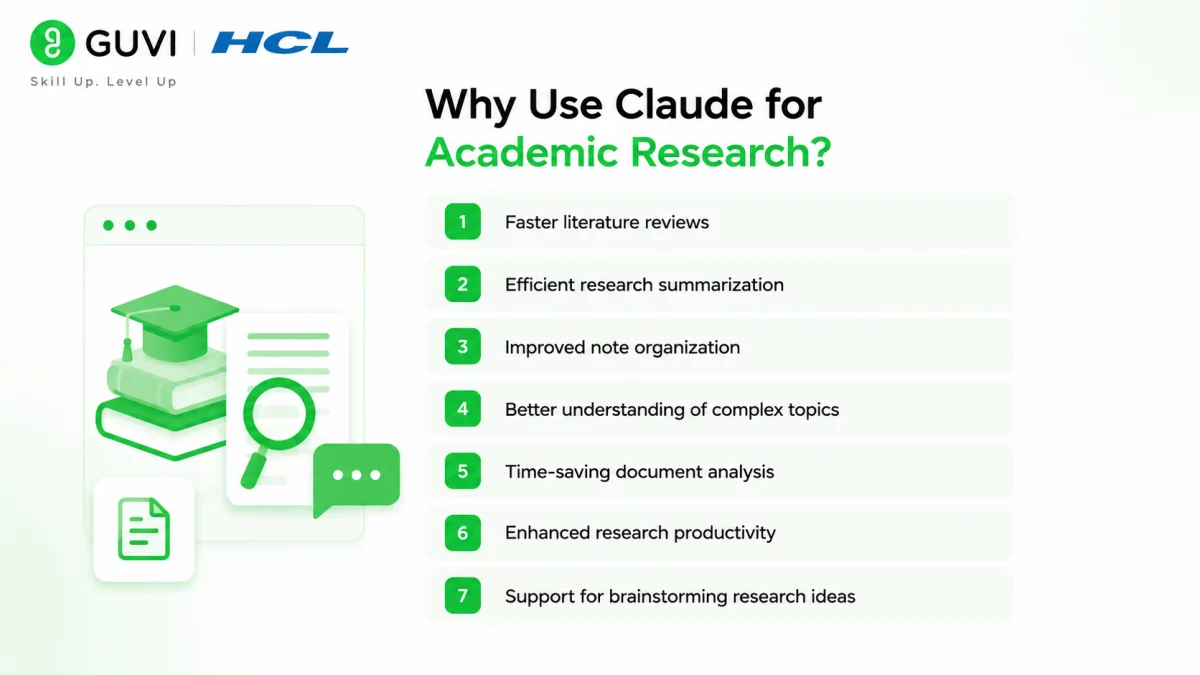
Academic research involves collecting, reviewing, and interpreting large amounts of information. Claude helps simplify these activities by organizing research materials and generating easy-to-understand summaries.
Some major advantages include:
- Faster literature reviews
- Efficient research summarization
- Improved note organization
- Better understanding of complex topics
- Time-saving document analysis
- Enhanced research productivity
- Support for brainstorming research ideas
Claude enables researchers to spend less time organizing information and more time developing meaningful insights.
Researchers often spend weeks reviewing academic literature before beginning a project. Using Claude for academic research can quickly summarize papers, compare multiple studies, identify research gaps, and organize findings into structured notes, allowing researchers to focus more on critical analysis and original contributions.
How to Use Claude for Academic Research
Step 1: Gather Research Papers
Collect journal articles, conference papers, reports, and other reliable academic sources related to your research topic before using Claude.
Step 2: Summarize Research Papers
Upload or paste research content into Claude and request concise summaries highlighting objectives, methodology, findings, and conclusions.
Step 3: Organize Your Literature Review
Claude can group studies based on themes, methodologies, research gaps, or publication years, making the literature review process more structured.
Step 4: Compare Multiple Studies
Ask Claude to identify similarities, differences, strengths, and limitations across multiple research papers to gain broader insights.
Step 5: Generate Research Notes
Claude can convert lengthy articles into well-organized notes that are easier to review while writing reports or preparing presentations.
Step 6: Brainstorm Research Ideas
Researchers can ask Claude for potential research questions, project ideas, hypotheses, or future research directions based on existing literature.
Step 7: Verify Information with Original Sources
Always compare Claude’s summaries with the original publications to ensure important details, citations, and interpretations remain accurate.
Step 8: Refine Research Continuously
As new publications become available, update your literature review and research summaries to keep your work current and comprehensive.
Academic Research Tasks Claude Can Assist With
Claude supports various research activities throughout an academic project.
It can help with:
- Literature reviews
- Research summarization
- Paper comparisons
- Note organization
- Brainstorming research ideas
- Draft outlines
- Explaining technical concepts
- Identifying research gaps
- Preparing presentation summaries
- Organizing references for review
These capabilities make Claude a valuable research assistant while allowing researchers to retain full control over their academic work.

The HCL GUVI AI Ebook also introduces practical AI concepts, data analysis techniques, and real-world applications that complement academic research workflows.
Research Tasks Claude Cannot Replace
While Claude is an excellent research assistant, certain academic responsibilities still require human expertise and judgment. AI should support these tasks rather than perform them independently.
Claude should not replace:
- Critical evaluation of research findings
- Developing original hypotheses and research questions
- Conducting experiments or collecting primary data
- Verifying citations and references
- Interpreting statistical results without expert review
- Making ethical or methodological decisions
- Writing original conclusions without independent analysis
Using Claude alongside human expertise allows researchers to speed up repetitive tasks like research summarization and literature review while maintaining academic integrity and producing high-quality scholarly work.
⚠️ Warning
Claude should support academic research—not replace independent analysis. Always verify AI-generated summaries against original research papers, cite sources correctly, and follow your institution’s academic integrity guidelines. Researchers remain responsible for interpreting findings, validating evidence, and producing original work.
Best Practice
To maximize the benefits of Claude’s academic research on AI:
- Use peer-reviewed academic sources.
- Verify AI-generated summaries.
- Organize papers by research themes.
- Review original citations before publishing.
- Avoid copying AI-generated text directly.
- Continuously update your literature review.
- Combine AI assistance with critical thinking.
Researchers looking to strengthen analytical skills can further benefit from HCL GUVI’s Data Science Course, which covers data analysis, machine learning, visualization, and practical AI techniques used across research and industry.
Conclusion
Claude is becoming a valuable AI assistant for academic research by simplifying literature review, research summarization, and knowledge organization. Instead of spending countless hours manually reviewing papers, researchers can use Claude to organize information, compare studies, and generate structured research notes more efficiently.
However, successful research depends on critical thinking, accurate citations, and independent evaluation. When combined with human expertise and responsible research practices, Claude’s academic research AI can significantly improve productivity while helping students, educators, and researchers produce higher-quality academic work.
FAQs
1. What is Claude’s academic research AI?
Claude’s academic research AI refers to using Claude to assist with literature reviews, research summarization, note organization, and academic writing support.
2. Can Claude summarize research papers?
Yes. Claude can summarize lengthy academic papers by highlighting key objectives, methods, findings, and conclusions.
3. How does Claude help with literature reviews?
Claude organizes research papers by themes, compares studies, identifies research gaps, and summarizes findings to simplify literature reviews.
4. Can Claude replace academic researchers?
No. Claude assists with research tasks, but researchers must interpret findings, verify information, and maintain academic integrity.
5. Is Claude suitable for students and researchers?
Yes. Students, educators, and researchers can use Claude to organize research materials, summarize papers, and improve productivity.
6. Does Claude provide accurate research summaries?
Claude generally provides helpful summaries, but all information should be verified using the original academic sources before use.
7. What are the best practices for using Claude in academic research?
Use trusted academic sources, verify AI-generated content, cite references correctly, update literature reviews regularly, and combine AI assistance with independent critical thinking.
Success Stories

About the Author
Vishalini Devarajan
An Aerospace Engineer turned content writer, I focus on making complex concepts easy to understand through well-structured, reader-friendly blogs. Whether it’s a technical topic or a non-technical one, I love creating content that is clear, engaging, and impactful.
View all posts by Vishalini Devarajan
Connect with me @












Did you enjoy this article?