


Artificial Intelligence and Machine Learning Articles
How to Evaluate LLM Outputs in Production Deployments
AI/ML Skills Gap 2026: Why Companies Can't Find Job-Ready Talent
20 AI/ML Interview Questions Recruiters Can Use Without a Tech Background - Best Guide
How Industry-Backed AI/ML Bootcamps Are Changing the AI/ML Hiring Pipeline - Best Guide 2026


Get In Touch For Details! Request More Information
How to Use Claude for A/B Testing Content Variations
Aug 18, 2026 3 Min Read 432 Views
(Last Updated)
Creating one version of your content is easy—but knowing which version performs better is what drives real results. Whether you’re writing email subject lines, landing page copy, social media posts, or ad campaigns, testing multiple variations can improve engagement and conversions. Claude makes this process faster by generating diverse content variations while maintaining a consistent message. In this guide, you’ll learn how to use claude ab testing workflows to create, compare, and refine content for better performance.
Table of contents
- TL;DR
- What Is Claude for A/B Testing?
- Why Use Claude for A/B Testing?
- What Content Can You Test with Claude?
- How to Generate Better Content Variations
- Define Your Goal
- Request Multiple Styles
- Keep One Variable Different
- How to Measure A/B Testing Success
- Real-World Example
- What Are the Limitations of Using Claude for A/B Testing?
- Key Takeaways
- Conclusion
- FAQs
- Can Claude generate content for A/B testing?
- What types of content can I test with Claude?
- Should I change multiple elements in one A/B test?
- Can Claude decide which variation will perform best?
- Is Claude useful for marketing teams?
TL;DR
- Claude can generate multiple content variations for A/B testing in minutes.
- AI helps test headlines, CTAs, email copy, ads, and landing pages.
- Effective prompts produce more meaningful content variations.
- Performance data—not AI alone—should determine the winning version.
- Human review ensures every variation aligns with your brand voice.
What Is Claude for A/B Testing?
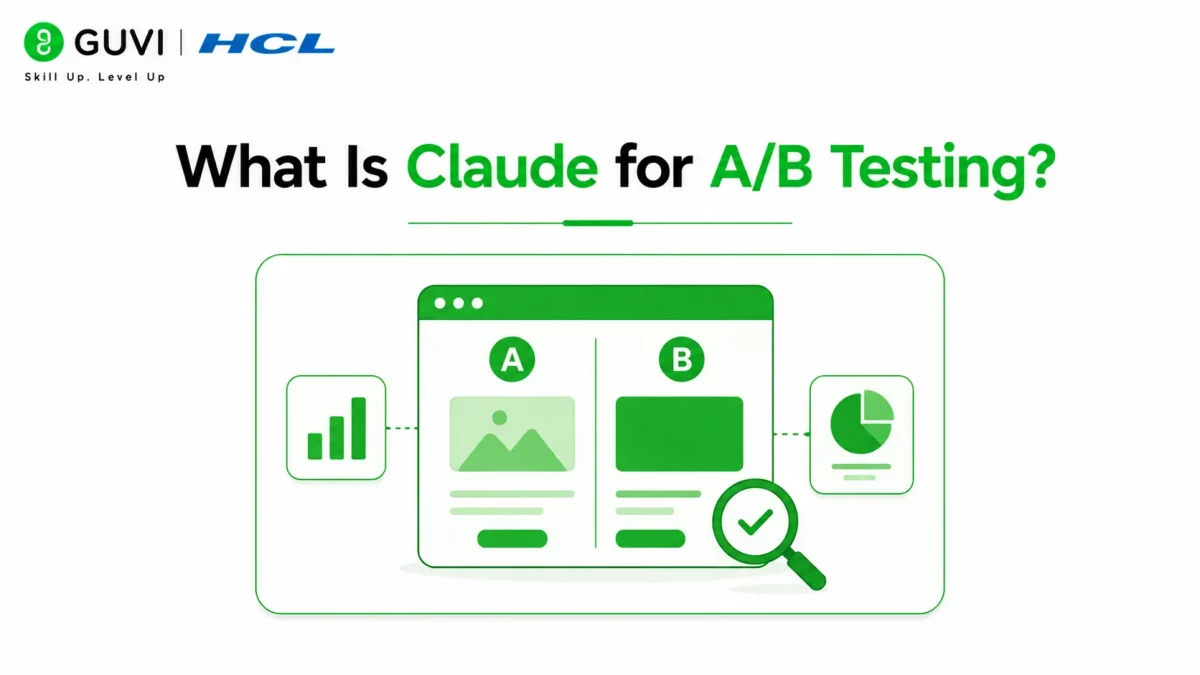
Claude is an AI assistant that helps marketers, content creators, and businesses generate multiple versions of the same content for A/B testing. Instead of manually rewriting headlines, email copy, or calls to action, you can ask Claude to create variations that differ in tone, structure, or messaging.
These variations can then be tested with real audiences to determine which version performs best.
Common content types include:
- Email subject lines
- Landing page copy
- Product descriptions
- Social media posts
- Call-to-action buttons
Read More: How to Use Claude Code: A Beginner’s Guide
Even small changes to a headline or CTA can noticeably affect click-through rates and user engagement when tested with the right audience.
Why Use Claude for A/B Testing?
Creating meaningful variations manually takes time and often limits creativity. Claude speeds up the process while giving you multiple approaches to test.
Some key benefits include:
- Generate ideas quickly. Claude creates multiple content versions within seconds.
- Experiment with different tones. Test professional, conversational, persuasive, or educational messaging.
- Save time. Instead of rewriting content repeatedly, focus on analyzing performance.
- Support multiple channels. Create variations for websites, emails, advertisements, and social media.
Data Point: Successful A/B testing focuses on changing one major element at a time, making it easier to identify what influenced the final results.
Turn data into better decisions with HCL GUVI’s Business Analytics Course. Learn A/B testing, campaign analysis, and data-driven optimization through practical, industry-focused projects.
What Content Can You Test with Claude?
Claude supports nearly every type of marketing and business content.
Popular examples include:
- Headlines
- Email subject lines
- Landing page copy
- Product descriptions
- Meta descriptions
- Advertisement copy
- Social media captions
- CTA buttons
Testing different versions helps identify the messaging that resonates most with your audience.
How to Generate Better Content Variations
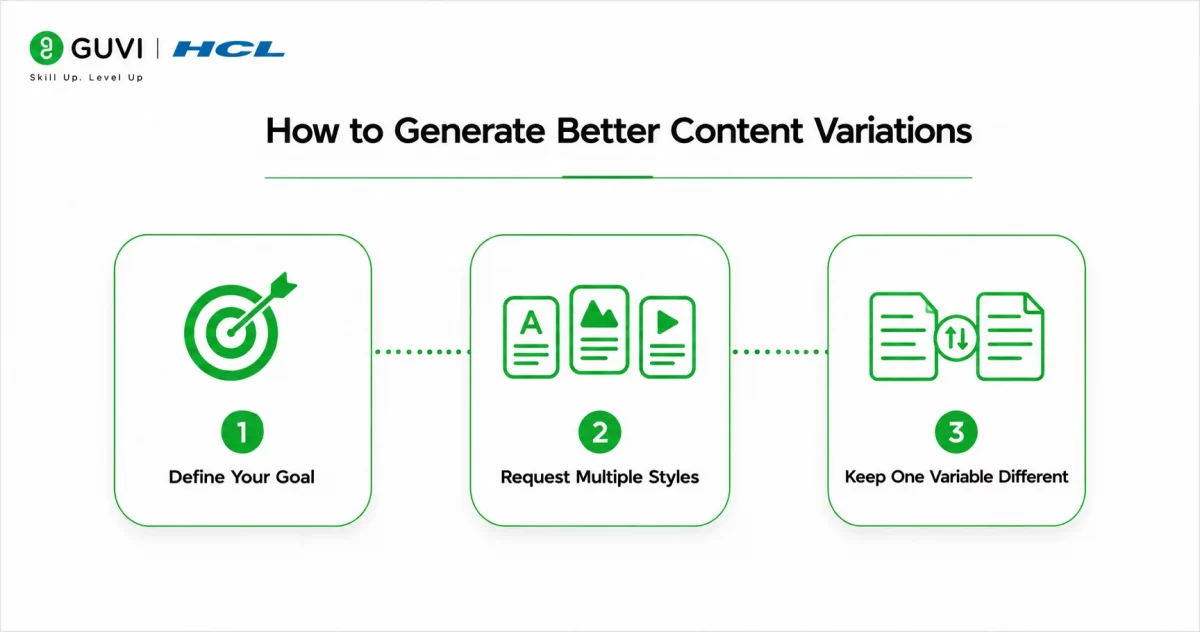
The quality of your A/B test depends on the prompts you provide. Giving Claude clear instructions leads to more useful and diverse content options.
1. Define Your Goal
Start by explaining what you’re trying to improve.
For example:
- Increase email open rates.
- Improve landing page conversions.
- Generate more ad clicks.
- Increase newsletter sign-ups.
Clear objectives help Claude produce more relevant variations.
2. Request Multiple Styles
Instead of asking for one rewrite, request several approaches.
For example, ask Claude to generate:
- A professional version
- A conversational version
- A curiosity-driven version
- A benefit-focused version
This provides meaningful differences for testing instead of minor wording changes.
3. Keep One Variable Different
For reliable A/B testing, avoid changing every element at once.
Test one major difference such as:
- Headline
- CTA
- Tone
- Opening sentence
- Value proposition
This makes it easier to understand which variation influenced user behavior.
Pro Tip: Ask Claude to explain the strategy behind each variation so you understand what makes every version different before launching your test.

How to Measure A/B Testing Success
Generating variations is only the beginning. The real value comes from measuring how each version performs.
Common performance metrics include:
- Click-through rate (CTR)
- Conversion rate
- Email open rate
- Bounce rate
- Engagement rate
- Time on page
Reviewing these metrics helps identify which variation delivers the strongest results.
Real-World Example
Imagine you’re promoting an online programming course.
Instead of publishing one headline, you ask Claude to generate five alternatives focused on different emotions, benefits, and levels of urgency. You then run an A/B test using two versions and compare click-through rates over several days.
The winning headline becomes your primary campaign while the remaining ideas inspire future marketing experiments.
Best Practice: Run each A/B test long enough to collect meaningful data before deciding which version performs better.
What Are the Limitations of Using Claude for A/B Testing?
While Claude can quickly generate multiple content variations, it cannot predict which version will perform best. The success of an A/B test depends on real audience behavior, campaign objectives, and accurate performance data rather than AI-generated assumptions.
Some limitations to keep in mind include:
- Claude cannot guarantee higher conversion rates.
- AI-generated variations still require human review for accuracy and brand consistency.
- Performance results may vary across different audiences and platforms.
- Testing too many variables at once can make results difficult to interpret.
- Final decisions should always be based on analytics rather than AI suggestions.
Warning: Treat Claude as a content generation assistant—not a replacement for data-driven experimentation. The winning variation should always be chosen based on actual test results, not predictions.
Key Takeaways
- Claude makes A/B testing content creation significantly faster.
- Multiple content variations improve experimentation.
- Test one major element at a time for reliable results.
- Performance metrics determine the winning variation.
- Human review ensures consistency with your brand voice.
- Continuous testing leads to stronger marketing performance over time.
Conclusion
Claude is a valuable tool for creating high-quality content variations for A/B testing. Whether you’re optimizing email campaigns, landing pages, advertisements, or social media posts, AI reduces the time spent rewriting content while expanding your creative options.
However, successful A/B testing depends on real user behavior—not assumptions. By combining Claude’s content generation capabilities with accurate performance data and thoughtful analysis, you can make better marketing decisions and continually improve your campaigns.
FAQs
Can Claude generate content for A/B testing?
Yes. Claude can create multiple versions of headlines, emails, landing pages, advertisements, and other content for A/B testing.
What types of content can I test with Claude?
You can test headlines, CTAs, email subject lines, product descriptions, social media posts, landing page copy, and more.
Should I change multiple elements in one A/B test?
No. It’s generally better to change one major element at a time so you can accurately measure what affected performance.
Can Claude decide which variation will perform best?
No. Claude can generate variations, but real audience data and testing determine the winning version.
Is Claude useful for marketing teams?
Yes. Claude helps marketing teams create diverse content variations quickly, making A/B testing faster and more efficient.
Success Stories

About the Author
HCL GUVI
This article was selected and published as part of the HCL GUVI AI Blogathon 2026, an initiative designed to encourage students, AI enthusiasts, and aspiring tech writers to simplify complex AI concepts through impactful technical content. The contest recognized high-quality, original, and insightful AI-focused blogs, with selected authors receiving publication opportunities on the HCL GUVI blog platform along with official author credits and recognition.
View all posts by HCL GUVI
Connect with me @













Did you enjoy this article?