


Interview Articles
My Full Stack Developer Interview Experience: What Nobody Tells You
My Digital Marketing Interview Experience: What They Don't Tell You [2026]
How Long Does Technical Interview Preparation Take? An Expert's Reality Check
Technical QA Interview Questions: What Top Companies Really Ask in 2026


Get In Touch For Details! Request More Information

How to Prepare for Coding and Technical Interview Rounds?
Dec 15, 2025 5 Min Read 1969 Views
(Last Updated)
Preparing for coding and technical interviews can be challenging, especially when you don’t know where to begin. These interviews test more than your ability to write code; they check how you think, solve problems, design systems, and explain your approach. Whether you want to become a software developer, data analyst, or tech engineer, the right coding interview preparation can help you stand out from other candidates.
This blog gives you a clear, step-by-step roadmap to make your technical interview preparation simple and effective. You’ll learn how to understand the interview format, strengthen your programming skills, master data structures and algorithms, and build real-world projects that showcase your talent. It also shares useful platforms to practice coding, tips to improve faster, and common mistakes to avoid during your preparation.
By the end of this guide, you’ll know exactly how to prepare for every stage of your coding and technical interviews. You’ll have a focused plan to build confidence, improve problem-solving skills, and stay consistent until you land your dream tech job.
Table of contents
- Understand The Interview Format
- Aptitude Round
- Coding Round
- Technical Round
- Behavioral Round
- Roadmap To Coding And Technical Interview Success
- Phase 1: Build Programming Fundamentals (2–3 Weeks)
- Phase 2: Master Data Structures And Algorithms (6–8 Weeks)
- Phase 3: Learn System Design Concepts (3–4 Weeks)
- Phase 4: Work On Real-World Projects (4–6 Weeks)
- Phase 5: Practice Mock Interviews (2–3 Weeks)
- Phase 6: Revise And Track Progress (2 Weeks)
- Common Mistakes To Avoid
- Importance Of The Technical Interview Round
- Stay Consistent And Confident
- Conclusion
- FAQs
- How long should I prepare for technical interviews?
- Which is more important: problem-solving or project experience?
- How can beginners start coding interview preparation?
- What are common mistakes candidates make during interviews?
- How do I stay calm during tough technical questions?
Understand The Interview Format
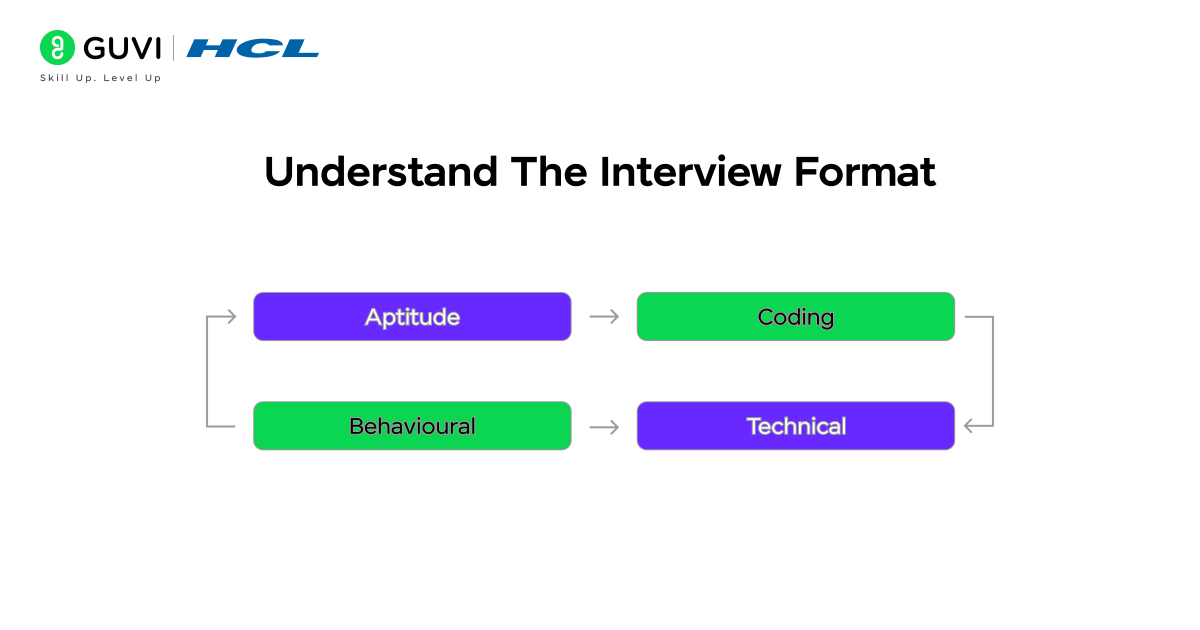
Before you begin your preparation, it’s important to know what each round in a coding or technical interview involves. Most companies follow these main rounds — Aptitude, Coding, Technical and Behavioral. Here’s a simple breakdown to help you understand each one clearly.
1. Aptitude Round
- Tests logical reasoning, math skills, and quick thinking.
- Includes questions on percentages, ratios, probability, and puzzles.
- Common in campus placements and fresher hiring.
- Practice on sites like IndiaBix, PrepInsta
- Tip: Focus on accuracy first, then improve your speed.
- Also read – HCL GUVI’S Aptitude test preparation for any company exam
2. Coding Round
- Tests your ability to solve problems using code.
- Questions are based on data structures and algorithms.
- Usually done on online platforms like HackerRank, LeetCode, or CodeSignal.
- You may solve function-based or whiteboard-style problems.
- Tip: Practice problems on arrays, strings, loops, and recursion regularly.
3. Technical Round
- Focuses on your understanding of core computer science concepts.
- Topics include Operating Systems, Databases, Networking, and OOPs.
- Interviewers may ask you to explain or debug your code.
- Be ready to discuss your projects and tech stack.
- Tip: Revise basics and explain your thought process clearly.
4. Behavioral Round
- Evaluates communication, teamwork, and problem-solving attitude.
- Questions are based on real-life experiences and challenges.
- Example: “Tell me about a time you solved a difficult problem.”
- Use the STAR method (Situation, Task, Action, Result) to answer.
- Tip: Stay calm, be honest, and show a positive mindset.
Roadmap To Coding And Technical Interview Success
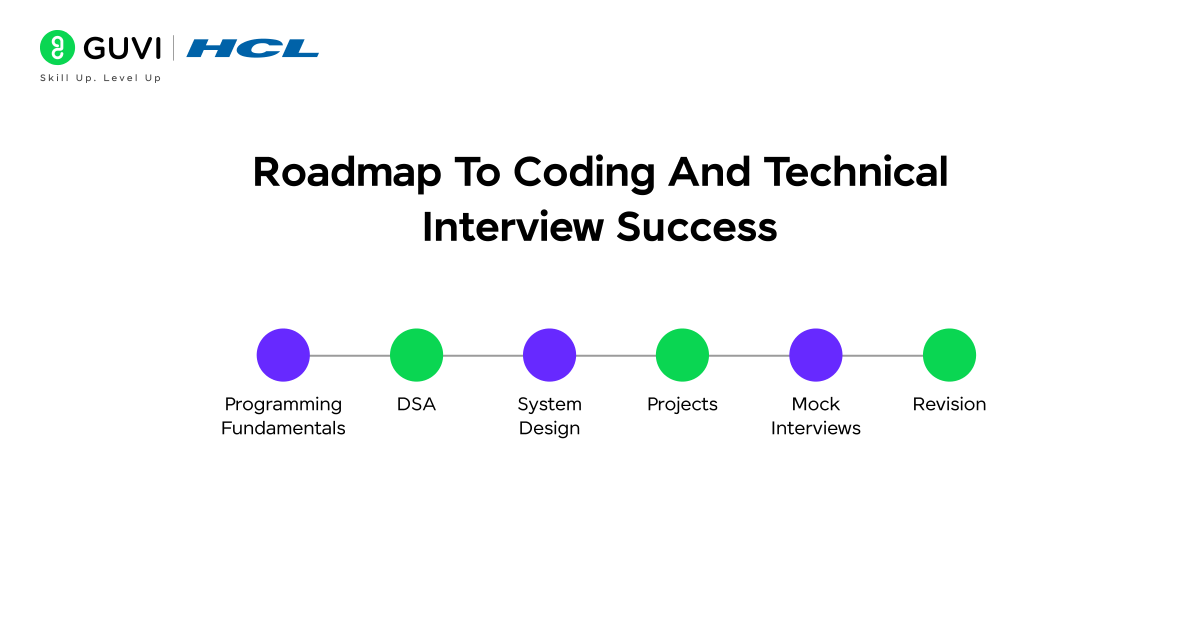
A roadmap helps you stay organized and track your progress while preparing for technical interviews. This step-by-step guide divides your preparation into clear phases, each with goals, learning areas, and a suggested timeline.
Follow each phase in order, but if you find any gaps later, go back and review the earlier concepts.

Phase 1: Build Programming Fundamentals (2–3 Weeks)
Goal:
- Learn one programming language thoroughly.
- Understand how to write, debug, and organize code properly.
What To Learn:
- Language syntax and basic programming rules.
- Writing and using functions effectively.
- Basics of Object-Oriented Programming (OOP).
- Recursion and how to approach small logical problems.
- Input/output handling for online coding platforms.
Platforms To Practice:
- Official documentation for your chosen language (Python, Java, or C++).
- HackerRank – Beginner-level problems and interview kits.
Tips:
- Choose one language and stick with it for all your problem-solving.
- Practice simple problems daily — strings, loops, arrays.
- Write short programs to test every new concept.
- Spend at least 1 hour daily coding consistently.
Time Allocation:
- Week 1–2: Learn syntax, data types, loops, and functions.
- Week 3: Practice 20–25 beginner problems and review mistakes.
Phase 2: Master Data Structures And Algorithms (6–8 Weeks)
Goal:
- Understand the main data structures and algorithms used in interviews.
- Be able to solve coding problems quickly and logically.
What To Learn:
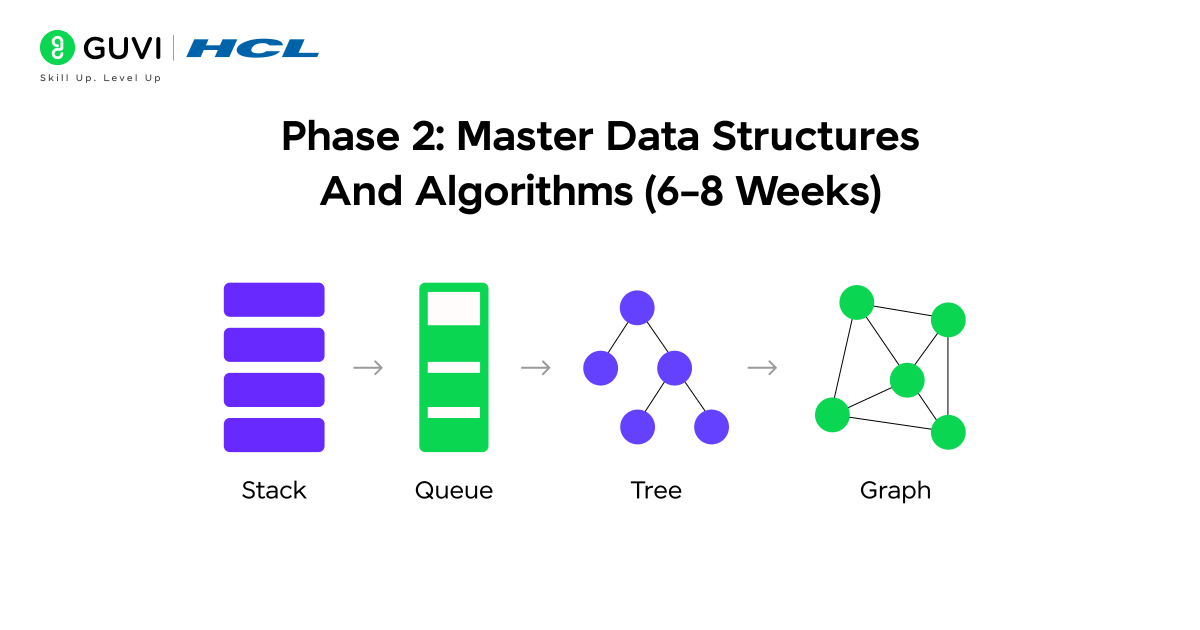
- Arrays, strings, linked lists, stacks, queues, heaps, trees, and graphs.
- Searching and sorting algorithms.
- Hash maps, recursion, and dynamic programming basics.
- Two pointers, sliding window, greedy, and divide-and-conquer patterns.
- Big-O time and space complexity.
Platforms To Practice:
- LeetCode – Problem-solving with difficulty levels and tags.
- HackerRank – Interview Preparation Kits.
Tips:
- Focus on learning “patterns” instead of memorizing answers.
- Maintain a “mistake log” to track weak areas.
- Solve at least 5–7 problems per week.
- Revisit solved problems after a week for better retention.
Time Allocation:
- Week 1–2: Arrays, strings, and linked lists.
- Week 3–4: Stacks, queues, trees, and graphs.
- Week 5–6: Sorting, searching, and recursion.
- Week 7–8: Dynamic programming, greedy, and revision.
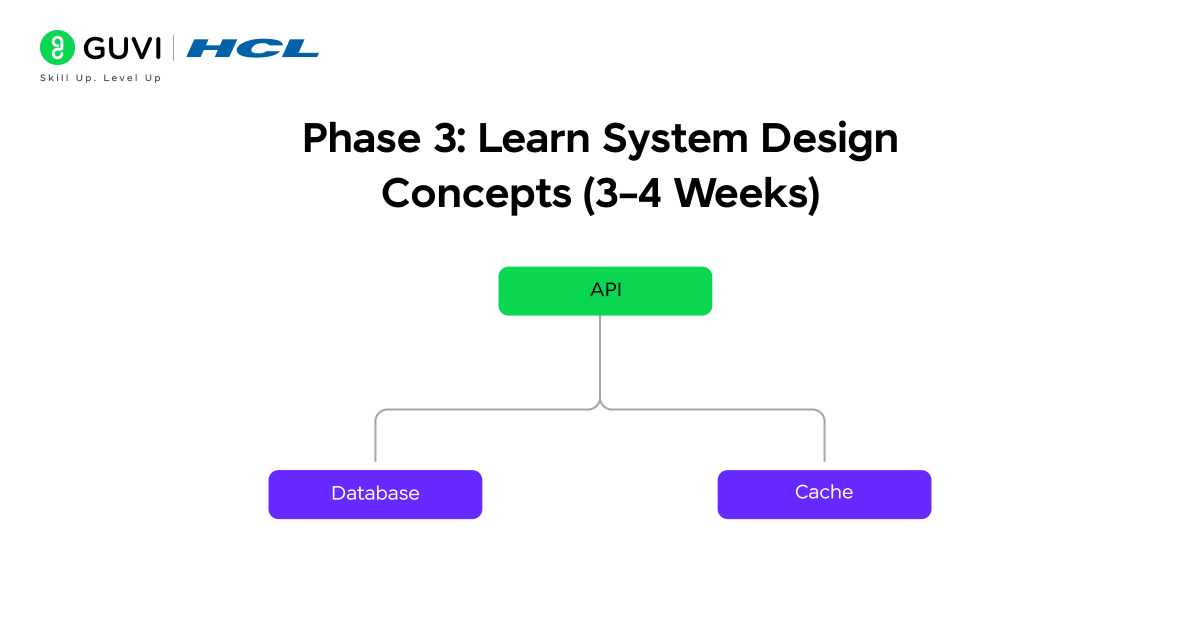
Phase 3: Learn System Design Concepts (3–4 Weeks)
Goal:
- Learn how to design scalable, real-world systems.
- Understand how to explain architecture and trade-offs in interviews.
What To Learn:
- Load balancing and caching techniques.
- SQL vs NoSQL database usage.
- Indexing, replication, and sharding.
- CAP theorem, consistency, and availability.
- CDNs, rate limiting, and queues.
Platforms To Practice:
- System Design Primer on GitHub.
- Grokking the System Design Interview (Educative).
Tips:
- Start by designing small systems like a URL shortener or chat app.
- Focus on how components communicate (APIs, databases, caches).
- Use simple diagrams to explain data flow and bottlenecks.
- Study 2–3 systems per week.
Time Allocation:
- Week 1–2: Learn basic system design concepts.
- Week 3: Practice designing 2–3 medium-scale systems.
- Week 4: Review and improve explanations for trade-offs.
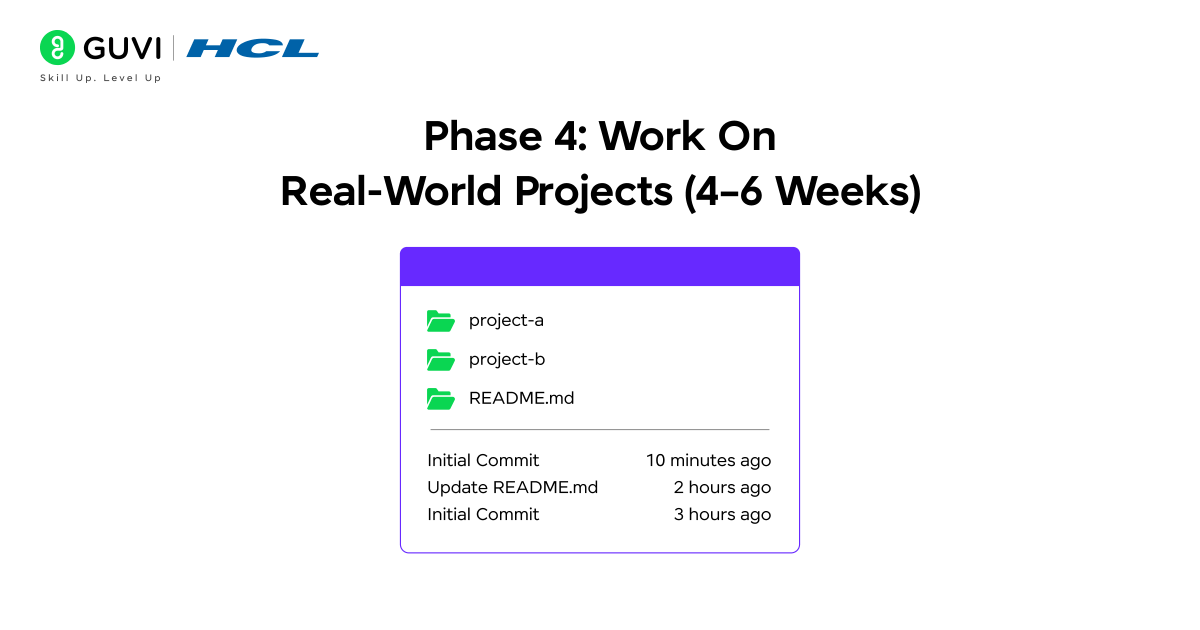
Phase 4: Work On Real-World Projects (4–6 Weeks)
Goal:
- Apply your skills in practical projects that you can showcase to recruiters.
- Learn how to build and deploy working applications.
What To Build:
- Small web apps, APIs, or full-stack projects.
- Data pipelines or automation tools.
- Open-source contributions or freelance mini-projects.
Platforms To Showcase:
- GitHub – Host and document all your work.
- GitLab or Bitbucket – For team collaboration.
Tips:
- Keep your GitHub clean with proper README and screenshots.
- Focus on one strong project that you can explain in depth.
- Write unit tests and clean documentation.
Time Allocation:
- Week 1–2: Choose a project idea and design it.
- Week 3–4: Develop and test the project.
- Week 5–6: Polish, document, and upload to GitHub.
Phase 5: Practice Mock Interviews (2–3 Weeks)
Goal:
- Simulate real interview conditions to build confidence.
- Improve time management and communication skills.
What To Practice:
- Timed coding challenges.
- Whiteboard and verbal explanation of logic.
- Mock system design and behavioral interviews.
Platforms To Practice:
- LeetCode mock contests.
- HackerRank mock interviews.
- Peer practice sites like Pramp or Interviewing.io.
Tips:
- Record your mock sessions and analyze mistakes.
- Use the STAR (Situation, Task, Action, Result) method for HR questions.
- After each mock, note down 3 areas for improvement.
Time Allocation:
- Week 1–2: Do one coding mock every alternate day.
- Week 3: Add one system design and one behavioral mock per week.
Phase 6: Revise And Track Progress (2 Weeks)
Goal:
- Strengthen your weak areas before the final interviews.
- Review all concepts, projects, and problem patterns.
What To Review:
- Common DSA and system design topics.
- Frequently asked problems and edge cases.
- Your key projects and what you learned from them.
Tools To Track Progress:
- Use a spreadsheet or Notion to log solved problems and daily goals.
- Review your “mistake log” and re-solve old problems.
Tips:
- Re-solve 50 previously tough problems for confidence.
- Revise main design concepts and explain them aloud.
- Keep a steady daily schedule with breaks and review sessions.
Time Allocation:
- Week 1: Review DSA and key problems.
- Week 2: Revise system design, behavioral questions, and project notes.
Total Estimated Preparation Duration:
- Around 4 to 6 months, depending on your experience and consistency.
- Spend at least 2–3 hours daily for the best results.
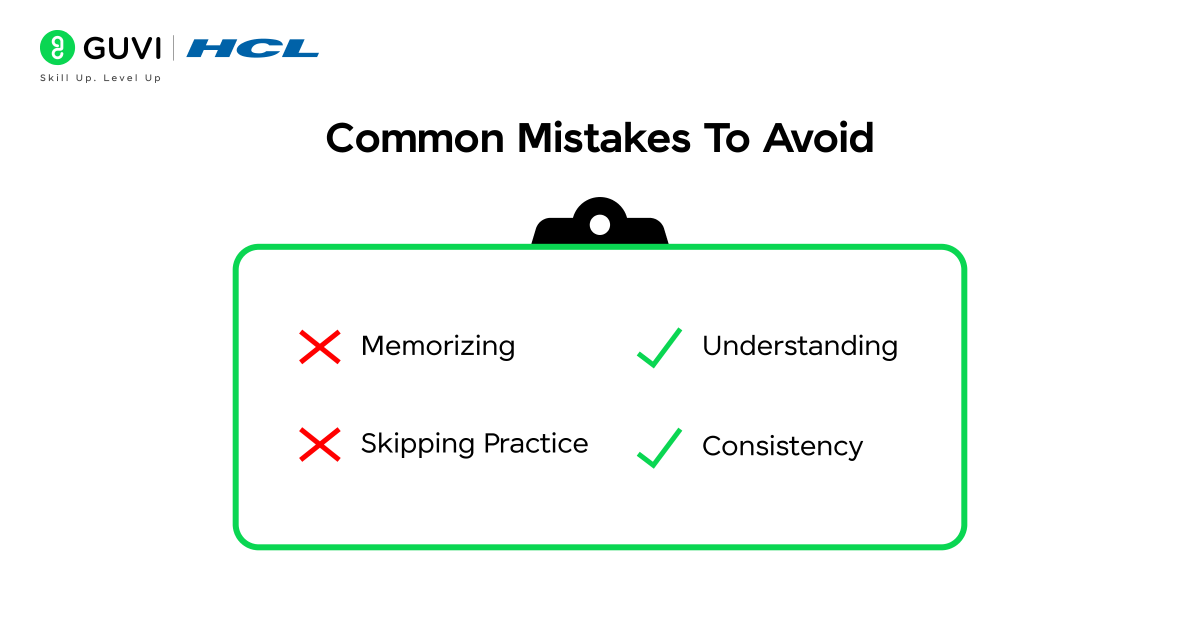
Common Mistakes To Avoid
Many candidates work hard but still struggle during interviews because they repeat the same avoidable mistakes. Understanding these early helps you prepare more effectively and perform confidently during actual interviews. Here are the most common errors and how to fix them:
1. Memorizing Instead Of Understanding
- Problem: Trying to memorize solutions from websites without really understanding how or why they work.
- Fix: Focus on learning problem-solving patterns like recursion, dynamic programming, and two-pointer methods. Understand the logic behind each step instead of copying answers.
2. Ignoring System Design And Behavioral Rounds
- Problem: Many candidates only prepare for coding problems and ignore other key rounds.
- Fix: Dedicate time to system design basics (even small-scale systems) and behavioral questions. Practice explaining your past experiences using clear examples.
3. Not Reviewing Your Own Code
- Problem: Submitting code that works for simple test cases but fails on edge cases.
- Fix: Always review your code before submission. Try to predict inputs that might break it, and write small test cases to confirm correctness.
4. Neglecting Time And Space Complexity
- Problem: Writing correct code that takes too long to run or uses too much memory.
- Fix: Learn to analyze your algorithm’s efficiency. During interviews, clearly explain how your approach scales and why it’s optimal.
5. Poor Communication During The Interview
- Problem: Jumping into coding without explaining your plan or reasoning.
- Fix: Speak your thoughts as you solve. Begin by explaining your approach, discussing trade-offs, and checking your understanding with the interviewer before writing code.
Importance Of The Technical Interview Round
The technical interview round is one of the most crucial parts of the hiring process. It helps employers understand how you think, solve problems, and apply your knowledge in real-world scenarios and not just whether you can write code that runs correctly. This round reflects both your technical depth and your problem-solving mindset.
What Interviewers Look For:
- Problem Decomposition: How clearly you can break a large problem into smaller, logical steps.
- Correctness and Efficiency: Whether your code not only works but also handles edge cases and runs efficiently.
- Trade-Off Analysis: Your ability to choose the right approach or data structure and justify why it fits the situation.
- Communication and Collaboration: How well you explain your approach, listen to hints, and adjust when given feedback.
Why It Matters:
- It shows who truly understands computer science principles rather than just memorizing solutions.
- It reflects your ability to think critically under pressure — a skill needed for real-world projects.
- It highlights your judgment in balancing performance, readability, and scalability.
Example:
Imagine you’re given a problem where your current approach runs in O(n²). If you can reason that using a divide-and-conquer technique or a more suitable data structure could reduce it to O(n log n), and then explain how to implement it, that demonstrates technical maturity and strong analytical thinking.
Stay Consistent And Confident
Preparing for coding and technical interviews takes time, effort, and patience. It’s not about how fast you learn but how consistently you practice. Regular study, steady progress, and a calm mindset matter far more than last-minute cramming. Treat your preparation like a long-term skill-building journey rather than a quick sprint.
Habits To Adopt:
- Set small, realistic goals each day — for example, solve one medium-level LeetCode problem or read DSA concepts for 30 minutes.
- Keep your routine balanced: dedicate one day to coding, one to system design, one to projects, and one to mock interviews each week.
- Track your learning with a simple spreadsheet or Notion tracker to see steady progress.
- Reward yourself for small wins and treat mistakes as learning opportunities instead of failures.
Conclusion
Preparing for coding and technical interview rounds is not just about solving problems — it’s about building a strong foundation step by step. A solid mix of programming basics, structured DSA practice, practical project work, and regular mock interviews helps you grow in both skill and confidence.
By following the roadmap carefully and avoiding common mistakes, you’ll learn how to think like an engineer, communicate effectively, and approach problems with clarity. Stay patient, track your progress, and keep refining your approach. Over time, your problem-solving speed, understanding, and ability to design real-world solutions will naturally improve — and that’s exactly what interviewers look for when choosing the right candidate.
FAQs
1. How long should I prepare for technical interviews?
Depends on your starting point: beginners may need 3–6 months of consistent practice; experienced engineers often need 4–8 weeks of focused preparation to refresh DSA and design concepts.
2. Which is more important: problem-solving or project experience?
Both matter. Problem-solving proves algorithmic capability; projects show practical engineering skills. For entry-level roles, DSA often dominates initial screens; for mid/senior roles, system design and projects carry more weight.
3. How can beginners start coding interview preparation?
Pick one language, start small (arrays/strings), follow a structured plan (fundamentals → DSA → projects → mocks), and use resources like LeetCode to practice.
4. What are common mistakes candidates make during interviews?
Relying on memorization, skipping edge-case checks, ignoring complexity analysis, poor communication, and lack of system design practice.
5. How do I stay calm during tough technical questions?
Pause, breathe, restate the problem, ask clarifying questions, outline an approach before coding, and break the problem into smaller subproblems.
Success Stories

About the Author
Jebasta
I translate the language of data into stories that anyone can understand. As a writer with a data science background, I simplify analytics, AI, and decision-making so beginners and enthusiasts can confidently explore the world of data.
View all posts by Jebasta
Connect with me @















Did you enjoy this article?