


Career Articles
Top Highest-Paying EV Careers in 2026: Skills, Salaries & Jobs Hiring Right Now
How Do You Choose the Right Electric Vehicle Course & Certification in 2026? The Only Guide You Need
Android Development Roadmap :10-Step Guide to Become an Android Developer


Get In Touch For Details! Request More Information

How to Improve Your Technical Interview Skills: A Beginner-Friendly Guide
Feb 16, 2026 6 Min Read 498 Views
(Last Updated)
Learning how to improve technical interview skills is important because interviews test both your understanding of core concepts and your ability to solve problems clearly under pressure. Tutorials can teach you the basics, but real interviews require structured thinking, clear explanations, and calm decision-making.
This guide helps beginners enhance their technical interview skills by strengthening fundamentals, practicing common problem patterns, and employing methods that foster confidence and real-time problem-solving abilities.
Quick Answer
You can improve your technical interview skills by practicing structured problem-solving daily, learning to explain your thought process clearly, and simulating real interview pressure. Focus on coding patterns, mock interviews, and clarity of communication to build both speed and confidence.
Table of contents
- What Are Technical Interview Skills?
- Understanding Core Concepts
- Applying Logic Under Pressure
- Communicating Your Thought Process
- Debugging And Improving Code
- Domains And The Technical Skills Required
- Software Development
- Data Science
- Web Development
- Mobile App Development
- AI & Machine Learning
- Cloud & DevOps
- Cybersecurity
- Data Engineering
- UI/UX Design
- Quality Assurance & Testing
- What You Should Focus On First
- Build A Strong Foundation
- Learn Patterns, Not Just Solutions
- Practice Active Problem Solving
- Track Your Mistakes
- Practical Steps And Methods To Improve
- Use The SCQA Method While Solving
- Code With Constraints
- Record Yourself
- Take Mock Interviews Regularly
- Strengthen Dry-Run Ability
- Master Breaking Down Problems
- Conclusion
- FAQs
- What Is The Best Way To Start Technical Interview Preparation?
- How Many Problems Should I Practice Daily?
- Do Mock Interviews Really Help?
- How Long Does Technical Interview Preparation Take?
What Are Technical Interview Skills?
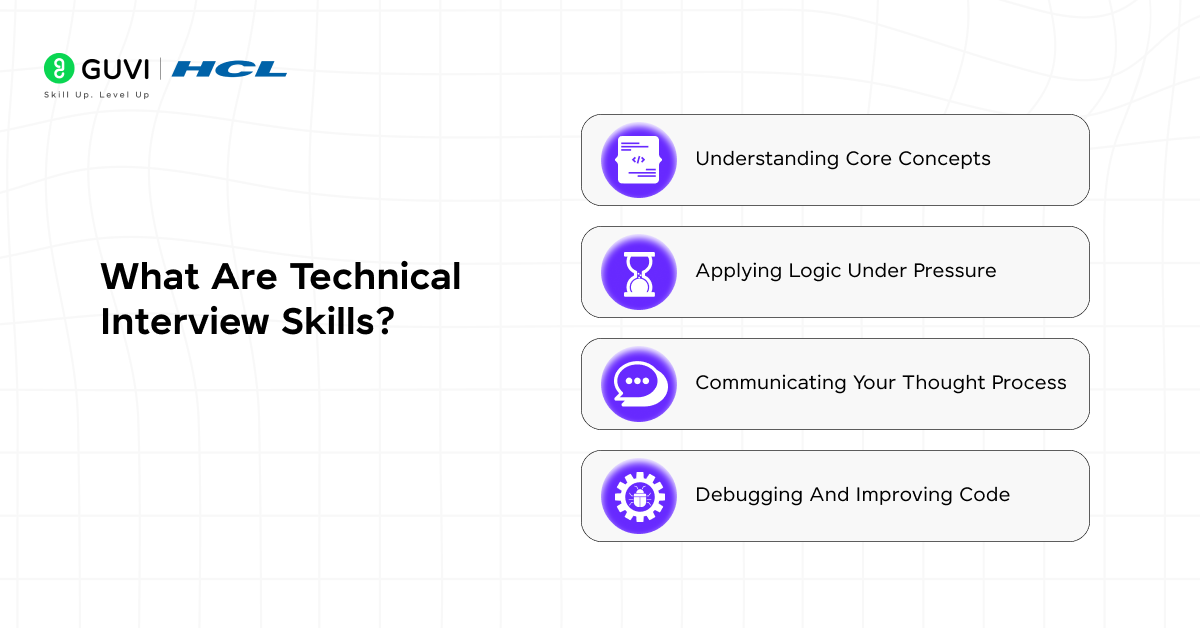
Technical interview skills are the abilities that help you perform well during coding rounds, logical problem-solving, and technical discussions. If you want to learn how to improve technical interview skills, you need a mix of strong fundamentals, clarity in communication, the ability to think under pressure, and solid debugging habits. In this section, we will cover the four essential components:
- Understanding Core Concepts
- Applying Logic Under Pressure
- Communicating Your Thought Process
- Debugging And Improving Code
1. Understanding Core Concepts
Improving technical interview skills starts with building strong fundamentals. When you understand core topics deeply, you recognize patterns faster, avoid confusion, and approach problems with clarity. A solid base makes every coding question easier to break down and solve efficiently.
- Mastering essential topics like data structures, algorithms, OOP, and problem-solving logic
- Knowing when and why to use certain techniques
- Identifying common patterns such as two pointers, sliding window, hashing, and recursion
Example: Choosing the sliding window technique for optimal subarray-related questions
Tip: Maintain a concept-to-problem notebook that links each topic with real examples
Advice: Revise complexity analysis weekly to strengthen decision-making
2. Applying Logic Under Pressure
Knowing concepts is not enough; you must also perform well under stress. Timed practice helps you understand how your brain reacts when the clock is ticking and questions get harder. This ability is crucial when learning how to improve technical interview skills effectively.
- Solving problems with strict timers
- Breaking down complex questions into simpler logical segments
- Using structured approaches for unfamiliar problems
Example: Solving two timed coding questions daily to simulate interview pressure
Tip: Use the “understand → plan → code → test” structure for every question
Advice: Pause for a few seconds before coding to mentally organize your logic
3. Communicating Your Thought Process
Communication is a core part of technical interviews because interviewers want to understand your reasoning. Clear communication helps you justify choices, correct mistakes early, and appear more confident, even if your approach changes midway.
- Explaining why you chose certain data structures
- Walking through your logic in clear, simple steps
- Keeping reasoning structured and easy to follow
Example: Saying, “I’ll use BFS because the problem needs level-order traversal.”
Tip: Practice thinking aloud during mock interviews
Advice: Keep explanations short and logical to avoid rambling
4. Debugging And Improving Code
Debugging is an essential part of technical interviews because it shows how well you understand your own code. Improving technical interview skills also means spotting errors quickly, refining logic, and optimizing solutions without panicking.
- Testing code using sample inputs and edge cases
- Identifying and fixing logical errors step-by-step
- Optimizing solutions for better performance
Example: Running a dry run with empty arrays, duplicates, or extreme values
Tip: Write test inputs before you start coding
Advice: After solving, revisit your approach to check if a more efficient solution exists

Domains And The Technical Skills Required
Different technology domains demand different skill sets, and understanding these helps you prepare for technical interviews with clarity and direction. Here are the top domains and the technical skills commonly expected from beginners and job seekers.
1. Software Development
- Programming Languages: Java, Python, C++, JavaScript
- Core Skills: DSA, OOP, debugging, problem-solving
- Tools & Concepts: Git, REST APIs, SDLC, unit testing
- Interview Focus: Coding rounds, logic building, system fundamentals
2. Data Science
- Core Skills: Statistics, probability, data cleaning, EDA
- Tools: Python, NumPy, Pandas, Matplotlib, Jupyter
- Concepts: ML models, model evaluation, feature engineering
- Interview Focus: Case studies, algorithm reasoning, data insights
3. Web Development
- Frontend Skills: HTML, CSS, JavaScript, React
- Backend Skills: Node.js, Express, SQL/NoSQL
- Additional Knowledge: API handling, authentication, responsive UI
- Interview Focus: DOM logic, API integration, coding tasks
4. Mobile App Development
- Android Skills: Java, Kotlin, Android Studio
- iOS Skills: Swift, Xcode
- Concepts: App lifecycle, UI components, data storage
- Interview Focus: Architecture patterns, debugging, performance
5. AI & Machine Learning
- Core Skills: Linear algebra, ML algorithms, data preprocessing
- Tools: Scikit-learn, TensorFlow, PyTorch
- Concepts: Overfitting, model metrics, tuning
- Interview Focus: ML case problems, optimization logic
6. Cloud & DevOps
- Core Skills: Linux, automation, version control
- Tools: AWS/Azure/GCP, Docker, Kubernetes, Jenkins
- Concepts: CI/CD, scaling, load balancing
- Interview Focus: Deployment scenarios, troubleshooting
7. Cybersecurity
- Core Skills: Networking basics, system security, encryption
- Tools: Burp Suite, Wireshark, Metasploit
- Concepts: OWASP Top 10, vulnerability analysis
- Interview Focus: Attack scenarios, threat detection
8. Data Engineering
- Core Skills: SQL, ETL pipelines, data modeling
- Tools: Hadoop, Spark, Airflow, Kafka
- Concepts: Distributed systems, batch vs stream processing
- Interview Focus: System design, pipeline architecture
9. UI/UX Design
- Core Skills: Wireframing, prototyping, usability principles
- Tools: Figma, Adobe XD, Sketch
- Concepts: User psychology, layout design, interaction flow
- Interview Focus: Portfolio review, problem-solving approach
10. Quality Assurance & Testing
- Core Skills: Manual testing, automation basics
- Tools: Selenium, Postman, JUnit, TestNG
- Concepts: Test cases, bug tracking, API testing
- Interview Focus: Scenarios, debugging, logic understanding
Do check out HCL GUVI’s LearnHub for structured learning, coding exercises, and guided tracks ,which is an ideal way to build strong fundamentals and sharpen your problem-solving before interviews.
What You Should Focus On First
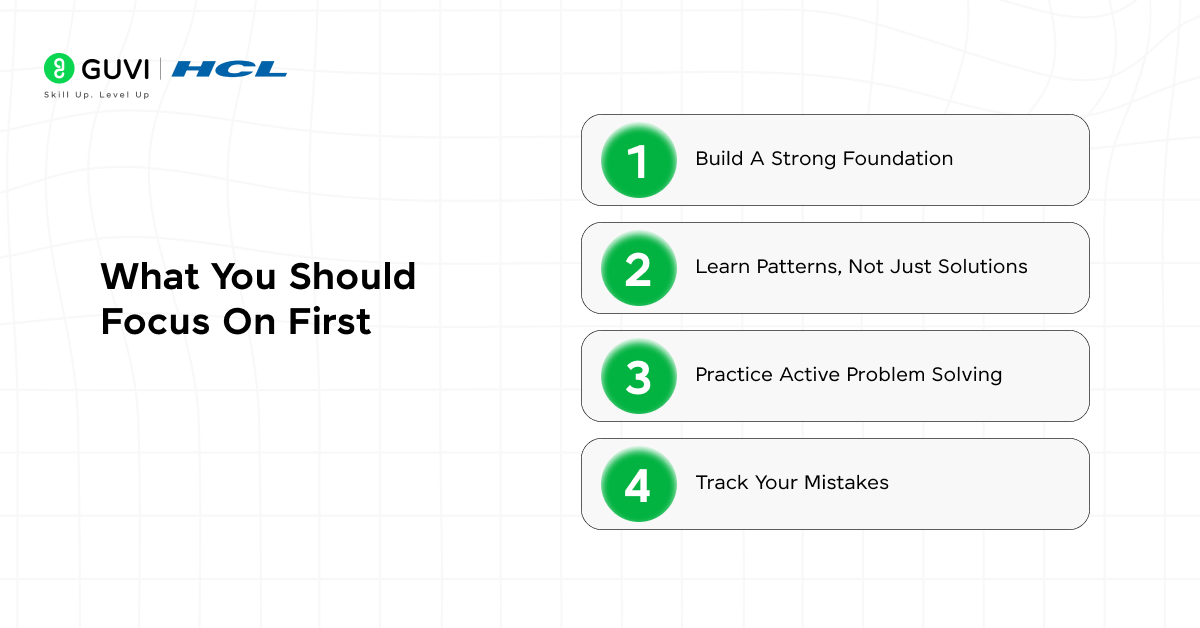
To learn how to improve technical interview skills effectively, you must start with the areas that create the strongest foundation. Beginners often jump into random coding problems, but true progress comes from mastering the basics, learning patterns, practicing consistently, and understanding your mistakes. In this section, we will cover the four core priorities:
- Build A Strong Foundation
- Learn Patterns, Not Just Solutions
- Practice Active Problem Solving
- Track Your Mistakes
Also check out – Guide to Crack Technical Interviews
1. Build A Strong Foundation
A strong foundation is the backbone of your technical interview preparation. When you understand basic concepts deeply, you can break down difficult questions more easily and avoid confusion during high-pressure interview moments. This base helps you approach problems with clarity and confidence.
- Strengthen fundamentals like DSA, time complexity, loops, arrays, recursion, and strings
- Understand problem types instead of memorizing answers
- Focus on thinking logically rather than copying solutions
Example: Understanding recursion makes tree, graph, and backtracking problems much easier
Tip: Spend the first 30 minutes of each study session reviewing core concepts
Advice: Rewatch or relearn basics anytime you start struggling with patterns
2. Learn Patterns, Not Just Solutions
Patterns are the fastest way to improve technical interview skills because most coding problems follow repeated logical structures. Once you recognize these patterns, even unfamiliar questions become easier to decode and solve.
- Master array patterns, sliding window, two pointers, binary search, and recursion patterns
- Learn basic dynamic programming structures to recognize repetitive subproblems
- Focus on understanding the “why” behind each pattern
Example: Many subarray problems repeat the sliding window technique
Tip: Group solved questions by pattern instead of topic
Advice: Keep a “pattern cheat sheet” and update it after every 20 questions
3. Practice Active Problem Solving
Passive reading or watching solutions does not build interview readiness. You must solve problems actively, test your ideas, and think through each step to build a strong problem-solving instinct.
- Practice daily using platforms like LeetCode, HackerRank, or CodeKata
- Aim for 2 to 3 problems daily using a structured approach
- Break problems down before coding to avoid confusion
Example: Use a timer for one question to simulate real interview pressure
Tip: Follow the “understand → plan → code → test” routine for every problem
Advice: Start with easy problems, then move to medium as your flow improves
4. Track Your Mistakes
Tracking mistakes is one of the most powerful habits for improving technical interview skills. It reduces repeated errors, strengthens weak areas, and helps you learn faster by understanding what went wrong.
- Maintain a mistake journal documenting logic errors and misunderstood concepts
- Revisit weak areas weekly instead of moving on too quickly
- Identify repeated patterns in your mistakes to fix them permanently
Example: If you often make off-by-one errors in loops, practice 10 focused loop problems
Tip: Review your mistake journal every Sunday
Advice: Tag your mistakes by topic so you know exactly where improvement is needed
Practical Steps And Methods To Improve
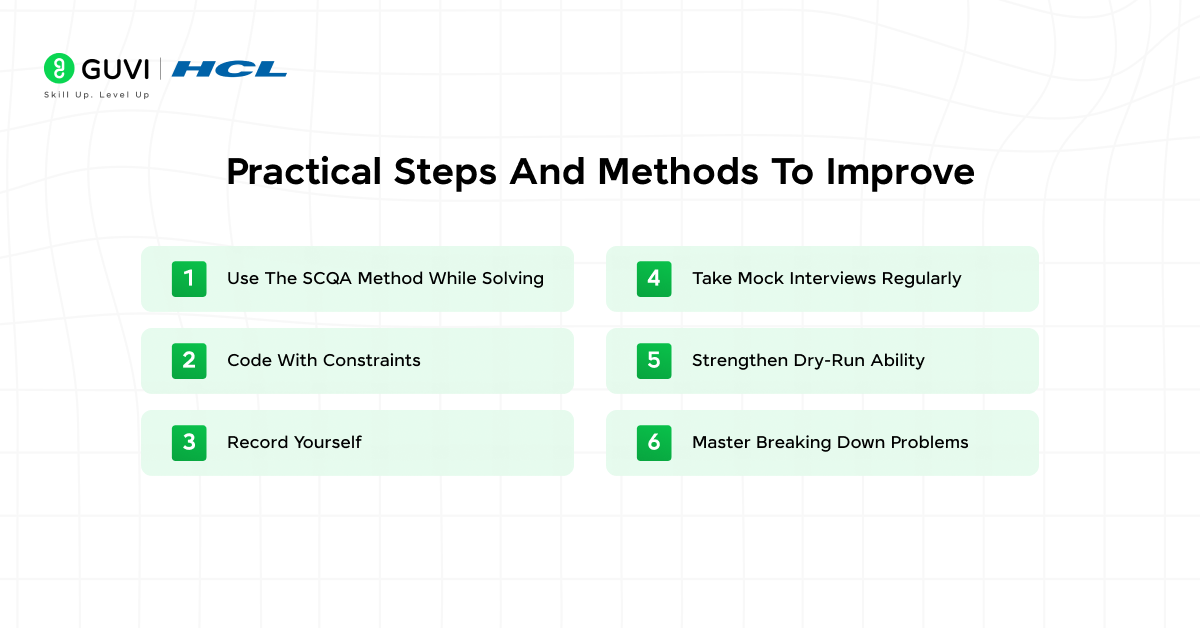
To truly learn how to improve technical interview skills, you need practical methods that build both your problem-solving ability and your performance under pressure. This section walks you through techniques that sharpen your thinking, strengthen core logic, and improve the way you explain solutions during interviews. We will cover the following:
- Use The SCQA Method While Solving
- Code With Constraints
- Record Yourself
- Take Mock Interviews Regularly
- Strengthen Dry-Run Ability
- Master Breaking Down Problems
Do check out HCL GUVI’s Interview Preparation course in the Professional Development section – it’s designed to help sharpen interview readiness, covering soft skills, aptitude round prep, and basic technical interview guidance.
1. Use The SCQA Method While Solving
The SCQA method helps you structure your thinking clearly before coding. It ensures you understand the problem context, identify the challenge, and communicate your approach in a clean, interviewer-friendly format. Using this method regularly improves clarity, confidence, and logical flow.
- Situation – What the problem is about
- Complication – What makes it challenging
- Question – What the interviewer is asking you to solve
- Answer – Your explained solution approach
Example: Before coding, say: “The situation is… the complication is… the question is… and my approach is…”
Tip: Use SCQA aloud for every medium question
Advice: Summarize your approach in 20–25 seconds for better clarity
2. Code With Constraints
Coding with constraints helps you simulate real interview pressure. Time limits and intentional boundaries sharpen your decision-making, reduce overthinking, and help you perform better during live interviews.
- Solve within a set time limit
- Think aloud while coding
- Avoid unnecessary pauses or re-starts
Example: Set a 25-minute timer for medium problems
Tip: Use a phone timer to add pressure
Advice: Never exceed 30 minutes for a single practice problem
3. Record Yourself
Recording your practice forces you to listen to how you explain logic, how confidently you speak, and where your reasoning becomes unclear. This helps you polish your delivery and eliminate verbal and logical mistakes.
- Improves clarity of explanation
- Reveals hesitation patterns
- Helps fix filler words or unclear reasoning
Example: Watch the first 60 seconds of your recording to evaluate tone and clarity
Tip: Keep explanations under 45 seconds when describing an approach
Advice: Record 2-3 problems per week for maximum improvement
4. Take Mock Interviews Regularly
Mock interviews replicate the environment of real interviews, building your ability to think, speak, and solve under pressure. This develops both confidence and performance consistency.
- Builds real interview confidence
- Improves communication under stress
- Gives you actionable feedback
Example: Use free mock interview platforms or peer practice
Tip: Pair with someone who can ask unpredictable follow-ups
Advice: Do one mock interview every weekend
5. Strengthen Dry-Run Ability
Dry-running your code mentally is a critical technical interview skill that helps you catch errors before execution. It also shows interviewers that you understand your logic fully.
- Walk through the code with sample inputs
- Catch logical and indexing errors early
- Understand the flow before running
Example: Simulate array pointer movements step-by-step
Tip: Always dry-run before telling the interviewer you are done
Advice: Practice dry-running at least 5 problems weekly
6. Master Breaking Down Problems
Many beginners jump into coding too quickly. Breaking the problem into smaller chunks improves clarity, prevents mistakes, and gives you a structured way to think during interviews.
- Identify input, output, constraints, and edge cases
- Split the solution into logical steps
- Clarify assumptions out loud
Example: For string problems, break into scanning, storing, processing, and returning
Tip: Use a simple 3-step breakdown: analyze, approach, solve
Advice: Sketch solutions on paper before coding to build habit
Conclusion
Improving technical interview skills isn’t about watching more tutorials; it’s about practicing structured problem-solving, explaining your logic clearly, and performing under real interview pressure.
To take it to the next level, simulate real interviews, record your explanations, review mistakes, and build consistent practice habits. This turns knowledge into confidence and readiness for any technical round.
FAQs
1. What Is The Best Way To Start Technical Interview Preparation?
Start with basics like arrays, strings, loops, and common problem-solving patterns before moving to advanced problems.
2. How Many Problems Should I Practice Daily?
Focus on 2–3 problems per day with full understanding rather than rushing through many.
3. Do Mock Interviews Really Help?
Yes, they simulate real pressure, improve confidence, enhance communication, and develop time-based problem-solving skills.
4. How Long Does Technical Interview Preparation Take?
Beginners typically take 8–12 weeks of consistent practice to become interview-ready.
Success Stories

About the Author
Jebasta
I translate the language of data into stories that anyone can understand. As a writer with a data science background, I simplify analytics, AI, and decision-making so beginners and enthusiasts can confidently explore the world of data.
View all posts by Jebasta
Connect with me @












Did you enjoy this article?