


Artificial Intelligence and Machine Learning Articles
CI/CD Pipelines for Machine Learning Projects
A/B Testing for Machine Learning Models
Canary Deployment Strategies for ML Models
What is Model Drift Detection: Keeping Models Accurate in Production


Get In Touch For Details! Request More Information

How to Build a Thriving Business with Lovable?
Jun 24, 2026 6 Min Read 636 Views
(Last Updated)
Most people with a business idea do not ship it. The gap between concept and working product is filled by the cost of hiring developers, the time required to learn to code, or the uncertainty of not knowing where to start.
Lovable is an AI-powered product builder that removes this gap. It allows founders, product managers, and non-technical entrepreneurs to describe what they want to build and receive a working application in return.
The ability to build a business with Lovable changes the equation for anyone who has a validated idea but lacks the technical resources to execute it. You do not need a development team to launch a product. You need a clear problem, a defined user, and the ability to iterate quickly on what Lovable generates.
In this article, let us understand what Lovable is, how it works as a business-building platform, what kinds of businesses it can support, and how to use it to move from idea to revenue-generating product.
TL;DR
1. Build a business with Lovable by using its AI application builder to move from idea to working product without writing code from scratch.
2. Lovable generates full-stack web applications from natural language descriptions and supports iteration through conversational refinement.
3. The platform is suited for SaaS tools, internal business tools, marketplaces, directories, and service productization across a wide range of industries.
4. A business built with Lovable follows the same validation, launch, and growth principles as any other startup but compresses the time from idea to product significantly.
5. Lovable does not replace business judgment, customer development, or marketing effort, but it removes the technical bottleneck that stops most ideas from becoming products.
Table of contents
- What Is Lovable?
- How Founders Build Products Today
- The Real Problem: The Technical Bottleneck Kills Good Ideas
- The Shift: From Hiring Developers to Directing an AI Builder
- How Lovable Works as a Business Building Platform
- Example: Describing a product to Lovable
- Hidden Architecture: What Lovable Builds and How It Deploys
- An Example: A Full Business Building Workflow with Lovable
- Business Models That Work Well with Lovable
- SaaS Tools
- Internal Business Tools
- Directories and Marketplaces
- Productized Services
- Iteration Speed as a Crucial Enabler
- Why This Enables Real Business Growth
- Conclusion
- FAQs
- What is Lovable and how does it work?
- Can a non-technical founder really build a business with Lovable?
- What kinds of businesses are best suited to Lovable?
- How quickly can a product be launched with Lovable?
- Can Lovable handle payments and user accounts?
What Is Lovable?
Lovable is an AI-powered application builder that lets users create full-stack web applications by describing what they want in natural language. It generates frontend interfaces, connects to backend services, and produces deployable products without requiring the user to write code manually.
How Founders Build Products Today
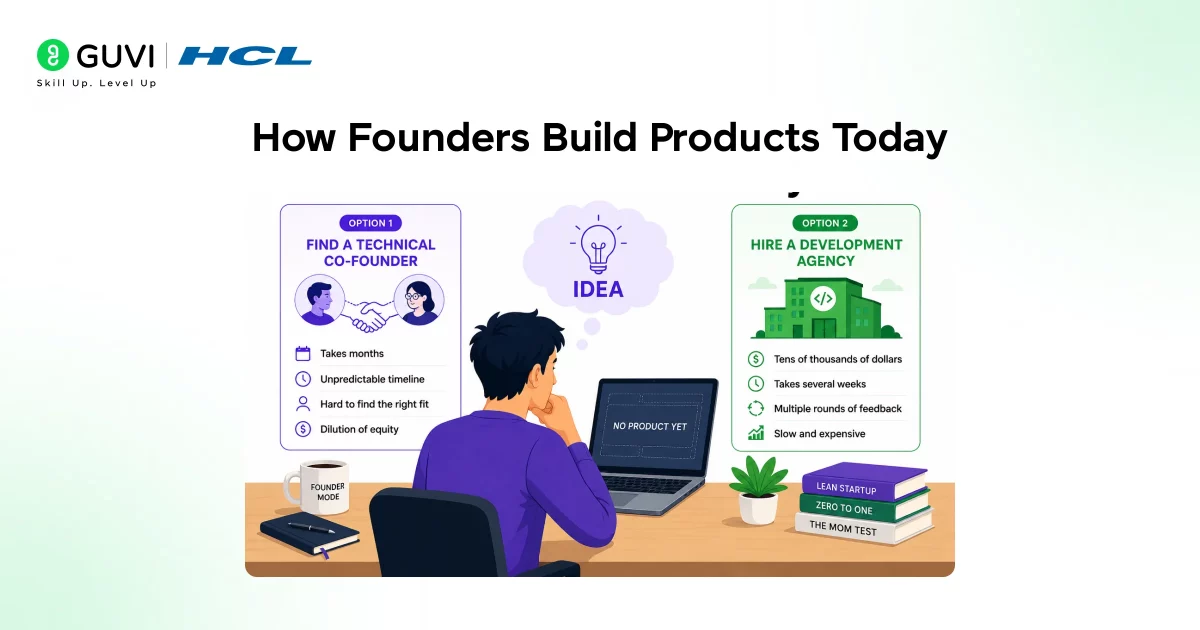
The traditional path from idea to product involves finding a technical co-founder or hiring a development agency. Both are slow and expensive. A co-founder search can take months. An agency engagement for a minimum viable product typically costs tens of thousands of dollars and takes several weeks before a working version exists.
The founder spends this time in a holding pattern. They cannot test their assumptions with real users because there is no product to show. They cannot refine their positioning because they do not know what the product will actually do until the developers build it.
No-code tools have helped, but most of them have meaningful ceilings. They work well for simple use cases and break down when the product requires custom logic, complex data relationships, or integrations that the platform does not natively support.
Lovable addresses this by generating custom application code rather than assembling predefined blocks. The output is a real application that can be extended, modified, and deployed without the constraints of a template-based builder.
The Real Problem: The Technical Bottleneck Kills Good Ideas
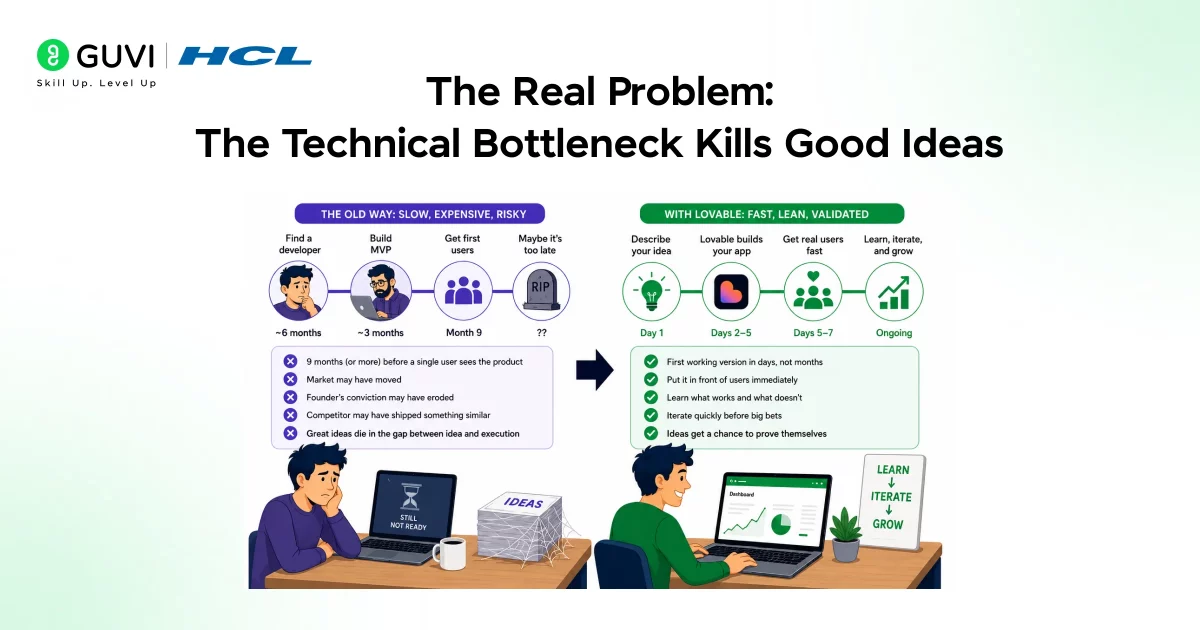
The technical bottleneck does not just delay products. It kills them. A founder who spends six months finding a developer and three months building a first version has invested nine months before a single user has seen the product.
By that point, the market may have moved, the founder’s conviction may have eroded, or a competitor may have shipped something similar. The idea that was fresh and differentiated in month one is stale by the time it reaches users in month nine.
When you build a business with Lovable, the first working version of a product can exist in days. The founder can put it in front of users immediately, learn what works, and iterate before any significant resource commitment has been made.
This compression of the feedback loop is the primary business advantage Lovable provides. It is not just faster development. It is a fundamentally different relationship between idea and validation.
The Shift: From Hiring Developers to Directing an AI Builder
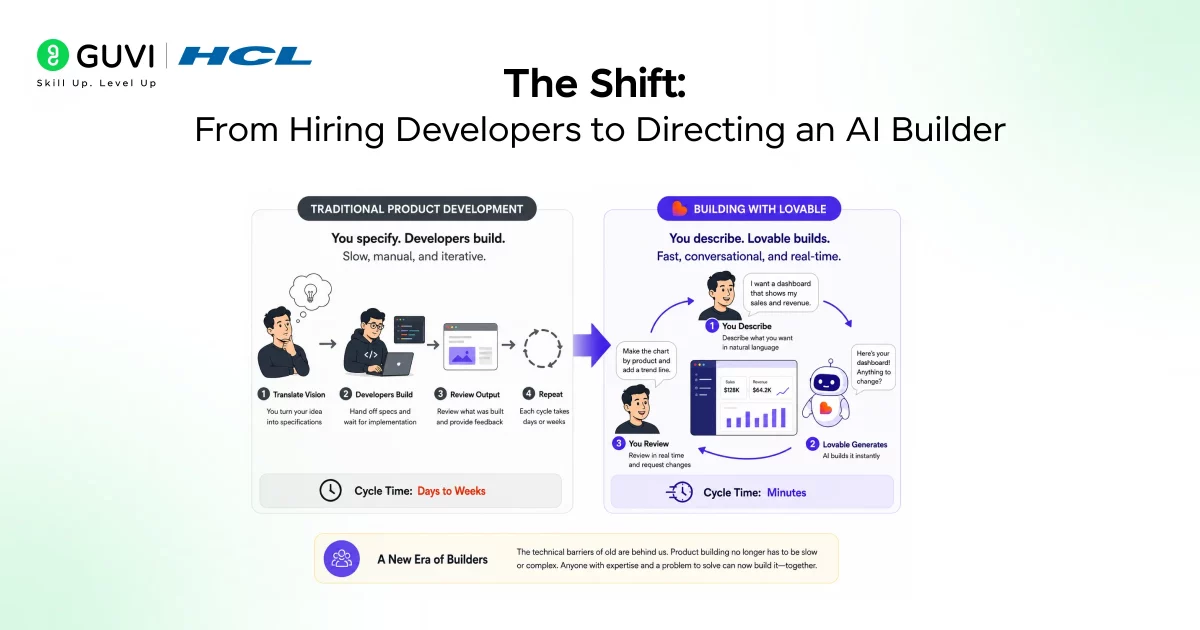
Traditional product development requires the founder to translate their vision into specifications, hand those specifications to developers, wait for implementation, review the output, and repeat. Each cycle takes days or weeks.
Building with Lovable replaces this with a conversational loop. The founder describes what they want, Lovable generates it, the founder reviews it in real time, and requests changes immediately. The cycle takes minutes rather than days.
This shift changes what kinds of people can build products. Domain experts who understand their industry deeply but have no engineering background can now build the tools their industry needs. Consultants can productize their methodology. Service businesses can build the software layer that makes their offering scalable.
The technical barrier that previously reserved product building for engineers or funded startups no longer exists in the same form when you build a business with Lovable.
How Lovable Works as a Business Building Platform
Lovable operates through a prompt-driven interface where the user describes the product they want to build. The platform generates the application structure, the user interface, the data model, and the logic that connects them.
Changes are made by continuing the conversation. If a feature needs to work differently, the founder describes the change, and Lovable updates the application. The product evolves through dialogue rather than through a development sprint cycle.
Example: Describing a product to Lovable
| Prompt:Build a SaaS tool for freelance copywriters to manage client projects.It should have: A dashboard showing active projects and upcoming deadlines A client portal where clients can submit briefs and review drafts A simple invoicing system that calculates fees based on word count User authentication so each copywriter has their own account Lovable generates: Full application with all described features Database schema for projects, clients, briefs, drafts, and invoices Authentication flow with individual user accounts Deployable to a live URL immediately |
The founder does not write a single line of code to produce this application. They describe the problem their users have and the features that address it, and Lovable handles the implementation.
Hidden Architecture: What Lovable Builds and How It Deploys
Lovable generates React-based frontend applications with Supabase as the backend database and authentication layer. The output is production-grade code that can be deployed to a live URL and shared with real users immediately.
The platform handles hosting, database provisioning, and deployment automatically. The founder does not manage infrastructure. The application is live the moment Lovable finishes generating it.
Custom domains can be connected so the product has its own branded URL. The codebase can be exported if the founder wants to hand it to a developer for further customisation or bring it into a version control system for more advanced development work.
This architecture means a business built with Lovable starts with a real, deployable product rather than a prototype that needs to be rebuilt before it can handle real users.
An Example: A Full Business Building Workflow with Lovable
A consultant who runs workshops on financial planning for small businesses wants to productize her methodology. She wants a tool that small business owners can use between workshops to track their cash flow projections. With Lovable, she builds and launches the product herself over a weekend.
| Day 1 Morning: Define the core product Prompt Lovable to build a cash flow projection tool Input: revenue streams, fixed costs, variable costs, months to project Output: visual projection chart and summary table Day 1 Afternoon: Add user accounts and data persistence Each user saves their own projection scenarios Users can name and compare multiple scenarios Day 2 Morning: Add the business layer Prompt Lovable to add a paywall using Stripe integration Free tier: 1 scenario, Paid tier: unlimited scenarios at $19/month Day 2 Afternoon: Connect the domain and launch Connect custom domain Share with existing workshop attendees as first users First paying subscriber within 48 hours of starting |
The consultant did not hire a developer, did not write code, and did not spend months waiting. She used her domain expertise to define the product and Lovable to build it.

Did You Know?
Lovable was among the fastest-growing AI developer tools by user count in the months following its launch, with a significant portion of its users reporting no prior programming experience. The platform demonstrated that the barrier between having a product idea and having a working product is now primarily one of clarity of thought rather than technical skill.
Business Models That Work Well with Lovable
Not every business model is equally suited to Lovable. The platform works best for digital products where the value is delivered through a web application. The following categories represent strong fits for founders who want to build a business with Lovable.
SaaS Tools
Software as a service products with a recurring subscription model are the most natural fit. Lovable can generate the full application, the user authentication, the subscription billing integration, and the feature set that drives the value proposition.
The founder focuses on identifying a specific workflow that a defined user group needs to do repeatedly and building the tool that makes it faster, more accurate, or less painful.
Internal Business Tools
Many businesses pay for multiple software subscriptions to cover workflows that could be served by a single custom tool built for their specific process. Lovable allows business owners to build the exact tool they need rather than adapting their workflow to fit a generic platform.
These tools can also be productized and sold to other businesses in the same industry that share the same workflow problem.
Directories and Marketplaces
Curated directories of service providers, tools, or resources in a specific niche can be built quickly with Lovable and monetised through listing fees, featured placement, or affiliate arrangements.
Marketplaces connecting buyers and sellers in a specific category follow a similar pattern and can be built as an initial version that validates demand before a more complex version is developed.
Productized Services
Consultants, coaches, and agencies that deliver recurring services can use Lovable to build the software layer that makes their service more scalable. A coach who runs a weekly accountability program can build the tracking and check-in application that their clients use between sessions.
The software becomes an additional revenue stream or a retention mechanism that makes the core service stickier.
Iteration Speed as a Crucial Enabler
The ability to build a business with Lovable is not just about the first version of a product. It is about what happens after the first version is in front of users.
Most products fail not because the initial idea was wrong but because the team could not iterate fast enough to find the version that users actually wanted. When iteration takes weeks, a startup has time for five or six significant changes before it runs out of runway.
When iteration takes hours, the same startup can make fifty changes in the same period. The product that emerges from fifty iterations of user feedback is fundamentally better than the one that emerges from five.
Lovable compresses iteration time to the point where a single founder can move as fast as a well-resourced team. This compression is the core business advantage that makes it possible to build and grow a product without a technical team.
Why This Enables Real Business Growth
Products built with Lovable are not just demos or prototypes; they are fully deployable applications that real users can sign up for, pay for, and use regularly.
Lovable provides built-in business infrastructure, eliminating the need to assemble multiple tools:
- Stripe integration for handling payments
- Supabase for managing user data
- Custom domains for branding and product identity
Founders can move directly from product creation to revenue generation within a single workflow.
The success of a Lovable-built product depends not on technical capability, but on:
- Solving a real problem
- Targeting a real user group
The platform takes care of the technical side, while the founder focuses on the business side.
Business growth follows core startup principles:
- Acquire users
- Retain users by delivering consistent value
- Expand revenue by:-
- Solving more user problems
- Reaching a broader audience
If you want to learn more about building skills for Claude Code and automating your procedural knowledge, do not miss the chance to enroll in HCL GUVI’s Intel & IITM Pravartak Certified Artificial Intelligence & Machine Learning courses. Endorsed with Intel certification, this course adds a globally recognized credential to your resume, a powerful edge that sets you apart in the competitive AI job market.
Conclusion
Lovable makes it possible for anyone with a clear problem and a defined user to build a real product and launch a real business. The technical bottleneck that filtered out most non-technical founders is no longer the obstacle it was.
The platform handles application generation, database provisioning, authentication, payment integration, and deployment. The founder handles customer understanding, positioning, and growth.
Through the combination of fast product generation, real-time iteration, and deployable output, Lovable compresses the time from idea to revenue to a degree that fundamentally changes what is possible for a single founder with limited resources.
If you have a validated problem and a clear user but no technical co-founder, that is no longer a reason not to build. Real business starts when the product exists and users can tell you what they actually need. Lovable gets you there faster than any previous alternative.
FAQs
1. What is Lovable and how does it work?
Lovable is an AI-powered application builder that generates full-stack web applications from natural language descriptions. Users describe the product they want to build and Lovable generates the application, database, authentication, and deployment without requiring manual coding.
2. Can a non-technical founder really build a business with Lovable?
Yes. Lovable is designed specifically for users without programming backgrounds. The founder needs to understand their user and articulate the problem clearly. The platform handles the technical implementation. Many solo founders with no coding experience have built and launched revenue-generating products with it.
3. What kinds of businesses are best suited to Lovable?
SaaS tools, internal business tools, directories, marketplaces, and productized services are the strongest fits. Any business where the value is delivered through a web application and where the use case can be clearly described is a candidate for being built with Lovable.
4. How quickly can a product be launched with Lovable?
A first working version of a product can be generated in hours. A complete version with user authentication, data persistence, and payment integration can be live within a day or two of starting. The timeline depends on the complexity of the product and how clearly the founder can describe what they need.
5. Can Lovable handle payments and user accounts?
Yes. Lovable integrates with Stripe for payment processing and uses Supabase for user authentication and database storage. These integrations allow founders to build products with subscription billing, user accounts, and persistent data without setting up the infrastructure manually.
Success Stories

About the Author
Vishalini Devarajan
An Aerospace Engineer turned content writer, I focus on making complex concepts easy to understand through well-structured, reader-friendly blogs. Whether it’s a technical topic or a non-technical one, I love creating content that is clear, engaging, and impactful.
View all posts by Vishalini Devarajan
Connect with me @








Did you enjoy this article?