


Artificial Intelligence and Machine Learning Articles
AI/ML Skills Gap 2026: Why Companies Can't Find Job-Ready Talent
20 AI/ML Interview Questions Recruiters Can Use Without a Tech Background - Best Guide
How Industry-Backed AI/ML Bootcamps Are Changing the AI/ML Hiring Pipeline - Best Guide 2026
From IT Support to AI Engineer: A Realistic Career Switch Guide 2026

Get In Touch For Details! Request More Information
How n8n Accelerates Product Development with Lovable
Jun 25, 2026 8 Min Read 778 Views
(Last Updated)
Every product team faces the same bottleneck. Ideas pile up. Feedback sits in documents. Roadmaps live in tools that were never quite right. Engineers are busy, designers are stretched, and the gap between “we should build this” and “this is built” stays stubbornly wide. n8n, the open-source workflow automation platform used by millions of developers, hit the same wall and solved it by making product development with Lovable the foundation of how their team works.
This blog covers the real story: how n8n’s Group Product Manager rebuilt his team’s entire prototyping and internal tooling workflow using Lovable, what n8n’s technical integration with Lovable actually enables, and what any product team can replicate from their approach.
Quick Answer
n8n uses Lovable for three things: rapid prototyping that replaces wireframes, a custom internal tool that stores roadmap initiatives and matches them to user feedback, and cross-functional alignment by sharing interactive prototypes instead of static slides. Technically, n8n also connects to Lovable via MCP, giving any Lovable app access to n8n’s 400+ automation integrations from day one.
Table of contents
- What is n8n?
- Why n8n Chose Product Development with Lovable
- How n8n Uses Product Development with Lovable: 3 Core Workflows
- Rapid Prototyping That Replaces Wireframes
- A Custom Internal Roadmap and Feedback Tool
- Cross-Functional Alignment Through Interactive Prototypes
- The Technical Integration: How n8n and Lovable Connect
- What MCP Means for Product Development with Lovable
- How to Set Up n8n in Lovable
- What You Can Build with n8n and Lovable Together
- The Webhook Architecture: How Data Flows
- What Product Teams Can Learn from n8n's Approach
- Tips for Product Development with Lovable
- 💡 Did You Know?
- Conclusion
- FAQs
- Do you need to know how to code to use Lovable for product development?
- How does the n8n and Lovable integration work technically?
- What kinds of internal tools can you build with Lovable?
- Is the n8n community edition free?
- Can Lovable prototypes be handed directly to engineers?
What is n8n?
n8n is a visual workflow automation platform that powers product development with Lovable through its 400+ integrations that connects over 400 tools and services. It sits between your apps and lets you automate processes across them using a drag-and-drop node-based editor without traditional coding.
What makes n8n different from tools like Zapier is the combination of power and openness:
- 400+ native integrations: HubSpot, Slack, Salesforce, Google Sheets, Airtable, Stripe, and hundreds more
- Code flexibility: Write JavaScript or Python directly inside workflows for custom logic
- Self-hosted option: The Community Edition is free to run on your own server, giving full data control
- AI workflow builder: Describe an automation in plain English and get a working workflow back
- 200,000+ community members sharing templates, nodes, and support
- 1,700+ pre-built workflow templates to start from
- MCP support: Lovable, Claude, and other AI clients can connect directly to n8n workflows via Model Context Protocol
n8n Cloud starts at approximately €20/month, making product development with Lovable accessible to small teams. The self-hosted Community Edition is free. Enterprise plans support SSO, RBAC, audit logs, and high availability for larger teams.
Do check out HCL GUVI’s AI and ML Course, which offers a structured learning path covering artificial intelligence, machine learning, deep learning, NLP, and real-world project development to help learners build industry-ready skills. The program includes live mentor-led sessions, hands-on projects, and placement guidance, making it suitable for beginners and professionals looking to transition into AI and ML roles.
Why n8n Chose Product Development with Lovable
Niklas (Nik) Hatje, Group Product Manager at n8n, drove the decision to adopt Lovable across his product and design teams. Here is exactly what led him there and why product development with Lovable won over every alternative.
- The operating principle: n8n runs on ship over perfectionism. “We default to building and shipping quite a lot,” Nik says. “And we believe in refining product taste and product sense to make the right decisions.”
- The problem before Lovable: Every new idea had to be written down and handed to a designer or engineer. A PM thinking through a user flow in a Google Doc cannot find the edge cases that become obvious the moment something is clickable.
- Personal experience first: Nik had already explored product development with Lovable on personal projects before bringing it to work. He knew firsthand it was different from typical prototyping tools.
- Why other tools did not qualify: When comparing vibe coding tools for workplace use, most stopped at prototyping. “I looked into different vibe coding tools, and Lovable seemed to be the one that worked best, especially for building end-to-end products,” Nik says.
- The deciding factor: “There are quite a few vibe coding products that focus on prototyping, but with Lovable, you can do that and take it one step further,” Nik explains. That step is a deployable backend, not just a mockup.
- What that means for handoffs: Product development with Lovable at n8n produces handoff-ready code. Engineers receive a working React and TypeScript app, not a design file to interpret.
Thought to ponder: How much product thinking gets lost in translation between a PM writing a spec, a designer making wireframes, and an engineer reading both? How different would development cycles look if the PM could hand engineers a working prototype instead?
n8n found out. The result of product development with Lovable for Nik is clear: “Sometimes, we don’t even need a high-fidelity version. We can just give the prototypes to the engineers.” That sentence represents a genuine reduction in the handoff tax that slows most product teams down.
How n8n Uses Product Development with Lovable: 3 Core Workflows
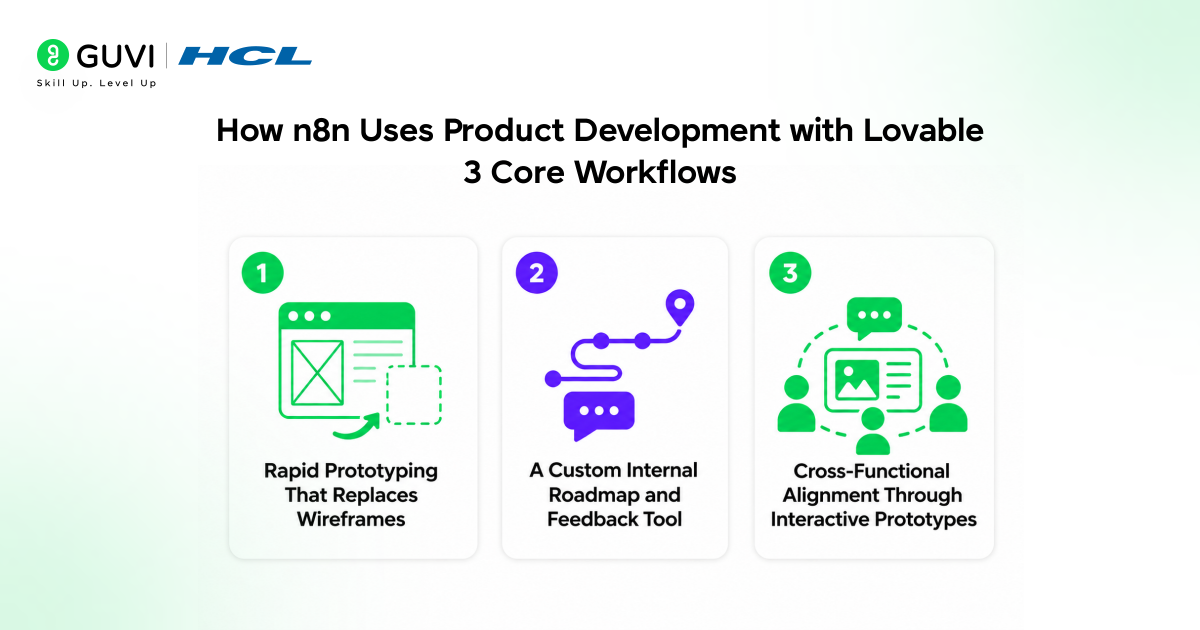
Lovable has become a core tool for the product management and design teams at n8n. Here is exactly how they use it.
1. Rapid Prototyping That Replaces Wireframes
Before Lovable, prototyping at n8n meant wireframes. Wireframes are useful but slow to make, static, and disconnected from the final product.
With product development with Lovable replacing the old wireframe process, Nik builds interactive prototypes:
- Faster ideation: “Now, when we talk about a new feature, instead of creating wireframes, I can quickly build a prototype to bring my idea across before we build a higher-fidelity version,” Nik says
- Better thinking: Describing a flow to Lovable surfaces edge cases that writing never does. “It’s much faster to develop ideas because you can use it as a thought partner, especially if you don’t know precisely what the UX should be”
- Direct handoff: Because Lovable generates deployable React and TypeScript code, prototypes sometimes go directly to engineers without a redesign phase. “I definitely feel faster,” Nik says
- Visual exploration: “Sometimes you’re thinking through things and having a visual helps you really explore the details,” Nik explains
2. A Custom Internal Roadmap and Feedback Tool
This is the use case that most clearly shows what becomes possible when a PM has the ability to build their own tools.
Nik needed to solve a problem that affects every lean startup product team: how do you communicate roadmap plans to many stakeholders while keeping everything grounded in real user feedback? He searched for an existing solution. None had exactly what he needed.
“There are many platforms that try to do this, but they either wouldn’t have everything we needed, or would have quite a lot that we didn’t need,” Nik explains.
With product development with Lovable, he built it himself:
- What the tool does: Stores all team initiatives, matches customer feedback to existing projects, and provides a single source of truth for roadmap priorities
- Who uses it: Initially the product team, with plans to expand to external use for collecting feedback on the n8n platform
- Why it matters: “Without Lovable, we wouldn’t have built it, or we would have used some existing tool that was suboptimal,” Nik says
- Ongoing refinement: Nik continues iterating on the tool based on feedback from internal users, the same way any product gets improved
This use case captures product development with Lovable at its most powerful: solving a real internal problem that no off-the-shelf tool addresses, built by the person who feels the problem most.
3. Cross-Functional Alignment Through Interactive Prototypes
The third workflow addresses stakeholder communication, which is a tax every PM pays but rarely talks about.
Getting alignment on what to build is one of the hardest parts of product development with Lovable-powered teams. Static slides and written specs create ambiguity. Interactive prototypes remove it.
Product development with Lovable at n8n extends to how the team presents roadmap decisions to cross-functional partners:
- Show, don’t tell: A clickable prototype communicates a product idea better than a slide deck. Partners can interact with the concept and respond to what they actually see.
- Faster feedback loops: When you can build and share a prototype quickly, the feedback cycle shortens. Bad ideas get killed fast. Good ideas get refined before engineers touch them.
- External use ahead: The internal roadmap tool may eventually be used to present the roadmap externally and collect feedback from n8n’s own users
Riddle: A PM has an idea for a new feature. Option A: write a spec, wait for a designer to make wireframes, review them, send them to engineers. Option B: describe the idea to Lovable, get an interactive prototype in two hours, share it with the team, iterate. Which path finds the user experience problems first?
Answer: Option B always finds them first, because problems in a user flow only become visible when someone actually clicks through it. n8n found this through product development with Lovable. Building the prototype is now the thinking process, not a step that comes after the thinking is done.
The Technical Integration: How n8n and Lovable Connect
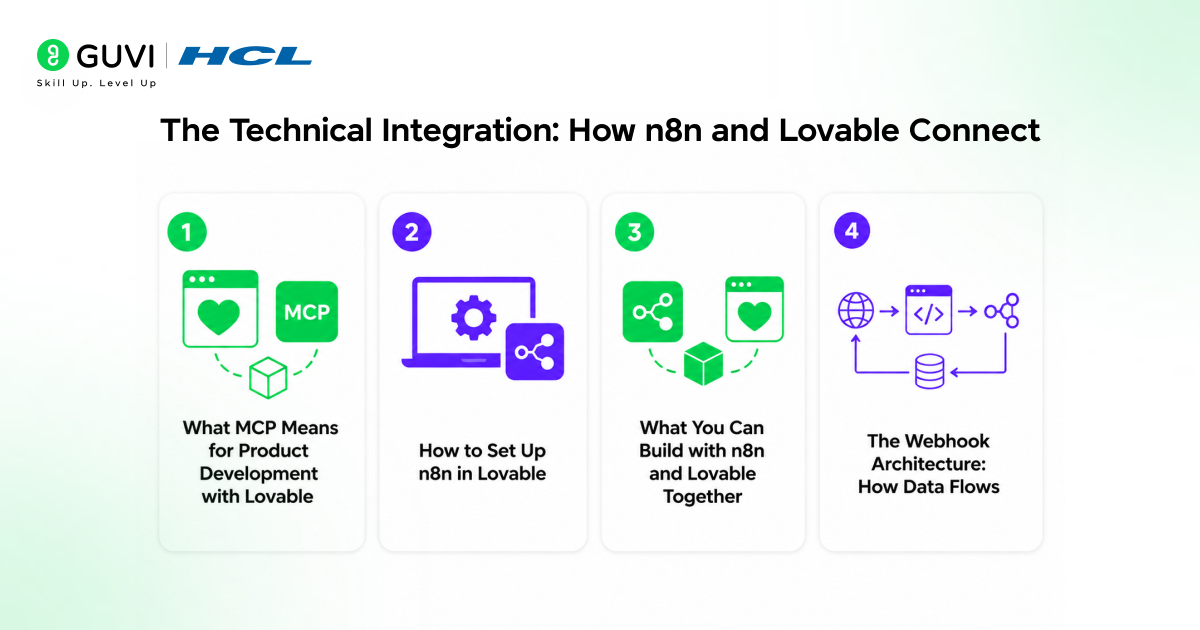
Beyond n8n’s internal use of product development with Lovable, there is a technical dimension: n8n and Lovable connect directly via MCP.
1. What MCP Means for Product Development with Lovable
MCP stands for Model Context Protocol. It is a standard that lets AI tools connect to external services and work with real data from those systems. When Lovable connects to n8n via MCP, your Lovable app can read from and write to any of n8n’s 400+ integrations without building that infrastructure yourself.
This is a key moment in product development with Lovable history, announced November 18, 2025, when Lovable released integrations with n8n, Notion, Linear, Confluence, and Jira simultaneously.
- What it enables: Connect n8n workflows to Lovable apps, pull live data from HubSpot, sync with Slack, trigger Salesforce actions, connect Google Sheets, and more
- How it runs: n8n workflows run continuously in the background, so Lovable apps stay connected to live data without you managing any backend infrastructure
- No rebuild needed: Any existing n8n workflow with a webhook, schedule, chat, or form trigger can be exposed to Lovable with a single settings toggle
2. How to Set Up n8n in Lovable
Setting up the n8n connector in Lovable for product development takes a few minutes:
- Step 1: Go to Settings → Connectors → Personal connectors in your Lovable project
- Step 2: Select n8n from the list of available connectors
- Step 3: Click Connect and sign in to your n8n account
- Step 4: In n8n, go to Settings and toggle on MCP access for your instance
- Step 5: Enable individual workflows for MCP access inside each workflow’s settings
- Step 6: Back in Lovable, the Lovable Agent can now read your enabled workflows and trigger them from natural language prompts

3. What You Can Build with n8n and Lovable Together
The combination that powers product development with Lovable at scale is Lovable’s front-end generation plus n8n’s automation backbone unlocks a specific class of tools that neither platform handles alone:
| Use Case | Lovable Handles | n8n Handles |
| Lead capture form | UI, form design, submission logic | Routes to HubSpot CRM, notifies Slack, sends email via Resend |
| Sales dashboard | Charts, tables, filters, user auth | Pulls from Salesforce, Stripe, and Gong in real time |
| Customer feedback tool | Form interface, data display, tagging | Stores responses, syncs to Airtable, triggers follow-ups |
| Roadmap tracker | Initiative list, feedback view, status updates | Matches feedback from Intercom or email to existing items |
| Approval workflow | Request form, status view, comments | Routes to reviewers, sends reminders, updates records |
| AI-powered tool | User input interface, result display | Calls OpenAI, processes response, formats and returns data |
4. The Webhook Architecture: How Data Flows
For teams building with both tools, the core pattern is simple:
- Lovable sends data: When a user submits a form or triggers an action in your Lovable app, the app sends that data to an n8n webhook
- n8n processes it: The n8n workflow receives the payload, runs it through any combination of AI, logic, and integrations (Slack, Gmail, Airtable, Salesforce, and so on)
- n8n sends data back: The workflow returns a result to the Lovable app, which displays it to the user
This architecture gives any Lovable app access to n8n’s full automation stack without writing API code or managing credentials for each service.
What Product Teams Can Learn from n8n’s Approach
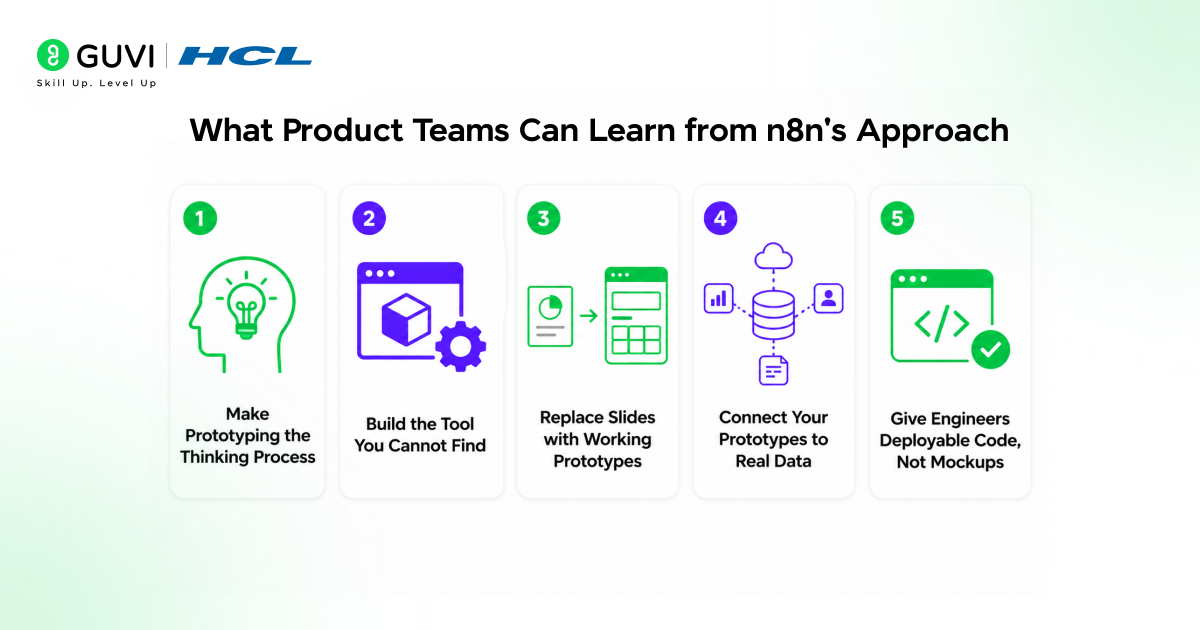
n8n’s approach to product development with Lovable is a replicable playbook for any team. Here is what any product team can take from it.
1. Make Prototyping the Thinking Process
Most teams prototype after they have thought something through. n8n flipped this. In product development with Lovable, the prototype is how they think. When you describe a flow to Lovable and see it rendered, the edge cases appear immediately. This is faster than a written spec and more honest than a wireframe.
2. Build the Tool You Cannot Find
Nik searched for a roadmap-and-feedback tool and came up empty. Instead of accepting a suboptimal solution, he built exactly what he needed. Product development with Lovable makes this viable for PMs and product teams who are not engineers. When the right tool does not exist, you can now build it.
3. Replace Slides with Working Prototypes
The next time you present a roadmap or a new feature proposal to stakeholders, consider sharing a working prototype instead of a deck. Product development with Lovable makes building something interactive faster than building a polished presentation. And an interactive prototype generates better feedback than a static slide.
4. Connect Your Prototypes to Real Data
A prototype created through product development with Lovable that shows real data from your CRM, your support inbox, or your analytics pipeline is more convincing and more useful than one with fake data. n8n + Lovable makes this straightforward. Build the interface in Lovable, connect the real data source through n8n.
5. Give Engineers Deployable Code, Not Mockups
Product development with Lovable generates React and TypeScript code. When a prototype is good enough, it goes straight to engineers as a starting point. The handoff from PM to engineering becomes: here is a working build, extend it. That removes an entire design and specification phase from the cycle.
Tips for Product Development with Lovable
- Start every feature with product development with Lovable: Before writing a spec or creating a ticket, build a rough interactive version. You will find problems in the UX faster than any amount of writing.
- Connect n8n early for real data: A prototype that uses real data from your stack via n8n is always more informative than one with placeholder content. Set up the webhook integration in the first session.
- Iterate in Lovable before handing it to engineers: In product development with Lovable, use Chat Mode to refine logic, Visual Edits for UI polish, and Agent Mode for adding features. The more resolved the prototype, the less back-and-forth during development.
- Use product development with Lovable to build the internal tools your team actually needs: Do not accept a suboptimal off-the-shelf solution. If the right tool does not exist, product development with Lovable makes building it a weekend project, not a quarter-long roadmap item.
- Use Plan Mode before every significant build: Since February 2026, product development with Lovable includes a Plan Mode that shows a detailed build plan before generating code. Review it carefully. Fixing a misunderstood requirement in the plan costs nothing. Fixing it after the build costs several credits.
- In product development with Lovable connected to n8n, keep your workflows documented: When you connect n8n to a Lovable app, add clear descriptions to each workflow. When the Lovable Agent queries your n8n MCP server, better workflow descriptions produce better results.
Do check out HCL GUVI’s AI & ML Email Course, a beginner-friendly 5-day program that introduces core AI and machine learning concepts, real-world applications, and simple project ideas to help you understand how AI works and how to start your learning journey.
💡 Did You Know?
- n8n’s own integration with Lovable was announced on November 18, 2025, the same day Lovable released MCP connectors for Notion, Linear, Confluence, and Jira. n8n, being a workflow automation platform, was a natural fit as the automation backbone for Lovable apps.
- n8n’s name comes from the word “nodemation.” The numeral 8 represents the eight letters between the first n and the last n in “nodemation.” It is pronounced “n-eight-n.”
- n8n workflows exposed via MCP can be triggered directly from natural language prompts inside Lovable. A developer demonstrated how product development with Lovable creates a fully functional bug tracker UI by analysing an n8n webhook workflow in a single attempt.
Conclusion
The lesson from n8n’s approach to product development with Lovable is not technical. It is cultural. A product team that can build, prototype, and iterate using Lovable moves differently. Ideas get tested instead of debated. Problems get solved instead of tracked. Internal tools get built instead of compromised on.
The outcomes from product development with Lovable at n8n are three concrete results: faster prototyping that sometimes bypasses the entire wireframe phase, a custom internal tool that no existing product could provide, and a better alignment process with cross-functional partners. These are not aspirational benefits. They are what a senior PM at one of the fastest-moving AI platforms in Europe documented and described in his own words.
For any product team still moving ideas through the old document-spec-wireframe-engineer pipeline, product development with Lovable offers a clear alternative. The n8n story is a clear signal. Product development with Lovable is not a shortcut. It is a different way of working. It is a different way of working, and it is faster.
Start product development with Lovable at lovable.dev and build the first thing on your list.
FAQs
1. Do you need to know how to code to use Lovable for product development?
No. Starting product development with Lovable requires no coding background. for non-technical PMs, designers, and founders. Nik at n8n comes from a technical background but uses Lovable precisely because it lets him build without going deep into code.
2. How does the n8n and Lovable integration work technically?
In product development with Lovable, the n8n connection works via MCP (Model Context Protocol). You enable MCP on your n8n instance, mark specific workflows for access, then connect n8n as a personal connector in Lovable. The Lovable Agent can then read and trigger those workflows from natural language prompts.
3. What kinds of internal tools can you build with Lovable?
Product development with Lovable supports roadmap trackers, feedback consolidation tools, approval workflows, customer dashboards, lead capture forms, reporting tools, and any custom tool your team needs that existing platforms do not provide precisely. n8n built a roadmap-and-feedback tool this way.
4. Is the n8n community edition free?
Yes. n8n’s Community Edition is free to self-host with no caps on executions or core features. n8n Cloud starts at approximately €20 per month for teams that prefer managed hosting.
5. Can Lovable prototypes be handed directly to engineers?
Yes. Lovable generates real React and TypeScript code that syncs to GitHub. At n8n, prototypes built through product development with Lovable sometimes go directly to engineers without a separate design phase, which is exactly what Nik described.
Success Stories

About the Author
Jebasta
I translate the language of data into stories that anyone can understand. As a writer with a data science background, I simplify analytics, AI, and decision-making so beginners and enthusiasts can confidently explore the world of data.
View all posts by Jebasta
Connect with me @







Did you enjoy this article?