


Software Development Articles
How to Read and Understand System Design Diagrams?
System Engineer Roles and Responsibilities: 12 Proven Duties for Growth
SAP Consultant Roles and Responsibilities: 12 Proven Duties for Growth and Success
Network Engineer Roles and Responsibilities: 12 Essential Duties for Success


Get In Touch For Details! Request More Information
Future of Software Development: A Comprehensive Overview
Sep 25, 2025 5 Min Read 2784 Views
(Last Updated)
If you’ve ever wondered what the future of software development looks like, you’re not alone. The way we build, deploy, and use software is changing faster than ever. New tools, smarter systems, and shifting user expectations are rewriting the rules of the industry.
India, with its massive developer community, thriving IT services sector, and growing startup ecosystem, is right at the heart of this transformation. Whether you’re a student, a budding developer, or someone already working in tech, understanding where things are headed can help you stay ahead.
Let’s break down the future of software development in this article, zoom into India’s unique position, and look at what this means for you. So, without further ado, let us get started!
Table of contents
- Global Trends in Software Development
- AI and Machine Learning in Development
- Low-code/No-code Platforms
- Quantum Computing on the Horizon
- Cloud-native Development
- Cybersecurity by Design
- Vibe Coding / Natural-Language Driven Development
- Edge Computing & Distributed Architecture
- The Indian Software Development Landscape
- India as a Global IT Hub
- Education and Skilling Initiatives
- Startups and Unicorn Growth
- Outsourcing to Innovation
- Remote and Hybrid Workforce
- What the Future Holds for Developers?
- Skills You’ll Need
- Collaboration with AI Agents
- Continuous Learning Mindset
- Progressive Web Apps (PWAs) & Modern UI Trends
- Green Software / Sustainable Coding
- Full‐stack or Polyglot Developer Demands
- Challenges of Software Development
- Talent vs. Readiness Gap
- Cybersecurity Threats
- Keeping Up with Global Standards
- Managing Remote and Hybrid Teams
- Ethical and Regulatory Hurdles
- Conclusion
- FAQs
- What skills should I learn to stay relevant in software development?
- Will AI replace software developers?
- Is software development still a good career choice in India?
- How does low-code/no-code impact traditional developers?
- What industries in India will need the most software talent in the future?
Global Trends in Software Development
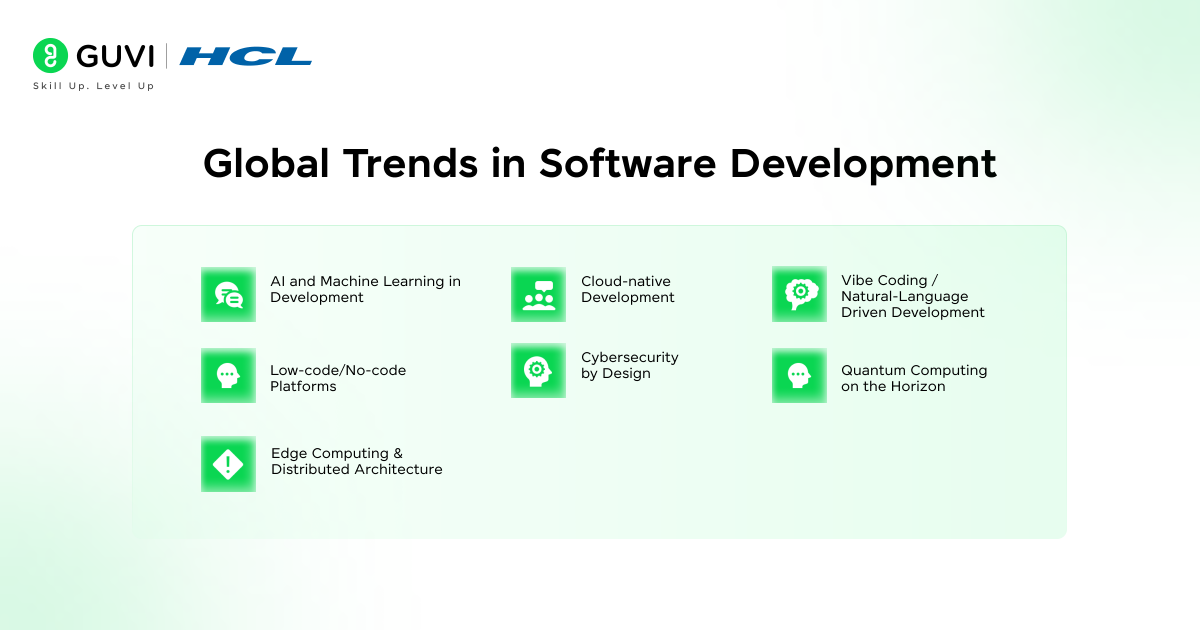
Software development worldwide is going through a dramatic shift. It’s not just about writing code anymore, it’s about how software integrates into every part of life, business, and technology. Here are the key trends shaping the future globally:
1. AI and Machine Learning in Development
AI has moved from theory to practice. Tools like GitHub Copilot, ChatGPT, and Tabnine are now helping developers write, review, and optimize code.
What this means for you is that instead of spending hours debugging or writing boilerplate code, you’ll rely on AI for the heavy lifting while focusing on logic, creativity, and design.
2. Low-code/No-code Platforms
Businesses can’t always wait months for apps. That’s why platforms like OutSystems, Mendix, and even Microsoft Power Apps are rising. These allow non-technical people to build apps quickly.
For professional developers, this doesn’t mean being replaced; it means working on high-value problems like scalability, integration, and custom features.
3. Quantum Computing on the Horizon
Quantum computing may still sound futuristic, but companies like IBM and Google are already testing practical use cases.
Software developers will eventually need to adapt to quantum-safe algorithms and rethink how data security is handled when quantum capabilities become mainstream.
4. Cloud-native Development
Cloud is no longer just a storage solution; it’s the foundation of modern software. Microservices, containerization (via Docker/Kubernetes), and serverless architectures are redefining how applications are built and scaled.
For developers, this means learning to design flexible applications that are distributed and always online.
5. Cybersecurity by Design
As cyberattacks grow in complexity, secure coding is becoming a necessity, not a specialty. Developers of the future will be expected to think about security from the first line of code, not as an afterthought.
6. Vibe Coding / Natural-Language Driven Development
One of the newest shifts in software development is what people are calling vibe coding. Instead of writing every line of code, you might describe what you want in natural language (English or your native language), and AI tools generate working code from that.
It’s not about replacing developers, but about changing how you work. You’ll do more specifying, validating, and refining.
Recent reports say about 84 % of developers use or plan to use AI tools regularly, but many still don’t fully trust the outputs due to accuracy concerns. Vetting becomes part of your job.
7. Edge Computing & Distributed Architecture
Edge computing, running compute and processing closer to where data is generated (on devices, local servers, gateways), is accelerating. This reduces latency, bandwidth use, and improves responsiveness for applications like IoT, real-time analytics, AR/VR, etc.
Key implications:
- Software needs to handle intermittent connectivity, partial failures, and synchronization between the central cloud and edge nodes.
- More emphasis on distributed architecture design: you’ll deal with microservices, data consistency, and fault tolerance.
- Testing and deployment pipelines become more complex (you might test on edge devices or simulated edge environments).
The Indian Software Development Landscape
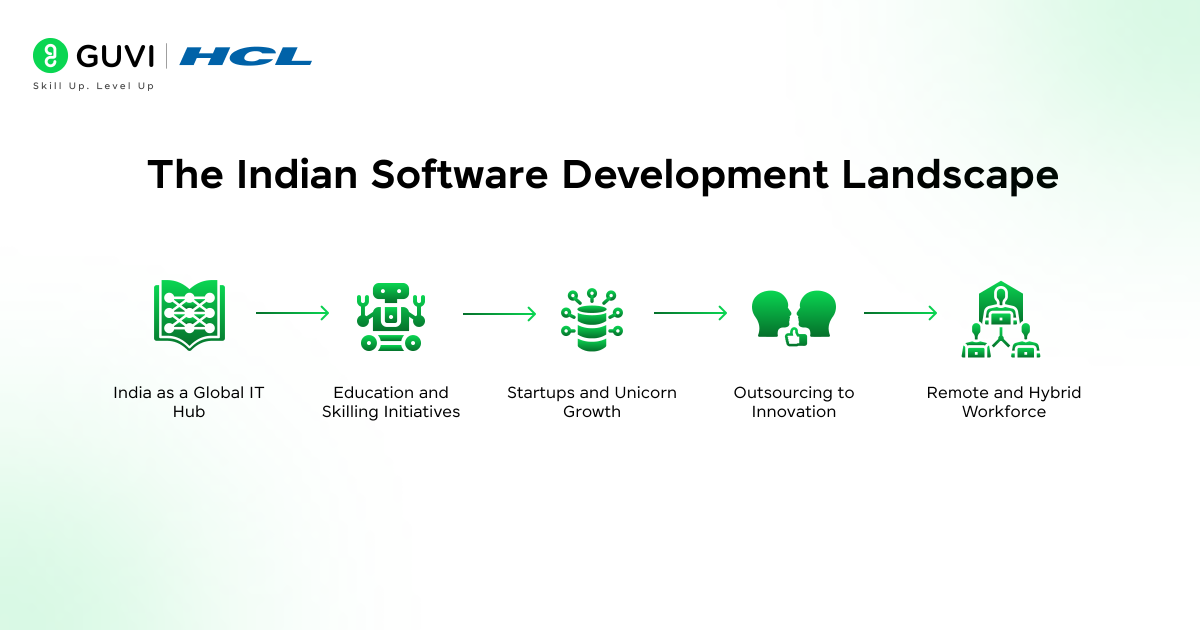
India plays a unique role in this global story. It has the advantage of a massive talent pool, strong IT service exports, and a startup scene that’s moving fast. But it also faces challenges like skill gaps and the need to move from outsourcing to innovation.
1. India as a Global IT Hub
India’s IT industry already contributes over 7% to the country’s GDP, with giants like TCS, Infosys, and Wipro leading globally.
By 2030, India is projected to be home to the largest developer community in the world, surpassing even the US. This makes the country not just a service hub, but a talent engine for the entire industry.
2. Education and Skilling Initiatives
A big reason for India’s rise is education. Top institutes like IITs and NITs produce world-class engineers, while edtech platforms like HCL GUVI are bridging the practical skill gap with hands-on training. Government initiatives like “Digital India” and “Skill India” are also equipping millions with future-ready skills in AI, data science, and cybersecurity.
3. Startups and Unicorn Growth
India has over 100 unicorn startups, many in fintech, healthtech, and SaaS. Companies like Freshworks, Zoho, and Razorpay are proof that Indian developers can build global-scale products. This shift from outsourcing projects to creating original products signals a maturing ecosystem.
4. Outsourcing to Innovation
Earlier, India was seen as the world’s “back office.” Today, IT firms are moving into consulting, AI-driven services, and cybersecurity solutions. The model is evolving from cost-driven outsourcing to innovation-driven partnerships.
5. Remote and Hybrid Workforce
The pandemic normalized remote work, and India adapted quickly. With developers now spread across cities, small towns, and even villages, companies are building remote-friendly systems. This makes collaboration tools, cloud-based workflows, and distributed development teams the new standard.
What the Future Holds for Developers?
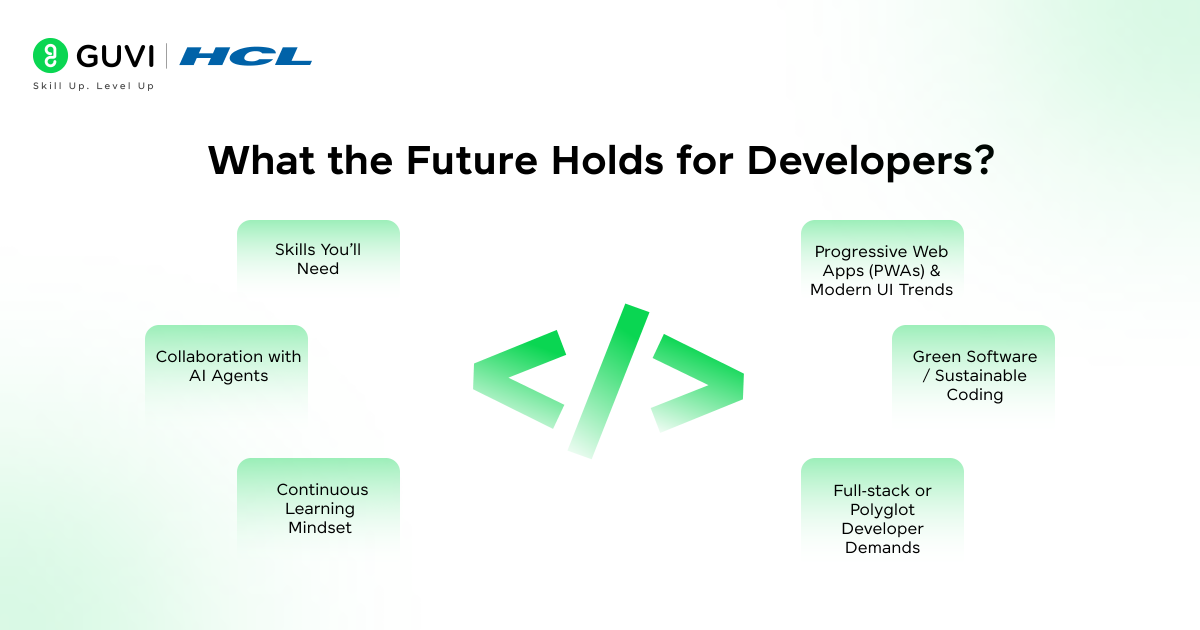
The role of a developer is evolving. In the past, you might have been measured by how many lines of code you wrote. In the future, your impact will be judged by how effectively you solve problems and work with new tools.
1. Skills You’ll Need
- AI literacy: You’ll need to know how to use AI coding assistants, validate their output, and guide them.
- Domain expertise: Industries like fintech, healthcare, and sustainability need developers who understand the domain, not just the tech.
- Systems thinking: Instead of isolated modules, you’ll design solutions that work across ecosystems of APIs, microservices, and cloud platforms.
- Soft skills: Communication and teamwork will matter as much as technical skill, especially in distributed teams.

2. Collaboration with AI Agents
AI won’t replace you; it’ll become your collaborator. Imagine writing an outline and having AI generate 60% of the boilerplate code, while you focus on architecture, optimization, and user experience. Developers who learn how to “manage” AI as a teammate will be more productive and in demand.
3. Continuous Learning Mindset
Technology has always evolved quickly, but the pace is accelerating. Frameworks become outdated in just a few years, and new paradigms (like serverless or Web3) pop up overnight. The best developers will treat learning as part of their daily routine, reading docs, trying new tools, and experimenting.
4. Progressive Web Apps (PWAs) & Modern UI Trends
Another trend is around user experience: Progressive Web Apps (PWAs) provide near-native app behavior in browsers. Faster loading, offline capabilities, push notifications, these are not gimmicks; they become expectations. Also, more focus on modern UI/UX designs, accessibility, and performance.
5. Green Software / Sustainable Coding
Sustainability is entering dev conversations. Green software means writing code and building systems in a way that minimises energy use, carbon footprint, and hardware waste.
As a developer, you might:
- Optimize algorithms and architecture for lower compute, fewer redundant calls, and leaner memory usage.
- Use more efficient languages/runtimes, or run on infrastructure that’s powered by renewable energy.
- Measure impact: be ready for tools/mechanisms that track the energy consumption of your application.
6. Full‐stack or Polyglot Developer Demands
There’s growing demand for developers who are comfortable across multiple layers, frontend, backend, and infrastructure. Also working in more than one programming paradigm or stack (polyglot), because different problems need different tools.
Implications:
- Learning multiple languages or frameworks becomes valuable. For instance, being good with both JavaScript/TypeScript (frontend) and Go, Rust, or Python (backend).
- Understanding infrastructure (servers, deployment, cloud, containerization) is increasingly expected even from “frontend” roles.
- Sharing knowledge across roles is becoming more common; full-stack teams offer flexibility.
Challenges of Software Development
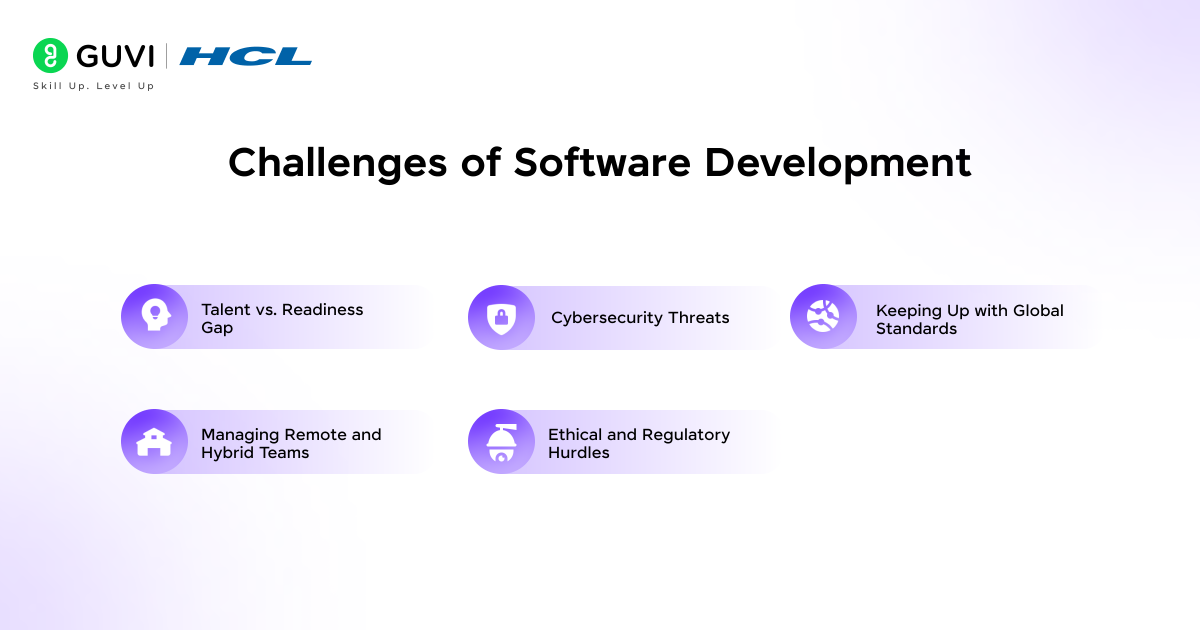
The future looks bright, but it isn’t without hurdles. Developers, companies, and even governments will have to address these challenges to keep the industry moving forward.
1. Talent vs. Readiness Gap
India produces millions of engineering graduates each year, but many aren’t industry-ready. Employers are demanding skills in AI, cloud, and cybersecurity, yet graduates often lack this practical exposure. Closing this gap will require better education, internships, and upskilling platforms.
2. Cybersecurity Threats
As digital adoption grows, so do attacks. Indian companies face increasing risks from ransomware, phishing, and data breaches. Developers will have to build security into every layer of software, from the database to the user interface.
3. Keeping Up with Global Standards
India is competing not just with itself, but with global players. Clients expect world-class performance, design, and reliability. Developers must continuously adapt to international coding standards, compliance rules, and user expectations.
4. Managing Remote and Hybrid Teams
Distributed work is here to stay, but it introduces its own challenges: communication gaps, time-zone mismatches, and collaboration issues. Developers will need to become comfortable with async workflows and remote-first tools like GitHub, Slack, and Jira.
5. Ethical and Regulatory Hurdles
As AI becomes central to software, questions of ethics, bias, and regulation will grow. Developers may be asked not just to code, but to make ethical decisions about data, privacy, and fairness.
Did you know that India is on track to become the world’s largest developer community by 2027, overtaking the United States? This means that in just a few years, more software will be written, maintained, and innovated from India than anywhere else in the world. Combine that with the fact that over 70% of Indian startups already rely on open-source software, and you can see how India isn’t just catching up, it’s shaping the global software future.
If you’re serious about mastering software development along with AI and want to apply it in real-world scenarios, don’t miss the chance to enroll in HCL GUVI’s IITM Pravartak and MongoDB Certified Online AI Software Development Course. Endorsed with NSDC certification, this course adds a globally recognized credential to your resume, a powerful edge that sets you apart in the competitive job market.
Conclusion
In conclusion, the future of software development is exciting, fast-changing, and full of opportunity. For India, it’s a chance to move from being the “world’s IT back office” to becoming the innovation engine of the digital age.
If you’re a developer, the future is not about writing lines of code endlessly; it’s about solving real-world problems, working alongside AI, and continuously adapting. The ones who thrive will be those who stay curious, flexible, and open to learning.
FAQs
1. What skills should I learn to stay relevant in software development?
Focus on AI tools, cloud-native development, cybersecurity, and problem-solving. Continuous learning is key.
2. Will AI replace software developers?
No. AI will automate repetitive tasks, but human creativity, judgment, and problem-solving are irreplaceable. Developers will work with AI, not be replaced by it.
3. Is software development still a good career choice in India?
Absolutely. With India becoming the largest developer hub, opportunities in startups, global firms, and freelancing will only grow.
4. How does low-code/no-code impact traditional developers?
It reduces repetitive work. Developers will focus on advanced integrations, system-level coding, and complex problem-solving.
5. What industries in India will need the most software talent in the future?
Fintech, healthcare, education, AI-driven SaaS, and cybersecurity are expected to be the biggest drivers.
Success Stories

About the Author
Lukesh S
A professional content writer who has experience in freelancing and now working as a Technical Content Writer at HCL GUVI having sound knowledge in Blog Writing and Creative Writing!
View all posts by Lukesh S
Connect with me @












Did you enjoy this article?