


Career Articles
Financial Analyst to Data Scientist Salary: What Can You Expect in India?
Accountant vs Data Analyst Salary in India After Switching Careers - Best Guide
Finance Managers: Could Data Science Be Your Next Career Move?
Insurance Claims Executive to Data Analyst: Is It a Good Switch?


Get In Touch For Details! Request More Information
Future of Remote Work in Tech: Trends and Predictions 2026
Oct 16, 2026 4 Min Read 957 Views
(Last Updated)
Remote work in tech is no longer an experiment it’s a permanent part of how the industry operates. Companies have spent years refining what works, while AI tools and global hiring continue to reshape collaboration. The future is being defined by smarter workflows, worldwide talent access, and a new generation of developers who see remote work as the norm
Table of contents
- Quick TL;DR
- The State of Remote Work in Tech in 2026
- Key Trends Shaping the Future of Remote Work in Tech
- AI-Augmented Remote Collaboration
- Async-First Culture Becoming Standard
- Global Talent Hiring at Scale
- Outcome-Based Performance Over Presence
- Challenges That Still Need Solving
- Common Mistakes Companies Make with Remote Work
- Conclusion
- FAQ
- What is the future of remote work in tech?
- Will remote work continue to grow in tech in 2026?
- What tools are shaping remote work in tech in 2026?
- What is async-first culture in remote work?
- How has global hiring changed remote work in tech?
- . What are the biggest challenges of remote work in tech in 2026?
- What skills are most important for succeeding in remote tech jobs?
Quick TL;DR
- The future of remote work in tech is not a binary choice between office and home it is an evolving model shaped by AI tools, async-first culture, global hiring, and outcome-based performance.
- By 2026, most tech companies are settling into hybrid or fully distributed structures, with new challenges around collaboration, equity, and developer productivity defining the next phase of remote work.
Want to build the skills that make you thrive in remote tech roles full-stack development, AI, cloud, and DSA? Check out HCL GUVI’s Tech AIML courses designed for learners and professionals who want to build job-ready tech skills with hands-on mentorship.
The State of Remote Work in Tech in 2026
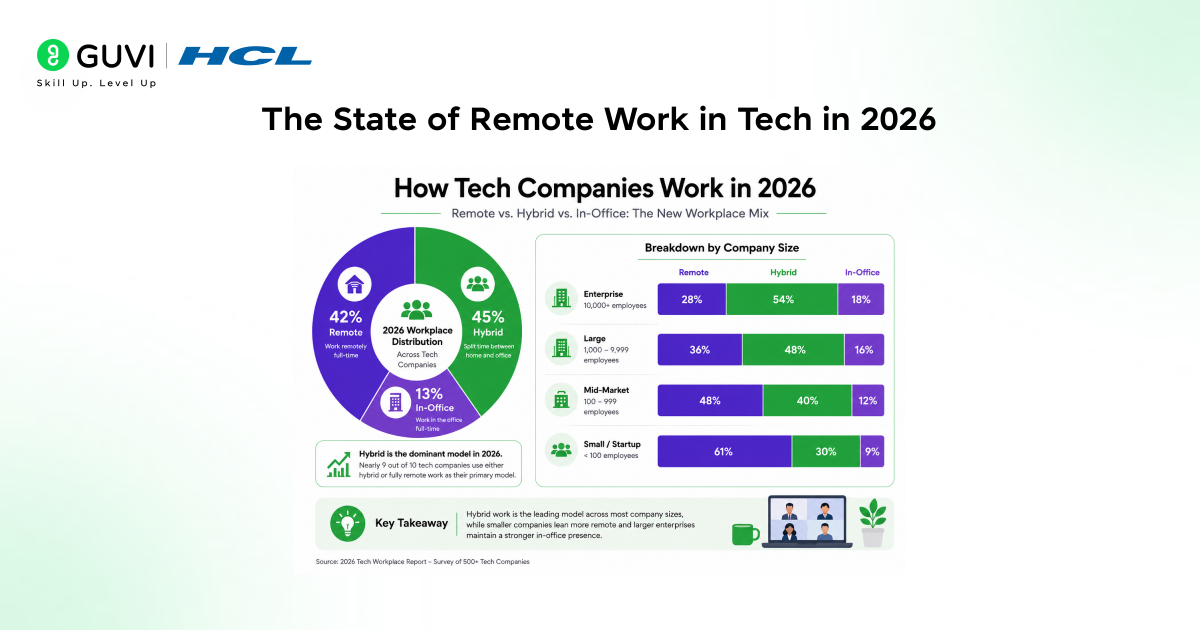
The “return to office” mandates of 2023 and 2024 had mixed results. Large companies like Amazon, Apple, and Google pushed for three- to five-day in-office workweeks and faced significant pushback, including talent exits to fully remote competitors. By 2026, the landscape will have stabilised into three broad categories:
- Fully remote companies: Startups and scale-ups with a distributed-first culture, no headquarters, async workflows
- Hybrid-flexible: Teams set their own in-office cadence; one to three days a week is common for engineering roles
- Office-first with exceptions: Large enterprises requiring in-person attendance, with remote roles limited to senior individual contributors
The data is clear: tech talent consistently prioritises remote or hybrid flexibility when evaluating offers. Companies that removed flexibility in 2024 reported longer hiring timelines and higher attrition among mid-level engineers.
Read More: Top Tech Skills to Learn in 2026 for Career Growth
Key Trends Shaping the Future of Remote Work in Tech
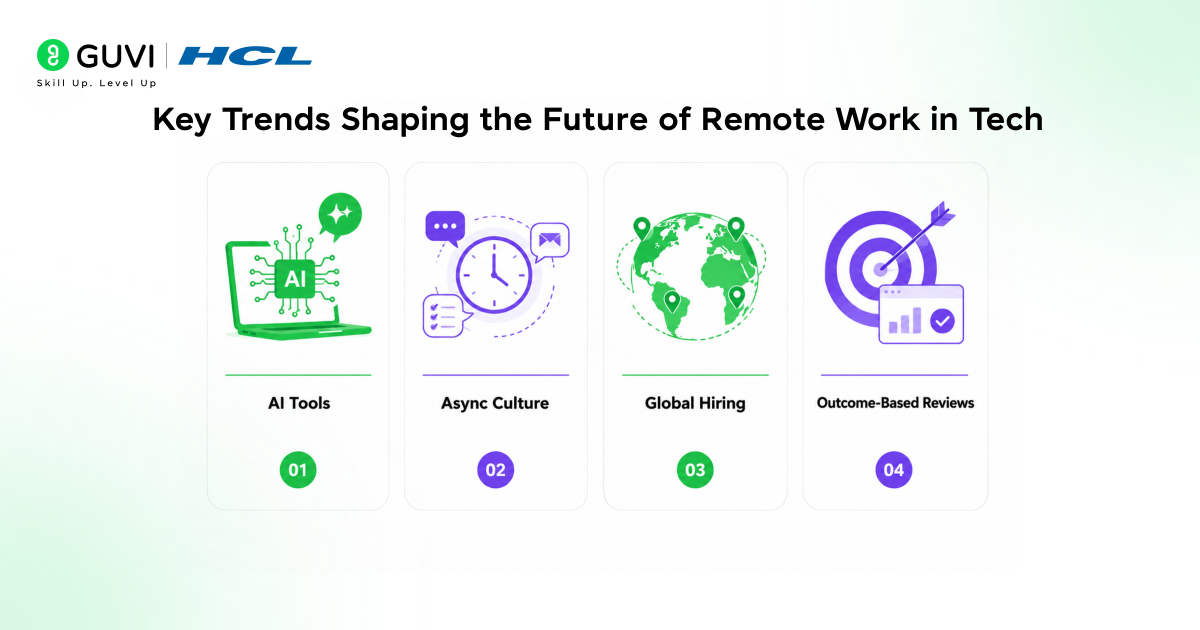
1. AI-Augmented Remote Collaboration
AI has become the biggest driver of remote work productivity, making asynchronous collaboration faster and more effective. Tools like GitHub Copilot, Notion AI, and AI meeting assistants streamline coding, documentation, and communication. As a result, leading remote teams in 2026 are thriving with async workflows instead of relying heavily on real-time meetings.
2. Async-First Culture Becoming Standard
The move to async-first work has become a defining trend in remote tech teams, improving productivity and flexibility. Practices such as written updates, recorded demos, and decision logs help teams collaborate effectively across different time zones. By reducing reliance on live meetings, companies can minimize meeting fatigue and support a healthier work-life balance.
3. Global Talent Hiring at Scale
Remote work has expanded the global talent pool, enabling companies to hire skilled engineers from virtually anywhere. By 2026, distributed teams spanning multiple continents are common, supported by platforms that simplify international hiring and payroll, while remote workforce management software helps coordinate distributed operations more broadly. This trend is reshaping compensation, team culture, and career growth in the tech industry.
Modern software development has increasingly embraced remote and hybrid work models, with many developers preferring flexible arrangements over traditional office setups. These work styles allow engineers to collaborate across time zones, reduce commuting time, and often improve work-life balance. As a result, companies in the tech industry have adopted flexibility as a key factor in attracting and retaining talent. At the same time, distributed teams rely heavily on collaboration tools, version control systems, and asynchronous communication practices to maintain productivity and coordination across global engineering teams.
4. Outcome-Based Performance Over Presence
A major change in the future of remote work is the shift from measuring hours worked to measuring outcomes. By 2026, many tech companies will evaluate engineers based on delivered features, code quality, and project impact rather than attendance. This approach improves productivity while giving employees greater flexibility and autonomy.
Want to build the skills that make you thrive in remote tech roles full-stack development, AI, cloud, and DSA? Check out HCL Guvi’s Tech AIML courses designed for learners and professionals who want to build job-ready tech skills with hands-on mentorship.
Challenges That Still Need Solving
The future of remote work in tech is not without friction. These are the challenges that teams and companies are still actively working through in 2026:
| Challenge | Why It Matters | Emerging Solution |
| Onboarding new engineers | Context transfer is harder without spontaneous in-person interaction | Structured async onboarding docs + dedicated buddy systems |
| Maintaining team culture | Distributed teams can feel transactional without deliberate investment | Regular virtual social rituals, annual off-sites, shared values docs |
| Timezone coordination | Async works well until decisions need real-time alignment | Overlap hours policy + decision logs for async sign-off |
| Career visibility | Remote engineers can be overlooked for promotions vs in-office peers | Documented impact tracking + remote-first promotion rubrics |
| Mental health and isolation | Lack of social contact affects wellbeing for many remote workers | Mental health stipends, flexible hours, co-working budgets |

Common Mistakes Companies Make with Remote Work
1. Treating remote as a perk instead of a model: Companies that allow remote work as a favour rather than designing for it structurally end up with remote employees who are second-class citizens, missing context, excluded from decisions, and first to be laid off.
2. Replicating office rituals online: Daily standups over video, full-team weekly all-hands, and meeting-heavy planning cycles all made sense in an office. Forcing them into a remote context creates Zoom fatigue without the benefits. Async alternatives almost always work better.
3. Ignoring timezone equity: Scheduling all recurring meetings in US or European time zones disadvantages engineers in Asia and the Middle East. Rotating meeting times or defaulting to async decision-making is a simple fix that signals genuine respect for a global team.
Conclusion
The future of remote work in tech in 2026 is nuanced, evolving, and for developers largely positive. Flexibility is now a baseline expectation, AI tools have made distributed collaboration genuinely productive, and the global talent pool means skilled engineers are no longer constrained by geography. The companies winning the talent war are not the ones with the fanciest offices; they are the ones that have figured out how to build culture, trust, and performance frameworks that work for people regardless of where they open their laptops. If you are building your tech career in 2026, learning to work effectively in a remote or hybrid environment is as important as any technical skill you can develop.
FAQ
1. What is the future of remote work in tech?
The future of remote work in tech is a hybrid and distributed model where flexibility is the norm, AI tools power async collaboration, and engineers are evaluated on outcomes rather than presence. Most tech companies are settling into hybrid-flexible or fully remote structures by 2026.
2. Will remote work continue to grow in tech in 2026?
Yes. While some large enterprises pushed return-to-office mandates, remote and hybrid work remains dominant in tech. Developer preference surveys consistently show flexibility as a top priority, and companies that removed it reported higher attrition and longer hiring timelines.
3. What tools are shaping remote work in tech in 2026?
AI-powered tools like GitHub Copilot, Notion AI, Loom, Linear, and Slack are central to remote tech workflows in 2026. They enable async code reviews, auto-generated documentation, recorded demos, and faster decision-making without requiring synchronous meetings.
4. What is async-first culture in remote work?
Async-first culture means the default mode of collaboration is asynchronous written updates, recorded demos, decision logs, and documented context rather than real-time meetings. It reduces meeting fatigue, accommodates global time zones, and is increasingly standard at distributed tech companies.
5. How has global hiring changed remote work in tech?
Remote work expanded the global talent pool dramatically. Platforms like Deel and Remote make it easy to employ engineers across continents. By 2026, it is common for small startups to have distributed teams across Asia, Europe, and the Americas, changing how companies think about compensation, culture, and career growth.
6.. What are the biggest challenges of remote work in tech in 2026?
Despite its benefits, remote work still presents challenges such as maintaining company culture, onboarding new employees, preventing burnout, and ensuring effective communication across distributed teams.
7. What skills are most important for succeeding in remote tech jobs?
Remote tech professionals need strong written communication, time management, self-discipline, and collaboration skills. The ability to work independently, document progress clearly, and effectively use digital collaboration tools has become just as important as technical expertise in distributed work environments.
Success Stories

About the Author
Vishalini Devarajan
An Aerospace Engineer turned content writer, I focus on making complex concepts easy to understand through well-structured, reader-friendly blogs. Whether it’s a technical topic or a non-technical one, I love creating content that is clear, engaging, and impactful.
View all posts by Vishalini Devarajan
Connect with me @















Did you enjoy this article?