


Software Development Articles
How to Read and Understand System Design Diagrams?
System Engineer Roles and Responsibilities: 12 Proven Duties for Growth
SAP Consultant Roles and Responsibilities: 12 Proven Duties for Growth and Success
Network Engineer Roles and Responsibilities: 12 Essential Duties for Success


Get In Touch For Details! Request More Information
Process Synchronization in OS: A Comprehensive Guide
Aug 18, 2026 4 Min Read 350 Views
(Last Updated)
Table of contents
- TL;DR Summary
- What is Process Synchronization?
- Why Race Conditions Happen
- The Critical Section Problem
- Three Conditions Every Solution Must Meet
- How Operating Systems Actually Enforce Synchronization
- Locks and Mutexes
- Semaphores
- Classic Synchronization Problems You Should Know
- A Real-World Example: Ticket Booking Systems
- Common Mistakes to Avoid
- Conclusion
- FAQs
- What is process synchronization in OS?
- What causes a race condition?
- What is a critical section in OS?
- What is the difference between a mutex and a semaphore?
- What are the three conditions for a correct critical section solution?
- Is process synchronization only relevant for operating systems?
- What is the producer-consumer problem?
TL;DR Summary
- Process synchronization is how an operating system makes sure multiple processes share data and resources without conflicting with each other.
- Without it, you get race conditions, where the final result depends on which process happens to run first.
- The critical section is the part of code where shared data is accessed, and it must follow mutual exclusion, progress, and bounded waiting.
- Tools like locks, mutexes, and semaphores are how operating systems actually enforce this coordination.
- You will see these same ideas in databases, ticket booking systems, and even how your phone runs apps in the background.
Have you ever wondered what stops two programs running at the same time from reading and writing the same piece of memory and producing completely wrong results? Process synchronization in OS is the set of rules and tools that prevent exactly this kind of conflict.
Every modern computer runs dozens of processes at once, and most of them quietly share the same CPU, memory, and files. If you are learning operating systems for the first time, this is a concept you will keep running into, in interviews, in coding tasks, and in real production systems.
What is Process Synchronization?
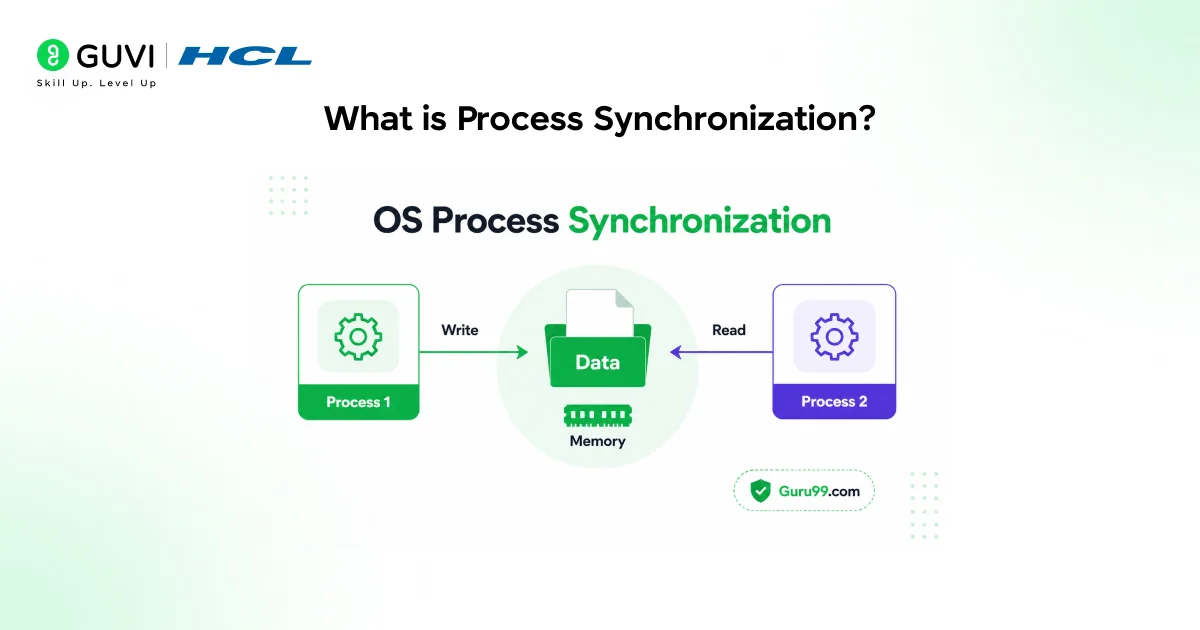
Process synchronization is the coordination of multiple processes or threads so that they access shared resources, like memory, files, or variables, in a controlled and predictable order. You can think of it as traffic signals for code. The processes are the vehicles, the shared resource is the intersection, and synchronization decides who goes first.
This matters because operating systems are built to run things concurrently. Concurrency makes systems faster, but it also opens the door to unpredictable behavior if two processes touch the same data at the same time.
In 1997, NASA’s Mars Pathfinder spacecraft kept resetting itself on Mars because of a synchronization bug. A low-priority task held onto a shared mutex that a high-priority task needed, a problem called priority inversion. Engineers fixed it by sending a software patch from Earth that turned on a setting called priority inheritance.
Why Race Conditions Happen
A race condition occurs when two or more processes access shared data at the same time, and the final result depends on the order in which they happen to execute. The output becomes a matter of luck rather than logic.
Here’s a simple example. Imagine two processes both trying to increase a shared counter from 10 to 12.
- Process A reads the counter value, which is 10.
- Process B also reads the counter value, which is still 10.
- Process A adds 1 and writes back 11.
- Process B adds 1 to the value it read earlier, and writes back 11 too.
The counter should have ended at 12, but it stayed at 11. This is exactly the kind of error process synchronization in OS is designed to prevent.
The Critical Section Problem
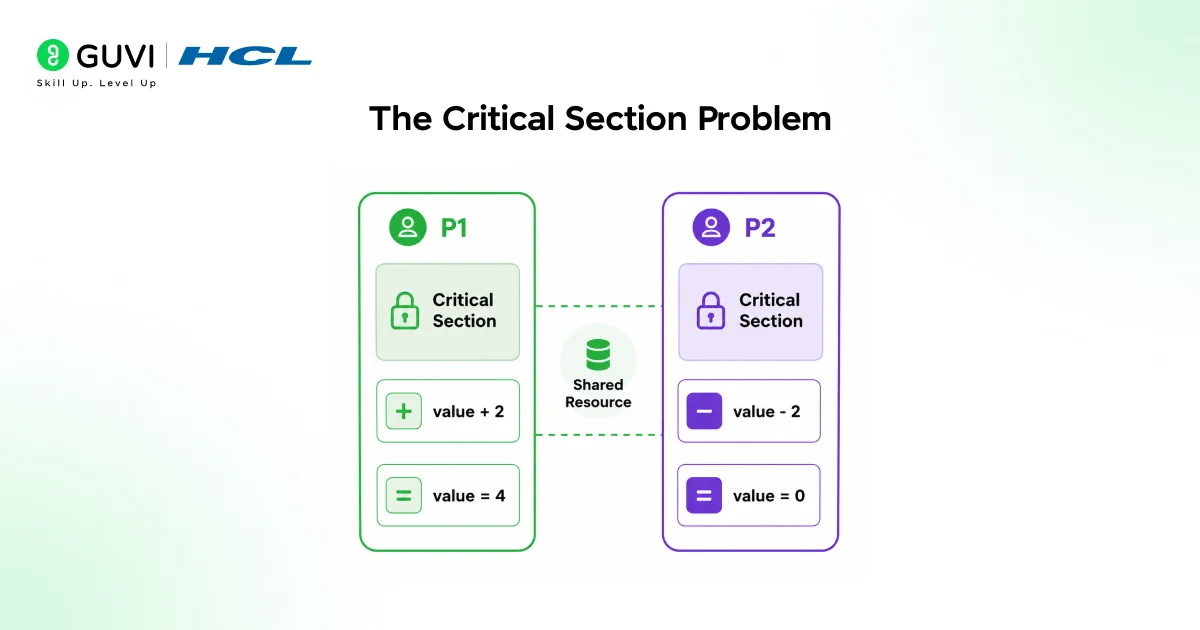
The part of a program where a process accesses shared resources is called the critical section. The critical section problem is about designing a system where only one process can execute inside this section at a time.

Three Conditions Every Solution Must Meet
- Mutual exclusion: Only one process can be inside the critical section at any given moment.
- Progress: If no process is currently in the critical section, one of the waiting processes must be allowed to enter without unnecessary delay.
- Bounded waiting: There must be a limit on how many times other processes can enter the critical section before a waiting process gets its turn.
If a synchronization mechanism fails to satisfy even one of these three conditions, it is not considered a correct solution.
How Operating Systems Actually Enforce Synchronization
Locks and Mutexes
A lock, often called a mutex (short for mutual exclusion), works like a key to a single door. A process must acquire the lock before entering the critical section and release it once it is done. Since only one process can hold the key at a time, the OS guarantees that the critical section runs without interference.
Semaphores
A semaphore is a slightly more flexible tool. Instead of a simple lock, it uses an integer counter along with two operations, wait() and signal(), to control how many processes can access a resource at once.
| Feature | Mutex | Semaphore |
| Purpose | Locking mechanism for one resource | Signaling mechanism, can manage multiple resources |
| Value | Binary lock, locked or unlocked | Integer counter, can go beyond 0 and 1 |
| Ownership | Owned by the process that locks it | No ownership, any process can signal |
| Operations | acquire() and release() | wait() and signal() |
| Best used for | Protecting a single shared resource | Managing access to a pool of identical resources |
| Example | Locking a shared print spooler | Allowing 3 out of 5 database connections at a time |
Classic Synchronization Problems You Should Know
These problems show up often in textbooks and interviews because they represent real coordination challenges in a simplified form.
- Producer-Consumer Problem: One process produces data into a buffer while another consumes it, and both must avoid overwriting or reading empty slots.
- Readers-Writers Problem: Multiple processes want to read a file at once, but only one should be allowed to write to it at a time.
- Dining Philosophers Problem: Several processes compete for a limited set of shared resources without ending up in a deadlock, originally framed by computer scientist Edsger Dijkstra.
A Real-World Example: Ticket Booking Systems
Think about what happens when an online platform releases tickets for a big concert or a popular train route. Thousands of users may try to book the same seat within the same second.
If the system does not synchronize access to seat availability, two users could both see the seat as available, both confirm payment, and both walk away with the same seat. This is the exact race condition problem that process synchronization solves, just applied to a booking database instead of a simple counter.
Common Mistakes to Avoid
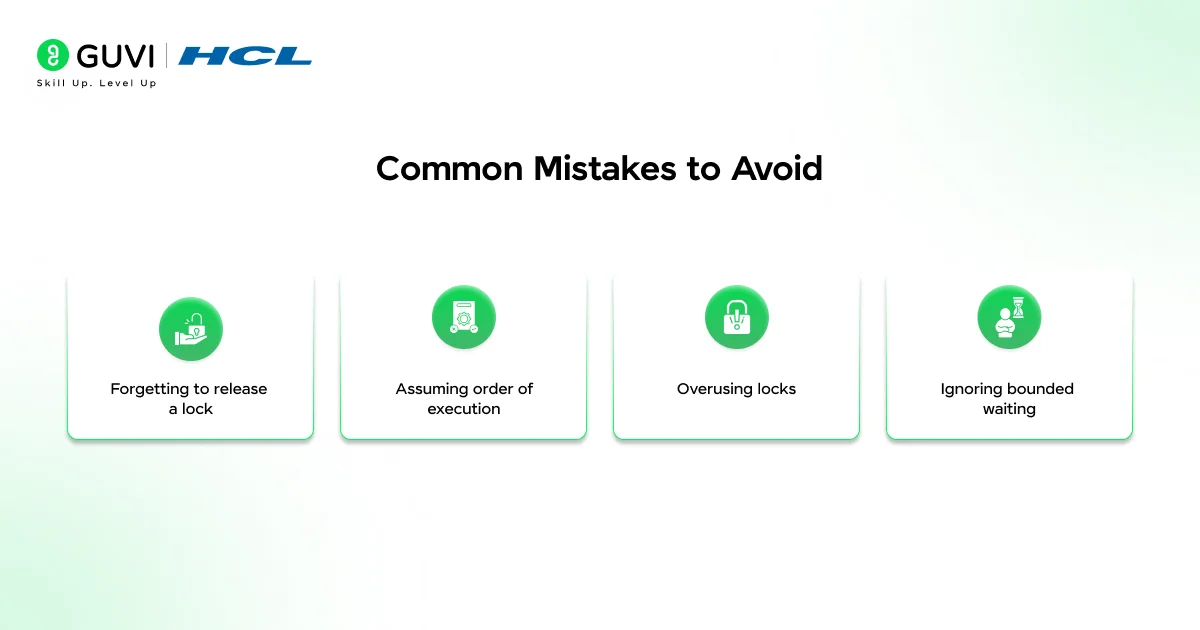
- Forgetting to release a lock: If a process acquires a lock and never releases it, every other process waiting for that resource gets stuck forever.
- Assuming order of execution: Beginners often write code assuming Process A will always finish before Process B starts, which is rarely guaranteed by the OS scheduler.
- Overusing locks: Locking too much code at once slows the whole system down and increases the chance of deadlocks. Lock only the smallest section that truly needs protection.
- Ignoring bounded waiting: A solution that satisfies mutual exclusion but lets one process wait indefinitely is still considered incorrect.
If you’re serious about mastering software development and want to apply it in real-world scenarios, don’t miss the chance to enroll in HCL GUVI’s IITM Pravartak and MongoDB Certified Online AI Software Development Course. Endorsed with NSDC certification, this course adds a globally recognized credential to your resume, a powerful edge that sets you apart in the competitive job market.
Conclusion
Process synchronization in OS exists because modern systems almost never run just one thing at a time. Whether it is two threads in your own code or millions of users hitting the same database row, the same core problem repeats itself: shared data needs controlled access.
Understanding race conditions, the critical section problem, and tools like mutexes and semaphores gives you a foundation that applies far beyond operating systems, into databases, distributed systems, and everyday backend development. Once this clicks, concepts like deadlocks and concurrency control become much easier to follow.
FAQs
1. What is process synchronization in OS?
It is the coordination of multiple processes so they can safely access shared resources like memory or files without producing incorrect or unpredictable results.
2. What causes a race condition?
A race condition happens when two or more processes access shared data at the same time, and the final outcome depends on the order in which they execute.
3. What is a critical section in OS?
A critical section is the part of a program where a process reads or modifies shared resources, and only one process should be allowed inside it at a time.
4. What is the difference between a mutex and a semaphore?
A mutex is a locking mechanism for one resource at a time, while a semaphore uses a counter and can manage access to multiple resources simultaneously.
5. What are the three conditions for a correct critical section solution?
The three conditions are mutual exclusion, progress, and bounded waiting.
6. Is process synchronization only relevant for operating systems?
No, the same concepts apply to databases, distributed systems, and any backend application where multiple users or processes access shared data at once.
7. What is the producer-consumer problem?
It is a classic synchronization problem where one process produces data into a shared buffer while another consumes it, and both must avoid conflicting access.
Success Stories

About the Author
Lukesh S
A professional content writer who has experience in freelancing and now working as a Technical Content Writer at HCL GUVI having sound knowledge in Blog Writing and Creative Writing!
View all posts by Lukesh S
Connect with me @














Did you enjoy this article?