


Software Development Articles
How to Read and Understand System Design Diagrams?
System Engineer Roles and Responsibilities: 12 Proven Duties for Growth
SAP Consultant Roles and Responsibilities: 12 Proven Duties for Growth and Success
Network Engineer Roles and Responsibilities: 12 Essential Duties for Success


Get In Touch For Details! Request More Information
URL Shortener System Design: How to Build a Bit.ly Clone
Jun 16, 2026 4 Min Read 1292 Views
(Last Updated)
URL shorteners are popular examples in system design. They show how real-world applications handle scalability, performance, and reliability. While turning a long URL into a shorter one seems easy, a URL shortener that works in production must efficiently manage millions of redirects, store large amounts of data, and provide quick responses with minimal downtime.
Table of contents
- TL;DR
- What Is a URL Shortener?
- Why URL Shorteners Matter in Modern Applications
- Functional and Non-Functional Requirements
- Functional Requirements
- Non-Functional Requirements
- Capacity Estimation and Traffic Analysis
- High-Level Architecture of a URL Shortener
- API Design
- Create Short URL API
- Redirect API
- Database Design and URL Generation Strategies
- Auto Increment + Base62
- Hash-Based IDs
- Random String Generation
- Cache Design with Redis
- URL Redirection Workflow
- Scaling the URL Shortener
- Load Balancing
- Database Replication
- Database Sharding
- Analytics and Security Features
- Click Tracking
- Spam Detection
- Rate Limiting
- Advanced Features in Modern URL Shorteners
- Common Challenges and Solutions
- Best Practices
- Common Mistakes to Avoid
- Conclusion
- FAQs
- Why do URL shorteners use Base62 encoding?
- Why is Redis commonly used in URL shortener systems?
- What is database sharding?
- How do URL shorteners track clicks?
- What are the biggest challenges in URL shortener system design?
- Can users create custom short URLs?
- How does a URL shortener handle high traffic efficiently?
TL;DR
- A URL shortener changes long URLs into short, shareable links.
- The system keeps track of the relationship between short URLs and original URLs.
- Redis caching helps lower database load and speed up redirects.
- Load balancing, replication, and sharding allow for handling large-scale traffic.
- Modern URL shorteners offer features like analytics, security controls, QR codes, and custom domains.
Understanding how these systems work can help developers strengthen their knowledge of backend development, databases, caching, and distributed architectures. Learners looking to build practical software engineering skills can explore HCL GUVI’s System Design Course, which covers modern development concepts used in real-world applications.
What Is a URL Shortener?
A URL shortener is a service that changes a long URL into a shorter and easier-to-share version. When someone clicks the shortened link, the service directs them to the original destination.
For example:
Original URL:
https://www.example.com/blog/system-design/url-shortener-guide
Short URL:
Services like Bitly and TinyURL use this method to simplify link sharing on social media, emails, messaging platforms, and marketing campaigns.
If you’re new to system design, following a structured learning path can help you understand concepts such as databases, APIs, caching, and scalability more effectively through this comprehensive System Design Roadmap (2026): From Basics to Interviews.
Why URL Shorteners Matter in Modern Applications
Long URLs can be hard to share and manage. URL shorteners make links more readable and easier to share across different channels.
Besides convenience, modern URL shorteners help businesses track campaign performance, understand user behavior, manage branded links, and measure engagement. They have evolved from simple redirection tools into full link management platforms.
Learners looking to strengthen their software engineering and system design skills can explore HCL GUVI’s System Design Course, which provides hands-on exposure to modern development practices used in scalable applications.
Functional and Non-Functional Requirements
Before designing the system, it’s important to identify the expected requirements.
Functional Requirements
The system should create unique short URLs, redirect users to the original location, support custom aliases, collect click analytics, and optionally allow links to expire after a set time.
Non-Functional Requirements
The platform should ensure high availability, low latency, scalability, fault tolerance, and secure URL management. Redirect operations must remain quick even during busy times.
Capacity Estimation and Traffic Analysis
Capacity estimation helps find out how much infrastructure the system will need.
Assume the service creates 10 million short URLs each day and gets 100 million redirects daily. This results in a read-heavy workload because redirect requests happen much more often than URL creation requests.
Since reads outnumber writes, enhancing retrieval performance becomes a priority. This is why URL shorteners rely heavily on caching solutions.
High-Level Architecture of a URL Shortener
A typical URL shortener has several components working together:
- Client Application
- Load Balancer
- Application Servers
- Redis Cache
- Database
- Analytics Service
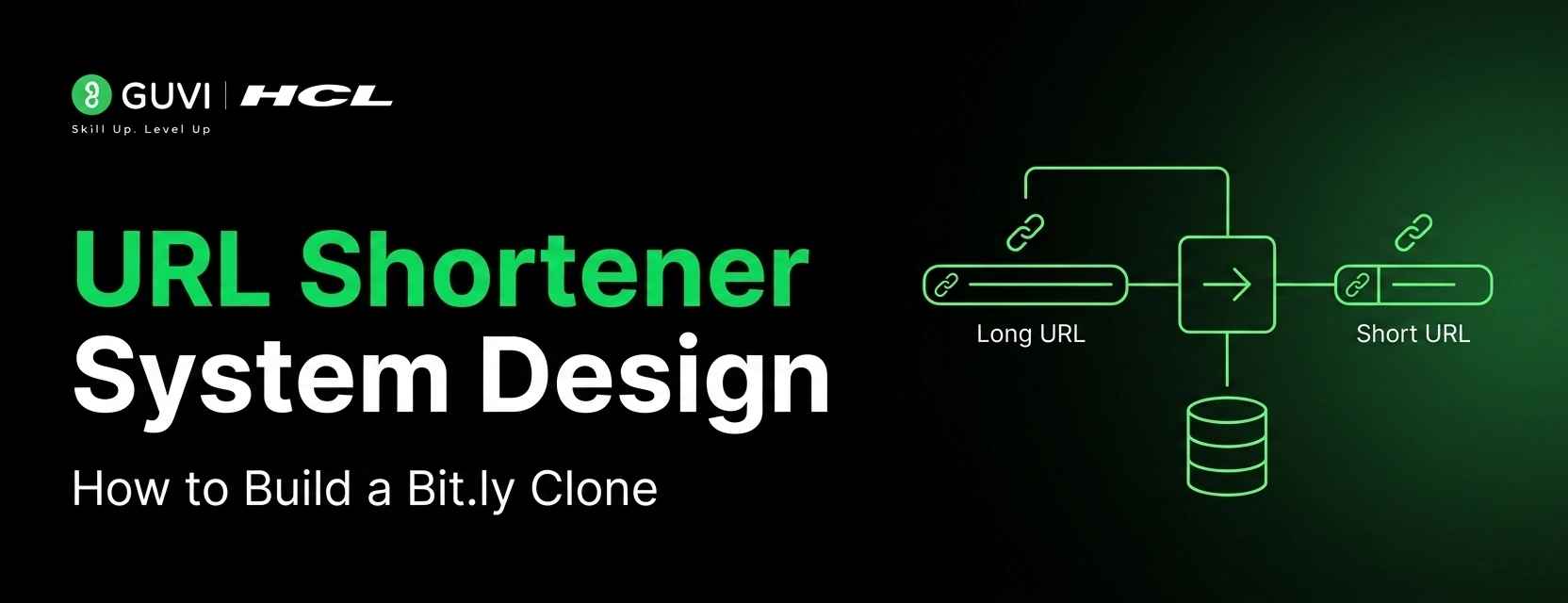
When a user submits a long URL, the application generates a unique short code and saves the mapping in the database. During redirection, the system retrieves the original URL and sends the user to the correct destination.
API Design
APIs allow users and applications to connect with the URL shortening service.
Create Short URL API
A POST request takes a long URL and returns a shortened version.
Example request:
{

  "longUrl": "https://example.com/article"

}

Example response:

{

  "shortUrl": "https://short.ly/abc123"

}
Redirect API
When users access a short URL, the application looks up the original URL and sends an HTTP redirect response.
URL shorteners rely heavily on CRUD operations to store, retrieve, and manage URL mappings efficiently, making it useful to understand the fundamentals covered in What Is CRUD? A Complete Guide to Create, Read, Update, and Delete in Modern Applications.
Database Design and URL Generation Strategies
The database stores the connections between short URLs and original URLs.
A simple schema might include fields like ID, short code, original URL, creation date, and expiration date.
Auto Increment + Base62
One common method uses auto-incrementing IDs changed into Base62 values. This method produces short, user-friendly URLs since Base62 uses numbers, uppercase letters, and lowercase letters.
Hash-Based IDs
Another approach generates hashes from the original URL. While easy to implement, it’s important to manage collisions when multiple URLs produce the same values.
Random String Generation
The system can also create random strings for each URL. However, uniqueness checks are necessary before saving new entries.
Did You Know?
Some large URL shortening services handle billions of redirects each month. Because redirect requests far surpass URL creation requests, caching often offers the greatest performance boost.
Cache Design with Redis
Redis is often used to lower database load and speed up response times.
When a redirect request arrives, the application first checks Redis for the URL mapping. If the entry exists, the original URL is returned right away. If not, the application queries the database, saves the result in Redis, and then completes the redirect.

This process reduces database traffic and helps ensure low latency.
URL Redirection Workflow
A redirect request usually follows these steps:
- A user clicks a shortened URL.
- The request reaches the load balancer.
- The application checks Redis.
- If no cached value exists, the database is queried.
- The original URL is retrieved.
- Analytics information is recorded.
- The user is redirected to the destination page.
This workflow lets the system handle many redirect requests efficiently.
Scaling the URL Shortener
As traffic increases, the architecture must scale to keep performance up.
Load Balancing
Load balancers distribute incoming requests across several application servers. This prevents individual servers from getting overloaded and improves system availability.
Database Replication
Replication creates multiple copies of the database. Read operations can be sent to replicas while write operations continue on the primary database.
Database Sharding
Sharding splits data among multiple database servers. This method improves scalability by spreading storage and query tasks across several machines.
Analytics and Security Features
Modern URL shorteners offer more than just redirection.
Click Tracking
The system can track details like click counts, timestamps, device types, locations, and referral sources. These insights help businesses gauge campaign success.
Spam Detection
Shortened links can sometimes hide harmful destinations. URL validation and reputation checks help prevent misuse.
Rate Limiting
Rate limiting restricts excessive requests from users or IP addresses. This protects the platform from spam, misuse, and denial-of-service attacks.
Advanced Features in Modern URL Shorteners
Today’s URL shortening services often include several advanced features.
These may involve custom aliases, branded domains, QR code generation, password-protected links, expiration settings, campaign tracking, and team collaboration tools. Such features turn a basic URL shortener into a full link management solution.
Learners looking to strengthen their software engineering and system design skills can explore HCL GUVI’s System Design Course, which provides hands-on exposure to modern development practices used in scalable applications.
Common Challenges and Solutions
Producing unique short URLs at scale is one of the main challenges in designing a URL shortener. Methods like Base62 encoding and distributed ID generation help tackle this issue.
Maintaining low latency during traffic spikes is another challenge. Caching, replication, and load balancing greatly enhance performance and reliability.
Security also needs careful attention. Spam detection, URL validation, and rate limiting help protect both users and the platform.
Practicing real-world architecture problems, such as URL shorteners, can also strengthen your preparation for system design interviews, and this guide on Cracking System Design Interview: Questions and Answers covers many of the concepts frequently discussed by interviewers.
Best Practices
- Use Base62 encoding to create short URLs.
- Implement Redis caching for faster lookups.
- Keep analytics processing separate from redirect services.
- Enable replication for better availability.
- Continuously monitor performance.
- Apply rate limiting and security checks.
Common Mistakes to Avoid
- Performing every lookup directly from the database.
- Overlooking cache implementation.
- Using weak URL generation methods.
- Ignoring security protections.
- Designing without considering scalability.
Conclusion
A URL shortener might seem simple, but building one at scale requires careful planning around performance, reliability, and scalability. By combining effective URL generation, caching, database optimization, load balancing, analytics tracking, and security measures, developers can create a strong platform capable of handling millions of requests. Understanding URL shortener design also provides valuable insight into the principles behind many large-scale distributed systems.
FAQs
1. Why do URL shorteners use Base62 encoding?
Base62 encoding creates short, readable URLs while allowing for many unique combinations.
2. Why is Redis commonly used in URL shortener systems?
Redis stores frequently accessed URL mappings in memory, lowering database queries and speeding up redirects.
3. What is database sharding?
Database sharding spreads records across multiple servers, helping the system scale effectively.
4. How do URL shorteners track clicks?
They gather information such as click counts, devices, locations, timestamps, and referral sources during each redirect.
5. What are the biggest challenges in URL shortener system design?
Common challenges include generating unique IDs, managing large traffic volumes, keeping low latency, ensuring reliability, and preventing misuse.
6. Can users create custom short URLs?
Yes. Many URL shortening services allow users to create custom aliases instead of automatically generated short codes. This makes links easier to remember, improves branding, and helps businesses create more recognizable URLs for marketing campaigns.
7. How does a URL shortener handle high traffic efficiently?
URL shorteners handle high traffic through techniques such as Redis caching, load balancing, database replication, and database sharding. These methods reduce latency, distribute requests efficiently, and ensure the system remains available even during periods of heavy traffic.
Success Stories

About the Author
Vishalini Devarajan
An Aerospace Engineer turned content writer, I focus on making complex concepts easy to understand through well-structured, reader-friendly blogs. Whether it’s a technical topic or a non-technical one, I love creating content that is clear, engaging, and impactful.
View all posts by Vishalini Devarajan
Connect with me @















Did you enjoy this article?