


Software Development Articles
How to Read and Understand System Design Diagrams?
System Engineer Roles and Responsibilities: 12 Proven Duties for Growth
SAP Consultant Roles and Responsibilities: 12 Proven Duties for Growth and Success
Network Engineer Roles and Responsibilities: 12 Essential Duties for Success


Get In Touch For Details! Request More Information
What Is POC in Software Development? A Complete Guide
Aug 24, 2026 5 Min Read 800 Views
(Last Updated)
QUICK TL;DR
- A POC (Proof of Concept) is a short, low-cost exercise to answer: “Can this be built?” it validates technical feasibility before significant investment.
- POC comes first, then prototype (how it looks/feels), then MVP (functional product for real users); skipping POC risks building the wrong thing or hitting unfixable tech constraints later.
- Build a POC when using unproven tech, integrating unknown systems, entering uncertain markets, or needing investor/stakeholder buy-in; keep scope tight, define success criteria, and make a go/no-go decision.
INTRODUCTION
Every great software product starts with an idea, but not every idea deserves a full development budget. Building something complex and expensive before validating the core concept is one of the most common and costly mistakes in software development. That’s exactly the problem a POC is designed to solve.
Ready to build real software products from concept to launch? Enroll in HCL GUVI’s AI Software Development Course and master full-stack development, AI-powered tools, Agile workflows, and end-to-end product building.
Table of contents
- What Is a POC in Software Development?
- Understanding POC in Plain Terms
- POC vs Prototype vs MVP: What's the Difference?
- Why POC Matters in Software Development
- When Should You Build a POC?
- How to Build a POC in 5 Steps
- Step 1: Define the Problem
- Step 2: Define the Solution and Scope
- Step 3: Build the Minimum Needed
- Step 4: Test and Collect Feedback
- Step 5 : Document and Make a Decision
- Real-World POC Examples
- Common POC Mistakes to Avoid
- Conclusion
- FAQs
- What’s the core question a POC answers?
- How does a POC differ from a prototype and MVP?
- When should I skip a POC?
- What are good POC success criteria examples?
- What should a POC include and not include?
- What are common POC mistakes?
- How do you document POC outcomes?
What Is a POC in Software Development?
POC stands for Proof of Concept. In software development, it’s a short, low-cost exercise that answers one focused question: can this idea actually be built and does it solve a real problem? A POC tests technical feasibility before any significant time or money is committed to full-scale development.
Understanding POC in Plain Terms
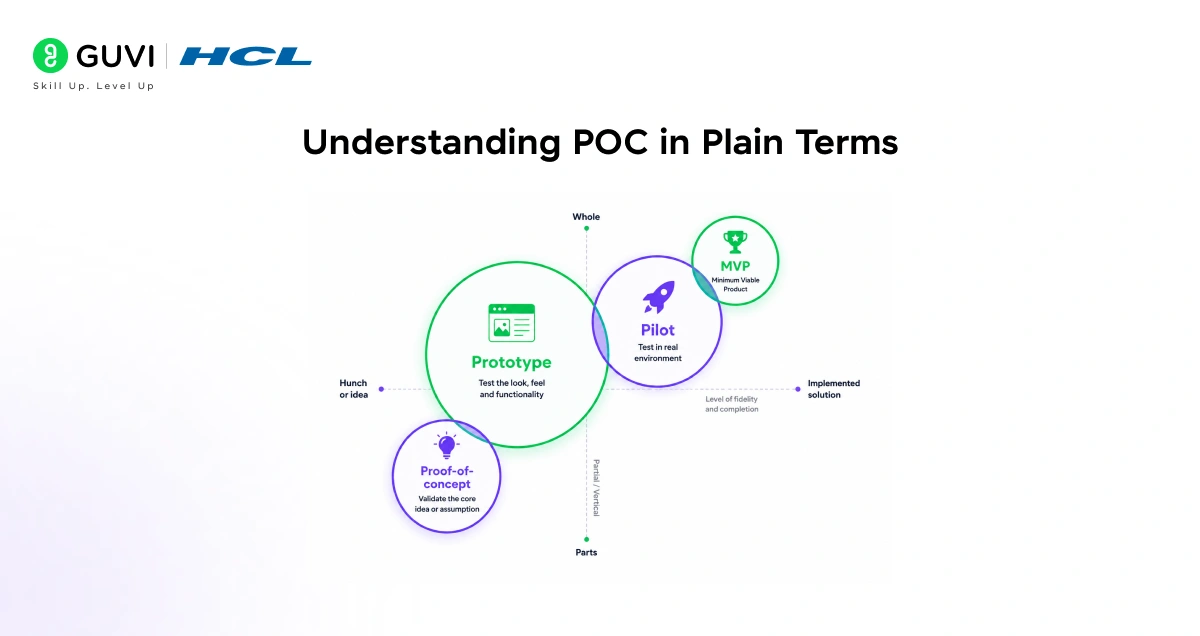
- A Proof of Concept is not a product. It’s not a prototype, and it’s not an MVP. It’s a validation exercise, often a document, a presentation, or a small technical demo that proves your idea is technically possible and worth pursuing further.
- Think of it like a blueprint before construction begins. An architect doesn’t build a skyscraper before testing whether the structural design will hold.
- A POC plays the same role in software: it surfaces feasibility issues, technical constraints, and market assumptions before you’ve invested months of engineering work.
- The core question a POC answers is “Will this work?” Not whether it looks good or is market-ready, just whether the concept is technically achievable.
POC vs Prototype vs MVP: What’s the Difference?
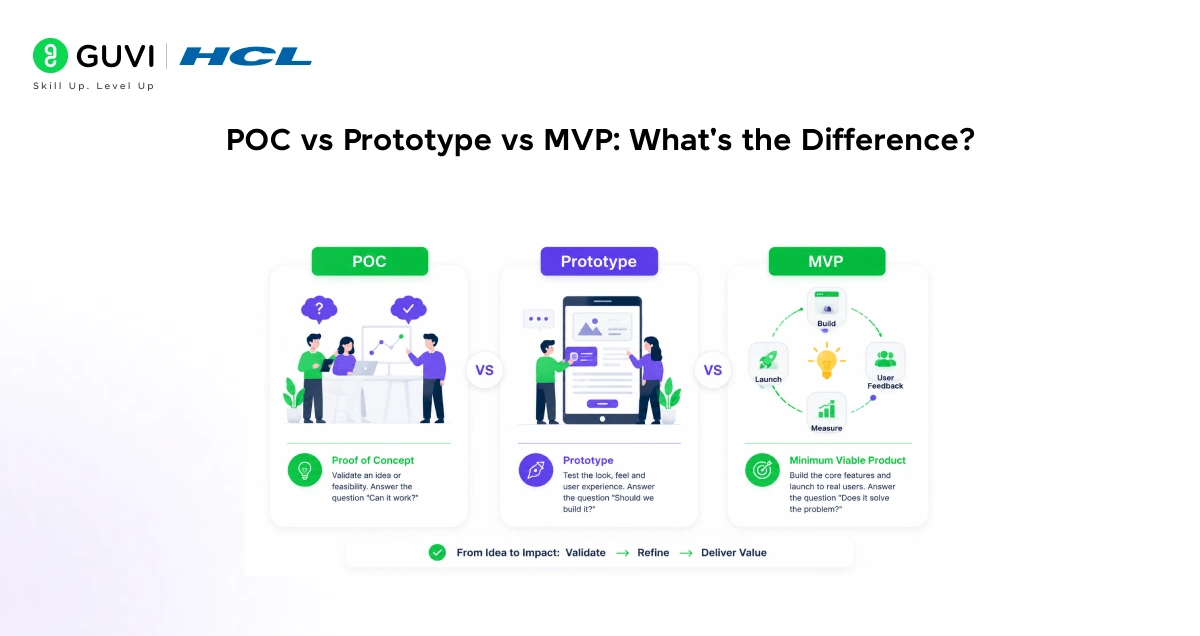
These three terms get mixed up constantly. Teams either over-invest in a POC by treating it like an MVP, or rush to ship an MVP before validating core technology.
| Stage | Core Question | What It Looks Like | Audience |
|---|---|---|---|
| POC | Can this be built? | Document, demo, small test | Internal team, investors |
| Prototype | How will it look and feel? | Clickable UI, no backend | Stakeholders, designers |
| MVP | Will people pay for this? | Functional product, basic features | Real end users |
A POC comes first. Once it passes, a prototype shows what the product will look and feel like. An MVP is a simplified but functional product that real customers use to give feedback.
Skipping the POC and going straight to MVP is like building an engine before confirming it runs on your fuel.
Why POC Matters in Software Development
A POC does more than validate technology it touches risk management, stakeholder confidence, and resource allocation at once.
- It catches problems early. A technical constraint discovered during a POC costs almost nothing to address. The same constraint discovered six months into development can derail an entire project.
- It saves money. Most failed software projects fail not because the team couldn’t build, but because they built the wrong thing. A POC validates the core assumption before significant investment is made.
According to widely cited industry research, fixing a bug discovered during development costs significantly more than catching it in the planning stage, and that logic applies even more forcefully to fundamental technical flaws.
- It builds stakeholder confidence. A POC gives executives and investors something tangible to evaluate. Instead of asking them to approve a budget based on a presentation alone, you’re showing them working proof that the idea is viable. That’s a very different conversation.
- It reduces scope creep. When a POC clearly defines what the core concept is and what it isn’t, it gives the team a shared anchor. This prevents the project from expanding in directions that weren’t validated upfront.
When Should You Build a POC?
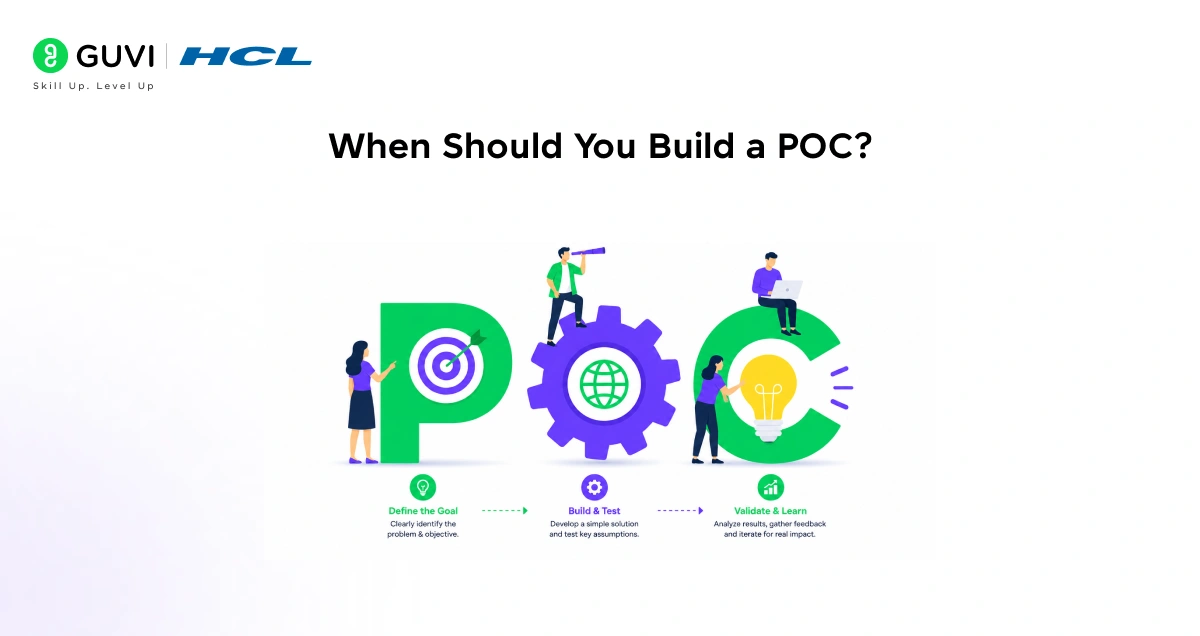
Not every project needs a POC.
- Build a POC when you’re working with a new or unproven technology and need to verify it can handle your requirements. Build one when you’re integrating systems that have never been connected before and aren’t sure the integration is even possible.
- Build one when you’re entering a new market where user needs and technical feasibility are both uncertain. And build one when you need to convince investors or executive stakeholders to fund further development.
- Skip the POC when you’re building something similar to what your team has built before, when the technology is completely standard, or when the time and cost of a POC outweigh the risk of proceeding without one.
- A practical rule of thumb: if the biggest risk in your project is “can we build this?”, build a POC. If the biggest risk is “will users want this?”, move to an MVP with real users instead.
Industry research consistently shows that the cost of fixing a defect increases significantly the later it is discovered in the software development lifecycle. Issues identified during early stages such as planning or requirements are far cheaper to resolve compared to those found during development, testing, or after release. This cost difference becomes even more pronounced for deeper architectural or technical flaws, where late-stage fixes may require substantial redesign or rework of existing systems. As a result, modern engineering practices emphasize early validation, strong design reviews, and continuous testing to catch problems as early as possible and reduce long-term development risk and cost.
How to Build a POC in 5 Steps
Step 1: Define the Problem
Start by articulating exactly what problem your software will solve, for whom, and why existing solutions fall short. Talk to potential users. Analyze the competitive landscape. The goal is to turn assumptions into evidence.

A POC that validates technical feasibility for a problem no one actually has is useless; you end up with a working system and zero addressable demand.
Step 2: Define the Solution and Scope
Map out how the software will solve the problem not the full product, just the core mechanism. What is the one thing this POC needs to prove? Define clear success criteria before you start. Without them, you have no way to evaluate whether the POC succeeded or failed.
Keep the scope tight. Scope creep in a POC is a warning sign that you’re building a prototype instead.
Step 3: Build the Minimum Needed
Build only what’s necessary to answer the feasibility question. A POC does not need a polished UI, a production-grade database, or an error-handling system. It needs just enough to demonstrate that the core concept works.
Depending on the project, this might be a technical demo, a data flow proof, an API integration test, or a working algorithm. It’s usually done internally or with a very small stakeholder group not released to end users.
Step 4: Test and Collect Feedback
Run the POC against your defined success criteria. Gather feedback from stakeholders, developers, and, where relevant, a narrow group of potential users. This step often surfaces issues that weren’t visible during planning, such as API limitations, performance constraints, and data incompatibilities.
Be honest about what the feedback reveals. The point of a POC is to find problems early, not to confirm your assumptions. A POC that exposes a fatal flaw has done its job.
Step 5 : Document and Make a Decision
Compile everything results, findings, limitations, technical recommendations, and next steps into a clear document or roadmap. This documentation becomes your foundation for the prototype and development phases. It also serves as a concrete reference for investors and team members joining later.
Then make a go/no-go decision. Does the concept work? Should you proceed to prototyping, pivot the approach, or stop entirely? A clear decision backed by evidence is the final product of a well-run POC.
Real-World POC Examples
- Walmart and Blockchain: Walmart ran two POC projects with IBM to test whether blockchain technology could improve food traceability, one tracking mangos in US stores and another tracking pork in China.
- Both POCs proved the concept worked, leading to full-scale implementation. Today, Walmart can trace food items in seconds rather than days.
- Airbnb and Co-hosting: When Airbnb wanted to build a co-hosting feature to improve how hosts and co-hosts collaborate, they launched a POC in Tokyo first.
- Rather than building the full feature, they simulated it in a limited market to test the concept before designing and developing the complete solution.
Ready to build real software products from concept to launch? Enroll in HCL GUVI’s AI Software Development Course and master full-stack development, AI-powered tools, Agile workflows, and end-to-end product building.
Common POC Mistakes to Avoid
- Treating it like a product. A POC that requires polish, full QA, and a production deployment has stopped being a POC. Keep it small and focused.
- No success criteria. If you haven’t defined what “success” looks like before you start, you can’t evaluate whether the POC passed or failed. Set measurable criteria upfront.
- Skipping user validation. Technical feasibility and user desirability are both required. Run at least a few user interviews or a competitive scan before scoping the POC. A technically successful POC solving a non-existent problem is not a success.
- Never making a decision. The purpose of a POC is to reach a clear go/no-go decision. POCs that linger without a conclusion waste the value of the exercise.
Conclusion
A POC is one of the smartest investments a team makes before a full build. It validates the concept, surfaces risks early, and keeps scope focused. Define the problem, scope tightly, build just enough, gather honest feedback, and document a decision. Teams that run POCs well build better products and spend their budget where it counts.
FAQs
1. What’s the core question a POC answers?
“Can this be built?”it validates technical feasibility, not UX polish or market readiness.
2. How does a POC differ from a prototype and MVP?
POC: feasibility (internal/investors). Prototype: UI/UX flow (clickable, no backend). MVP: functional product for real users to test demand/payments.
3.When should I skip a POC?
When the tech is standard, you’ve built similar systems before, or the POC’s cost/time outweighs the risk of proceeding without one.
4. What are good POC success criteria examples?
Clear, measurable targets like “API integration succeeds with <2s latency,” “algorithm achieves 90% accuracy,” or “data pipeline processes 10K events/min.”
5. What should a POC include and not include?
Include: minimal demo, data flow, API test, or working algorithm. Exclude: polished UI, production DB, full QA, or deployment to end users.
6. What are common POC mistakes?
Treating it like a product, no success criteria, skipping user validation, and failing to make a go/no-go decision afterward.
7. How do you document POC outcomes?
Compile results, findings, limitations, technical recommendations, and next steps into a clear document or roadmap, then record the go/no-go decision.
Success Stories

About the Author
Vishalini Devarajan
An Aerospace Engineer turned content writer, I focus on making complex concepts easy to understand through well-structured, reader-friendly blogs. Whether it’s a technical topic or a non-technical one, I love creating content that is clear, engaging, and impactful.
View all posts by Vishalini Devarajan
Connect with me @








Did you enjoy this article?