


Artificial Intelligence and Machine Learning Articles
Getting Started with Azure OpenAI Service
LLM Data Security: 9 Best Practices That You Need to Know


Get In Touch For Details! Request More Information

Forward Chaining and Backward Chaining in Artificial Intelligence: An In-depth Guide
Sep 09, 2025 7 Min Read 3443 Views
(Last Updated)
Artificial intelligence often relies on reasoning methods to move from raw facts to meaningful decisions. Two of the most widely applied techniques are forward chaining and backward chaining. Both methods use production rules and inference engines, but they approach problem-solving from opposite directions. Forward chaining begins with facts and expands toward conclusions. Backward chaining begins with a goal and works backward to check if the goal can be supported.
Let us unravel more about forward and backward chaining in artificial intelligence:
In the 1980s, nearly two-thirds of Fortune 500 companies were using expert systems in their operations—highlighting the early widespread adoption of rule-based AI.
A recent IoT-based AI study combined forward chaining for real-time diagnostics with backward chaining for failure prediction—vital for maintaining systems expected to include 41.6 billion IoT devices by 2025.
The expert system OPS5, based on forward chaining, implemented the influential Rete algorithm—a key innovation that allowed rapid rule matching by avoiding repeated checks across thousands of rules.
Table of contents
- What is Forward Chaining in Artificial Intelligence?
- Examples of Forward Chaining in Artificial Intelligence
- How Does Forward Chaining Work?
- Step 1: Fact Initialization
- Step 2: Rule Matching
- Step 3: Fact Expansion
- Step 4: Iterative Rule Application
- Step 5: Goal Resolution
- Technology Behind Forward Chaining in Artificial Intelligence
- Top Benefits of Forward Chaining in Artificial Intelligence
- Cons of Forward Chaining in Artificial Intelligence
- What is Backward Chaining in Artificial Intelligence?
- Examples of Backward Chaining in Artificial Intelligence
- How Does Backward Chaining Work?
- Step 1: Goal Identification
- Step 2: Fact Checking
- Step 3: Rule Discovery
- Step 4: Sub-goal Expansion
- Step 5: Recursive Proof and Conclusion
- Technology Behind Backward Chaining in Artificial Intelligence
- Top Benefits of Backward Chaining in Artificial Intelligence
- Cons of Backward Chaining in Artificial Intelligence
- Comparison Table: Forward and Backward Chaining in Artificial Intelligence
- Conclusion
- FAQs
What is Forward Chaining in Artificial Intelligence?
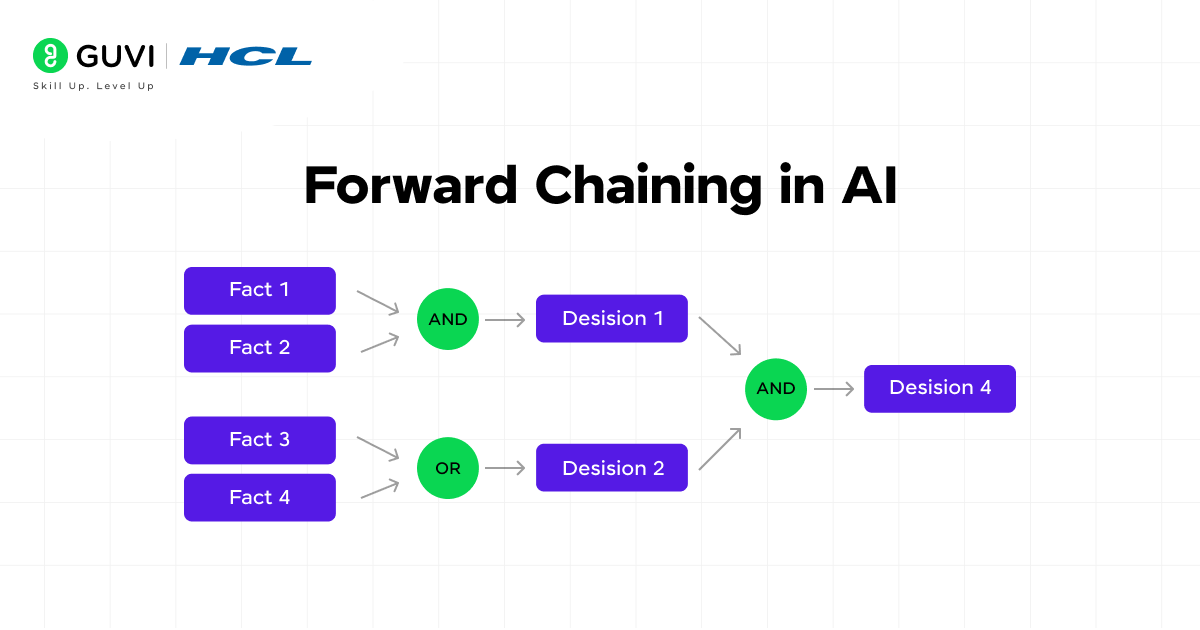
A forward chaining expert system is a reasoning method in artificial intelligence that begins with available facts and applies inference rules to reach new conclusions. The process continues step by step until a specific goal is achieved or no further rules can be applied.
This approach is often used in systems where data is provided first and the objective is to derive outcomes. Expert systems in medical diagnosis and production rule systems often use forward chaining because it is effective in generating all possible solutions from known conditions.
Examples of Forward Chaining in Artificial Intelligence
- A medical system uses forward chaining by starting with patient symptoms such as fever and cough. The system then applies rules step by step until it concludes the disease.
- A weather prediction program applies forward chaining by beginning with data like temperature and humidity. It further moves forward through rules to predict rainfall.
- A credit approval model uses forward chaining by starting with applicant details such as salary and repayment history. It then pertains to rules until it decides to approve or reject the loan.
- A fire alarm setup applies forward chaining by starting with sensor data like smoke and heat. It then employs rules to decide whether to activate the alarm or sprinkler.
- A recommendation engine uses forward chaining by starting with user preferences and past purchases. It furthermore applies rules to generate product suggestions.
How Does Forward Chaining Work?
Here’s how forward chaining works, step by step:
Step 1: Fact Initialization
The process begins with a collection of known facts in the knowledge base. These facts act as the foundation. They may come from sensors or stored data. For example, in a medical system, the starting facts could be symptoms such as fever and cough.
Step 2: Rule Matching
The inference engine scans all available rules in the system. It checks which rules have conditions that match the current facts. Only those rules that are completely satisfied by the known facts are selected for application.
Step 3: Fact Expansion
When a rule is applied, it produces a new fact or conclusion. This conclusion is added to the knowledge base. This addition of a conclusion expands the set of known facts. The system now has more information to work with than it had in the beginning.

Step 4: Iterative Rule Application
The inference engine again compares the updated facts with the rules. Each cycle may trigger more rules, which creates a forward chain of reasoning. The knowledge base grows step by step, and the reasoning moves closer to the conclusion.
Step 5: Goal Resolution
The process continues until the system reaches the goal or no more rules can be applied. If the goal is reached, the system outputs the conclusion. If no goal is reached, the process stops with the best information available.
Also Read: Will AI Replace Programmers? The Future of AI
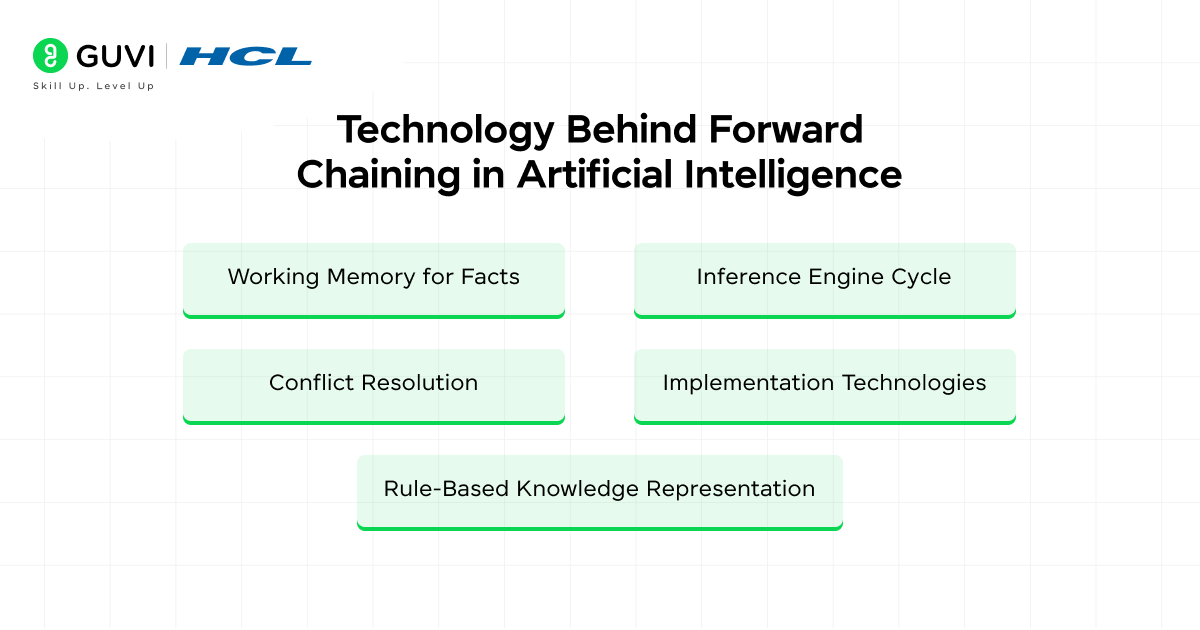
Technology Behind Forward Chaining in Artificial Intelligence
- Rule-Based Knowledge Representation
Forward chaining relies on production rules stored in the knowledge base. Each rule is written in an “if condition then conclusion” format. The condition specifies the facts that must exist, and the conclusion adds new knowledge once the conditions are satisfied. These rules are organized so the inference engine can check them efficiently.
- Working Memory for Facts
A dedicated working memory stores the current facts. Each time a new fact is generated through a rule, it is added to this memory. The inference engine keeps comparing these stored facts with the available rules to see what new facts can be created. This memory grows step by step, plus it supports continuous reasoning.
- Inference Engine Cycle
The inference engine drives the reasoning through a cycle of match, select, and act. It first matches rules with facts, then selects one applicable rule, and finally acts by adding the rule’s conclusion as a new fact. This cycle repeats until no more rules apply or until a desired goal is reached.
- Conflict Resolution
More than one rule may apply at the same time. Conflict resolution strategies decide which rule should fire first. Priority may be based on the importance of the rule, its recency, or its specificity. Without this step, the system could waste time or fall into loops.
- Implementation Technologies
Forward chaining has been implemented in both classic and modern systems. CLIPS and OPS5 are early expert system shells built around this approach. Drools is a widely used modern framework that supports forward chaining along with business process integration. These technologies provide the tools to design rules and run inference efficiently.
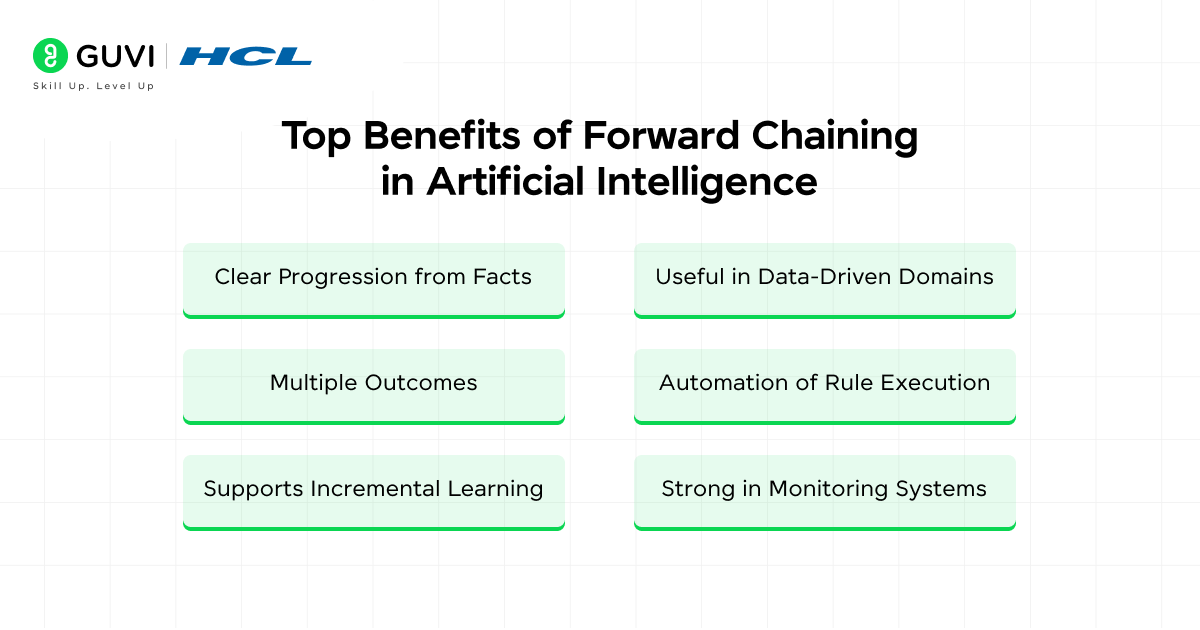
Top Benefits of Forward Chaining in Artificial Intelligence
- Clear Progression from Facts
Forward chaining is effective because it starts with facts and builds step by step. The reasoning naturally expands as more rules apply, which makes it easier to track how conclusions are formed.
- Useful in Data-Driven Domains
Forward chaining works well in fields where data and big data is abundant. Systems such as medical diagnosis or sensor monitoring benefit from this approach because the process begins with input data and continues until a result is reached.
- Multiple Outcomes
Forward chaining can generate more than one conclusion. The system can provide different results that may all be valid under the given conditions if the facts trigger several rules.
- Automation of Rule Execution
The system applies rules automatically without needing a predefined goal. This makes it suitable for expert systems that require continuous reasoning based on new incoming data.
- Supports Incremental Learning
Forward chaining allows facts to be added over time. Each new piece of information can activate rules and expand the knowledge base further, which further makes the process flexible.
- Strong in Monitoring Systems
Applications that track changes, such as environmental monitoring or fraud detection, benefit from forward chaining because the system responds directly to new facts.
Read: The Ultimate List of Free AI Tools You Shouldn’t Miss
Cons of Forward Chaining in Artificial Intelligence
- The process can become inefficient if too many rules exist. The system may waste time checking rules that do not contribute to the goal.
- The reasoning can produce irrelevant results if the rules are broad and trigger multiple conclusions not linked to the actual need.
- The system requires frequent updates of the knowledge base. Conclusions may be outdated or inaccurate without updates.
- The process can stop without reaching a useful conclusion if no rules match the available facts.
What is Backward Chaining in Artificial Intelligence?
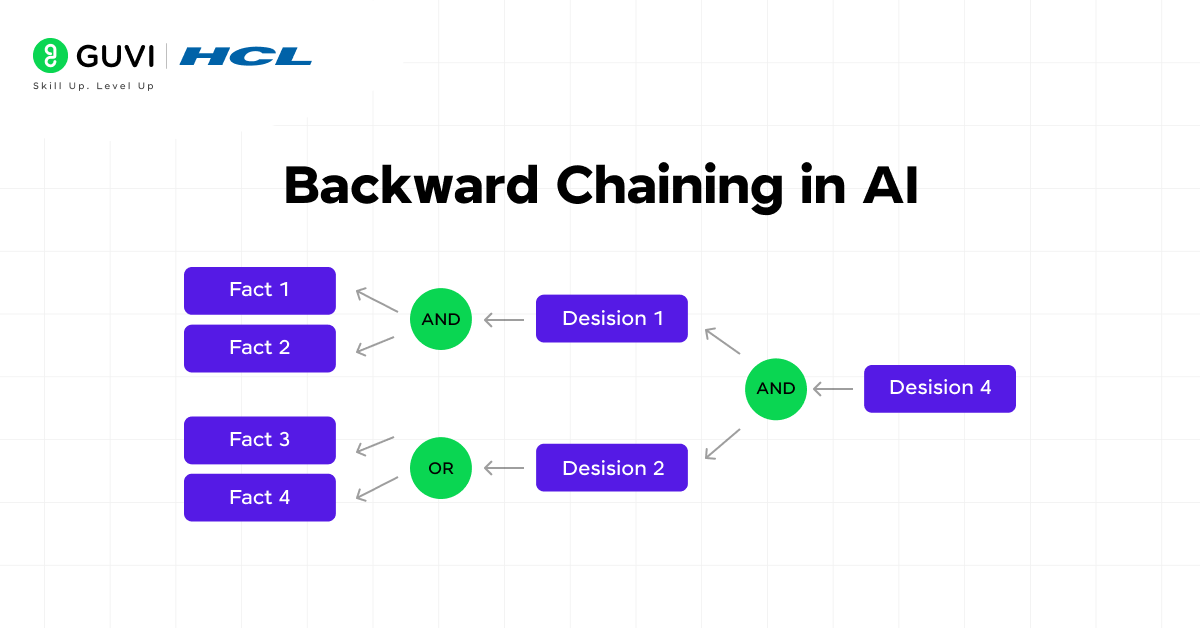
Backward chaining is a reasoning method in artificial intelligence and machine learning that begins with a goal and works backward to determine the facts or conditions needed to support it. The system checks if the goal is directly supported by known facts, and if not, it looks for rules that could lead to the goal, verifying their premises recursively. This method is efficient when the number of possible goals is limited and when verifying a specific hypothesis is required. It is widely applied in rule-based systems for troubleshooting and diagnostic reasoning.
Examples of Backward Chaining in Artificial Intelligence
- A medical tool applies backward chaining by starting with the goal of confirming diabetes. It further works backward to check if high blood sugar and related symptoms support it.
- A computer troubleshooting system uses backward chaining by beginning with the assumption that a power issue is the cause. It then checks backward through cable and supply conditions to verify it.
- A legal reasoning program applies backward chaining by starting with the goal that a person is eligible for compensation. It works backward to see if the legal requirements are met.
- A network security system uses backward chaining by starting with the suspicion of a breach, then working backward through access logs and conditions to confirm or reject it.
- A tutoring system applies backward chaining by starting with the goal that a student has mastered a concept. The system then functions backward to verify if the prerequisite steps were completed correctly.
How Does Backward Chaining Work?
Here is how backward chaining works:
Step 1: Goal Identification
The process starts with a specific goal or hypothesis that needs to be verified. The system sets this as the target. For example, in a medical case, the goal may be to confirm whether the patient has diabetes.
Step 2: Fact Checking
The system checks the knowledge base to see if the goal already exists as a fact. The goal is proven without further reasoning if the fact is directly available.
Step 3: Rule Discovery
If the goal is not directly supported, the system searches for rules where the goal appears as the conclusion. Each of these rules is considered as a potential path to proving the goal.
Step 4: Sub-goal Expansion
The system then examines the conditions of the chosen rule. Each condition becomes a sub-goal. The system must prove these sub-goals one by one. It does the same by working backward to check whether they can be supported by existing facts or by applying more rules.
Step 5: Recursive Proof and Conclusion
This process continues recursively. The system keeps moving backward. It keeps testing sub-goals against the knowledge base until the original goal is either fully proven or cannot be proven. The hypothesis is accepted if all required sub-goals are verified. The system rejects the hypothesis if any condition cannot be satisfied.
Technology Behind Backward Chaining in Artificial Intelligence
- Goal-Based Reasoning
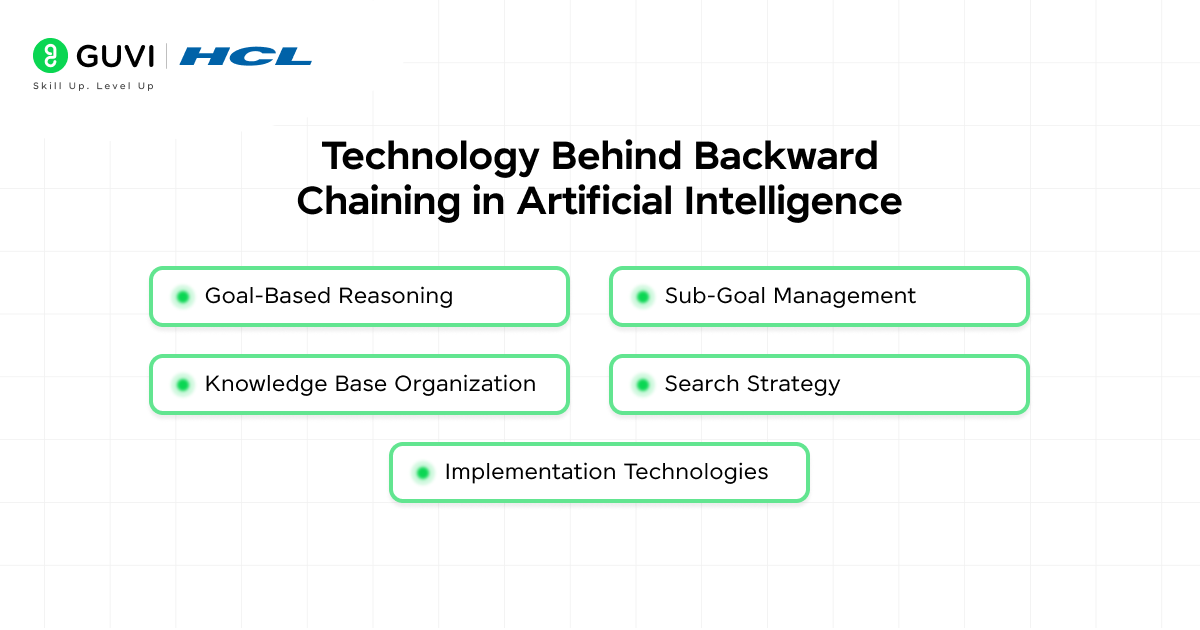
Backward chaining begins with a goal or hypothesis. The system checks whether the goal can be supported directly by existing facts. If not, it searches for rules that conclude the goal and works backward through their conditions.
- Sub-Goal Management
Each rule that can prove a goal contains conditions that become sub-goals. The system must prove each sub-goal before the rule is considered valid. If all sub-goals are satisfied, the main goal is proven. If even one fails, the system may attempt alternative rules or conclude that the goal cannot be supported.
- Knowledge Base Organization
Backward chaining systems organize rules so that the inference engine can quickly locate those linked to a goal. Indexing methods and tree-based structures help reduce search time. This allows the system to focus only on relevant rules without scanning the entire knowledge base.
- Search Strategy
Most backward chaining uses depth-first search. This approach follows one chain of reasoning completely before returning to explore another path. Depth-first search conserves memory and works well for systems with limited goals. However, it may slow down reasoning if the wrong path is taken first.
- Implementation Technologies
Prolog is a well-known language designed around backward chaining. It represents facts and rules as clauses and uses queries as goals to be proven. Early expert systems such as MYCIN also applied backward chaining to diagnose bacterial infections. Modern shells and frameworks continue to include backward chaining to support diagnostic and troubleshooting applications.
Top Benefits of Backward Chaining in Artificial Intelligence
- Goal-Oriented Reasoning
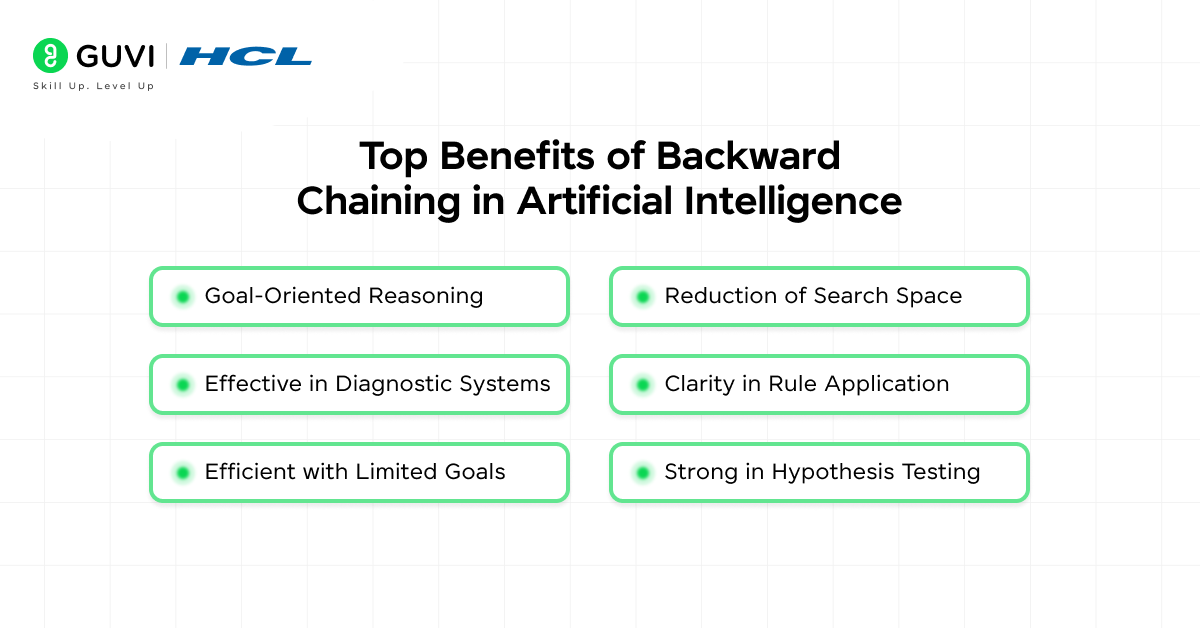
Backward chaining is efficient because it begins with a clear goal or hypothesis. The system works backward only as much as needed to verify or reject that goal.
- Reduction of Search Space
Backward chaining avoids checking unnecessary rules. It focuses only on those rules that can support the goal, which saves time and resources.
- Effective in Diagnostic Systems
This method is well-suited to troubleshooting and decision-making. Medical diagnosis and legal reasoning often apply backward chaining because it starts with a conclusion and verifies it.
- Clarity in Rule Application
Backward chaining makes the reasoning path transparent. Each sub-goal shows why certain facts are being tested, which makes the decision-making process easier to follow.
- Efficient with Limited Goals
Backward chaining is most useful when there are few possible conclusions. The system does not waste effort generating results that are not relevant to the target.
- Strong in Hypothesis Testing
Research systems benefit from backward chaining because it allows direct testing of a theory. The process checks whether supporting evidence exists in a structured manner.
Cons of Backward Chaining in Artificial Intelligence
- The process fails if the starting hypothesis is not well defined. A vague or wrong goal leads to wasted reasoning steps.
- It can become complex if the system generates too many sub-goals. Each sub-goal may require its own set of rules to be proven.
- The reasoning may stop without results if required supporting facts are missing from the knowledge base.
- The system can become slow if the goal depends on deep chains of rules that must be checked repeatedly.
Elevate your AI expertise with HCL GUVI’s Intel‑certified Artificial Intelligence & Machine Learning course, a six-month, live-online program crafted in collaboration with Intel and IITM Pravartak. Gain hands-on experience through over 20 modules covering Generative AI, Agentic AI, Deep Learning, and MLOps, supported by expert-led bootcamps, hackathons, and lifetime access to mentor‑assisted sessions.
You’ll receive a joint certification from HCL GUVI, Intel, and IITM Pravartak, unlock placement assistance with 1,000+ hiring partners. Enroll now to turn your understanding of AI reasoning methods like chaining into real-world AI mastery!
Comparison Table: Forward and Backward Chaining in Artificial Intelligence
| Feature | Forward Chaining | Backward Chaining |
| Starting Point | Begins with known facts and moves step by step to reach conclusions | Begins with a goal or hypothesis and works backward to find supporting facts |
| Direction of Reasoning | Fact-driven reasoning that expands toward outcomes | Goal-driven reasoning that verifies conclusions |
| Knowledge Base Use | Continuously adds new facts to working memory as rules fire | Uses rules to break a goal into sub-goals until facts prove or disprove it |
| Search Method | Breadth-oriented, since it explores all possible rules from facts | Depth-oriented, often using depth-first search to follow one path at a time |
| Best Suited For | Real-time monitoring, data-driven decision-making, and environments where facts flow in constantly | Diagnostic systems, troubleshooting, legal reasoning, and hypothesis testing |
| Efficiency | May generate many irrelevant outcomes if rules are broad | Efficient when the goal is clear and the number of possible outcomes is limited |
| Examples | Medical diagnosis systems, credit approval, weather forecasting, fraud detection | Medical diagnosis tools, computer troubleshooting, tutoring systems, legal reasoning |
| Technologies | CLIPS, OPS5, Drools | Prolog, MYCIN, modern diagnostic expert systems |
Conclusion
Forward chaining and backward chaining both play a central role in reasoning within artificial intelligence. Forward chaining progresses from facts toward conclusions, which makes it effective in domains where data flows continuously and multiple outcomes may be useful. Backward chaining begins with a goal and works backward through rules, which makes it valuable in troubleshooting and hypothesis testing.
Both methods rely on:
- Production rules
- Inference engines
- Conflict resolution strategies
Although the direction of reasoning differs in both systems. Choosing between them depends on whether the system must expand from available data or verify a defined target. Together, they represent two complementary approaches that continue to guide the design of expert systems and decision-making technologies.
FAQs
Q1. What is the difference between an expert system and machine learning?
An expert system relies on predefined rules created by human experts, while machine learning models learn patterns directly from data without explicit rules.
Q2. Can forward and backward chaining be combined in one system?
Yes. Many systems use a hybrid approach where forward chaining handles real-time data updates and backward chaining checks specific goals or hypotheses.
Q3. Are chaining methods used outside artificial intelligence?
Yes. Similar reasoning principles are applied in business process management and even in legal case analysis.
Q4. Why are production rules important in AI?
Production rules provide a structured way to represent knowledge. They guide the inference engine in applying reasoning consistently.
Q5. What is the role of conflict resolution in rule-based systems?
Conflict resolution ensures that only the most relevant or prioritized rule fires when multiple rules could apply. It prevents wasted processing and confusion in conclusions.
Success Stories

About the Author
Vaishali
I'm a seasoned writer with four years of experience across technical, non-technical, and just about every genre or niche you can imagine. Adaptable and curious, I enjoy exploring new topics and making information engaging and easy to understand. Fueled by a steady stream of tea, I approach each project with creativity, reliability, and genuine enthusiasm for storytelling.
View all posts by Vaishali
Connect with me @












Did you enjoy this article?