


Data Science Articles
My Data Scientist Interview Experience: From Rejection to 6-Figure Offer
My Data Analyst Interview Experience: From Rejection to Success Story
Validation and Metrics: Are They Being Ignored in Modern Data Science?


Get In Touch For Details! Request More Information
8 Different Data Science Roles Beyond “Data Scientist”
Sep 15, 2025 9 Min Read 2459 Views
(Last Updated)
Data Science, Machine Learning, and AI have never been more popular. These fields have become the de facto buzzwords of the tech space, capturing the imagination of students, professionals, and fresh graduates alike.
The Harvard Business Review has proclaimed Data Science “The hottest job of the 21st century.” With demands soaring, data science roles have seen a tremendous increase of 480% since 2016, not only in India but across the globe. This explosive growth reflects the critical need for skilled data scientists in today’s data-driven world.
However, navigating the data science job market can be overwhelming and confusing, especially for newcomers. Job postings and descriptions are often filled with technical jargon and buzzwords that can obscure the true nature of the role.
• Data scientist positions in the US are projected to grow by 36% between 2023 and 2033, far outpacing most occupations.
• Employment for data analysts is expected to rise by 23% by 2032.
• Nearly all companies are investing in data and AI initiatives, proving how central these fields have become.
• Healthcare analytics is expanding at a compound annual growth rate of about 19%.
• Around 77% of consumer devices already include some form of AI.
• AI is expected to add nearly $15.7 trillion to the global economy by 2030.
• Close to 83% of data scientists use machine learning regularly in their daily work.
• Companies driven by data attract customers at 23× the rate of others and retain them at 6× the rate.
• The world has entered the Zettabyte Era: from just 1 zettabyte in 2012, global data is expected to reach 175 zettabytes by 2025.
Table of contents
- Navigating Data Science Job Roles
- Data Scientist
- Roles and Responsibilities
- Required Tools/Skills
- Top Companies
- Salary Range:
- Data Analyst
- Roles and Responsibilities
- Required Tools/Skills
- Top Companies
- Salary Range:
- Data Architect
- Roles and Responsibilities
- Required Tools/Skills
- Top Companies
- Salary Range:
- Data Engineer
- Roles and Responsibilities
- Required Tools/Skills
- Top Companies
- Salary Range:
- Statistician
- Roles and Responsibilities
- Required Tools/Skills
- Top Companies
- Salary Range:
- Database Administrator
- Roles and Responsibilities
- Required Tools/Skills
- Top Companies
- Salary Range:
- Business Analyst
- Roles and Responsibilities
- Required Tools/Skills
- Top Companies
- Salary Range:
- Data and Analytics Manager
- Roles and Responsibilities
- Required Tools/Skills
- Top Companies
- Salary Range:
- Emerging Trends Shaping the Future of Data Science Careers
- AI-First Organizations
- Rise of Data Democratization
- Greater Focus on Data Ethics and Privacy
- Cloud-Native and Real-Time Data Engineering
- Convergence of Roles
- Industry-Specific Specialization
- Automation in Model Deployment
- Growth of Edge Analytics
- Integration of Data with Sustainability Goals
- Expansion of Data Products
- Human-Centered AI
- Rise of Multimodal Data
- The Bottom Line
- FAQs
- What skills are essential for starting a career in data science?
- How can I choose the right data science role for my interests?
- What are the career prospects and growth opportunities in data science?
Navigating Data Science Job Roles

It’s crucial to read between the lines and understand what a job entails daily and what skills are necessary for success. Many aspiring data scientists have specific interests within the broad field of data science, and it’s important to find a role that aligns with these passions to avoid career dissatisfaction.
This article aims to help you decipher job postings and understand what different data science roles involve. It’s essential to recognize whether a role is realistic for one person to handle successfully, as companies sometimes look for a single data scientist to fulfil multiple roles, leading to unsustainable and unpleasant work conditions.
By understanding these nuances, you can make informed decisions and steer your career in a direction that aligns with your interests. For a detailed overview of how to approach a Data Science career head-on, refer to this detailed guide.
| Role | Tools Used | Stakeholder Engagement | Main Responsibility in Pipeline | Levels |
|---|---|---|---|---|
| Data Scientist | R, Python, SQL, Hive, Pig, Tableau, ggplot2 | Business Managers, Analysts | Gathering, analyzing, and visualizing data | Entry to Senior |
| Data Analyst | SQL, Excel, Tableau, Power BI, Python, R | Marketing, Product Teams, Business Units | Collecting and interpreting data, creating reports | Entry to Mid-level |
| Data Architect | SQL, Oracle, NoSQL, ETL tools | IT, Management | Designing and implementing database solutions | Mid to Senior |
| Data Engineer | Python, Java, Scala, Hadoop, Spark, Kafka | Data Scientists, Analysts | Building and maintaining data pipelines | Entry to Senior |
| Statistician | SAS, SPSS, R, Tableau, ggplot2 | Research Teams, Business Analysts | Designing surveys, analyzing and interpreting data | Entry to Senior |
| Database Administrator | Oracle, MySQL, Microsoft SQL Server | IT, Security Teams | Ensuring database performance, integrity, and security | Entry to Senior |
| Business Analyst | Excel, Tableau, Power BI, SQL | Business Units, IT, Management | Analyzing business processes, creating data models | Entry to Mid-level |
| Data and Analytics Manager | R, Python, SQL, NoSQL, Project Management tools | Department Heads, Data Teams | Coordinating data projects, strategic data analysis | Mid to Senior |

1. Data Scientist
The first role that comes to mind when thinking about data science roles is that of a data scientist. This general role can also be a jack of all trades. To advance in your career as a data scientist, you must understand all business aspects and offer the best solutions to business problems by implementing processes, from collecting and analyzing to visualizing and presenting data.
The role of a data scientist often combines various responsibilities from multiple job roles in a somewhat haphazard manner. This can occur because hiring managers may not realize the breadth of the tasks involved, or they hope to find someone who can handle everything for a single salary.
This is especially common in organizations that are hiring their first data science professional and do not yet have a dedicated data science function. While this role can be an excellent opportunity to learn by doing, it often comes with a low salary compared to the expectations placed on the individual.
Before we move into the next section, ensure you have a good grip on data science essentials like Python, MongoDB, Pandas, NumPy, Tableau & Power BI Data Methods. If you are looking for a detailed course on Data Science, you can join HCL GUVI’s Data Science Course with Placement Assistance. You’ll also learn about the trending tools and technologies and work on some real-time projects.
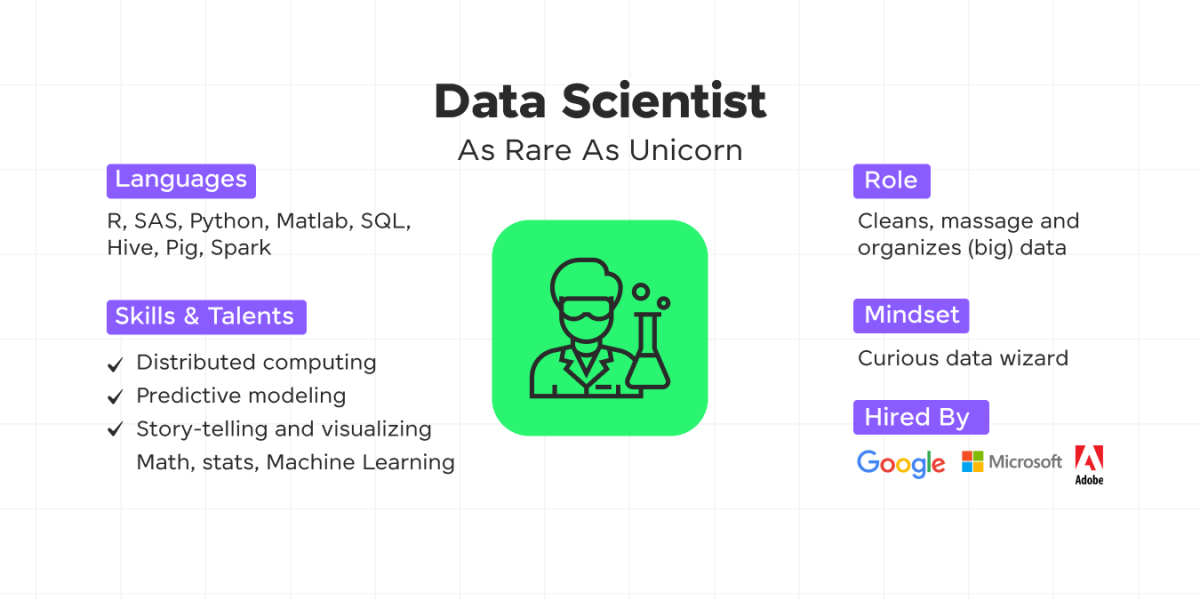
Roles and Responsibilities
- Gathering and analyzing data from various trustworthy sources.
- Processing, cleansing, and integrating data to derive insights.
- Utilizing tools and techniques to visualize data and help design future strategies.
- Suggesting alternative methods and proposing solutions to tackle complex business challenges.
Required Tools/Skills
- Proficiency in languages like R or Python and query languages such as SQL, Hive, Pig, etc.
- Good knowledge of machine learning algorithms and applied statistical skills.
- Strong command of data visualization tools like Matplotlib, ggplot2, D3.js, Tableau, etc.
- Excellent written and verbal communication skills.
Top Companies
- Top companies hiring data scientists include Deloitte, PwC, Amazon, and Microsoft.
Salary Range:
Data Scientist roles in India typically range from ₹8.5 lakh to ₹22 lakh per year.
Reference: Glassdoor
2. Data Analyst
A data analyst’s role is vital yet often underappreciated, helping companies assess if they are meeting their goals and ensuring operations run smoothly. This multifaceted role is distinguished from a data science role and includes building dashboards, analyzing sales and product success, and evaluating internal performance metrics like turnover.
Historically referred to as Operations Analysts or BI Specialists, data analysts now handle diverse data from various sources, utilizing extensive SQL. Although machine learning isn’t a core part of the role, tasks like NLP on feedback responses or A/B testing for product effectiveness may arise. Data analysts are pivotal in marketing and analytics departments, frequently approached for critical business metrics.
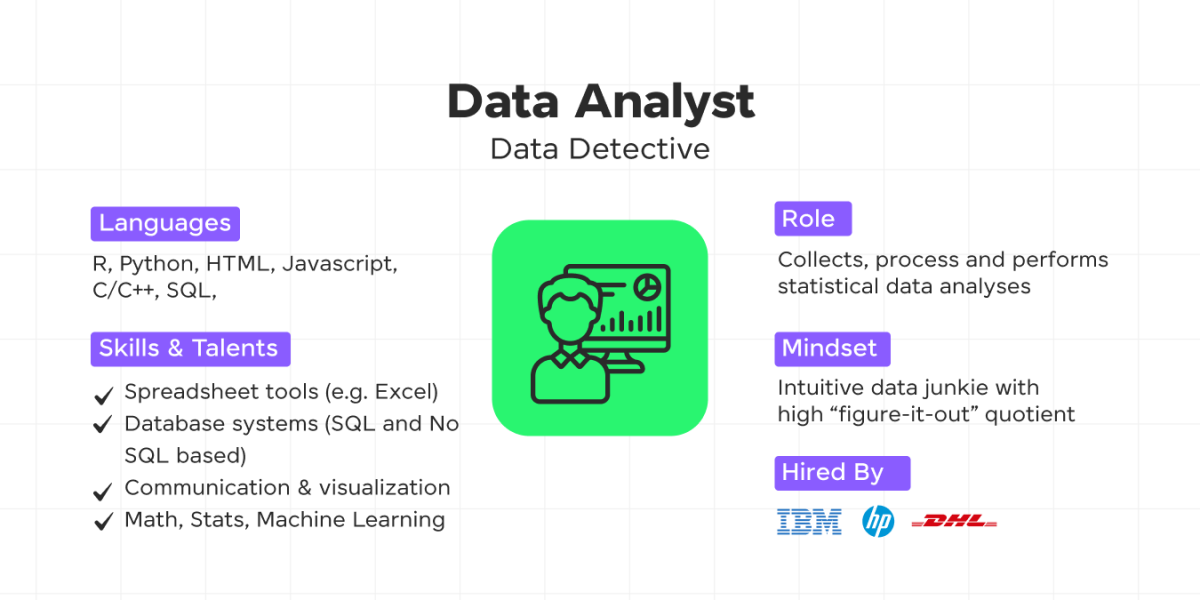
Roles and Responsibilities
- Collecting and interpreting data sets to identify trends and patterns.
- Creating visualizations and reports to present findings to stakeholders.
- Performing data validation and cleaning to ensure data accuracy.
- Collaborating with different departments to understand their data needs and deliver relevant solutions.
Required Tools/Skills
- Strong proficiency in SQL, Excel, and data visualization tools like Tableau and Power BI.
- Familiarity with statistical software such as R or Python.
- Excellent analytical skills and attention to detail.
- Effective communication skills to explain technical results to non-technical audiences.
Top Companies
- Companies like IBM, Facebook, Google, and Accenture frequently hire data analysts.
Salary Range:
Data Analyst positions usually offer between ₹4 lakh and ₹10 lakh annually
Reference: Glassdoor
3. Data Architect
Data architects play a critical role in designing and managing an organization’s data infrastructure. This position requires a comprehensive understanding of both business needs and technology, ensuring that data is easily accessible, secure, and organized for analysis. Data architects lay the foundation for data scientists and analysts to perform their roles effectively, often working behind the scenes to create robust data solutions.
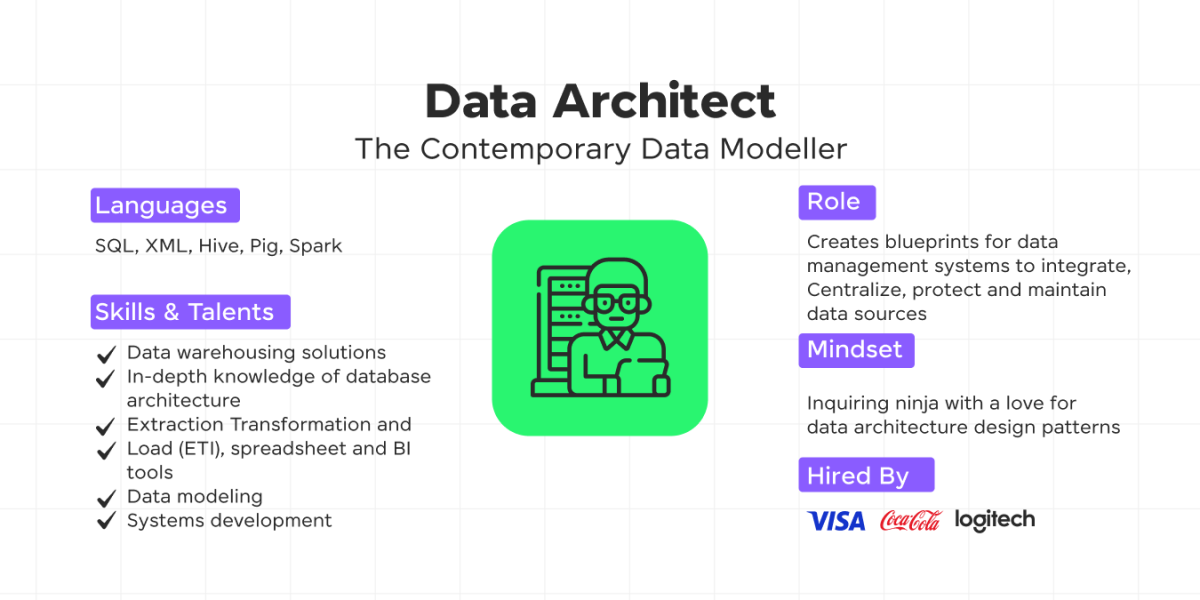
Roles and Responsibilities
- Designing and implementing effective database solutions and models.
- Ensuring the stability, security, and scalability of data systems.
- Collaborating with IT and management to devise data strategies.
- Overseeing data migration, integration, and ensuring data quality.
Required Tools/Skills
- Proficiency in database management systems like SQL, Oracle, and NoSQL databases.
- Strong understanding of data warehousing solutions and ETL tools.
- Knowledge of data modelling, architecture, and schema design.
- Strong problem-solving skills and attention to detail.
Top Companies
- Data architects are in demand at companies such as Amazon, IBM, Microsoft, and Oracle.
Salary Range:
Data Architect salaries fall between ₹18 lakh and ₹30 lakh annually, with strong confidence in this range
Reference: Glassdoor
This role can be particularly challenging in organizations establishing their data infrastructure for the first time. Data architects must be self-starters and capable of handling the technical and strategic aspects of their role without extensive guidance. While this can offer significant learning opportunities, it can also lead to high expectations and a risk of burnout if not managed carefully.
The future of the Data Science niche looks promising, but what would it look like? What are emerging trends and technologies that are rapidly shaping the Data Science industry? We’ve stressed this topic in great detail in this blog. Don’t forget to read.
4. Data Engineer
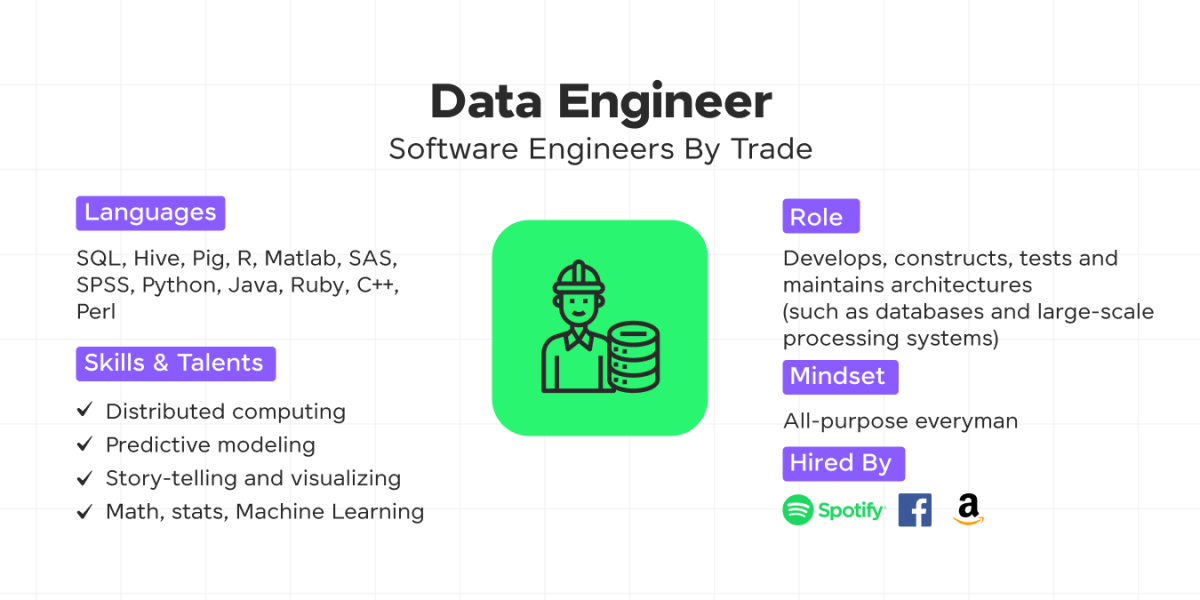
Data engineers are responsible for developing and maintaining the architecture that allows data extraction, transformation, and loading (ETL) processes. They build the infrastructure that data scientists and analysts rely on for their work, making this role pivotal in any data-driven organization.
The data engineer role can often feel overwhelming, especially in organizations with complex data needs and limited support. While this position offers valuable hands-on experience, it requires a high degree of self-reliance and problem-solving ability. The risk of burnout is real, particularly if the scope of work is broad and the resources are limited.
Roles and Responsibilities
- Designing, constructing, and maintaining large-scale data processing systems.
- Building and managing data pipelines for real-time and batch data processing.
- Ensuring data integrity, quality, and security.
- Collaborating with data scientists and analysts to understand data needs.
Required Tools/Skills
- Proficiency in programming languages like Python, Java, and Scala.
- Experience with big data tools such as Hadoop, Spark, and Kafka.
- Knowledge of cloud services like AWS, Google Cloud, or Azure.
- Strong understanding of data warehousing solutions and ETL tools.
Top Companies
- Leading employers of data engineers include Google, Netflix, Facebook, and LinkedIn.
Salary Range:
Data Engineer roles show a base pay range of about ₹6 lakh to ₹15 lakh per year
Reference: Glassdoor
5. Statistician
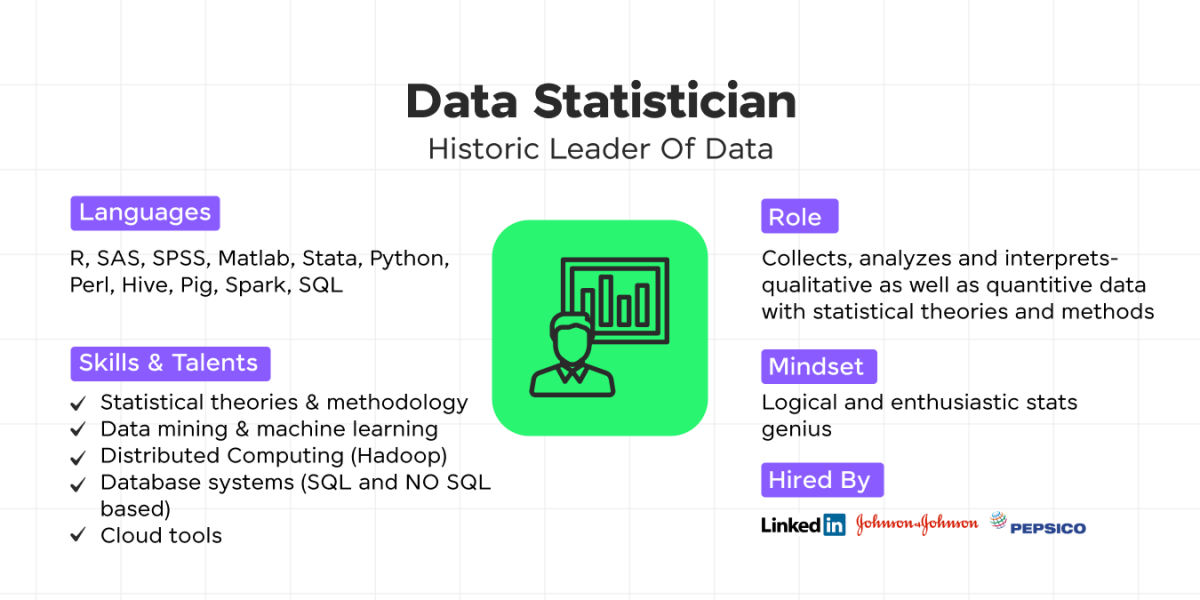
Statisticians apply mathematical theories and techniques to analyze data and solve real-world problems in various fields, from healthcare to marketing. They focus on interpreting data to identify trends and relationships, often working on a highly rigorous analysis involving designing and maintaining experiments such as A/B tests and hypothesis testing.
Roles and Responsibilities
- Designing surveys, experiments, and opinion polls.
- Analyzing and interpreting data using statistical techniques.
- Presenting findings through reports, charts, and graphs.
- Advising on the validity and reliability of findings.
Required Tools/Skills
- Proficiency in statistical software like SAS, SPSS, and R.
- Strong mathematical and analytical skills.
- Ability to communicate complex data findings clearly.
- Knowledge of data visualization tools like Tableau and ggplot2.
Top Companies
- Statisticians are often hired by organizations such as Nielsen, Gallup, and pharmaceutical companies like Pfizer and Merck.
Salary Range:
Statistician roles pay between ₹3 lakh and ₹8 lakh per year, on average
Reference: Glassdoor
This role can be particularly isolating, especially in organizations where statistical expertise is not well understood or valued. Statisticians must be comfortable working independently and continuously seeking out new learning resources to stay current in their field. The lack of mentorship and high expectations can lead to burnout if not managed carefully.
6. Database Administrator
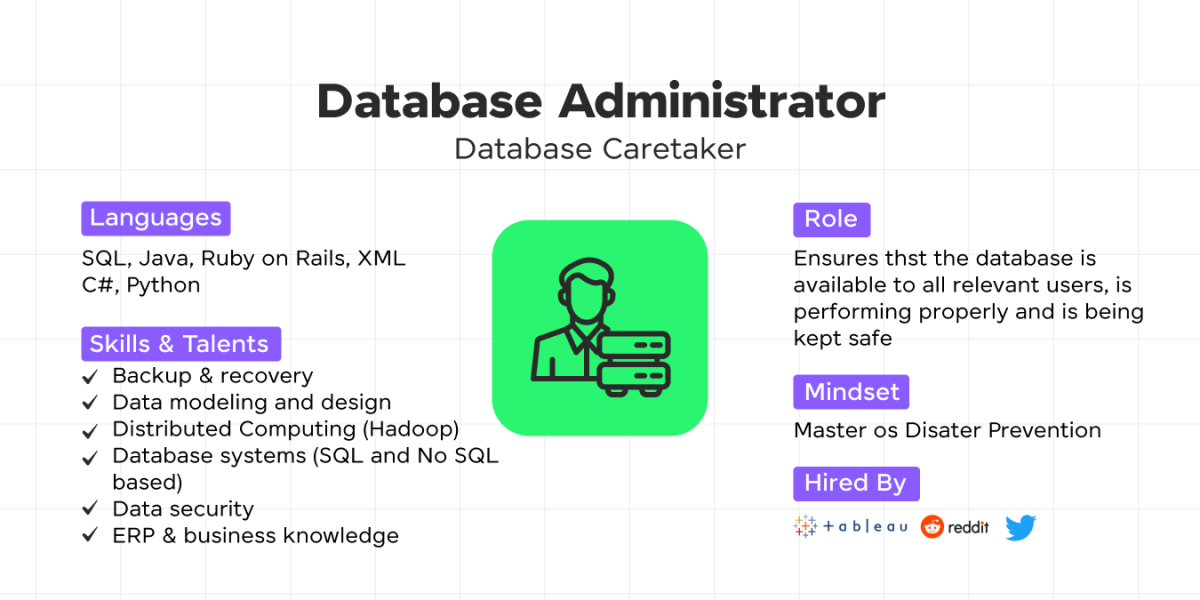
Database administrators (DBAs) are responsible for the performance, integrity, and security of databases. They ensure that data is available, reliable, and safeguarded from unauthorized access. This role is crucial for maintaining the backbone of any data-driven organization.
The role of a DBA can often be demanding, especially in large organizations with complex data needs. The responsibility of ensuring data security and performance can lead to high-stress situations, particularly if resources and support are limited. DBAs must be proactive and resourceful, continuously seeking out new solutions to improve database management.
Roles and Responsibilities
- Installing, configuring, and upgrading database servers.
- Monitoring database performance and implementing optimization strategies.
- Ensuring data security and recovery policies are in place.
- Managing database access and setting user privileges.
Required Tools/Skills
- Proficiency in database management systems like Oracle, MySQL, and Microsoft SQL Server.
- Knowledge of database security, backup, and recovery solutions.
- Strong problem-solving and troubleshooting skills.
- Ability to manage large-scale databases and handle data migrations.
Top Companies
- Major employers of DBAs include IBM, Oracle, Microsoft, and financial institutions like JPMorgan Chase.
Salary Range:
Database Administrator (DBA) compensation ranges around ₹4 lakh to ₹10.5 lakh annually for Oracle DBAs, with an average near ₹6.23 lakh.
Reference: Glassdoor
The role of a DBA can often be demanding, especially in large organizations with complex data needs. The responsibility of ensuring data security and performance can lead to high-stress situations, particularly if resources and support are limited. DBAs must be proactive and resourceful, continuously seeking out new solutions to improve database management.
7. Business Analyst
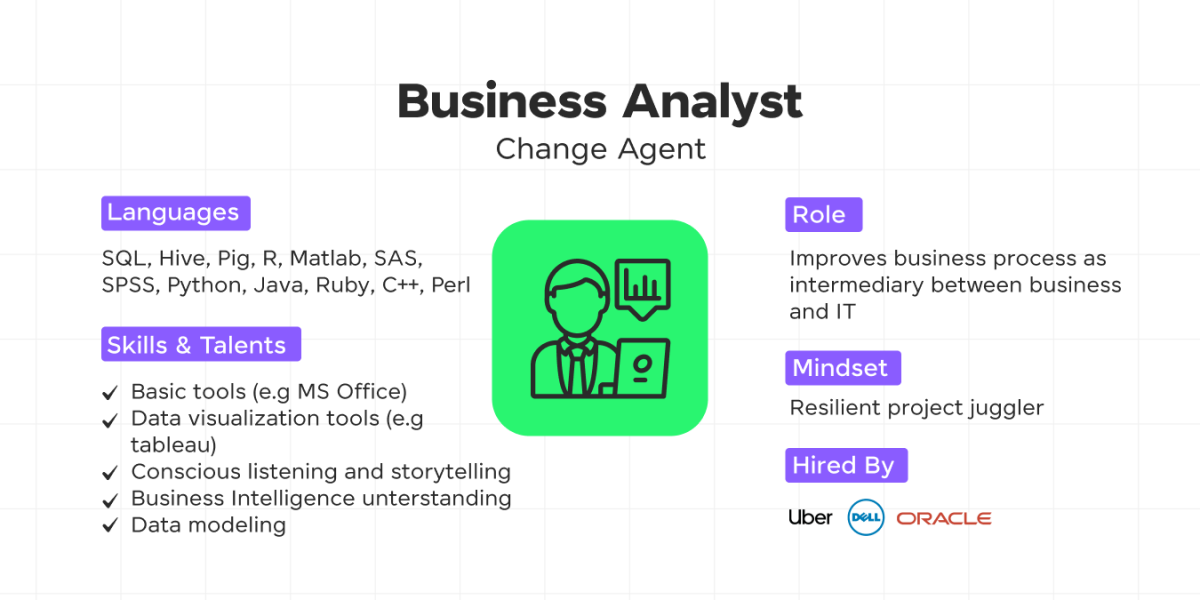
Business analysts bridge the gap between IT and business by assessing processes, determining requirements, and delivering data-driven recommendations. They play a critical role in guiding businesses toward efficiency and profitability.
Roles and Responsibilities
- Analyzing business processes and identifying areas for improvement.
- Gathering and documenting business requirements.
- Creating data models and visualizations to support business decisions.
- Communicating findings and recommendations to stakeholders.
Required Tools/Skills
- Proficiency in business analytics tools like Excel, Tableau, and Power BI.
- Strong understanding of SQL and data querying.
- Excellent analytical, problem-solving, and communication skills.
- Ability to translate business requirements into technical specifications.
Top Companies
- Companies frequently hiring business analysts include Deloitte, EY, PwC, and KPMG.
Salary Range:
Business Analyst roles commonly offer between ₹6 lakh and ₹12.5 lakh per year
Reference: Glassdoor
Business analysts often find themselves at the centre of organizational change, which can be both exciting and stressful. They must be adept at managing multiple stakeholders and balancing technical and business demands. This role requires a high level of adaptability and continuous learning to keep up with evolving business needs and technologies.
8. Data and Analytics Manager
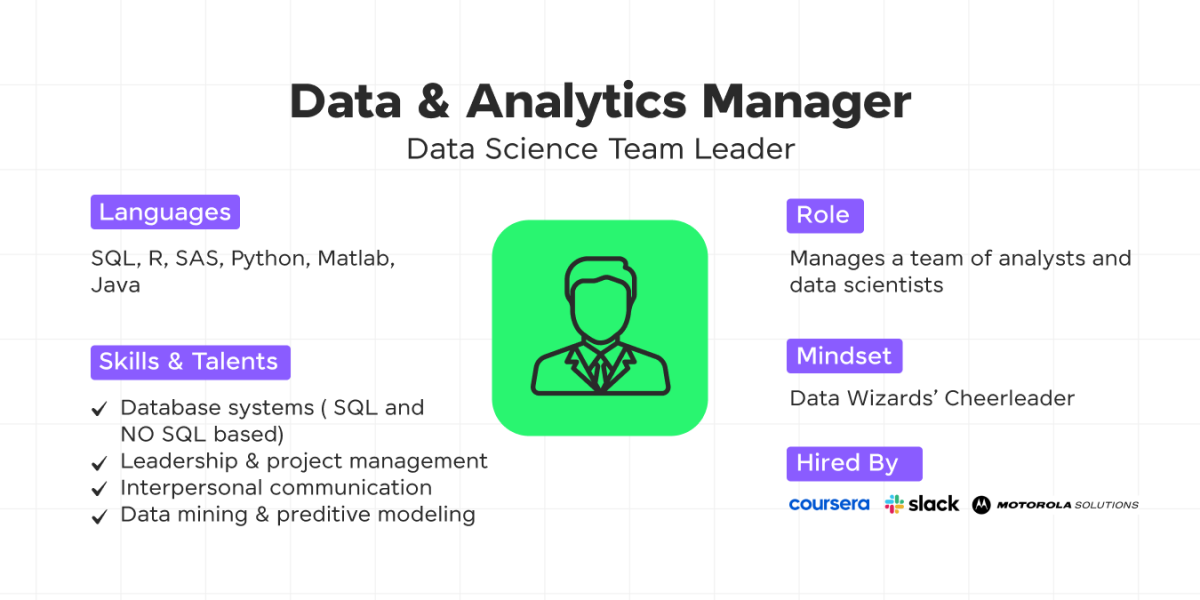
The data and analytics manager plays a pivotal role in leading a team of data professionals to complete various data-related projects. This position requires a blend of advanced technical skills, project management expertise, and leadership abilities. Data and analytics managers are responsible for overseeing the collection, analysis, and strategic use of data to recommend solutions and drive business decisions.
Roles and Responsibilities
- Coordinating tasks for big data projects.
- Researching and creating effective data collection methods.
- Analyzing information and recommending business solutions.
- Managing project forecasts, schedules, and technological improvements.
- Communicating with managers across departments to align goals and strategies.
Required Tools/Skills
- Proficiency in programming languages like R, Python, and Java.
- Knowledge of SQL and NoSQL database systems.
- Experience with data visualization tools and machine learning.
- Strong project management, critical thinking, and communication skills.
Top Companies
- Top employers include Verizon, Microsoft, Salesforce, Procter & Gamble, Fidelity Investments, Major League Baseball, Starbucks, and Deloitte.
Salary Range:
Analytics Manager positions span roughly ₹19 lakh to ₹37 lakh annually in base pay
Reference: Glassdoor
This role is common in larger organizations that utilize extensive data analytics to guide strategic decisions. The data and analytics manager must be adept at technical and business skills, ensuring the data team’s efforts align with overall business objectives. The combination of leadership and analytical expertise makes this position essential for leveraging data to drive business success.
Kickstart your Data Science journey by enrolling in HCL GUVI’s Data Science Course where you will master technologies like MongoDB, Tableau, Power BI, Pandas, etc., and build interesting real-life projects.
Alternatively, if you want to explore Python through a Self-paced course, try HCL GUVI’s Python course.
Emerging Trends Shaping the Future of Data Science Careers
Today’s data roles are in high demand, but the field of data science continues to shift as technology and business priorities change. Understanding the new directions in this space can help professionals build careers that remain valuable in the long term.
1. AI-First Organizations
Many companies are moving toward an AI-first model where decision-making in product design and customer strategy relies on predictive and generative AI. Data professionals will need a strong grasp of large language models, generative AI, and reinforcement learning in addition to traditional machine learning approaches.
2. Rise of Data Democratization
Self-service BI platforms and automated analytics tools give business teams direct access to data. This reduces their reliance on specialists for routine reports. It also increases demand for professionals who can create and manage scalable data systems that are easy for non-technical users to work with.
3. Greater Focus on Data Ethics and Privacy
Data misuse and biased algorithms have gained wide attention. Organizations face growing pressure to follow ethical practices and comply with regulations such as GDPR and CCPA. New roles are emerging, including AI Ethicist and Responsible AI Specialist. Professionals will need skills in bias detection, transparency, and model interpretability.
4. Cloud-Native and Real-Time Data Engineering
Massive amounts of data are now created in real time through apps, IoT devices, and digital transactions. Tools such as Kafka and Flink, combined with cloud services like AWS, Azure, and GCP, have become essential. Data engineers and architects are expected to design systems that process large volumes of fast-moving data.
5. Convergence of Roles
The lines between Data Scientists, ML Engineers, and Data Engineers are becoming less distinct. Employers often look for individuals who can design models and also deploy them into production. Professionals with a full-stack data approach are positioned to stand out, even as specialization remains important.
6. Industry-Specific Specialization
General data science skills are valuable, but domain knowledge often leads to stronger career growth. Professionals working in healthcare, finance, climate modeling, or retail analytics benefit from combining technical expertise with a deep understanding of their sector.
7. Automation in Model Deployment
Many companies are turning toward automated machine learning and MLOps practices. These approaches make it easier to deploy, monitor, and retrain models. Professionals who understand automation pipelines gain an advantage since they can reduce the time it takes to move models from experiments into production environments.
8. Growth of Edge Analytics
With smart devices and sensors producing continuous streams of information, more data is being processed at the source. Edge analytics reduces delays and keeps sensitive data closer to where it originates. Specialists who can design and manage such systems are becoming important in sectors like manufacturing, healthcare, and logistics.
9. Integration of Data with Sustainability Goals
Companies are now using data science to track and improve sustainability performance. Analysts and scientists are expected to provide insights on energy usage, carbon emissions, and supply chain efficiency. This trend is opening roles where technical knowledge combines with environmental and social impact expertise.
10. Expansion of Data Products
Data is increasingly being treated as a product rather than only an asset. Teams are building data platforms that serve both internal departments and external clients. Data scientists who can design services with reliability and scalability in mind will be at the center of this shift.
11. Human-Centered AI
There is growing demand for AI that supports people rather than replaces them. Professionals are expected to design models that are transparent and easy to interpret. Strong communication skills and the ability to translate technical results into business insights are now just as valuable as coding ability.
12. Rise of Multimodal Data
Information no longer comes only in structured formats. Organizations are dealing with text, images, video, and sensor data at once. Data scientists who can combine multiple forms of data in a single analysis will be positioned for high-impact roles, especially in industries like retail, healthcare, and entertainment.
The Bottom Line
Data science is more than a collection of technical roles; it is becoming the core of how organizations make decisions and create value. A career in this space grows strongest when professionals balance technical mastery with curiosity for business problems and awareness of ethical responsibility. The field will continue to expand into areas like real-time analytics and sustainability, which means the most successful data scientists are those who stay adaptable, build depth in their chosen niche, and approach their work with clarity and purpose.
FAQs
What skills are essential for starting a career in data science?
To start a career in data science, you need a solid understanding of programming languages like Python or R, proficiency in SQL for database management, and knowledge of machine learning algorithms.
Additionally, strong analytical skills, experience with data visualization tools such as Tableau or Power BI, and a good grasp of statistical methods are crucial.
How can I choose the right data science role for my interests?
Choosing the right data science role involves understanding your strengths and interests. If you enjoy coding and building data pipelines, a Data Engineer role might be suitable. If you’re more inclined towards analyzing data and creating visual reports, consider a Data Analyst role.
For those who like a mix of technical and business responsibilities, roles like Data Scientist or Data and Analytics Manager might be a good fit.
What are the career prospects and growth opportunities in data science?
The career prospects in data science are very promising, with roles in high demand across various industries such as technology, finance, healthcare, and retail. Entry-level positions like Data Analyst and Junior Data Scientist can lead to advanced roles such as Senior Data Scientist, Data Engineer, and Data Architect.
Continuous learning and gaining certifications can further enhance growth opportunities, potentially leading to managerial roles like Data and Analytics Manager.
Success Stories

About the Author
Vaishali
I'm a seasoned writer with four years of experience across technical, non-technical, and just about every genre or niche you can imagine. Adaptable and curious, I enjoy exploring new topics and making information engaging and easy to understand. Fueled by a steady stream of tea, I approach each project with creativity, reliability, and genuine enthusiasm for storytelling.
View all posts by Vaishali
Connect with me @













Did you enjoy this article?