


Forward Deployed Engineer Articles
Excalidraw and Whiteboarding: How FDEs Communicate Technical Solutions
How to Fine-Tune Open-Source Models as a Forward Deployed Engineer
Rate Limiting, Retries, and Caching: Production AI Patterns for FDEs
How to Run a Great Client Demo as a Forward Deployed Engineer

Get In Touch For Details! Request More Information
The “Customer Discovery First” Framework for FDE Interviews
Sep 27, 2026 3 Min Read 229 Views
(Last Updated)
The Customer Discovery First framework helps Forward Deployed Engineer candidates approach interviews by understanding the customer’s problem before designing a technical solution. FDEs often work with incomplete requirements, unfamiliar workflows, and competing priorities. A strong interview answer therefore begins with discovery: identify the users, understand the existing process, uncover the real pain point, define success, and then connect those findings to a practical engineering solution.
Table of contents
- TL;DR Summary
- Step 1: Identify the Customer and User
- Who Actually Experiences the Problem?
- Step 2: Understand the Current Workflow
- How Does the Process Work Today?
- Step 3: Find the Real Pain Point
- What Is Actually Going Wrong?
- Step 4: Define Success Before Designing
- How Will You Know the Solution Worked?
- Step 5: Discover Technical Constraints
- What Could Limit the Solution?
- Step 6: Prioritize Requirements
- Which Requirement Matters Most?
- Step 7: Propose the Solution
- When Should You Start Designing?
- How Should You Handle Ambiguity?
- What If the Interviewer Cannot Answer Everything?
- A Simple FDE Interview Framework
- The Ten-Step Sequence
- Real-World Example
- How Can You Practice This Framework?
- Conclusion
- FAQs
- 1. What is customer discovery in an FDE interview?
- Why is customer discovery important for FDEs?
- What questions should I ask in an FDE case study?
- Should I propose a technical solution immediately?
- How should I handle unclear requirements?
- What is the biggest FDE case-study mistake?
- How can I practice customer discovery?
TL;DR Summary
- Start with the customer’s problem instead of immediately proposing technology.
- Ask focused questions about users, workflows, goals, constraints, and priorities.
- Define measurable success before discussing architecture or implementation.
- Recommend a solution that directly connects technical decisions to customer outcomes.
Quick Answer
| The Customer Discovery First framework is a structured approach for FDE interviews that puts customer understanding before solution design. Begin by identifying who has the problem, what they are trying to achieve, how the current workflow operates, and where it fails. Then establish business impact, success metrics, technical constraints, and priorities before presenting an architecture or implementation plan. |
Step 1: Identify the Customer and User
Who Actually Experiences the Problem?
Start by identifying the people affected by the problem. The customer may be an organization, but the users could be support agents, analysts, managers, developers, or external customers.
Ask, “Who is experiencing this problem most directly?” Then determine whether different user groups have different goals or requirements.
Step 2: Understand the Current Workflow
How Does the Process Work Today?
Ask the customer to explain the workflow from beginning to end. Look for manual steps, repetitive tasks, delays, handoffs, existing tools, data sources, and points where errors occur.
A useful question is, “Can you walk me through what happens today, from the moment this task begins until it is completed?”
Step 3: Find the Real Pain Point
What Is Actually Going Wrong?
Not every inconvenience deserves a major engineering project. Your goal is to discover the highest-value problem.
Ask what part of the workflow is most frustrating, how frequently it happens, how much time it consumes, and what happens when something goes wrong. Also ask why the existing process is no longer sufficient.
Step 4: Define Success Before Designing
How Will You Know the Solution Worked?
Before discussing architecture, establish what success means. Ask, “If we solved this successfully, what would improve?”
Possible measures include processing time, accuracy, cost, response time, adoption, conversion, or reduction in manual work.
Suppose a workflow currently takes four hours and the target is thirty minutes. That gives you a concrete outcome and helps you evaluate different technical approaches.
Step 5: Discover Technical Constraints
What Could Limit the Solution?
Once the business problem is clear, investigate technical and operational constraints. Ask about existing systems, available data, APIs, integrations, infrastructure, security, permissions, compliance, data volume, and latency requirements.
This matters because a theoretically excellent architecture may be unusable in the customer’s environment.
Step 6: Prioritize Requirements
Which Requirement Matters Most?
Customers often want speed, accuracy, low cost, customization, security, and scalability at the same time. In an interview, show that you recognize these trade-offs instead of treating every requirement as equally important.
Ask, “Which matters most here: speed, accuracy, cost, or flexibility?”
Step 7: Propose the Solution
When Should You Start Designing?
Only after discovery should you transition into architecture. A simple structure is:
Problem → Users → Workflow → Pain Point → Success Metric → Constraints → Priorities → Solution
For example, if a team manually classifies incoming documents, you could propose an automated classification pipeline with appropriate model selection, confidence thresholds, human review for uncertain cases, and monitoring.
For additional technical preparation, HCL GUVI’s Artificial Intelligence & Machine Learning Certification Bundle can strengthen the AI and engineering concepts you may need when turning customer requirements into implementation plans.
FDE interviews often assess how you understand the problem before proposing a solution? The right discovery questions can reveal the customer’s real need and lead to a more effective technical solution.

How Should You Handle Ambiguity?
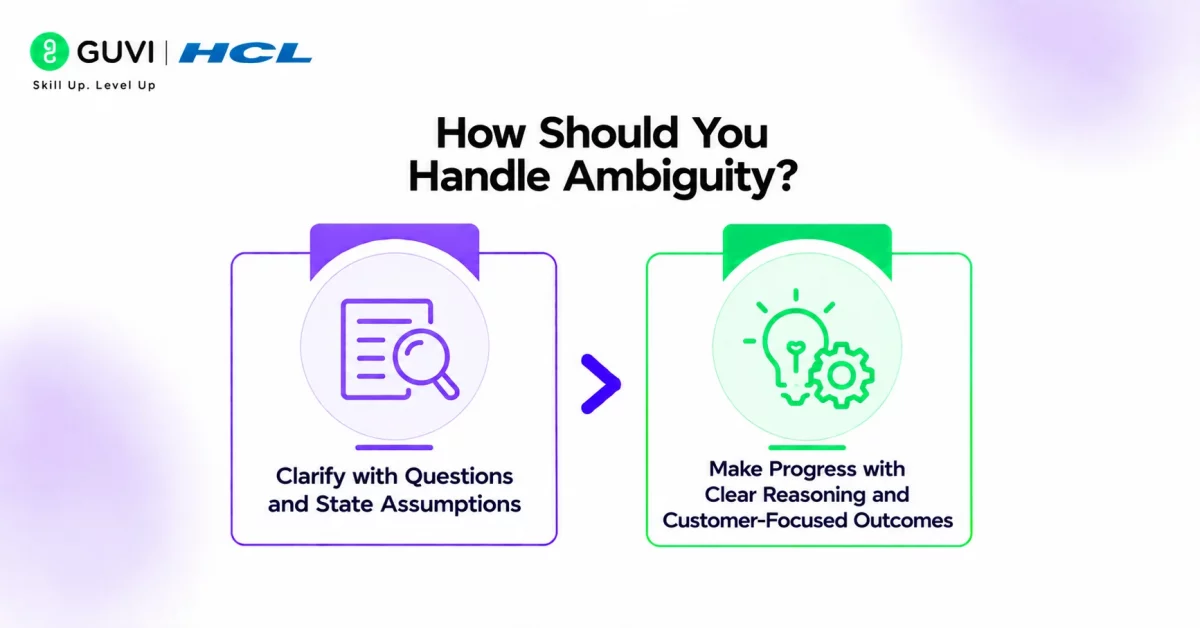
It keeps the discussion grounded in outcomes, makes assumptions visible, and gives every technical choice a clear customer-facing reason rather than personal preference or habit.
What If the Interviewer Cannot Answer Everything?
Ambiguity is often intentional in FDE interviews. You are not expected to know every requirement immediately.
Say, “Before I design this, I want to clarify two things because they could significantly change the architecture.” Then ask the highest-value questions.
If the interviewer cannot provide an answer, state a reasonable assumption and continue. This shows that you can make progress without waiting for perfect information.
A Simple FDE Interview Framework
The Ten-Step Sequence
Use this sequence to structure your case study:
- Customer: Who has the problem?
- Goal: What are they trying to accomplish?
- Workflow: How does the process work today?
- Pain: Where does it fail?
- Impact: Why does solving it matter?
- Success: How will improvement be measured?
- Constraints: What limitations exist?
- Priorities: What trade-offs matter most?
- Solution: What should be built?
- Validation: How will you test and improve it?
Real-World Example
Imagine a retailer says, “We want an AI assistant for our support team.” Instead of immediately designing a chatbot, investigate which support tasks consume the most time, what information agents search for, where that information lives, and how responses are evaluated.
If the primary issue is repeatedly searching internal policies, a retrieval-based assistant with citations, confidence handling, and human escalation could be more useful than a general chatbot. The discovery process gives you a clear reason for choosing that architecture.
You can also use the HCL GUVI Artificial Intelligence eBook to revise core AI concepts before technical discussions and case-study interviews.
How Can You Practice This Framework?
Take common business scenarios and spend the first few minutes asking questions instead of proposing solutions. Practice with customer support, healthcare operations, financial workflows, logistics, and internal enterprise tools.
For every scenario, write down the customer, current workflow, pain point, business impact, success metric, constraints, priorities, and proposed solution. This trains you to separate discovery from design while keeping the final recommendation focused.
Conclusion
The Customer Discovery First framework gives FDE candidates a repeatable method for handling ambiguous interview problems. Start by understanding the customer, users, workflow, pain point, impact, success criteria, constraints, and priorities. Only then recommend the technical solution.
FAQs
1. What is customer discovery in an FDE interview?
It is the process of understanding users, workflows, goals, pain points, constraints, and success criteria before designing a solution.
2. Why is customer discovery important for FDEs?
FDEs solve ambiguous customer problems, so discovery helps ensure that engineering work addresses the actual business need.
3. What questions should I ask in an FDE case study?
Ask about users, goals, current workflows, pain points, impact, success metrics, existing systems, constraints, and priorities.
4. Should I propose a technical solution immediately?
No. Understand the problem first, then design a solution that directly addresses the requirements you discovered.
5. How should I handle unclear requirements?
Ask targeted questions. When information remains unavailable, state your assumptions clearly and continue with a reasonable approach.
6. What is the biggest FDE case-study mistake?
Jumping directly into technology without understanding the customer’s workflow, priorities, business impact, and desired outcome.
7. How can I practice customer discovery?
Choose a business problem and practice moving through customer, goal, workflow, pain, impact, success, constraints, priorities, solution, and validation.
Success Stories

About the Author
HCL GUVI
This article was selected and published as part of the HCL GUVI AI Blogathon 2026, an initiative designed to encourage students, AI enthusiasts, and aspiring tech writers to simplify complex AI concepts through impactful technical content. The contest recognized high-quality, original, and insightful AI-focused blogs, with selected authors receiving publication opportunities on the HCL GUVI blog platform along with official author credits and recognition.
View all posts by HCL GUVI
Connect with me @










Did you enjoy this article?