


Career Articles
Capgemini Exceller Placement Papers and Solutions 2026 - Best Guide
How to Pass the Accenture Recruitment Process 2026/27: The Complete Guide
Accenture Selection Process 2026: Full 6-Stage Guide to Crack Every Round
Accenture ASE 2026: Assessment Pattern, Rounds & the Best Preparation Guide


Get In Touch For Details! Request More Information
Cognizant GenC Next Interview Experience (On-Campus): Rounds, Questions & Prep – Best Guide
Sep 15, 2026 6 Min Read 59 Views
(Last Updated)
Table of contents
- TL;DR
- What Should You Expect in a Cognizant GenC Next Interview Experience?
- How Does the GenC Next On-Campus Interview Flow Usually Work?
- Is There Always One Technical Interview?
- Self-Introduction and Resume Questions
- Java, OOP, or Your Main Programming Language
- SQL and DBMS Questions
- Coding Questions
- Project and Internship Questions
- Backend, Spring, REST, or Web Questions
- HR and Workplace Questions
- How Important Are Your Resume and Projects in the Cognizant GenC Next Interview Experience?
- How Should You Prepare for a Cognizant GenC Next Interview?
- Step 1: Revise Your Skill Cluster
- Step 2: Practise SQL Every Day
- Step 3: Practise Short Coding Problems
- Step 4: Prepare Two Projects Properly
- Step 5: Prepare Your Introduction and HR Answers
- Step 6: Review the Earlier Hiring Stages
- Real-World Example: A Typical Java-Cluster Interview
- Common Mistakes to Avoid in a GenC Next On-Campus Interview
- Prepare for Campus Interviews with HCL GUVI
- Conclusion
- FAQs
- What is the Cognizant GenC Next interview experience like?
- Is the GenC Next interview difficult?
- What questions are asked in the Cognizant GenC Next interview?
- Is Java compulsory for GenC Next?
- Is SQL important for the GenC Next interview?
- How long does a GenC Next interview last?
- Can there be a second GenC Next technical interview?
- Are project questions important in a Cognizant GenC Next interview?
- How should I prepare one day before the interview?
- Where should I check official Cognizant interview updates?
TL;DR
A Cognizant GenC Next interview experience usually becomes more technical after you clear the earlier campus assessments. Recent candidate reports commonly describe a resume-led interview covering projects, programming fundamentals, SQL, OOP, coding, and questions linked to the assigned skill cluster.
Some 2025–26 campus candidates also reported a second technical interview for GenC Next or Pro shortlisting. The exact format is not fixed, and Cognizant itself says the process can vary by role. For the best GenC Next preparation, know your resume deeply, revise one main programming language, practise SQL and basic coding, and prepare short, clear answers for project and HR questions.
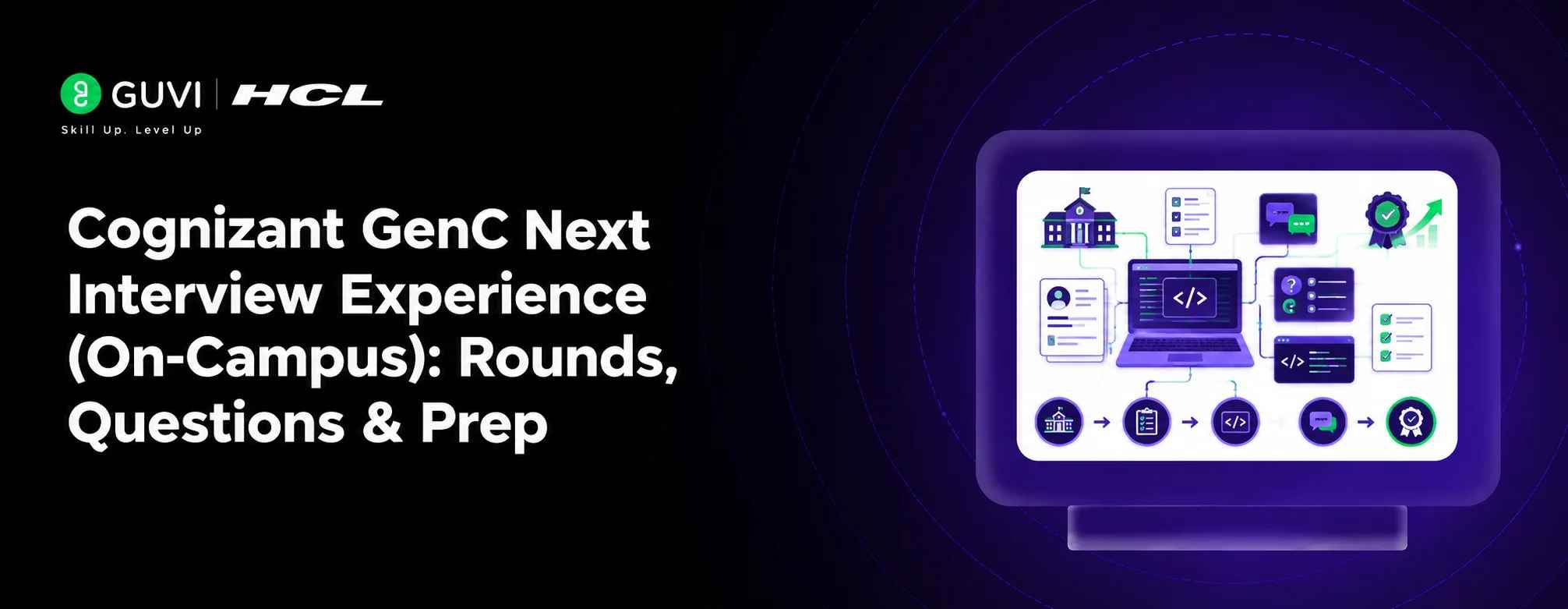
The Cognizant GenC Next interview experience is usually the stage where your technical basics, project knowledge, problem-solving, and communication are tested more closely. For students appearing through Cognizant campus placement, the interview can feel different from the earlier aptitude or technical assessment because the interviewer can follow up on anything you say.
Recent GenC Next interview reports show a strong focus on the candidate’s resume, assigned technical cluster, SQL, programming fundamentals, and projects.
This guide explains what the Cognizant GenC Next interview experience commonly looks like, which GenC Next interview questions you should prepare, and how to approach the round without treating any one candidate’s experience as a fixed pattern.
What Should You Expect in a Cognizant GenC Next Interview Experience?
The Cognizant GenC Next interview experience is best understood as a technical discussion rather than a memorisation test. Most recent candidate reports start with a self-introduction or resume discussion and then move into technical questions based on the skills listed by the candidate.
A typical GenC Next on-campus interview may cover:
- Self-introduction
- Resume and internship discussion
- Final-year or personal projects
- One main programming language
- OOP concepts
- SQL and DBMS
- One or more short coding problems
- Skill-cluster-specific topics
- Basic HR or workplace questions
The exact mix can change. Cognizant’s official GenC hiring page says assessments may evaluate communication, aptitude and/or technical skills depending on the role, and candidates who clear them may be invited to interview virtually or in person.
If you want the complete process before the interview stage, see the Cognizant GenC Next recruitment process 2026.
The key lesson from a Cognizant GenC Next interview experience is simple: prepare the skills you actually claimed on your resume instead of trying to revise every technology at the last minute.
How Does the GenC Next On-Campus Interview Flow Usually Work?
Recent Cognizant interview experience reports from 2025 and 2026 show some variation, but the broad interview flow is fairly consistent.
| Interview Part | What You May Be Asked About |
| Opening | Self-introduction, education, interests |
| Resume | Skills, internships, certifications, achievements |
| Projects | Your role, tech stack, challenges, decisions |
| Programming | Java, Python, C# or another assigned skill |
| CS fundamentals | OOP, DBMS, basic backend or web concepts |
| SQL | Joins, queries, keys, indexes, commands |
| Coding | Small array, string, logic or search problems |
| HR-style questions | Relocation, shifts, flexibility, why Cognizant |
Is There Always One Technical Interview?
No. This is one area where the Cognizant GenC Next interview experience can differ between drives.
Some recent campus candidates reported one combined technical and HR-style discussion. Others in the 2025–26 hiring cycle reported an additional technical interview after performing well in the first assessment and interview stages.
So, do not assume that clearing one interview always ends the GenC Next selection process. Follow the mail, Superset update, or placement-cell communication sent for your campus.
This variation is also why a Cognizant GenC Next interview experience from another college should be used for preparation ideas, not as an exact timetable for your own drive.
Cognizant’s official GenC page says the hiring process can vary depending on the role, and not every candidate advances through every step. GenC assessments may evaluate communication, aptitude and/or technical skills before the interview.
What GenC Next Interview Questions Are Commonly Asked?
A Cognizant GenC Next interview experience can go in different directions depending on your skill cluster and resume. Still, recent candidate reports repeatedly mention the following areas.
1. Self-Introduction and Resume Questions
Your introduction often sets the direction of the interview.
Prepare a 45–60 second answer covering:
- Your degree and branch
- Your strongest technical skill
- One useful project or internship
- One achievement if relevant
- Why the role interests you
Do not list five technologies in your introduction unless you are ready to answer follow-up questions on all five.
A strong Cognizant GenC Next interview experience often starts with a simple introduction that gives the interviewer clear areas to explore.
2. Java, OOP, or Your Main Programming Language
For Java-focused candidates, recent reports mention Core Java, OOP, exceptions, collections, threads, Java 8 features, and basic backend concepts.
Typical practice questions can include:
- How is abstraction different from encapsulation?
- What is method overloading versus overriding?
- When would you use an interface?
- What is exception handling?
- How does a HashMap work at a basic level?
- What is the difference between a process and a thread?
If Java is your main language, revise these Java interview questions and answers before your GenC Next interview.
For Python or C# clusters, focus on the equivalent fundamentals rather than memorising Java answers that are not relevant to your profile.
3. SQL and DBMS Questions
SQL appears frequently in recent GenC Next interview experience reports, especially when the candidate’s assessment cluster includes a database component.
Prepare:
- Joins
- Primary and foreign keys
- GROUP BY and aggregate functions
- Subqueries
- Indexes
- Normalisation basics
- DELETE vs TRUNCATE vs DROP
- Simple query writing
Practise writing queries rather than only reading definitions. These SQL interview questions are useful for revision.
A Cognizant GenC Next interview experience may include a query you need to explain aloud, so practise describing why your query works.
4. Coding Questions
Coding questions are usually more useful for testing your logic than checking whether you remember a long algorithm.
Prepare problems around:
- Arrays
- Strings
- Character frequency
- Second largest or smallest values
- Palindrome checks
- Searching
- Basic sorting
- Hash maps
- Simple number logic
While a particular Cognizant GenC Next interview experience may mention one specific question, do not memorise that problem. Practise the underlying pattern and explain your time and space complexity when asked.
5. Project and Internship Questions
Projects are one of the most important parts of the Cognizant GenC Next interview experience because they let the interviewer see whether you have actually applied what you learned.
Be ready to explain:
- The problem your project solves
- What you personally built
- The tech stack
- Database choice
- One difficult problem
- How you tested the project
- What you would improve next
- How your project would handle more users or data
If you mention an internship, prepare the same level of detail about your actual responsibilities.
6. Backend, Spring, REST, or Web Questions
Some recent candidates shortlisted for higher GenC categories reported questions beyond Core Java, including Spring, Spring Boot, REST APIs, annotations, and backend concepts.
These topics are not guaranteed in every GenC Next interview. Prepare them if they appear in your skill cluster, resume, project, or assessment track.
The Cognizant GenC Next interview experience becomes harder when a candidate lists advanced tools on the resume but cannot explain where or why they used them.
7. HR and Workplace Questions
A Cognizant GenC Next interview may also include simple workplace questions such as:
- Why do you want to join Cognizant?
- Are you open to relocation?
- Are you comfortable with different shifts?
- Are you flexible about the technology you work on?
- What are your strengths?
- Tell me about a team challenge.
Prepare honest answers rather than memorised speeches.
For a broader interview strategy, use this MNC interview preparation guide for freshers.
How Important Are Your Resume and Projects in the Cognizant GenC Next Interview Experience?
Very important. Across recent candidate reports, the resume often decides which direction the interviewer takes.
If your resume says Java, SQL, Spring Boot, machine learning, Docker, or cloud, the interviewer may ask you to explain those technologies. If you list a project, expect questions about your role and design choices.

Before your interview, go through your resume line by line and ask:
- Can I explain this skill in simple words?
- Can I give one example of where I used it?
- Can I answer a follow-up question?
- Can I explain every project without reading from my resume?
- Can I clearly separate what I did from what my teammates did?
The Cognizant GenC Next interview experience is usually easier when your resume is focused and truthful.
Do not add technologies only because they look impressive.
How Should You Prepare for a Cognizant GenC Next Interview?
A good GenC Next preparation plan does not require studying every computer science topic again.
Step 1: Revise Your Skill Cluster
Start with the language and technical areas mentioned in your assessment or campus communication.
For Java candidates, revise Core Java, OOP, SQL, and basic coding first.
Step 2: Practise SQL Every Day
Write a few queries involving joins, grouping, subqueries, and common SQL commands.
This helps because SQL often appears as both a written and verbal topic in a Cognizant GenC Next interview experience.
Step 3: Practise Short Coding Problems
Solve small array and string problems without relying on an IDE for every step.
After solving, practise explaining your logic out loud.
Step 4: Prepare Two Projects Properly
Pick your strongest one or two projects.
Prepare the problem, your contribution, technology choices, challenge, solution, and result.
Step 5: Prepare Your Introduction and HR Answers
Keep your introduction short.
Also prepare practical answers for relocation, shifts, teamwork, flexibility, and why you want to join Cognizant.
Step 6: Review the Earlier Hiring Stages
If you are still before the interview shortlist, revise communication and aptitude too. The aptitude preparation guide can help you structure that part of your preparation.
The best way to use another Cognizant GenC Next interview experience is to identify recurring topics, not to predict the exact questions you will receive.
Real-World Example: A Typical Java-Cluster Interview
Consider a B.Tech fresher who clears the campus assessments with Java and SQL as the main technical areas.
The interview begins with a short introduction. The interviewer notices a Java-based web project on the resume and asks the candidate to explain the project architecture, database, and personal contribution.
The discussion then moves to OOP, exception handling, collections, SQL joins, and one short string or array problem. The interviewer ends with questions about relocation, shift flexibility, and why the candidate wants to join Cognizant.
This is a realistic composite based on themes repeated across recent public candidate reports, not the exact Cognizant GenC Next interview experience of one individual.
The example shows why GenC Next preparation should connect your resume, projects, programming, SQL, and communication instead of treating them as separate topics.
Common Mistakes to Avoid in a GenC Next On-Campus Interview
1. Memorising candidate questions: Another Cognizant GenC Next interview experience can show you common topics, but your interviewer may ask completely different questions. Learn the concept behind each question.
2. Adding too many skills to your resume: Every extra technology can become a follow-up question. Mention skills you can explain confidently.
3. Ignoring projects: Candidates often revise Java and SQL but forget their own project details. Prepare your contribution, challenges, and technical choices.
4. Giving only definitions: Interviewers may ask you to apply a concept or write a small piece of code. Practise explaining concepts with examples.
5. Panicking after one weak answer: One missed question does not automatically decide the complete Cognizant GenC Next interview experience. Stay calm and handle the next question clearly.
Prepare for Campus Interviews with HCL GUVI
If you are preparing for the Cognizant GenC Next interview experience along with other campus opportunities, focus on building strong technical fundamentals rather than studying one company’s questions only.
HCL GUVI’s Career Programs combine guided learning, practical projects, and job-readiness support across software, data, AI, cloud, and other technology paths. Choose a program that matches the technical role you want to build toward.
Conclusion
The Cognizant GenC Next interview experience is usually focused on your resume, projects, programming fundamentals, SQL, problem-solving, and communication. Recent on-campus reports also show that the exact interview flow can vary, with some candidates facing one combined interview and others receiving an additional technical discussion for higher GenC categories.
For effective GenC Next preparation, know your resume thoroughly, revise your assigned skill cluster, practise SQL and basic coding, and explain your projects clearly. Most importantly, use candidate experiences as preparation references rather than guaranteed question papers. Your own GenC Next interview will depend on your profile, role, campus drive, and interviewer.
FAQs
1. What is the Cognizant GenC Next interview experience like?
A Cognizant GenC Next interview experience commonly includes resume questions, project discussion, programming fundamentals, SQL, coding, and some HR-style questions. The exact interview varies by role and campus drive.
2. Is the GenC Next interview difficult?
The GenC Next interview is manageable if your fundamentals and resume are clear. Difficulty can increase when the interviewer goes deeper into your skill cluster, projects, backend concepts, or follow-up coding questions.
3. What questions are asked in the Cognizant GenC Next interview?
GenC Next interview questions often cover self-introduction, projects, OOP, programming fundamentals, SQL, DBMS, basic coding, and role-specific technologies. HR-style questions about relocation and flexibility may also appear.
4. Is Java compulsory for GenC Next?
No. Your technical questions depend on your assigned skill cluster and profile. Java is common in candidate reports, but Python, C#, SQL, web technologies, or other areas may be relevant depending on the drive.
5. Is SQL important for the GenC Next interview?
Yes, SQL appears frequently in candidate-reported interview experiences and technical assessments. Prepare joins, keys, indexes, grouping, subqueries, and basic query writing.
6. How long does a GenC Next interview last?
There is no official fixed duration. Recent candidate reports include technical interviews around the 25–40 minute range, but your interview can be shorter or longer depending on the discussion.
7. Can there be a second GenC Next technical interview?
Yes, some recent on-campus candidates have reported a second technical interview for GenC Next or Pro consideration. This is not guaranteed for every drive, so follow your campus and Cognizant communication.
8. Are project questions important in a Cognizant GenC Next interview?
Yes. A Cognizant GenC Next interview experience often includes questions about the projects, internships, and technologies listed on your resume. Be ready to explain what you personally built and why you made specific technical choices.
9. How should I prepare one day before the interview?
Revise your self-introduction, resume, one main programming language, SQL, OOP basics, and your strongest projects. Avoid trying to learn completely new technologies the night before.
10. Where should I check official Cognizant interview updates?
Use the official Cognizant Careers page, your registered email, Superset communication where applicable, and your college placement cell. Candidate experiences are useful for preparation but should not replace official instructions.
Success Stories

About the Author
Reemsha Khan
Always been a storyteller at heart. Now, I turn complex topics into simple, easy-to-understand stories through content. Hope you find it helpful.
View all posts by Reemsha Khan
Connect with me @







Did you enjoy this article?