


Artificial Intelligence and Machine Learning Articles
AI/ML Skills Gap 2026: Why Companies Can't Find Job-Ready Talent
20 AI/ML Interview Questions Recruiters Can Use Without a Tech Background - Best Guide
How Industry-Backed AI/ML Bootcamps Are Changing the AI/ML Hiring Pipeline - Best Guide 2026
From IT Support to AI Engineer: A Realistic Career Switch Guide 2026


Get In Touch For Details! Request More Information
Claude Prompt Templates for Marketing Teams
Aug 05, 2026 4 Min Read 333 Views
(Last Updated)
Marketing teams frequently create blog posts, email campaigns, ad copy, social media content, and SEO articles. Instead of writing new prompts for every task, they can use Claude prompt templates to standardize workflows and ensure consistent results.
Table of contents
- TL;DR
- What Are Claude Prompt Templates?
- Claude Prompt Templates for Marketing Teams
- How Claude Prompt Templates Work
- Common Marketing Tasks That Benefit from Prompt Templates
- Define the Marketing Objective
- Include Context About Your Audience
- Specify Brand Voice and Writing Style
- Define the Output Format
- Claude Prompt Template Examples for Marketing Teams
- SEO Blog Template
- Email Marketing Template
- Social Media Template
- Product Description Template
- What are Claude's prompt templates?
- Why should marketing teams use Claude prompt templates?
- What should a Claude prompt template include?
- Can Claude prompt templates be reused?
- Which marketing tasks benefit from prompt templates?
- Do Claude prompt templates improve AI output quality?
- Are Claude's prompt templates suitable for beginners?
TL;DR
- Claude prompt templates help marketing teams create consistent, high-quality content faster.
- Reusable templates reduce repetitive prompting and improve collaboration.
- Teams can build templates for copywriting, email marketing, SEO, social media, and campaign planning.
- Well-structured templates improve response accuracy while maintaining brand voice.
- Marketing organizations use prompt templates to streamline AI-powered content workflows.
HCL GUVI’s Business Analytics Professional Program helps you build practical analytics, AI, and business intelligence skills through hands-on projects for real-world marketing and business decision-making.
What Are Claude Prompt Templates?
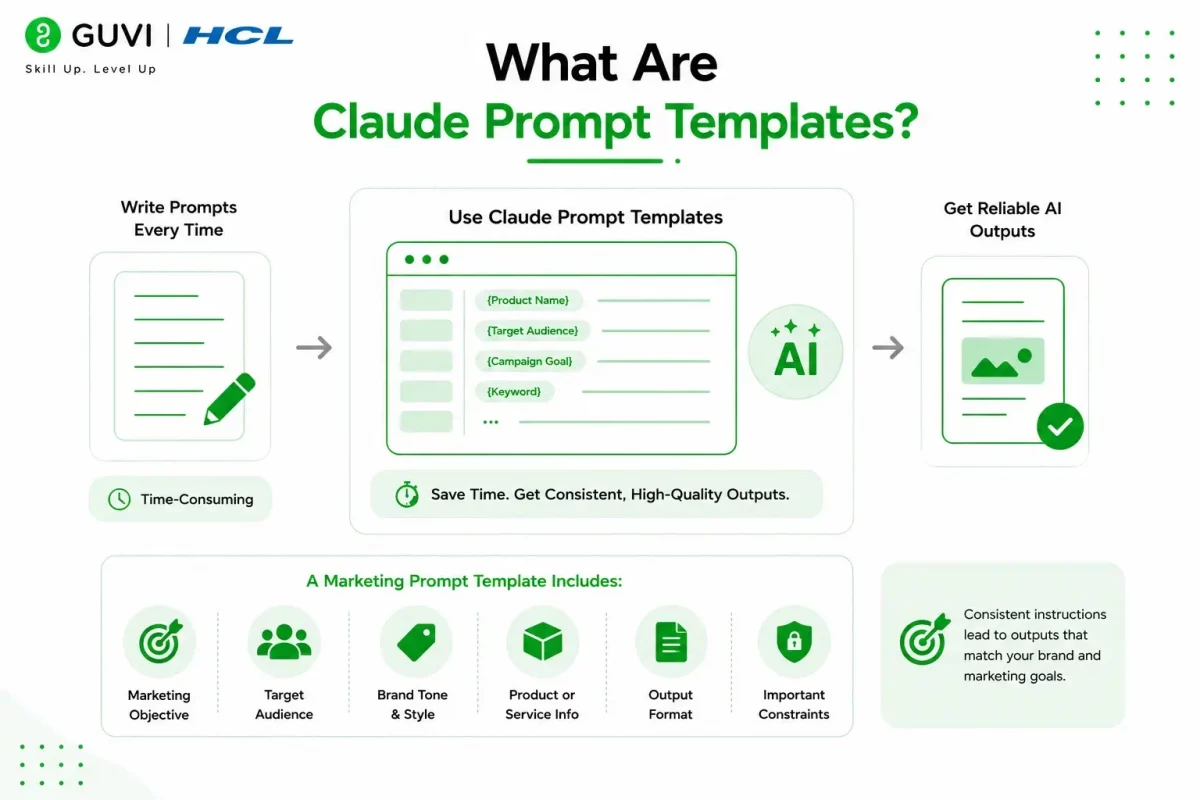
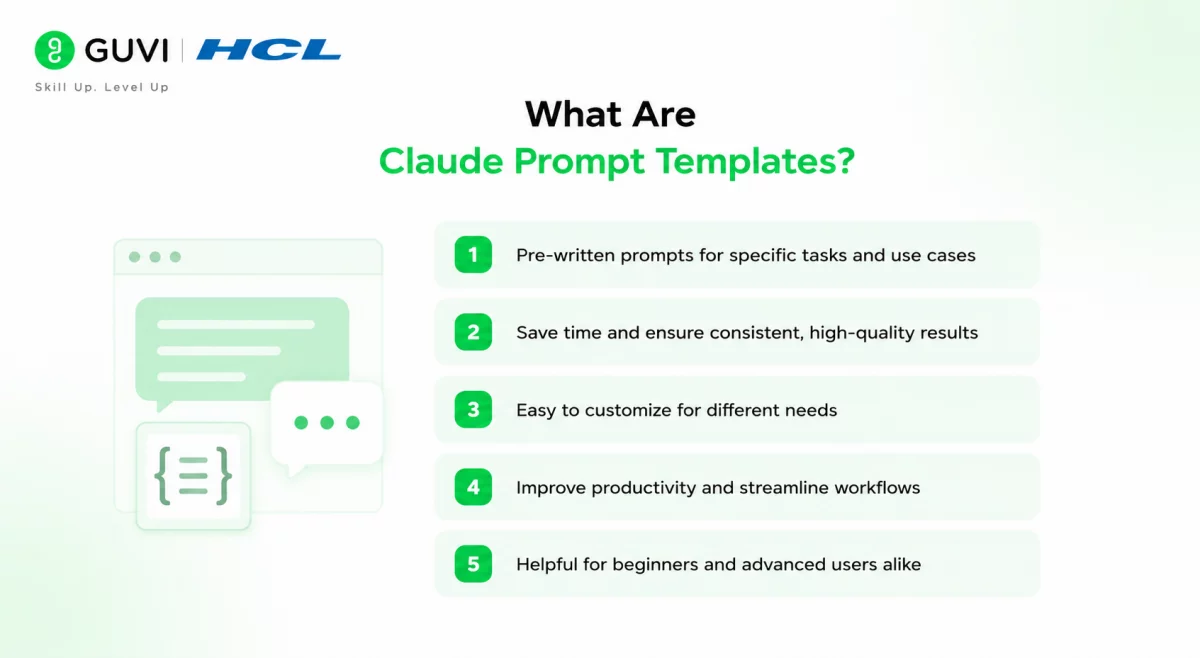
Claude prompt templates are predefined prompt structures designed for tasks that marketers perform repeatedly. Instead of writing instructions from scratch every time, teams create standardized templates that can be reused by simply updating variables such as the product name, target audience, campaign goal, or keyword.
Think of them as reusable blueprints for AI interactions. Just as email templates save time when communicating with customers, prompt templates help teams generate reliable AI responses without rewriting detailed instructions.
A marketing prompt template may include:
- The marketing objective
- Target audience
- Brand tone and style
- Product or service information
- Output format
- Important constraints
Because these instructions remain consistent, Claude can produce outputs that better match the organization’s branding and marketing goals.
Claude Prompt Templates for Marketing Teams
Marketing departments often create similar types of content across multiple campaigns. Writing detailed prompts for every request is inefficient and may produce inconsistent results.
Claude prompt templates solve this challenge by standardizing AI instructions across the team.
Some major benefits include:
- Faster content creation
- Consistent brand messaging
- Improved collaboration
- Reduced repetitive prompting
- Higher-quality AI outputs
- Easier onboarding for new team members
As a result, marketing teams can focus more on strategy and creativity instead of repeatedly writing prompts.
How Claude Prompt Templates Work
A prompt template combines fixed instructions with editable variables.
The fixed section contains information that rarely changes, such as:
- Brand voice
- Writing style
- Output structure
- Formatting requirements
The variable section contains campaign-specific information, including:
- Product name
- Primary keyword
- Target audience
- Campaign objective
- Call-to-action
Whenever a new campaign begins, marketers only update these variables instead of creating an entirely new prompt.
This approach improves consistency while significantly reducing content production time.
Many organizations maintain internal libraries of reusable AI prompt templates for recurring marketing tasks. These standardized templates help teams maintain consistent brand messaging, improve collaboration, and generate higher-quality content across multiple campaigns while reducing repetitive manual work.
Common Marketing Tasks That Benefit from Prompt Templates
Claude’s prompt templates can simplify numerous marketing activities.
Some common use cases include:
- SEO blog writing
- Email marketing campaigns
- Product descriptions
- Google Ads copy
- Social media captions
- Landing page content
- Marketing strategy brainstorming
- Content calendars
- Video script generation
- Customer personas
Rather than creating separate prompts every time, marketers can reuse a proven template and simply customize the required details.
Download HCL GUVI’s free AI eBook to explore prompt engineering, large language models (LLMs), generative AI concepts, and practical AI applications through beginner-friendly explanations and real-world examples.
How to Create Effective Claude Prompt Templates
Creating reusable prompt templates requires more than saving a few instructions. An effective template should provide Claude with enough context to generate consistent, high-quality outputs while remaining flexible for different campaigns.
Define the Marketing Objective
Start by identifying the primary goal of the prompt.
For example, your objective may be to:
- Write an SEO blog.
- Create a product description.
- Generate an email campaign.
- Produce social media captions.
- Develop Google Ads copy.
A clearly defined objective helps Claude understand what kind of content it needs to generate.
Include Context About Your Audience
Marketing content performs best when it is written for a specific audience.
Instead of writing:
Write a blog about AI.
Provide additional context such as:

Write an SEO-friendly blog for beginners who want to learn prompt engineering.
Useful audience details include:
- Industry
- Experience level
- Pain points
- Business type
- Geographic region
Providing audience context allows Claude to generate more relevant and engaging content.
Specify Brand Voice and Writing Style
One of the biggest advantages of prompt templates is maintaining a consistent brand voice across all marketing materials.
For example, you can instruct Claude to write in a:
- Professional tone
- Conversational style
- Educational format
- Technical voice
- Friendly and approachable manner
You can also define formatting preferences, including paragraph length, heading structure, and reading level.
Define the Output Format
Always tell Claude how you want the final response to appear.
Common formats include:
- Blog articles
- Bullet-point summaries
- Email sequences
- Product descriptions
- Social media posts
- Tables
- Markdown
Providing a clear output format reduces ambiguity and minimizes editing later.
Claude Prompt Template Examples for Marketing Teams
Below are some common prompt template ideas that marketing teams frequently use.
SEO Blog Template
This template helps create optimized blog articles by defining:
- Primary keyword
- Target audience
- Search intent
- Tone
- Article structure
- Call-to-action
Email Marketing Template
Marketing teams can reuse templates for newsletters, promotions, onboarding emails, and product launches.
Typical variables include:
- Campaign objective
- Product name
- Audience
- Subject line
- CTA
Social Media Template
Social media prompt templates simplify the creation of platform-specific posts.
Common instructions include:
- Platform name
- Character limit
- Target audience
- Brand tone
- Hashtags
- CTA
Product Description Template
E-commerce businesses often use reusable templates to generate consistent product descriptions.
The template may contain:
- Product name
- Features
- Benefits
- Target customer
- Tone
- Word limit
Because only the product information changes, marketers can quickly generate descriptions for hundreds of products.
Master AI-powered marketing and data-driven decision-making with HCL GUVI’s Business Analytics Professional Program. Build practical skills to optimize marketing workflows, improve business insights, and solve real-world challenges through hands-on projects and expert-led training.
Best Practices for Claude Prompt Templates
To maximize consistency and quality, follow these best practices:
- Clearly define the objective before writing the template.
- Include audience and brand context.
- Use placeholders for reusable variables.
- Specify the preferred output format.
- Keep instructions unambiguous.
- Test templates with multiple scenarios.
- Update templates as marketing requirements evolve.
Well-designed templates save time while producing more reliable AI-generated content.
Conclusion
Claude prompt templates help marketing teams standardize AI-assisted content creation while improving speed, consistency, and collaboration. By creating reusable frameworks that define objectives, audience, tone, and formatting, marketers can generate high-quality outputs with minimal effort. Whether you’re producing SEO blogs, email campaigns, product descriptions, or social media content, reusable prompt templates make AI workflows more efficient and scalable.
Frequently Asked Questions
1. What are Claude’s prompt templates?
Claude prompt templates are reusable prompt frameworks that help generate consistent AI responses for recurring marketing and business tasks.
2. Why should marketing teams use Claude prompt templates?
They improve consistency, reduce repetitive prompting, save time, and help teams create brand-aligned content more efficiently.
3. What should a Claude prompt template include?
A good template should include the objective, audience, context, brand voice, constraints, variables, and desired output format.
4. Can Claude prompt templates be reused?
Yes. Most templates are designed to be reusable by replacing variables such as product names, keywords, campaign goals, or target audiences.
5. Which marketing tasks benefit from prompt templates?
Common use cases include SEO blogs, email campaigns, social media posts, product descriptions, ad copy, landing pages, and content planning.
6. Do Claude prompt templates improve AI output quality?
Yes. Clear and structured templates help Claude produce more accurate, consistent, and brand-aligned responses while reducing ambiguity.
7. Are Claude’s prompt templates suitable for beginners?
Yes. Beginners can start with simple reusable templates and gradually build more advanced prompt frameworks as they gain experience with AI-assisted marketing.
Success Stories

About the Author
Vishalini Devarajan
An Aerospace Engineer turned content writer, I focus on making complex concepts easy to understand through well-structured, reader-friendly blogs. Whether it’s a technical topic or a non-technical one, I love creating content that is clear, engaging, and impactful.
View all posts by Vishalini Devarajan
Connect with me @












Did you enjoy this article?