


Software Development Articles
My Google SDE Interview Experience: From Rejection to Selection [2026 Success Story]
Apple Interview Experience for Software Developers: What to Expect
Decoding Differences between Network OS and Distributed OS
Operating System Examples: Top OS Types, Features, and Uses Explained


Get In Touch For Details! Request More Information
Challenges of Using AI in Software Development
Oct 22, 2025 6 Min Read 1749 Views
(Last Updated)
Can the same technology that accelerates software delivery also create new roadblocks for developers? Artificial Intelligence promises productivity and smarter decision-making, but its adoption in software development is not free of challenges. Teams often face issues with data quality, high costs, skill gaps, and integration hurdles that can slow down projects rather than speed them up. Understanding these challenges is essential for organizations that want to benefit from AI without falling into hidden pitfalls.
Read the full blog to explore the top challenges of using AI in software development and practical solutions to overcome them.
- 84% of software developers are using AI tools, yet 46% of them do not trust the accuracy of AI outputs.
- 10,000+ new security vulnerabilities per month were detected in AI-generated code by mid-2025 — a tenfold increase since December 2024 — largely due to insecure patterns and exposed secrets.
- Approximately 45% of code produced by large language models contains security flaws, even when the models appear production-ready.
Table of contents
- What is AI in Software Development & its Importance?
- Importance of AI in Software Development
- Top 10 Challenges of Using AI in Software Development
- Data Quality & Availability
- High Implementation Costs
- Talent and Skill Gap
- Integration Complexity
- Ethical and Bias Concerns
- Explainability and Transparency
- Scalability Issues
- Security and Privacy Risks
- Continuous Maintenance Needs
- Regulatory and Compliance Challenges
- Future Advancements of AI in Software Development
- Key Advancements Expected in the Future:
- Final Words
- FAQs
- How is AI changing the role of software developers?
- Can small businesses afford AI tools for software development?
- What industries benefit most from AI-driven software development?
- Will AI improve software testing and debugging?
- How does AI improve software security?
What is AI in Software Development & its Importance?
Artificial Intelligence (AI) in software development refers to the integration of machine learning algorithms and natural language processing into the procedure of designing, coding, testing, and maintaining applications. AI works strategically as instead of replacing developers, it acts as an accelerator that enriches productivity. It helps teams build smarter and more reliable software at scale. Right from intelligent code completion and automated debugging to predictive analytics for project risks, AI is changing the way software is planned and delivered.
Importance of AI in Software Development
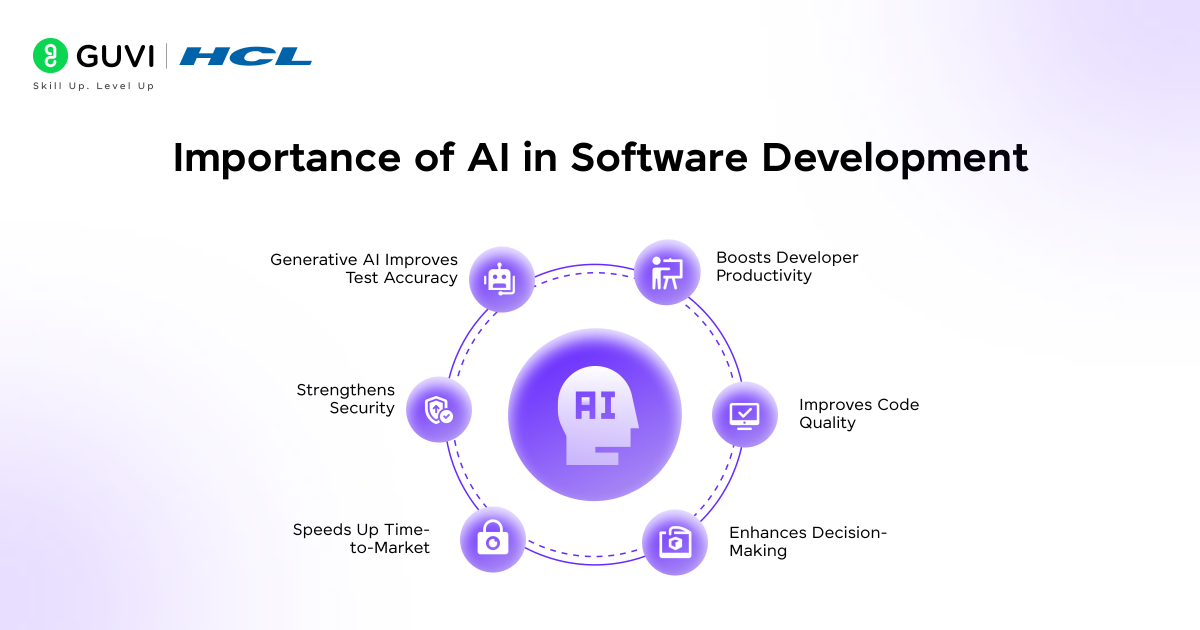
- Boosts Developer Productivity: Automates repetitive coding tasks and accelerates development cycles.
- Improves Code Quality: Detects bugs, vulnerabilities, and inefficiencies early with AI-powered software testing and code review tools.
- Enhances Decision-Making: Provides predictive insights for project planning and resource allocation.
- Speeds Up Time-to-Market: Reduces delays by streamlining testing and continuous integration workflows.
- Strengthens Security: Identifies potential threats and anomalies through AI-driven monitoring and security analysis.
- Generative AI in Software Testing: Uses AI models to create diverse test cases automatically, which improves coverage and reduces human effort in identifying defects.
Top 10 Challenges of Using AI in Software Development
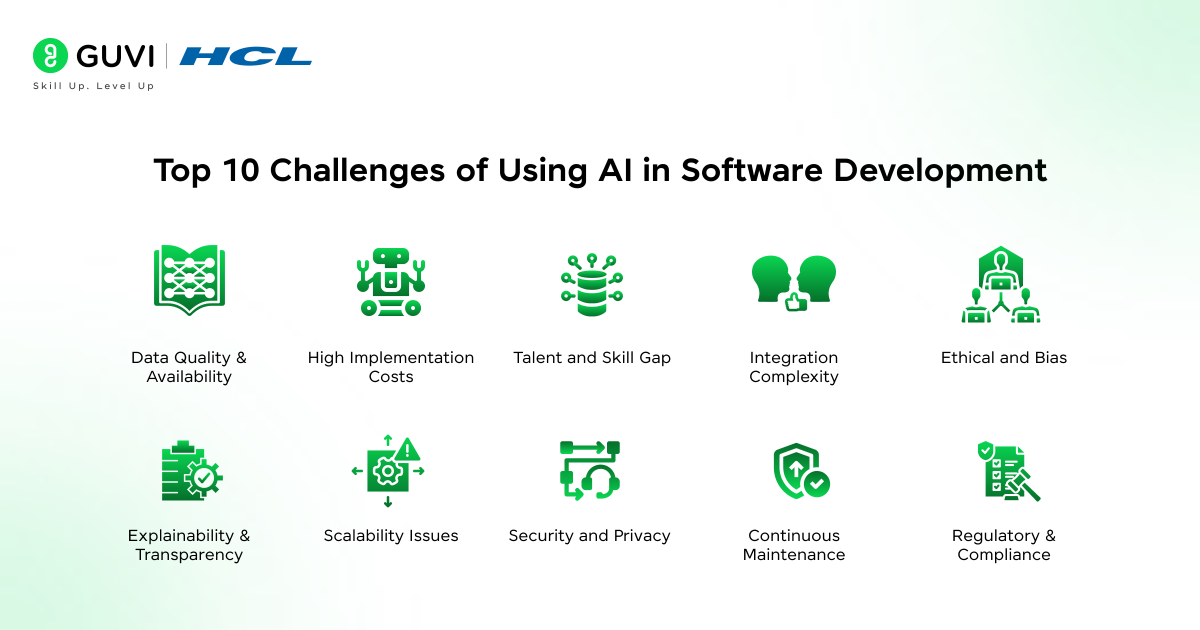
1. Data Quality & Availability
AI thrives on high-quality and contextually relevant data. In software development, when datasets are incomplete or biased, AI-driven tools can become unreliable and even counterproductive. This reduces accuracy in predictions and slows down adoption. It also increases costs for engineering teams. Poor data quality can quickly turn into a bottleneck that undermines performance and innovation for companies relying on AI to speed up development.
Business & Development Impacts of Poor Data Quality and Limited Availability
- Inaccurate bug detection and false positives during automated code reviews.
- Limited ability to deliver personalized and user-centric software experiences.
- Higher costs and extended timelines due to excessive data preprocessing.
- Reduced developer trust in AI-driven automation and decision-making.
- Difficulty scaling AI features across diverse platforms and applications.
Practical Solutions to Overcome Data Quality and Availability Challenges
- Implement strong data governance frameworks to enforce standards and labeling accuracy.
- Deploy AI-powered data cleaning and validation tools for continuous improvement.
- Leverage synthetic data generation to supplement real-world datasets where gaps exist.
- Establish monitoring systems to ensure datasets remain fresh and unbiased.
- Encourage collaboration between developers, DevOps, and data teams to streamline pipelines.

2. High Implementation Costs
AI adoption in software development often faces high implementation costs. Organizations need advanced infrastructure and skilled experts, which makes the entry barrier steep. Smaller businesses struggle to justify investments that may take years to generate visible returns.
Business & Development Impacts of High Implementation Costs
- Slower adoption of AI in startups and mid-sized companies.
- Reduced competitiveness compared to enterprises with larger budgets.
- Limited ability to experiment with AI-driven prototypes and innovation.
Practical Solutions to Reduce High Implementation Costs
- Adopt open-source AI frameworks that reduce licensing expenses.
- Use cloud-based AI platforms to avoid heavy upfront infrastructure costs.
- Start with pilot projects that prove value before scaling across systems.
- Train existing staff to handle AI-related workflows instead of hiring large teams.
- Partner with specialized vendors for shared resources and expertise.
3. Talent and Skill Gap
Talent shortages create another major hurdle in AI-powered software development. Few professionals have strong expertise in both AI and software engineering. Companies often struggle to find developers who can work with machine learning models and integrate them into production systems.
Business & Development Impacts of the Talent and Skill Gap
- Slower delivery timelines due to limited skilled resources.
- Dependence on external consultants increases project costs.
- Difficulty maintaining AI models once deployed into production.
Practical Solutions to Overcome the Talent and Skill Gap
- Provide continuous training for in-house developers in AI and data science.
- Partner with universities and online programs to access emerging talent.
- Build cross-functional teams where developers work alongside data scientists.
- Invest in internal knowledge-sharing sessions that spread AI expertise.
- Use automated AI-assisted development tools to reduce skill dependency.
4. Integration Complexity
AI integration in existing software development workflows often proves complex. Legacy systems and multiple toolchains create compatibility challenges. Teams face delays because AI tools must be adapted before they can operate within established systems.
Business & Development Impacts of Integration Complexity
- Delays in deployment due to compatibility and workflow conflicts.
- Higher maintenance costs are caused by fragmented tool ecosystems.
- Increased frustration among developers due to disrupted processes.
Practical Solutions to Address Integration Complexity
- Select AI tools that offer strong API compatibility with existing systems.
- Introduce AI in phased rollouts instead of full-scale integration at once.
- Standardize development environments to minimize conflicts.
- Use middleware solutions that connect AI tools with legacy infrastructure.
- Involve both operations and development teams early in integration planning.
5. Ethical and Bias Concerns
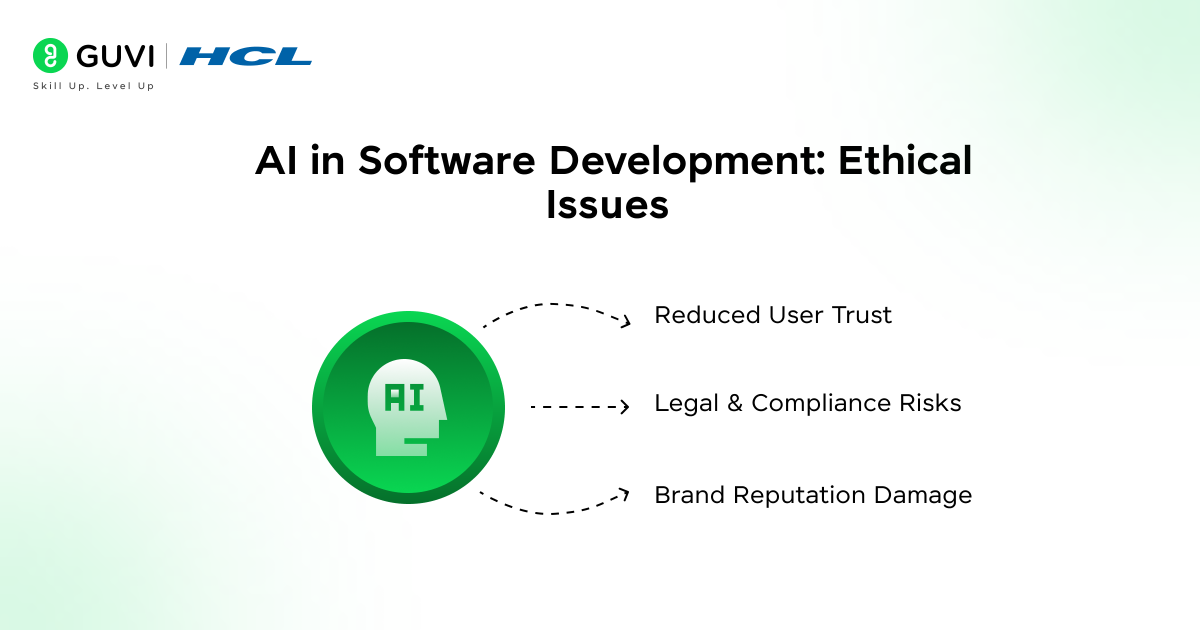
AI systems in software development often reflect the biases present in their training data. When algorithms make decisions influenced by skewed data, outcomes can become unfair or discriminatory. This creates both ethical challenges and reputational risks for organizations deploying AI-driven solutions.
Business & Development Impacts of Ethical and Bias Concerns
- Reduced user trust in software that produces biased or unfair results.
- Legal and compliance risks due to discriminatory outcomes.
- Damage to brand reputation when ethical standards are questioned.
Practical Solutions to Address Ethical and Bias Concerns
- Conduct fairness audits on AI models before production use.
- Train models on diverse and representative datasets.
- Introduce bias detection tools that highlight potential issues in predictions.
- Establish ethical review committees to evaluate AI deployments.
- Provide transparency reports that explain how AI-driven decisions are made.
6. Explainability and Transparency
AI models, particularly deep learning systems, often function like black boxes. Developers struggle to understand how predictions are generated, which makes debugging and validation difficult. Lack of transparency reduces stakeholder confidence and slows adoption in high-stakes applications.
Business & Development Impacts of Explainability and Transparency Issues
- Difficulty debugging AI models during software development.
- Reduced confidence among business leaders and end-users.
- Challenges in meeting compliance standards that require explainable AI.
Practical Solutions to Improve Explainability and Transparency
- Use interpretable models where possible instead of complex opaque ones.
- Implement explainable AI tools that highlight feature importance in predictions.
- Provide detailed documentation on how models are trained and validated.
- Educate developers and stakeholders on interpreting AI outputs.
- Involve compliance experts early in the development lifecycle.
7. Scalability Issues
AI tools may perform well in controlled test environments but fail when scaled to production. As data volumes grow and real-world conditions vary, models can struggle to maintain accuracy and efficiency. These limitations slow down large-scale adoption across organizations.
Business & Development Impacts of Scalability Issues
- Reduced model performance when deployed across high-volume systems.
- Increased infrastructure costs to maintain efficiency at scale.
- Delays in expanding AI solutions across multiple business units.
Practical Solutions to Overcome Scalability Issues
- Optimize models to reduce computational requirements.
- Use distributed computing platforms that handle large-scale processing.
- Test AI systems with real-world data before scaling organization-wide.
- Build modular AI components that scale independently.
- Monitor performance continuously and retrain models as volumes increase.
8. Security and Privacy Risks
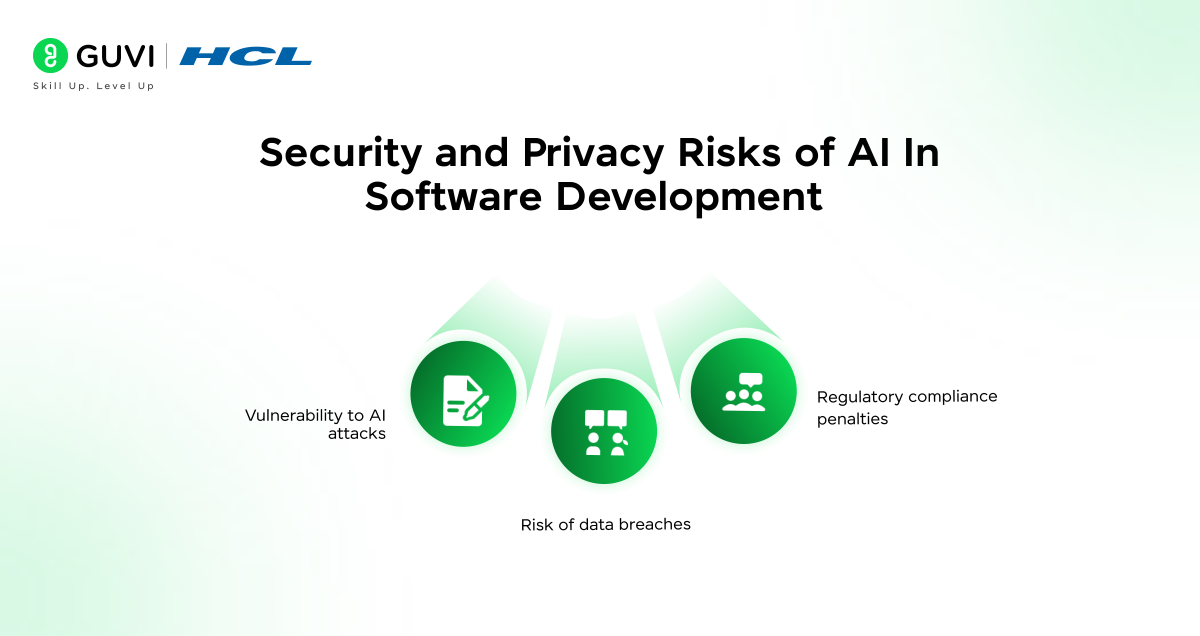
AI introduces new security and privacy challenges in software development. Models can be exposed to attacks such as data poisoning or adversarial inputs, which alter their performance. Handling sensitive data for training also raises compliance and confidentiality concerns.
Business & Development Impacts of Security and Privacy Risks
- Increased vulnerability to cyberattacks targeting AI models.
- Higher risk of data breaches when sensitive information is mishandled.
- Regulatory penalties for failing to comply with data protection laws.
Practical Solutions to Reduce Security and Privacy Risks
- Encrypt training data and enforce strict access controls.
- Apply adversarial testing methods to identify vulnerabilities.
- Use anonymization techniques to protect user identities.
- Regularly audit AI systems for potential security flaws.
- Adopt privacy-by-design principles during development.
9. Continuous Maintenance Needs
AI models degrade over time because data patterns change. A system that works well during initial deployment may lose accuracy as new data emerges. Continuous monitoring and retraining are necessary to keep AI-driven software relevant and effective.
Business & Development Impacts of Continuous Maintenance Needs
- Declining accuracy of predictions in real-world use.
- Higher operational costs due to frequent retraining cycles.
- Increased workload for developers and data engineers.
Practical Solutions to Manage Continuous Maintenance Needs
- Schedule regular model retraining with updated datasets.
- Automate monitoring systems that track model performance.
- Use version control for datasets and models to manage changes.
- Allocate dedicated resources for AI model lifecycle management.
- Collect feedback from end-users to detect performance drops.
10. Regulatory and Compliance Challenges
AI in software development operates within complex regulatory frameworks. Governments are enforcing stricter rules on data usage, fairness, and transparency. Organizations must adapt quickly or risk penalties and restrictions that slow down AI adoption.
Business & Development Impacts of Regulatory and Compliance Challenges
- Delays in AI project rollouts due to compliance reviews.
- Higher legal and financial risks from failing to meet regulations.
- Reduced flexibility in experimenting with new AI solutions.
Practical Solutions to Address Regulatory and Compliance Challenges
- Stay updated with global AI and data protection regulations.
- Involve legal and compliance teams in early development stages.
- Build AI systems that include traceability and audit features.
- Adopt industry standards that align with regulatory requirements.
- Document decision-making processes for accountability.
Overcome the real challenges of AI in software development by mastering cutting-edge tools, frameworks, and practical applications with HCL GUVI’s Intel Certified AI & Machine Learning Course. Build end-to-end expertise in machine learning, model training, deployment, and AI-powered problem-solving while preparing yourself for the future of intelligent software systems. Enroll today and transform your career with industry-ready AI skills.
Future Advancements of AI in Software Development
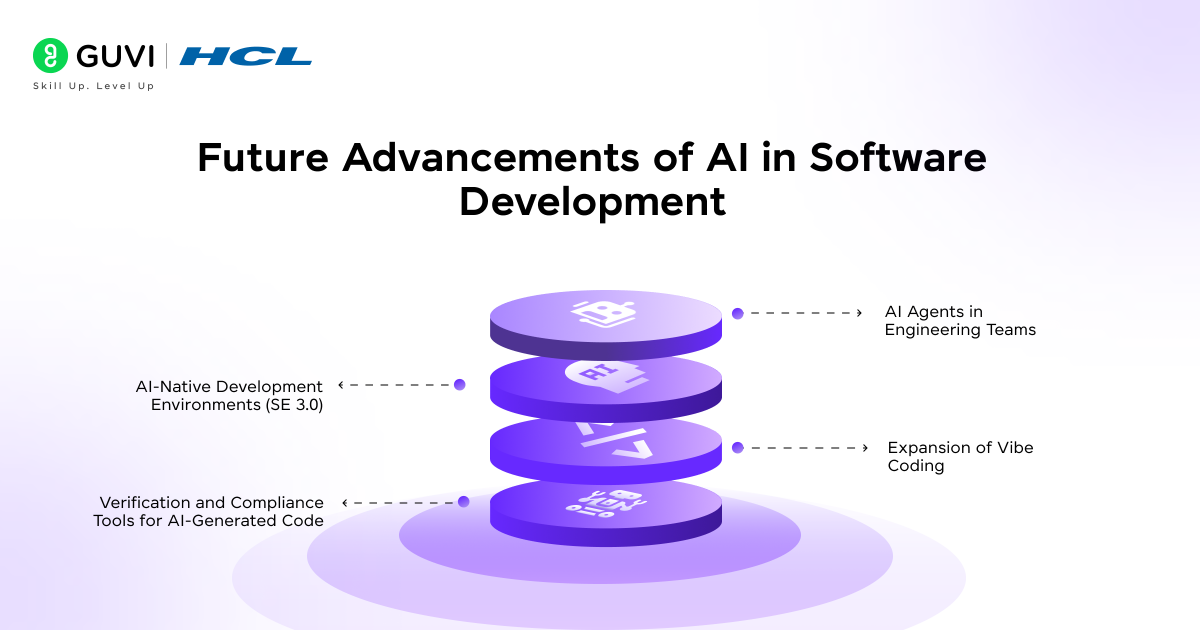
AI in software development is moving beyond automation and error detection toward deeper collaboration with developers. Future advancements will focus on intelligent systems that act as coding partners, project advisors, and security watchdogs. These systems will shift from reactive support to proactive innovation, helping organizations build faster and smarter applications.
Key Advancements Expected in the Future:
- AI Agents in Engineering Teams: Research points to agents capable of understanding developer intent and repairing code automatically. These agents are expected to move from experimental stages into practical production use.
- Expansion of Vibe Coding: Companies are advancing natural language prototyping, where non-technical professionals can describe requirements and receive working prototypes. Built-in safety layers will reduce risks while maintaining speed.
- AI-Native Development Environments: Also referred to as SE 3.0, these environments will combine intent-first development, conversational IDEs and multi-objective code generation. They will also comprise runtime monitoring for performance and reliability.
- Verification and Compliance Tools for AI-Generated Code: As AI begins producing more production-ready code, frameworks for verifying correctness and auditing behavior will grow more sophisticated.
Upgrade your skills with our AI Software Development Course. This course offers 300+ hours of live & recorded classes, weekend batches over 9 months, 4 certifications (MongoDB, IITM Pravartak, NSDC, HCL GUVI), 1:1 mock interviews with industry experts, hands-on real-world projects, offline immersions for industry exposure, and dedicated placement support. Leap today and become job-ready in AI and software development.
Final Words
AI in software development stands as both a powerful accelerator and a complex challenge. Its proficiency to improve productivity and support smarter decision-making is reshaping the industry, yet issues like data quality, costs, skill gaps, and compliance remain critical hurdles. The future will bring advancements such as AI agents and AI-native environments that will redefine how teams build and maintain software. Organizations that prepare today by dealing with current challenges and adopting responsible strategies will be best positioned to thrive in this AI-driven era of software engineering.
FAQs
1. How is AI changing the role of software developers?
AI is reducing repetitive coding tasks and authorizing developers to concentrate on design and innovation. It serves as an assistant rather than a replacement, which seamlessly enriches productivity and accuracy.
2. Can small businesses afford AI tools for software development?
Yes, cloud-based AI platforms and open-source frameworks make adoption more affordable. Small businesses can start with pilot projects before scaling investment.
3. What industries benefit most from AI-driven software development?
Industries like finance, healthcare, e-commerce, and cybersecurity gain significant advantages because AI supports automation and faster deployment of secure applications.
4. Will AI improve software testing and debugging?
AI testing tools detect bugs and vulnerabilities earlier than traditional methods. They also suggest code improvements, which shorten release cycles and enhance reliability.
5. How does AI improve software security?
AI continuously monitors applications for anomalies and potential threats. It provides predictive security alerts and decreases the risk of data breaches through real-time analysis.
Success Stories

About the Author
Vaishali
I'm a seasoned writer with four years of experience across technical, non-technical, and just about every genre or niche you can imagine. Adaptable and curious, I enjoy exploring new topics and making information engaging and easy to understand. Fueled by a steady stream of tea, I approach each project with creativity, reliability, and genuine enthusiasm for storytelling.
View all posts by Vaishali
Connect with me @















Did you enjoy this article?