


Career Articles
Data Analyst or Data Scientist: Which Has Better Demand for Mid-Career BPO Professionals?
BPO Workforce Management Analyst to Data Analyst: What Skills Transfer?
CFA Charterholders: Are You Missing Out on Data Science Opportunities?


Get In Touch For Details! Request More Information

Working in a Business Process Outsourcing (BPO) company can help you develop communication, problem-solving, customer handling, and process management skills. But if you want to move beyond customer support, voice processes, or routine operations, a Business Analyst career could be worth exploring.
A Business Analyst helps businesses understand problems, document requirements, improve processes, and coordinate solutions with relevant teams. Your BPO experience may provide a useful foundation, especially if you have worked with process metrics, quality reports, customer issues, or operational improvements.
Table of contents
- TL;DR
- Quick Answer
- Why Should BPO Professionals Consider a Business Analyst Career?
- What Skills Do You Need to Become a Business Analyst?
- Requirements Gathering
- Documentation and Process Mapping
- Excel and SQL
- Power BI
- Communication and Stakeholder Management
- How Can You Transition From BPO to Business Analyst?
- Step 1: Identify Your Transferable Experience
- Step 2: Learn Business Analysis Fundamentals
- Step 3: Develop Technical Skills
- Step 4: Build Practical Projects
- Step 5: Tailor Your Resume and Apply
- What Is the Business Analyst Salary in India?
- How Can You Grow After Becoming a Business Analyst?
- Conclusion
- FAQs
- Can a BPO employee become a Business Analyst?
- Which Business Analyst jobs are suitable for BPO professionals?
- Is coding necessary for a Business Analyst career?
- Should BPO professionals learn SQL?
- Is Power BI necessary for Business Analysts?
- Is a Business Analyst course necessary to switch from BPO?
- What is the career growth path for a Business Analyst in India?
TL;DR
- BPO professionals can explore Business Analyst roles by building on their process knowledge and communication skills.
- Excel, SQL, requirements gathering, documentation, and process mapping are useful skills to develop.
- Reporting Analyst and Operations Analyst roles can also provide relevant experience.
- Business Analyst responsibilities differ from data and reporting analyst responsibilities.
- Practical projects, a targeted resume, and interview preparation can strengthen your applications.
Quick Answer
| BPO professionals can explore Business Analyst opportunities by combining their understanding of business processes with skills in requirements gathering, documentation, stakeholder communication, and process improvement. Depending on your experience, you may also consider reporting or operations analyst roles. Fusion CX’s guide to becoming a Business Analyst in BPO discusses a transition path for professionals working in operations, quality, and reporting. |
Why Should BPO Professionals Consider a Business Analyst Career?
BPO work involves more than handling customer queries. Depending on your role, you may monitor service-level agreements, investigate recurring complaints, track team performance, review quality scores, or identify process bottlenecks.
A Business Analyst builds on this understanding by identifying stakeholder needs, documenting requirements, analysing workflows, and helping teams implement solutions.
For example, if your team repeatedly receives complaints about a complicated customer verification process, a Business Analyst might investigate the workflow, gather feedback, document the problem, and work with relevant teams to improve the process.
What Skills Do You Need to Become a Business Analyst?
1. Requirements Gathering
Learn how to understand stakeholder problems, ask clarifying questions, identify business needs, and distinguish requirements from proposed solutions.
A Business Analyst must understand what users need before helping a team determine how to deliver it.
2. Documentation and Process Mapping
Practise writing business requirements documents, functional requirements where relevant, user stories, and acceptance criteria.
Learn to map workflows using charts or process diagrams. These skills help you explain existing processes and identify unnecessary steps or gaps.
3. Excel and SQL
Excel is useful for organizing information, comparing metrics, and analysing operational reports.
SQL helps you retrieve and analyse data from databases. It becomes especially important when a job description involves reporting, data analysis, or working with technical teams.
4. Power BI
Power BI can help you turn operational data into dashboards that show trends in productivity, service quality, ticket volume, or performance against targets.
It is particularly useful for reporting-focused Business Analyst roles, although not every Business Analyst position requires it.
5. Communication and Stakeholder Management
BPO professionals may already have experience communicating with customers, supervisors, and internal teams. To apply these skills in business analysis, learn to facilitate discussions, clarify disagreements, summarize findings, and document decisions accurately.
Business Analysts do not simply collect requirements. They also help clarify the underlying business problem, evaluate possible solutions, and communicate what a successful outcome should look like. This makes structured thinking and clear documentation important alongside technical skills.
How Can You Transition From BPO to Business Analyst?
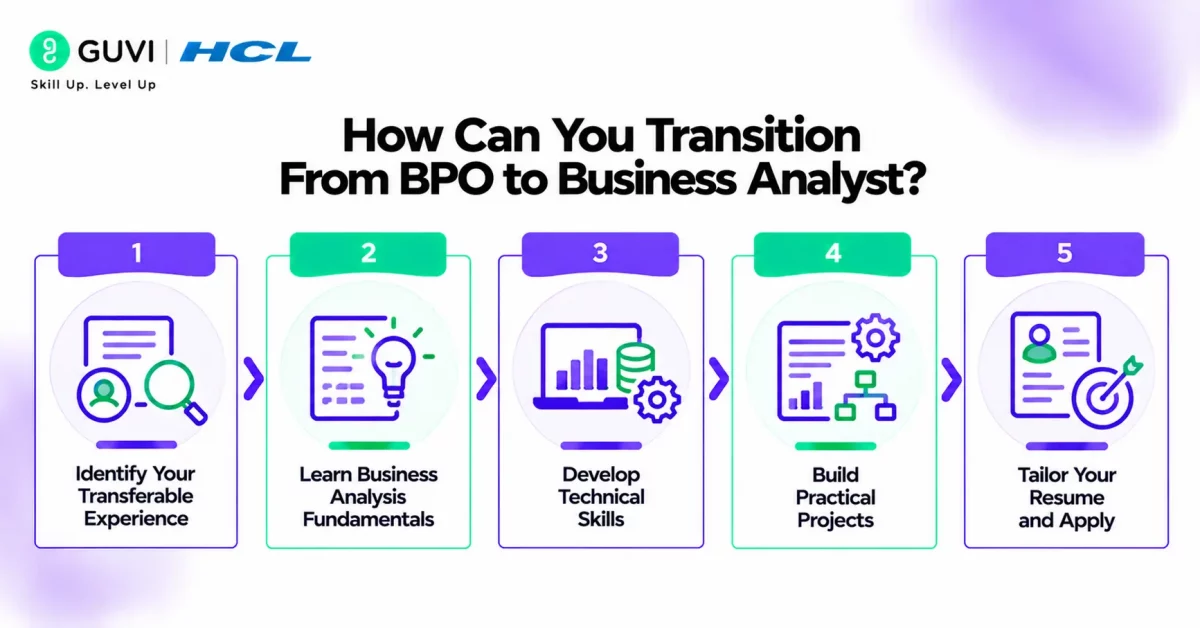
A structured approach can help you move from your current role toward business analysis without relying on a certificate alone.
Step 1: Identify Your Transferable Experience
Review your current responsibilities and identify examples involving process problems, performance trends, reporting, customer feedback, or coordination between teams.
Focus on work you have genuinely performed. Do not describe routine customer handling as formal requirements gathering unless you actually conducted that activity.
Step 2: Learn Business Analysis Fundamentals
Study requirements gathering, stakeholder analysis, process mapping, documentation, and basic Agile concepts.
Understand how a Business Analyst works with business stakeholders, developers, testers, and project managers. Practise creating simple user stories and workflow diagrams.
Step 3: Develop Technical Skills
Start with Excel and basic data analysis. Learn SQL and Power BI if they appear in your target job descriptions.
You do not need to learn every tool at once. Prioritize skills based on the type of Business Analyst role you want.
Step 4: Build Practical Projects
Create sample projects that demonstrate how you analyse a business problem and recommend an improvement.
Consider these examples:
- Customer Complaint Workflow: Map the complaint-resolution process and identify possible bottlenecks.
- SLA Performance Report: Use sample data to analyse response times and missed service targets.
- Process Improvement Proposal: Document an inefficient workflow, identify its pain points, and propose a revised process.
- Operations Dashboard: Use Excel or Power BI to visualize productivity and quality metrics.
Include the problem statement, analysis, process map or dashboard, recommendations, and expected benefits. Clearly label practice projects as portfolio work rather than professional assignments.

Step 5: Tailor Your Resume and Apply
Use your resume to demonstrate relevant experience, not just list daily duties.
For example, if you genuinely investigated recurring customer issues or helped improve a process, explain the problem, your contribution, and the outcome.
Search for junior Business Analyst, Associate Business Analyst, Operations Analyst, and Reporting Analyst vacancies. Read each job description carefully because titles and responsibilities vary between employers.
What Is the Business Analyst Salary in India?
Business Analyst salaries in India vary according to experience, company, location, industry, and technical requirements. There is no single salary that applies to everyone transitioning from BPO.
Before evaluating an opportunity, compare current job postings for your target role and experience level. Consider whether the position requires domain expertise, SQL, BI tools, client interaction, or prior business analysis experience.
Also assess the responsibilities and growth opportunities rather than choosing a role based on its title alone. A transition into an analyst position may involve a different level of responsibility from your current BPO role.
How Can You Grow After Becoming a Business Analyst?
Business analysis can lead to several career directions as you gain experience.
You may progress to Senior Business Analyst, Lead Business Analyst, or Business Analysis Manager. Depending on your interests and the skills you develop, you could also explore product ownership, consulting, process improvement, or business intelligence.
Your next step should depend on the work you enjoy. If you prefer stakeholder discussions and requirements, deepen your business analysis skills. If you enjoy working with data and dashboards, strengthen SQL and Power BI.
Conclusion
Moving from BPO to Business Analyst is a realistic career path for professionals willing to develop the right skills. Your experience with customers, operations, service quality, and business processes can provide a useful starting point, but it does not replace formal business analysis techniques.
The most effective career transition combines your existing BPO experience with evidence that you can analyse business problems and help teams reach practical solutions.
FAQs
1. Can a BPO employee become a Business Analyst?
Yes. BPO employees can pursue Business Analyst roles by developing requirements gathering, documentation, process analysis, and communication skills. Eligibility depends on the employer and position.
2. Which Business Analyst jobs are suitable for BPO professionals?
Junior Business Analyst, Associate Business Analyst, Operations Analyst, Reporting Analyst, and MIS Analyst roles may be worth exploring, depending on your experience and technical skills.
3. Is coding necessary for a Business Analyst career?
Not every Business Analyst role requires programming. However, SQL is useful for data-focused positions, and some technical roles may require additional programming or system knowledge.
4. Should BPO professionals learn SQL?
Learning SQL is beneficial if your target roles involve databases, reporting, or data analysis. Start with basic queries, filtering, aggregation, and joins.
5. Is Power BI necessary for Business Analysts?
Power BI is useful for roles involving dashboards and performance reporting, but it is not mandatory for every Business Analyst position. Check the requirements of your target vacancies.
6. Is a Business Analyst course necessary to switch from BPO?
A course can provide structured learning, but it is not the only route. You can also learn through reputable resources and practical projects. Employers may assess your skills and relevant experience rather than certification alone.
7. What is the career growth path for a Business Analyst in India?
Depending on experience and performance, a Business Analyst may progress to Senior Business Analyst, Lead Business Analyst, or Business Analysis Manager. Other paths include product ownership, consulting, and business intelligence.
Success Stories

About the Author
HCL GUVI
This article was selected and published as part of the HCL GUVI AI Blogathon 2026, an initiative designed to encourage students, AI enthusiasts, and aspiring tech writers to simplify complex AI concepts through impactful technical content. The contest recognized high-quality, original, and insightful AI-focused blogs, with selected authors receiving publication opportunities on the HCL GUVI blog platform along with official author credits and recognition.
View all posts by HCL GUVI
Connect with me @
















Did you enjoy this article?