


Artificial Intelligence and Machine Learning Articles
How to Audit LLM Models for Backdoors: Tools & Frameworks for Developers
AI Governance & Compliance in Web Apps: Why You Can’t Ignore Data Risk When Using LLMs
How to Evaluate LLMs for Production: Beyond Benchmarks (A Developer’s Guide)


Get In Touch For Details! Request More Information
7 Best AI and ML Certifications to Power Up Your Career
Aug 30, 2025 6 Min Read 2691 Views
(Last Updated)
Have you ever wondered how some professionals seem to skyrocket into AI and ML roles while others keep circling entry-level jobs or endless tutorials? The truth is, with the right certification, you don’t just learn, you level up with purpose.
In today’s competitive tech landscape, having a well-recognized AI or ML certification can make a real difference in how you’re perceived, what roles you qualify for, and how confidently you can build and ship solutions.
But with so many courses flooding the internet, choosing the right one can feel overwhelming. That’s why we’ve broken it down, clearly, practically, and based on what matters in the real world. So, without further ado, let us get started!
Table of contents
- What Are AI and ML Certifications?
- Top 7 AI and ML Certifications
- HCL GUVI Zen Class – Artificial Intelligence & Machine Learning Course
- Google AI Professional Certificate – Coursera
- IBM AI Engineering Professional Certificate – Coursera
- Stanford Machine Learning Course by Andrew Ng – Coursera
- Deep Learning Specialization – DeepLearning.AI (Coursera)
- Applied Data Science with Python – University of Michigan
- IIIT Hyderabad & TalentSprint – Advanced Certification in AI/ML
- Summary Table
- Why Get Certified in AI and ML?
- Structured Learning
- Better Understanding Through Projects
- Stronger Job Applications
- Faster Career Growth
- Access to Communities and Mentorship
- How to Choose the Right AI/ML Certification?
- Your Skill Level
- Curriculum Quality
- Time Commitment
- Pricing
- Certification Value
- Career Support & Placement Assistance
- Student Reviews & Outcomes
- Pro Tip: How to Make the Most of Your Certification
- Conclusion
- FAQs
- Which certification is best for AI and machine learning?
- Are AI and ML certifications worth it in 2025?
- Can I learn AI and ML without a technical background?
- How long does it take to complete an AI/ML certification?
- Which platforms offer globally recognized AI/ML certifications?
What Are AI and ML Certifications?
AI and ML certifications are structured programs designed to validate your knowledge and skills in artificial intelligence and machine learning. Think of them as your guided tour through the AI jungle, complete with a map, checkpoints, and a badge at the end proving you made it out alive.
You might already be dabbling with AI tools or experimenting with Python. But a certification formalizes that learning. It gives you a clean, linear path instead of letting you wander through random blog tutorials and YouTube videos.
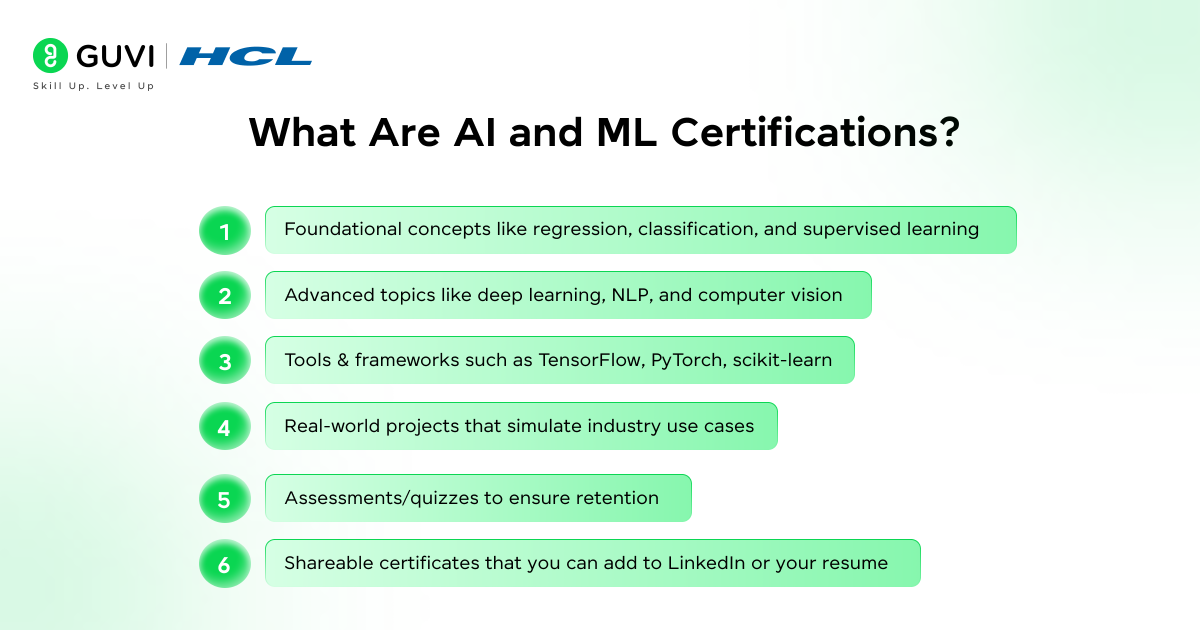
These certifications typically cover:
- Foundational concepts like regression, classification, and supervised learning
- Advanced topics like deep learning, NLP, and computer vision
- Tools & frameworks such as TensorFlow, PyTorch, scikit-learn
- Real-world projects that simulate industry use cases
- Assessments/quizzes to ensure retention
- Shareable certificates that you can add to LinkedIn or your resume
Some certifications are offered by top universities (like Stanford or IIT), others by tech giants (like Google or IBM), and some by edtech platforms like Coursera, Udacity, and HCL GUVI.
Top 7 AI and ML Certifications
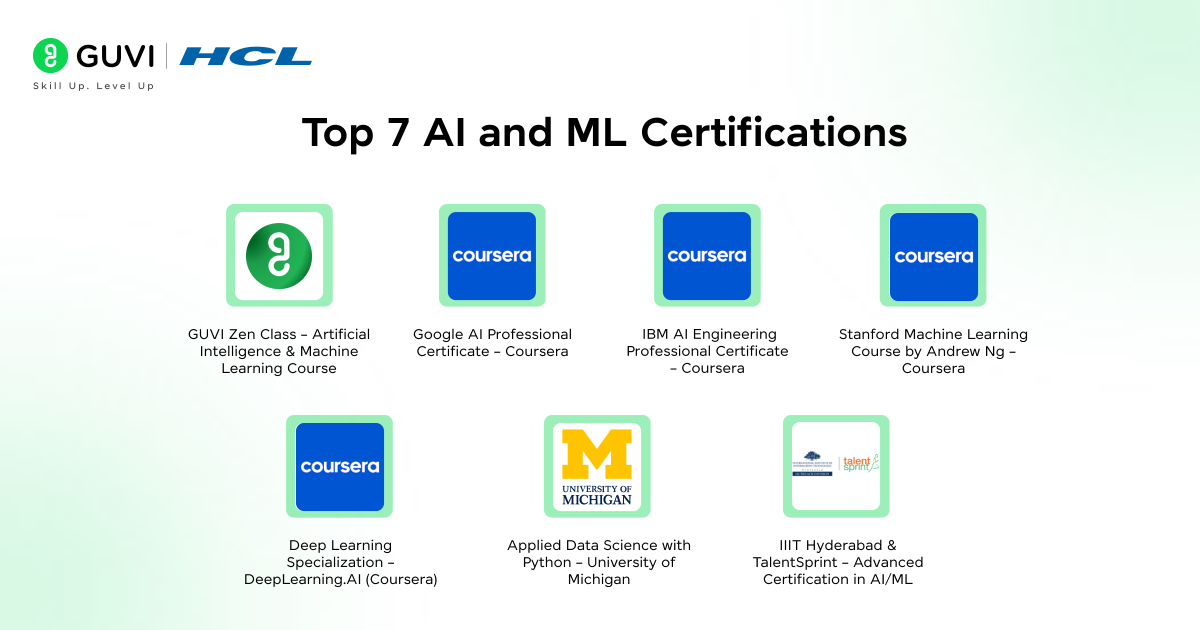
Choosing the right certification is like choosing the right vehicle; you want something that fits your journey, pace, and terrain. Below are some of the best AI and ML certifications available today, across different levels, platforms, and price points.
1. HCL GUVI Zen Class – Artificial Intelligence & Machine Learning Course
If you’re looking for an industry-relevant course that takes you from zero to job-ready, HCL GUVI’s Zen Class is a smart choice. Co-designed with Intel and certified by IIT-M Pravartak, this NASSCOM-accredited program is created by IIT-M and IIM alumni. It’s built with a strong focus on placement, mentorship, and real-world applications, making it highly valued in both the Indian and global job markets.
Having Intel’s name on your certificate signals to employers that you’ve been trained to meet global AI standards.
Course Highlights:
- Covers Python, machine learning, deep learning, NLP, computer vision, deployment, and real-world case studies
- Fully hands-on with live mentor-led sessions, real-time project reviews, and lifetime access to recorded lessons
- Includes career services like mock interviews, resume reviews, portfolio building, and job referrals
- Backed by a hiring network of 600+ companies and a strong alumni community
- Bilingual support – learn in English or Tamil for better understanding
- Certification carries both IIT-M and Intel branding for maximum recognition
Duration: 3–6 months (flexible, online)
Price: Around ₹1,80,000 (discounts and EMI options often available)
Certificate: Globally recognized, with IIT-M and Intel logos that enhance your professional credibility
Additional Benefits:
- Structured career path from orientation to placement
- Access to mentors for 1:1 doubt-solving
- Strong demand in the job market, the average AI/ML engineer salary in India is ₹11.3 LPA
- Designed to make you employable, not just skilled
Certificate Link: HCL GUVI Zen Class – Intel and IIT-M Pravartak Certified Artificial Intelligence & Machine Learning Course

2. Google AI Professional Certificate – Coursera
Offered by Google and hosted on Coursera, this course provides a structured and practical introduction to machine learning and AI development. It’s best suited for those who want to build AI products using TensorFlow and Google Cloud tools.
Course Highlights:
- A beginner-friendly yet powerful curriculum covering ML workflows, model training, and deployment
- Exposure to TensorFlow, AutoML, and cloud-based machine learning pipelines
- Flexible learning pace through monthly subscription (₹4,000/month approx.)
- Real-world exercises and assessments to validate learning
- Completion time: ~4 Hours
- Certificate credibility backed by Google’s brand
Certificate Link: Google AI Professional Certificate – Coursera
3. IBM AI Engineering Professional Certificate – Coursera
This certification is perfect for intermediate learners aiming to deepen their skills in building, training, and deploying AI models. It’s more technical than theoretical and is highly practical for real-world engineering roles.
Course Highlights:
- Strong focus on deep learning with PyTorch and TensorFlow
- Includes supervised, unsupervised learning, model evaluation, and ML Ops
- Price: Around ₹10,000
- Duration: Around 6 months
- Great for software developers and data professionals pivoting to AI roles
- Certificate recognized globally with IBM’s branding
Certificate Link: IBM AI Engineering Professional Certificate – Coursera
4. Stanford Machine Learning Course by Andrew Ng – Coursera
This is the classic course that introduced millions to machine learning. Taught by Andrew Ng, it’s more academic in tone but gives you a deep understanding of ML fundamentals.
Course Highlights:
- Covers foundational topics like linear regression, logistic regression, neural networks, and SVMs
- Offers strong mathematical and conceptual depth
- Great for understanding the “why” behind ML algorithms
- Price Range: Around ₹4,000/month
- Duration: ~11 weeks
- Ideal for students, researchers, and those who like to build a solid theoretical base
Certificate Link: Stanford Machine Learning Course by Andrew Ng – Coursera
5. Deep Learning Specialization – DeepLearning.AI (Coursera)
If your primary interest is in deep learning, neural networks, and AI applications like computer vision or NLP, this specialization is an excellent next step. Also taught by Andrew Ng, this is a series of 5 advanced courses.
Course Highlights:
- Neural network architecture, CNNs, RNNs, optimization algorithms, and more
- Real-world applications like facial recognition, language modeling, and time series forecasting
- Hands-on assignments using Python and TensorFlow
- Subscription model (₹4,000/month); usually takes 3–4 months
- Excellent for engineers who want to get serious about deep learning
Certificate Link: Deep Learning Specialization – DeepLearning.AI (Coursera)
6. Applied Data Science with Python – University of Michigan
This course is less about AI theory and more about applied machine learning in business and data science contexts. Perfect for analysts, product managers, and people looking to transition into AI roles from non-tech backgrounds.
Course highlights:
- Teaches data visualization, supervised and unsupervised learning, and NLP
- Uses real-world datasets and Python tools like pandas, scikit-learn, and matplotlib
- Moderate difficulty with a practical orientation
- Total cost: Around $200 for the certificate
- Duration: ~5 months
Certificate Link: Applied Data Science with Python – University of Michigan
7. IIIT Hyderabad & TalentSprint – Advanced Certification in AI/ML
This is a premium option for professionals seeking a deep dive into AI and ML, with live faculty sessions, structured mentorship, and networking. It’s designed for working individuals aiming for leadership in tech or specialized AI roles.
Here’s why it’s elite:
- Delivered live with interaction from IIIT-H professors and industry experts
- Deep curriculum including ML, DL, NLP, GANs, and more advanced techniques
- Includes case studies, real-world problem solving, and guided projects
- Duration: 9 months (part-time, online)
- Price: ₹2.5L+ (EMI options available)
- Ideal for mid- to senior-level professionals aiming to pivot or accelerate in AI
Certificate Link: IIIT Hyderabad & TalentSprint – Advanced Certification in AI/ML
Summary Table
| Certification | Ideal For | Duration | Price | Level |
| HCL GUVI Zen Class | Beginners to mid-level job-seekers | 3–6 months | ₹85,000 | Beginner–Intermediate |
| Google AI Certification | Beginners in product-building AI | ~6 months | ₹4,000/month | Beginner–Intermediate |
| IBM Certification | Developers & data professionals | ~6 months | ₹10,000 | Intermediate |
| Stanford ML | Academics & theorists | ~11 weeks | ₹4,000/month | Intermediate |
| Deep Learning Specialization | Aspiring DL engineers | ~3–4 months | ₹4,000month | Advanced |
| UoM Data Science | Data analysts & PMs | ~5 months | $200 | Intermediate |
| IIIT-H + TalentSprint | Experienced professionals | 9 months | ₹2.5L+ | Advanced |
Learn More: 10 Best AI and ML Courses For You [Free + Paid]
Why Get Certified in AI and ML?
Let’s be real, you can learn almost anything online for free today. But that doesn’t mean certification is redundant. It adds layers of value that self-learning alone often can’t.
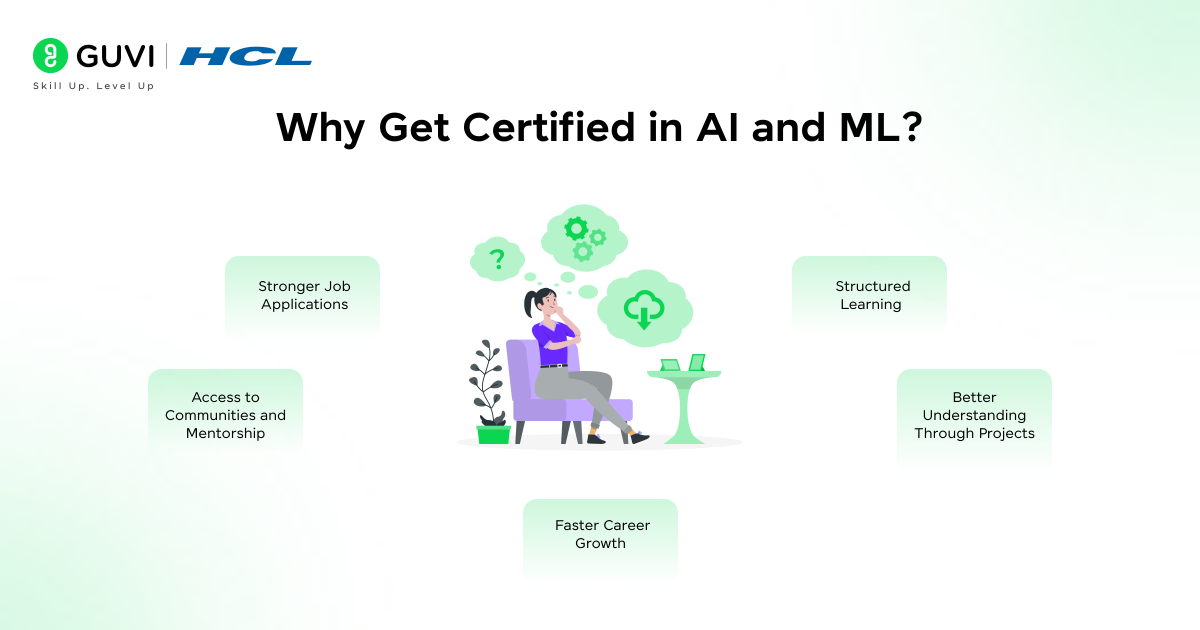
Here’s why an AI/ML certification is worth considering:
1. Structured Learning
You won’t waste time figuring out “what to learn next.” Certifications guide you step-by-step, starting from the basics and gradually advancing.
2. Better Understanding Through Projects
Many certifications include real-life projects that simulate problems you’d face on the job, like predicting housing prices, building chatbots, or detecting fake news.
3. Stronger Job Applications
Recruiters like to see skills, but they need proof. A good certification can serve as:
- A stamp of credibility
- A conversation starter in interviews
- A filter-breaker in ATS systems (Applicant Tracking Systems)
4. Faster Career Growth
Certified professionals tend to upskill faster, switch domains more confidently, and command better pay over time.
5. Access to Communities and Mentorship
Courses from places like GUVI, Coursera, or Udacity often offer peer discussion forums, instructor support, and even career coaching.
How to Choose the Right AI/ML Certification?
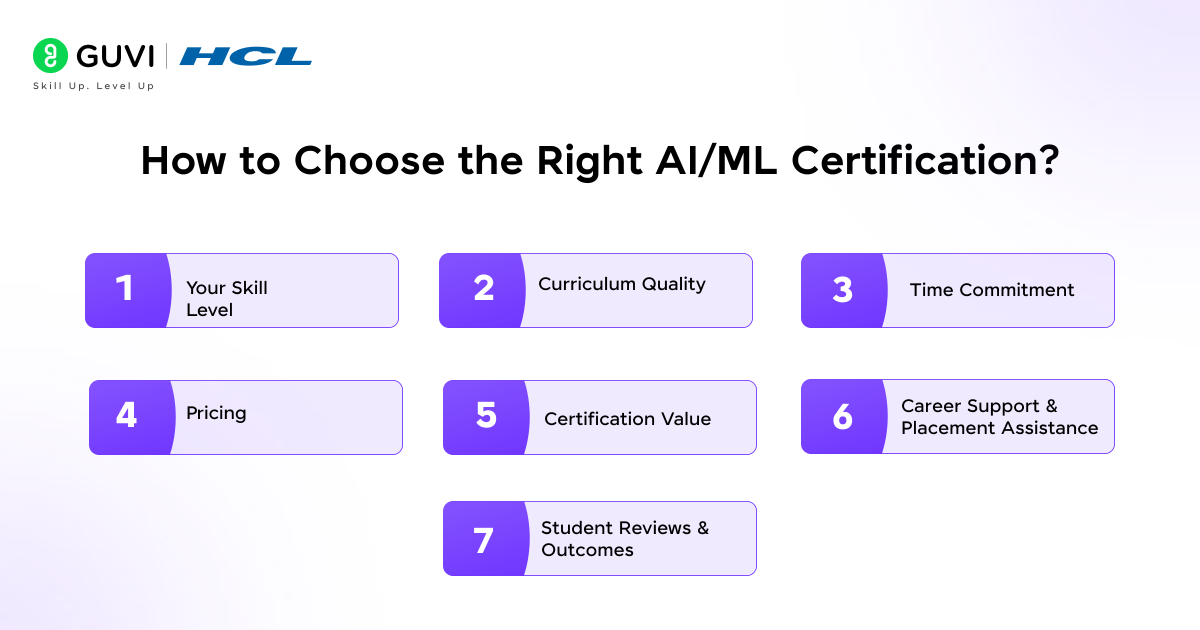
This is where most people get stuck; there are hundreds of options. So let’s simplify it. Choosing the right certification depends on a mix of your background, goals, and budget.
Start with this core question: What do I want this certification to do for me?
Based on that, here are the key factors you should weigh before enrolling:
1. Your Skill Level
- Beginner: Look for foundational courses that start with Python and basic ML (e.g., GUVI Zen Class, Google AI Foundations)
- Intermediate: Go for programs covering deep learning, NLP, and deployment (e.g., IBM AI Engineering, DeepLearning.AI)
- Advanced: If you already work in data science or software development, seek out specialized certifications in AI Ops, transformers, or RL (Reinforcement Learning)
2. Curriculum Quality
Ask yourself:
- Does it cover real-world use cases?
- Are modern tools like TensorFlow, PyTorch, or OpenCV included?
- Does it include capstone projects?
Check the syllabus before signing up.
3. Time Commitment
- Short-term (4–8 weeks): Ideal for a quick intro
- Mid-length (3–6 months): Balanced depth and flexibility
- Long-term (6–12 months): Great for career switches and job-ready training
4. Pricing
There’s a wide range here:
- Free: Audit options on Coursera, YouTube tutorials
- Affordable (<₹10k/$120): Entry-level self-paced programs
- Mid-range (₹25k–₹80k / $300–$1000): Bootcamps and mentored courses
- Premium (₹1L+ / $1200+): University-certified or job guarantee programs
Look for platforms that offer EMI options, scholarships, or discounts.
5. Certification Value
Ask these questions:
- Is it recognized by employers?
- Does it come from a reputable organization or platform?
- Can you showcase it on LinkedIn and in interviews?
6. Career Support & Placement Assistance
This is huge if your goal is to get hired or transition into AI/ML. Programs like GUVI’s Zen Class stand out here with:
- Dedicated career teams
- Interview preparation
- Guaranteed placement support
7. Student Reviews & Outcomes
Read the reviews on Google, Reddit, Quora, or LinkedIn. Look for outcomes like:
- Where graduates are placed
- How much time did they take to land jobs
- Whether the program helped them transition
Pro Tip: How to Make the Most of Your Certification
- Build AI and ML projects and post them on GitHub
- Write LinkedIn posts about what you’re learning
- Present a mini case study or project walkthrough in interviews
- Join communities (like Reddit ML, Discord AI groups, etc.)
Certification alone won’t guarantee a job. But how you showcase and apply your learning will.
Conclusion
In conclusion, no certification can guarantee a job, but the right one can absolutely open doors, boost your skills, and give you the credibility to compete. Whether you’re starting, shifting careers, or climbing higher into AI leadership roles, there’s a course out there that fits your path.
The key isn’t just enrolling, it’s committing, practicing, building real things, and staying curious. So pick a program that suits your learning style, set a timeline, and get started. Because the AI wave isn’t coming, it’s already here. And the smartest thing you can do is learn how to ride it.
FAQs
1. Which certification is best for AI and machine learning?
There’s no one-size-fits-all answer, it depends on your experience level and goals. If you’re a beginner, HCL GUVI’s Zen Class or Google’s AI certification is a great starting point. For those with some experience, IBM’s AI Engineering certificate or Andrew Ng’s Deep Learning Specialization offers deeper insights.
2. Are AI and ML certifications worth it in 2025?
Yes, especially if they’re hands-on, project-based, and recognized by employers. Certifications help you learn in a structured way, demonstrate proof of skill, and often give you access to mentorship or job support. They’re particularly valuable when transitioning careers or looking to stand out in a competitive job market.
3. Can I learn AI and ML without a technical background?
You can, but you’ll need to put in extra effort to learn programming basics (usually Python), math (especially linear algebra and statistics), and logic. Many beginner certifications include foundational content to help you ramp up.
4. How long does it take to complete an AI/ML certification?
Duration varies widely. Short courses can be completed in 4–6 weeks, while job-oriented bootcamps or specializations typically take 3 to 6 months. Advanced certifications or part-time professional programs may stretch up to 9–12 months.
5. Which platforms offer globally recognized AI/ML certifications?
Some of the top platforms offering globally recognized certifications include:
– Coursera (in partnership with Google, IBM, Stanford, and DeepLearning.AI)
– edX (University of Michigan, Harvard, etc.)
– HCL GUVI (NASSCOM-certified, IIT-M incubated, industry-aligned)
– Udacity (known for nanodegrees focused on applied AI)
Success Stories

About the Author
Lukesh S
A professional content writer who has experience in freelancing and now working as a Technical Content Writer at GUVI. Google Certified Digital Marketer. Have a sound knowledge of SQL, Data Structures and Cloud Computing.
View all posts by Lukesh S
Connect with me @




Did you enjoy this article?