


Artificial Intelligence and Machine Learning Articles
How to Use Claude Artifacts: Create, Share, and Remix AI Content in 2026
Create a Business Pitch Using ChatGPT: A Beginner-Friendly Guide
How to Use ChatGPT for Advanced Data Analysis?
How to Set Up a ChatGPT Account: A Complete Beginner's Guide (2026)


Get In Touch For Details! Request More Information

Artificial Intelligence in Cybersecurity: The Future of Smarter, Safer Systems
Sep 19, 2025 5 Min Read 1581 Views
(Last Updated)
Imagine waking up one day and finding your account drained, your email hacked, or your company’s sensitive information exposed on the web? Sounds scary, right? Unfortunately, this is a part of today’s digital world. As technology evolves, cybercriminals evolve as well, creating more sophisticated ways to break into systems, steal data, and take advantage of vulnerabilities.
Firewalls, intrusion detection systems, antivirus software, and other traditional cybersecurity tools are still used today, but they can’t anticipate the speed and complexity of modern attacks. Cybercriminals are faster and smarter, and almost always one step ahead.
This is where artificial intelligence in cybersecurity, or AI cybersecurity, steps in. AI doesn’t just defend itself; it learns, adapts, and innovates. It is capable of processing millions of activities in seconds, discovering patterns hidden from humans, and responding to threats before they can cause harm. In summary, AI is revolutionizing cybersecurity as a reactive shield to a proactive guardian.
In this blog, we’ll explore the role of AI in cybersecurity, explore its applications in the real world, its benefits, challenges, and the future of AI-driven defence.
Table of contents
- What is Artificial Intelligence in Cybersecurity?
- Why is Artificial Intelligence Important in Cybersecurity?
- Role of AI in Cybersecurity
- How Does AI in Cybersecurity Work?
- Data Collection and Analysis
- Pattern Recognition by Machine Learning
- Real-Time Threat Identification
- Automated Responses
- Continuous Learning and Adaptation
- Applications of AI in Cybersecurity
- Network Security:
- Faster detection rate
- Phishing Detection
- Secure Authentication
- Preventing Online Frauds
- Behavioral Analytics
- Benefits of AI in Cyber Security
- Challenges of Using AI in Cybersecurity
- Final thoughts..
- FAQs
- How can AI be used in cybersecurity?
- What types of cyber threats can AI detect?
- What role does machine learning play in AI cybersecurity?
- What are some examples of AI tools used in cybersecurity?
What is Artificial Intelligence in Cybersecurity?
Artificial Intelligence (AI) refers to teaching machines to think, learn, and make decisions like humans but at superhuman speed and scale. Imagine applying that intelligence for the purpose of fighting cybercrime? That’s what Artificial Intelligence in cybersecurity means.
Rather than using only traditional defenses, which are reactive—waiting for an incident to happen to fire a defense, AI instead actively analyzes vast amounts of data, learns from a past incident and anticipates the event when it happens. Think of AI like a digital guard that doesn’t sleep and is always watching for unusual activities like logins from another country or unusual downloads of files at midnight and immediately sounds an alarm.
So, what’s so powerful about AI? Its adaptiveness. Hackers can be very creative and have no limits on the tricks they can pull with the intent of bypassing firewalls and anti-virus. And while AI may not ever become completely creative, it can learn from each of the hackers’ attempts. AI, however, can identify behavioral similarities among hackers using deep learning and machine learning to make it smarter every time, ultimately creating a more dynamic and proactive security system.
Why is Artificial Intelligence Important in Cybersecurity?
The importance of AI in cybersecurity is its efficiency and adaptability. With the increasing volume and complexity of cyberattacks, it will become impossible for human analysts to keep up with the pace of the attacks. AI-based systems can improve security strategies by providing the following contributions:
- Real-time threat detection: AI can instantly identify anomalies.
- Predictive analysis: AI can help predict potential attacks.
- Automated response: Automation reduces response time in the event of a cyberattack.
- Big data handling: AI can process and analyze massive amounts of network traffic within large volumes of data.
Role of AI in Cybersecurity
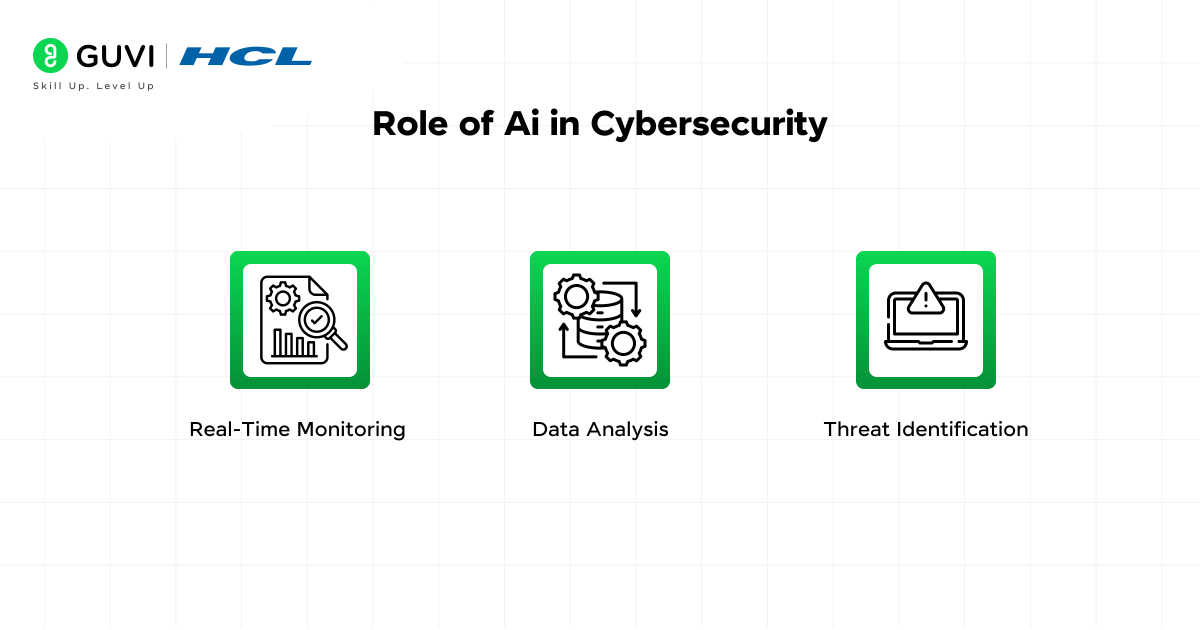
Real-Time Monitoring: AI tools can continually monitor devices, networks, and applications to gather relevant data, with the goal of not allowing any piece of suspicious activity to go unnoticed.
Data Analysis: AI analyzes large volumes of data at lightning speed, identifying patterns and behaviors that humans will not and that legacy tools will fail at recognizing.
Threat Identification: As AI identifies anomalies, potential threats can be identified for cyber attacks (phishing, malware, insider attacks) before they can cause damage.
• Over 90% of successful cyberattacks begin with a phishing email, and AI-powered tools can detect and block these in real time.
• The global AI in Cybersecurity market is projected to reach $133.8 billion by 2030, showing how crucial AI is for future defense.
• AI systems can analyze millions of events per second, far beyond human capacity, making them one of the fastest defense mechanisms today.

How Does AI in Cybersecurity Work?
To know about the impact that is created by ai, you must first know about how AI in cybersecurity works. The following is the process of AI cybersecurity:
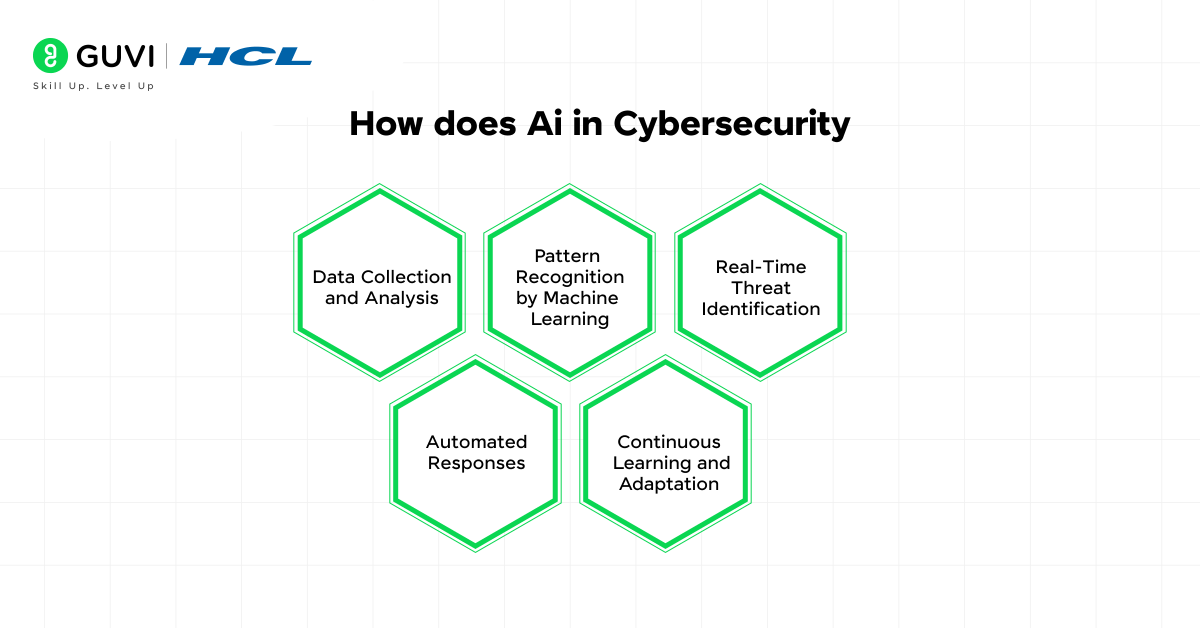
Data Collection and Analysis
AI systems collect vast amounts of data from networks, user activity, logs, and external threat feeds. This data serves as the baseline for differentiating normal from abnormal behavior.
Pattern Recognition by Machine Learning
With machine learning implemented in cybersecurity, AI can create models of patterns for legitimate activity. When anything deviates from these learned patterns, the system may flag the action as a suspicious activity. For instance, the system might initiate alerts for unusual login attempts from different geographic locations.
Real-Time Threat Identification
Once AI has learned and shaped itself to the internal environment, it will oversee and monitor the systems. Any anomalies will be detected in real time. This is where AI’s role in threat detection is most significant, as it can catch cyberattacks in seconds rather than hours.
Automated Responses
AI can take immediate automatic action, like quarantining infected devices, blocking suspicious IP addresses, and shutting down malicious processes to lessen the severity of the impact from attacks.
Continuous Learning and Adaptation
AI systems grow with each attack. With the use of deep learning in cybersecurity, neural networks learn from previous attacks and improve their ability to identify an even more complex attack.
Applications of AI in Cybersecurity
Artificial Intelligence has transitioned from concept to functionality, offering many ways to strengthen digital defense systems, with the primary applications being:
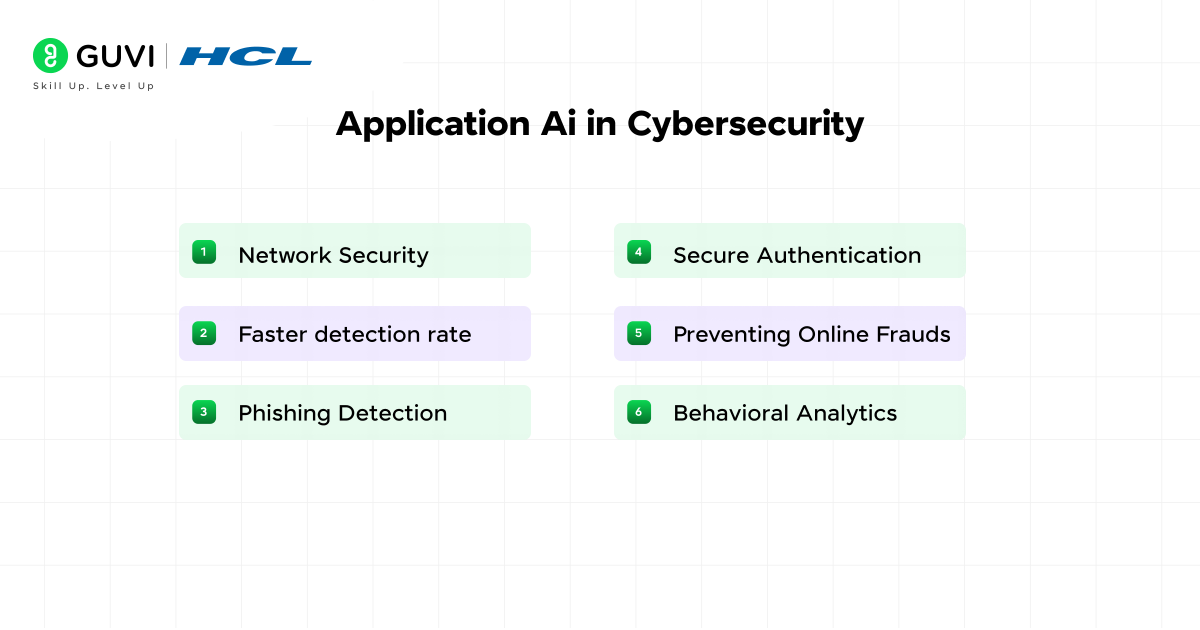
1. Network Security:
AI plays a critical role in protecting networks by continuously monitoring data traffic and identifying unusual activity. While a firewall only uses predetermined instructions to identify and prevent suspicious behavior, AI establishes a basic baseline and uses data mining techniques for anomaly detection. Here’s an example. An AI tool with built-in heuristics could easily discover a hacker gaining unauthorized access to the internal systems of a corporate organization.
2. Faster detection rate
Speed is one of the greatest advantages of AI. Traditional systems can take hours or even days to detect a breach, but AI systems can do so within seconds by identifying anomalous behaviors or underlying data even faster than a human. The sooner the breach is identified, the less damage will be done before it spreads across systems.
3. Phishing Detection
Phishing emails and fake websites are two of the most common cyberattacks in today’s cyber world. AI in phishing detection uses natural language processing (NLP) to detect suspicious content and image recognition for checking potential suspicious sources/fraudulent sites. AI can suspend or prevent malicious emails sent to the inbox before the user engages with the email or fraudulent website.
4. Secure Authentication
The most frequent cause for data breaches is weak or stolen credentials. AI is capable of enhancing secure authentication through recognition methods, including biometric verification, face recognition or behavioral biometrics. For example, if a user starts to type differently or is logging in from a very different location, integrated AI systems could enhance the login attempt by challenging the login with supplementary verification.
5. Preventing Online Frauds
Fraudulent online activities are rising drastically in banking, e-commerce, and digital payments every day. The AI technology prevents fraud online by analyzing how users typically behave, transaction histories, and device fingerprints. Anytime that behavior deviates from the norm, for example, if users suddenly do an unusually high-value transaction, alerts will be generated to help prevent fraud.
6. Behavioral Analytics
AI-based behavioral analytics assess how users typically interact with systems. For example, if a user accesses files outside of normal working hours or downloads an abnormally high quantity of data, AI can flag this strange behavior as suspicious. This becomes useful to spot insider threat behavior.
Benefits of AI in Cyber Security
The benefits of AI in cybersecurity can transform any organization that seeks to enhance its defense system. Here’s why:
Speed and Precision
AI monitors and identifies threats live, meaning it can also react immediately to any breaches and mitigate malicious damage. It applies continuous developments of threat detection patterns; thus, it eliminates human errors and always ensures accurate anomalies.
Predictive Defense
AI can forecast threats by reviewing past data trends and predicting a potential attack ahead of time, preventing a breach and thus keeping you ahead of the cybercriminals.
Scalability
AI can handle enormous amounts of data with ease, so organizations with large systems can work with AI without having to worry about overloading their resources.
Reduce human errors
By automating repetitive analysis and threat monitoring, AI eliminates the risk of human error.
Continuous Learning
AI systems develop with information gathered from their learning experience and threats, and thus can always adapt to current cyberattacks and continually strengthen their defense systems.
Challenges of Using AI in Cybersecurity
While ai in cybersecurity offers various benefits, it also faces several challenges. The following are the common challenges faced by the organization.
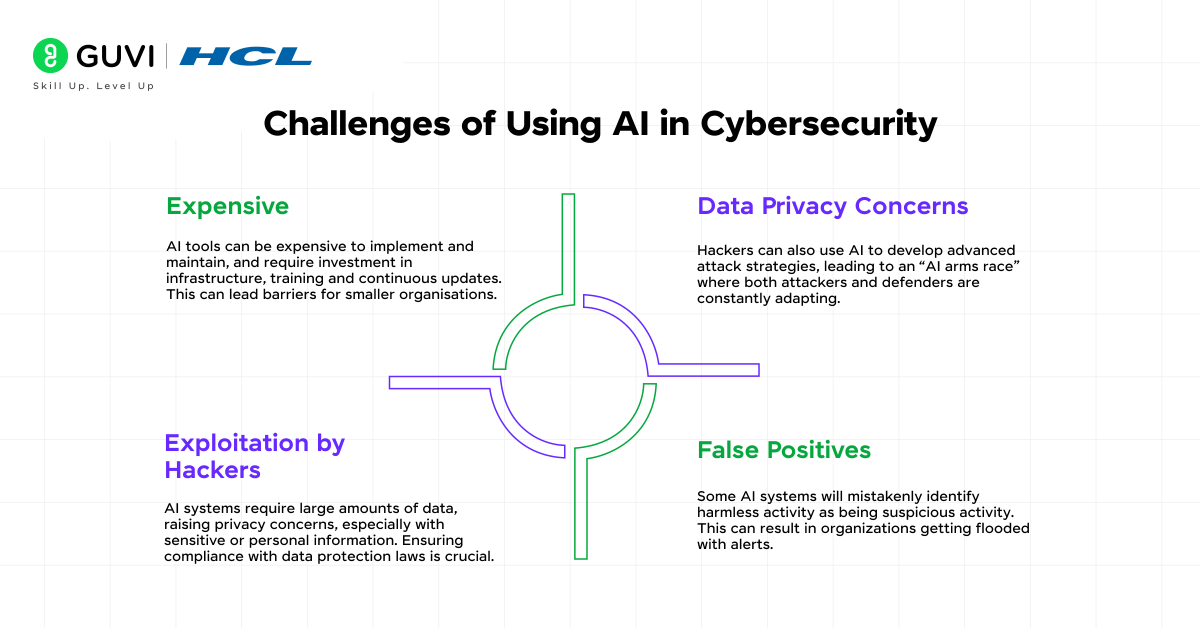
- Expensive
- AI tools can be expensive to implement and maintain, and require investment in infrastructure, training and continuous updates. This can lead to barriers for smaller organisations.
- Data Privacy Concerns
- AI systems require large amounts of data, raising privacy concerns, especially with sensitive or personal information. Ensuring compliance with data protection laws is crucial.
- Exploitation by Hackers
- Hackers can also use AI to develop advanced attack strategies, leading to an “AI arms race” where both attackers and defenders are constantly adapting.
- False Positives
- Some AI systems will mistakenly identify harmless activity as suspicious activity. This can result in organizations getting flooded with alerts.
Future of AI in Cybersecurity
The future of AI in cybersecurity is bright and will grow brighter as technology continues to improve. As cyber attacks grow larger and more complicated, AI will play a vital role in predicting, preventing, and responding to these threats. We can expect to see self-healing systems capable of recognizing vulnerabilities and automatically taking steps to fix them. Additionally, AI’s integration with blockchain technology may create more secure, tamper-proof systems.
The future of AI in cybersecurity isn’t just about responding to new threats, it is about the capacity to anticipate and mitigate risk before a threat even begins.
If this blog sparked your curiosity about AI in cybersecurity, it’s just the beginning. With HCL GUVI’s Advanced AI & Machine Learning Course, co-designed with industry leaders, you’ll master hands-on skills in Python, Deep Learning, NLP, Generative AI, and MLOps. Gain real-world experience through projects, mentorship, and job-ready training to turn your learning into a career advantage.
Final thoughts..
In this blog, we have seen how Artificial Intelligence is changing cybersecurity. AI is effortlessly detecting, responding to threats in real-time, predicting the future, and preventing attacks. As technology continues to advance, the usage of AI-based solutions will increase exponentially, resulting in smarter, faster, and more proactive cybersecurity.
I hope you found this blog useful in understanding the role of AI in cybersecurity. Happy learning and stay safe in the digital world!
FAQs
1. How can AI be used in cybersecurity?
AI can help identify threats, automate security-related tasks, and respond to cyber threats in real time using data patterns by detecting anomalies, and is faster than traditional methods.
2. What types of cyber threats can AI detect?
AI can identify all types of threats from malware, phishing attempts, and ransomware to data breaches and insider threats by examining patterns in network traffic and user behaviors.
3. What role does machine learning play in AI cybersecurity?
Machine learning enables AI systems to “learn” from previous cyber-attacks, increasing their ability to anticipate and detect potential threats and evolve with the strategies of attackers over time.
4. What are some examples of AI tools used in cybersecurity?
Examples are intrusion detection systems (IDS), behavioural analytics systems, malware detection systems, incident response systems and so on.
Success Stories

About the Author
Vishalini Devarajan
An Aerospace Engineer turned content writer, I focus on making complex concepts easy to understand through well-structured, reader-friendly blogs. Whether it’s a technical topic or a non-technical one, I love creating content that is clear, engaging, and impactful.
View all posts by Vishalini Devarajan
Connect with me @













Did you enjoy this article?