


Software Development Articles
My Google SDE Interview Experience: From Rejection to Selection [2026 Success Story]
Apple Interview Experience for Software Developers: What to Expect
Decoding Differences between Network OS and Distributed OS
Operating System Examples: Top OS Types, Features, and Uses Explained


Get In Touch For Details! Request More Information
Adaptive Software Development: Navigating Complexity with Ease
Oct 24, 2025 6 Min Read 1424 Views
(Last Updated)
Have you ever wondered about these terms “market demand” and “market trends”? From where these phrases originated, how trends are born, and how the demand for something is generated? If we observe closely, the market is formed by people and the desires and objectives that drive us to achieve specific goals, which in turn determine the direction of the market, resulting in the creation of demands and trends.
That’s why in real-world scenarios, the software project’s requirements, types of tools and technologies integrations, and the client needs rarely remain the same during the entire software development life cycle (SDLC) process. So, to tackle these types of hindrances, development or technical teams often implement the Adaptive Software Development methodology to build software projects and applications.
It is a development strategy that focuses on meeting the customer expectations and stakeholders’ priorities through enabling flexibility and encouraging frequent feedback to ensure product relevance and usability, while staying aligned with the actual goals.
In this blog, we will try to understand this advanced development approach and how it is playing an integral role in shaping modern software products.
Table of contents
- What is Adaptive Software Development, and What Is Its Significance from a Development Perspective?
- Adaptive Software Development Model
- Adaptive Software Development Process
- Strengths of Adaptive Software Development
- Limitations of Adaptive Software Development
- Adaptive vs. Agile Development Methodology
- Conclusion
- FAQs
- List the three main phases of the Adaptive Software Development Methodology.
- What are the advantages of Adaptive software development?
- Is Adaptive software development a type of Agile methodology?
What is Adaptive Software Development, and What Is Its Significance from a Development Perspective?
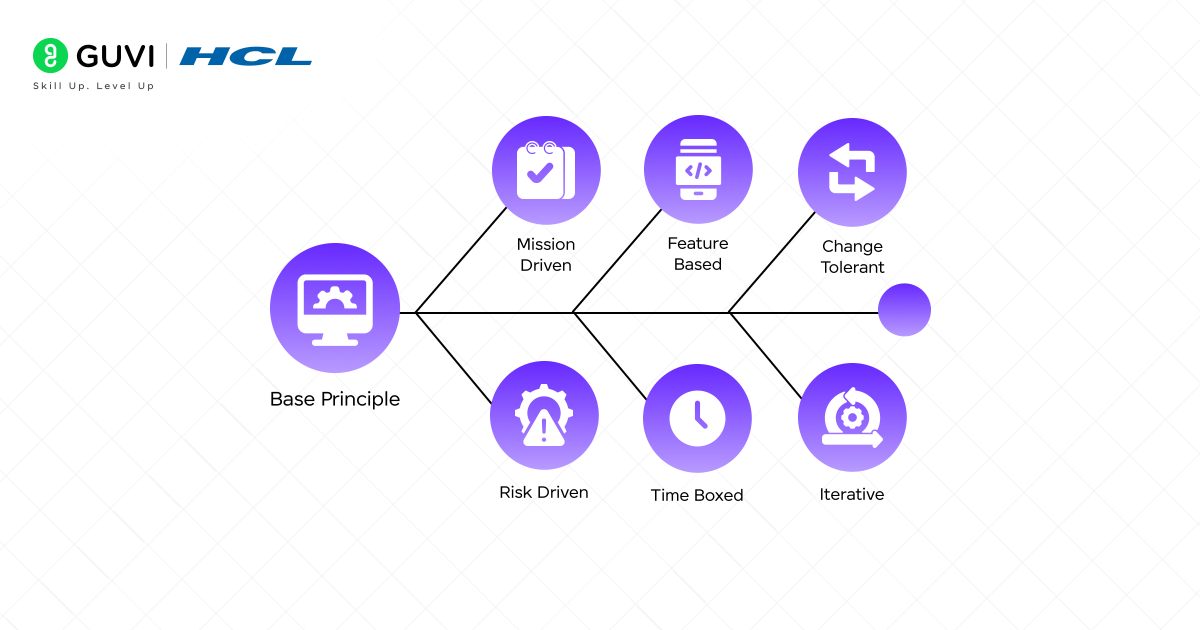
Adaptive Software Development is a software development method that was created to manage the uncertainties involved in projects, such as evolving business requirements, development upgradation, revamping of features and functionalities, and many more. The core purpose behind the incorporation of this method is to lay the primary focus on fostering flexibility, versatility, team collaboration, and continuous learning.
In this process, instead of following a concrete developmental approach, the technical team chooses to build software systems and platforms in time-boxed cycles. In these cycles, developers are responsible for crafting features quickly, gathering reviews from end-users or business representatives, and fine-tuning the product based on these inputs.
The entire development flow aims at emphasizing teamwork, customer involvement, and maintaining proper documentation in each product-building phase. In simple terms, it is mission-driven, meaning the project is guided by an overall vision rather than strict assignment checklists. Adaptive software development also contributes to minimizing unnecessary effort, promoting innovation, and creating flexible software that is suitable for dynamic business environments.
Now, let’s know why it is essential for developers, and the simple answer lies in the liberty it provides during designing and developing a project from scratch. In traditional approaches, teams used to be more focused on completing the predefined tasks without analyzing and comprehending the effectiveness and feasibility of the project; as a result, in the majority of the time, the end products were incapable of making real-world impacts.
Adaptive software development, on the other hand, facilitates the development team in delivering the desired results quickly with excellent practical uses. Here, in this approach, developers not only focus on just writing programs and maintaining codebases, but their responsibilities span across various areas such as project execution planning, customizing the product design based on real insights, and optimizing the quality of both the product and the process. It transforms a developer’s approach from routine, mechanical thinking to a creative and innovative mindset.
Adaptive Software Development Model
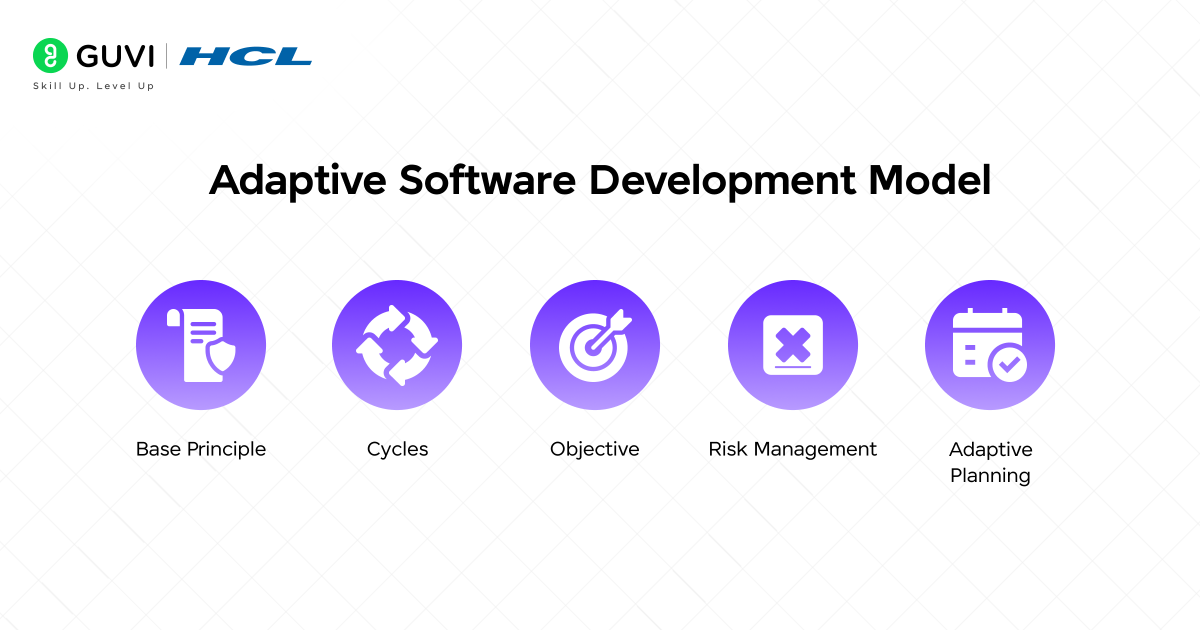
The Adaptive Software Development Model is an approach for conducting the SDLC process. It has mainly five essential components associated with it.
- Base Principle
The central principle of Adaptive software development is to revolutionize the traditional development methodologies completely. It is based on accepting the fact that change is inevitable, and the focal point in this process is on prioritizing the product delivery with the most enhanced and complex functionalities, as well as valuing the collaboration and effective communication between the team members and the project stakeholders.
The principle ensures that the development approach remains flexible, adaptable, and solves the real user issues without following any rigid plan.
- Cycles
The adaptive development approach operates in an iterative cycle, rather than a sequential linear process. Each development cycle begins with Speculation, where the team sets objectives, identifies potential risks, and selects a flexible strategy for implementation.
After establishing a robust theoretical background, the team members (developers, testers, designers, engineering managers, and product consultants) work closely with each other (collaboration) to build, test, and refine the features and functionalities in the applications or platforms.
The final stage is taking action based on the stakeholder or end user reviews, where the inputs regarding upgradation or modifications are captured, and the next cycle is adjusted in accordance with that.
For a better understanding, remember this iteration: Speculate → Collaborate → Learn.
- Objective
The key objective of the model is to have a proper vision at the beginning of the project development. As compared to the traditional models that rely extensively on defining specifications and acting based on them, Adaptive software development deals with a high-level purpose that directs the project.
This model provides coherence by helping the team to make better decisions, prioritize features, and ensure success even as the requirements and needs change over the course of time.
- Risk Management
Mitigating the possible risks is an essential element of this model. Dividing the unified task into small modular chunks and continuously reviewing the progress allows the development team to detect and address the vulnerabilities at an early stage—whether technical, business, or user-related.
Doing this helps reduce the likelihood of major technical malfunctions while keeping development on track and uninterrupted.
- Adaptive Planning
Planning, in other words, organizing or arranging the resources and information, is a vital aspect of the Adaptive Software Development Model, as it enables flexibility. Rather than following a predetermined software development roadmap, plans are modified at the end of each development cycle, which is mainly based on what the team has observed and learned. This model empowers the team to respond to the frequently changing requirements, user feedback, or technical challenges while maintaining the quality of the development process.
Together, these elements make Adaptive Software Development a dynamic model that helps teams deliver valuable, high-quality software in unpredictable environments.

Adaptive Software Development Process
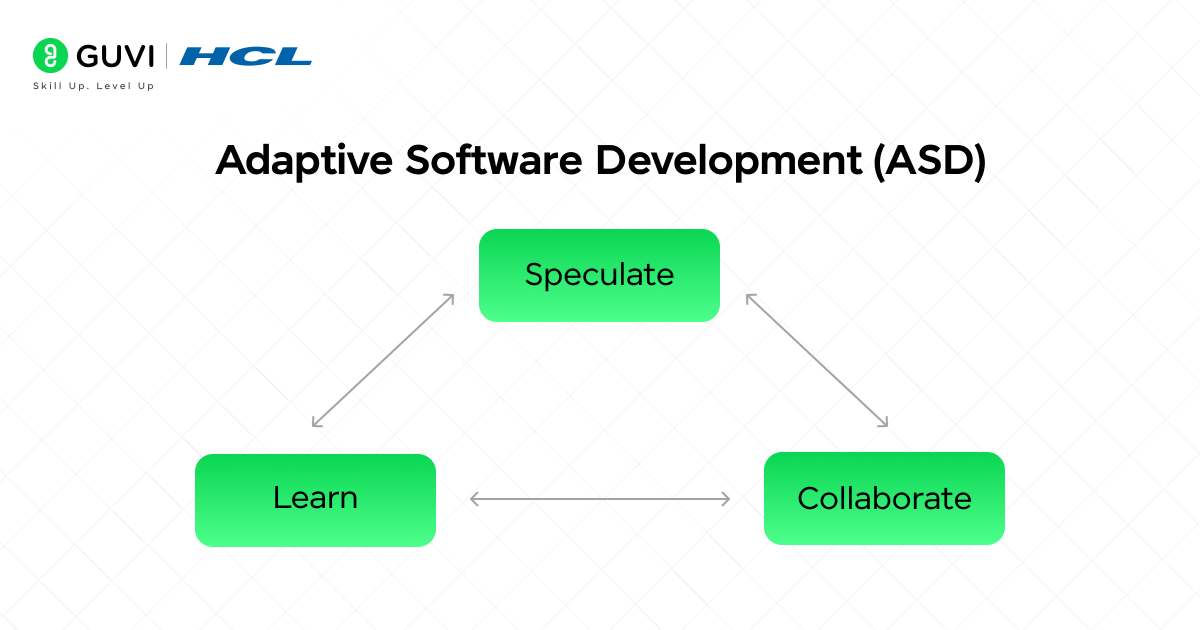
The Adaptive Software Development process goes through three essential phases, namely the Speculate Phase, the Collaborate Phase, and the Learn Phase. Let’s discuss them one by one.
- Speculate Phase (Flexible Planning)
- In the speculation phase, the initial step is to define clear objectives for the project development. By defining a sense of direction, it can be predicted that this ensures the development team can now easily navigate through all the intricacies involved in building a fully functional software product. This also helps the developers to know what value the particular project is expected to deliver.
- Once all the objectives are defined, the next step is to assess all the potential risks and uncertainties that might strongly affect the development flow. A pragmatic prediction of the risks helps in understanding the operational and financial feasibility of the project.
- After accumulating all the details, the team then creates a descriptive document that highlights the timelines, resource allocations, and techniques through which flexibility can be generated to handle the regular changes during the development process.
- At last, the features and functionalities are prioritized, and specific iteration goals are set to ensure the most valuable and expensive modular components are developed first with accuracy and precision.
- Collaborate Phase (Team Execution)
- The second phase is more focused on enhancing team efficiency and productivity. The first step here is to establish a friendly and cooperative work environment that promotes transparency and effective communication between team members.
- Developers, testers, designers, or professionals from various tech domains, along with their competencies, are deployed into the project to work closely and support each other.
- After team members are finalized, the core engineering process begins, where each team member is assigned with separate set of tasks (such as a Frontend Developer designing the user interfaces, a Backend Engineer responsible for building and creating APIs along with writing the server-side logic, an QA Tester performing testing and reporting bugs, and a DevOps Engineer managing deployment and CI/CD pipelines, etc).
- The final step in this phase is ensuring the continuous involvement of stakeholders and customers so that the development aligns with real user needs and expectations.
- Learn Phase (Feedback and Adaptation)
- In this specific stage, an ideal functional version of the software is delivered to the stakeholders or launched among the end users, which allows the development team to observe and analyze the real progress rather than having some misconceptions that can lead to significant financial losses and fruitless efforts.
- After experiencing the operational performance of the project, the stakeholders or end customers then provide feedback, suggestions, and reviews, based on which the areas of improvement and the actual requirements are discovered.
- After accumulating the essential inputs, the next step is to develop plans for the successive update cycles, where priorities and strategies are filtered and refined to meet the expectations of end users.
- And when the software product is ready, the further responsibility is to provide maintenance and upgrade services to ensure the quality and performance are maintained in the long run, as the project evolves with the rapidly changing technological landscape.
Strengths of Adaptive Software Development
- Highly flexible and can easily adapt to changing requirements and environments.
- Continuous customer involvement ensures the product aligns with real user needs.
- Iterative cycles help identify and fix issues early, reducing risks.
- Working software is delivered in increments, allowing faster value delivery.
- Encourages experimentation and learning from mistakes, fostering innovation.
Limitations of Adaptive Software Development
- Timelines, budgets, and scope can be challenging to predict.
- Requires constant stakeholder involvement, which may not always be feasible.
- Teams need to be highly skilled, self-organized, and collaborative.
- Focusing on adaptability may lead to less formal documentation.
- Frequent changes and iterations can make coordination and management more complex.
Adaptive vs. Agile Development Methodology
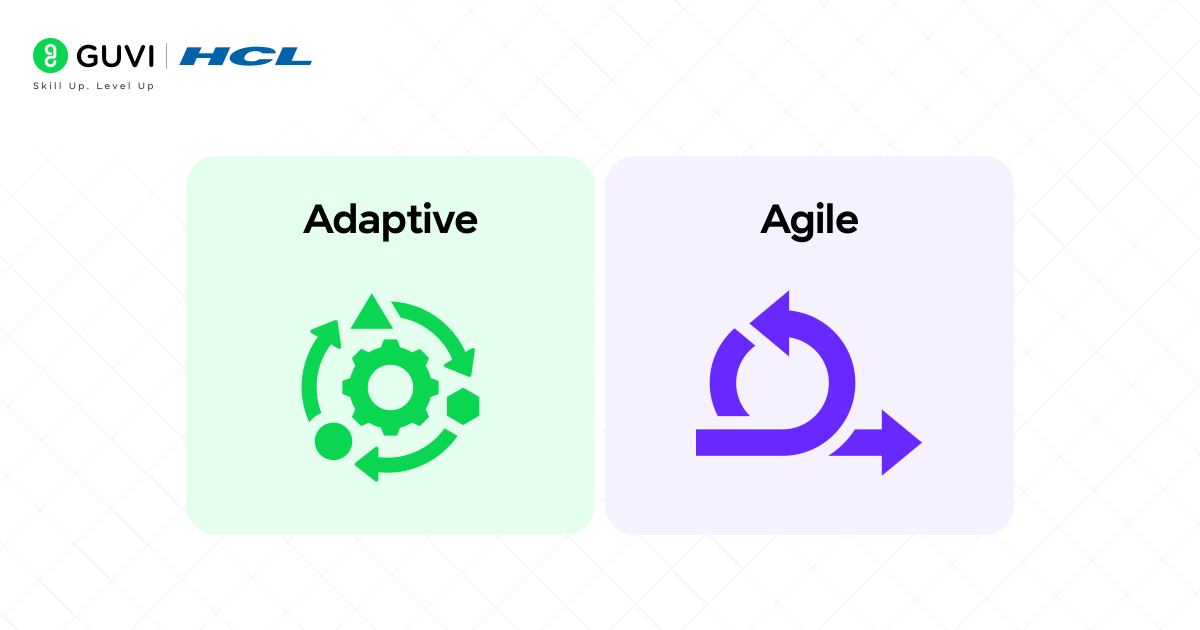
Adaptive Software Development is explicitly designed for highly complex and unpredictable projects. It emphasizes speculation, learning, and adaptation in every cycle. Planning is intentionally flexible, and change is expected at every stage. Its core focus is on continuous learning from each iteration and adapting both process and product accordingly.
On the other hand, Agile Development is a broader methodology framework (such as Scrum, Kanban, and XP) that focuses on delivering software incrementally and iteratively. Agile assumes requirements can evolve, but often works best when there is at least some predictability. It emphasizes collaboration, customer feedback, and iterative delivery, but may not explicitly structure the process around continuous learning from complexity and high uncertainty like Adaptive Software Development.
Adaptive Software Development (ASD) was introduced in the early 1990s through the collaborative efforts of Jim Highsmith and Sam Bayer. The sole purpose behind this creation was to extend the scope of Rapid Application Development (RAD) methodology, which only emphasized speed over iterative learning and was very inefficient in handling complex and unpredictable software projects. To address these limitations, an adaptive approach to software development was created that focused on embracing changes and delivering end-to-end functional applications iteratively.
If you are someone who wants to equip himself/herself with the essential skills to create intelligent and automated solutions to create real-world impact, then enroll in HCL GUVI’s IITM Pravartak & MongoDB certified AI Software Development course and enhance your tech profile for rewarding opportunities in the cutting-edge software field like machine learning, data science, and robotics.
Conclusion
In an era where technology evolves at a rapid pace and business landscapes shift unpredictably, Adaptive Software development stands as one of the best options a development team can opt for. By accepting the change as an integral part of the development process, this method encourages the teams to go beyond just development and cultivate an environment where elements such as interactive collaboration, continuous learning path, creativity, and innovation can be fostered. This particular development model completely transforms the project building phases from a rigid and mechanical approach into a dynamic and objective-driven endeavor that aligns with the end users’ needs and requirements. Software products that thrive on complexity and unpredictability should be developed through this iterative approach.
FAQs
List the three main phases of the Adaptive Software Development Methodology.
The three main phases of Adaptive Software Development are Speculate, Collaborate, and Learn. These phases are iterative in nature until the final product is developed.
What are the advantages of Adaptive software development?
The main advantages of this method include flexibility, quick product delivery through incremental releases, enhanced collaborative efforts, risk minimization, innovation, and constant optimization.
Is Adaptive software development a type of Agile methodology?
Yes, it is a type of Agile methodology, but its specialty lies in tailoring the development process for highly sophisticated and uncertain software projects. However, Agile focuses mainly on iterative product delivery.
Success Stories













Did you enjoy this article?