


Python Articles
Freelancing as a Python Developer: Getting Your First Client
Common Python Mistakes Beginners Make And How to Fix Them
Python Best Practices: Writing Clean, Maintainable Code Like a Pro
How to Build a Python Developer Portfolio That Gets You Hired


Get In Touch For Details! Request More Information
Python Floor Division (//) Explained: Difference from / with Examples
Sep 09, 2026 5 Min Read 3278 Views
(Last Updated)
When you’re coding in Python, floor division can be a real game-changer for your mathematical operations. Unlike regular division, which returns floating-point numbers with decimals, floor division returns the largest integer less than or equal to the result. This powerful operator (represented by //) ensures any fractional part is completely discarded.
What is floor division in Python exactly? It’s a specialized division operation that returns whole numbers only. The floor division operator in Python (//) truncates the decimal part of your result, which is especially useful when you need clean integers in your calculations.
Throughout this guide, you’ll learn and understand exactly what floor division in python is, where and why it is used, and how to use it efficiently with ease. Let’s begin!
TL:DR
Python floor division uses the // operator to divide two values and return the quotient rounded down to the nearest whole number.
print(7 // 2)  # 3
print(7 / 2)   # 3.5
The / operator returns the complete decimal result. The // operator applies mathematical flooring to the result.
Table of contents
- What is Floor Division in Python?
- 1) How It Differs From Regular Division
- 2) Why it's Called 'Floor' Division
- How to do Floor Division in Python?
- 1) Using the // Operator
- 2) Using math.floor() with /
- 3) Using int() for Truncation
- 4) Using divmod() for Quotient and Remainder
- Python Floor Division Code Examples
- Integer Floor Division
- Float and Integer Floor Division
- Floor Division With Negative Numbers
- Python Floor Division vs Regular Division
- Floor Division With Negative Numbers- The Common Interview Trap
- Interview Example
- Floor Division vs Integer Division- Are They the Same?
- When and Why to Use Floor Division
- 1) Splitting Items Evenly
- 2) Indexing in Lists or Arrays
- 3) Pagination and Chunking
- 4) Time Calculations (e.g., seconds to minutes)
- Concluding Thoughts…
- FAQs
- Q1. What is the result of 7 // 2 in Python?
- Q2. How does floor division differ from regular division in Python?
- Q3. Why is it called "floor" division?
- Q4. How does floor division handle negative numbers?
- Q5. What are some practical uses of floor division in Python?
What is Floor Division in Python?
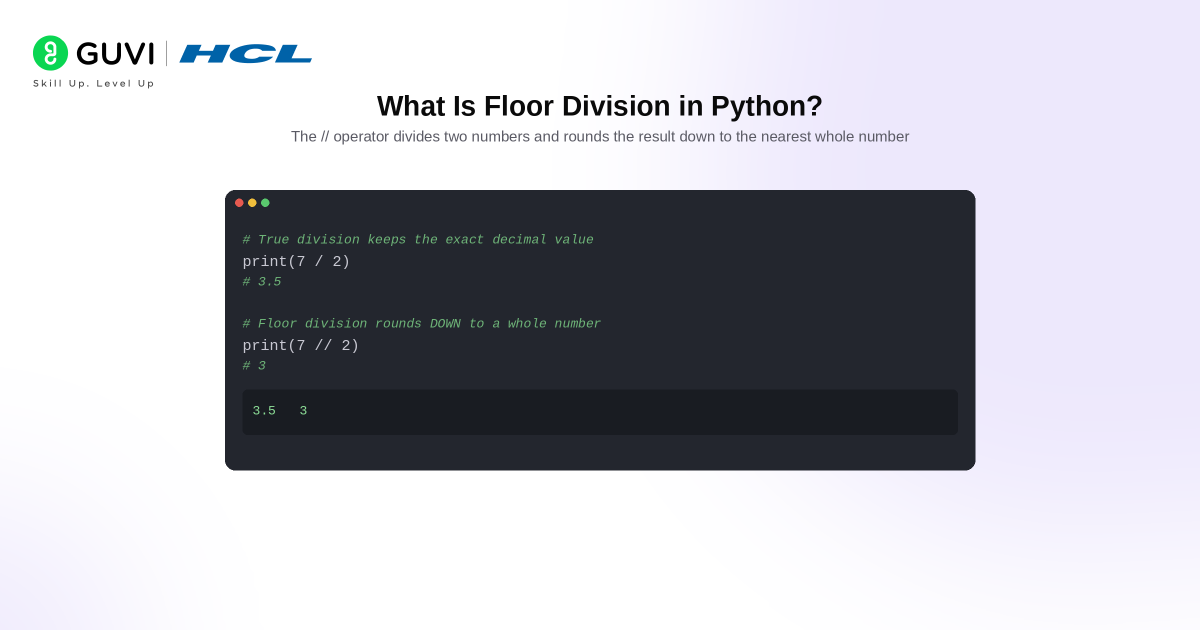
Floor division in Python returns the largest integer less than or equal to the quotient of two numbers. The operation uses the double slash operator (//), which instantly signals to other programmers that you’re intentionally seeking an integer result.
The primary purpose of floor division is straightforward – it provides a quick way to perform division while automatically handling the rounding for you. This becomes particularly valuable in scenarios such as:
- Splitting items evenly among groups
- Creating integer indices for arrays
- Calculating quotients without remainder
Consider this basic floor division example:
result = 7 // 2
print(result) # Output: 3
1) How It Differs From Regular Division
Regular division and floor division serve different mathematical needs in your code:
| Division Type | Operator | Result Example | Output Type |
| Regular Division | / | 7 / 2 = 3.5 | Always float |
| Floor Division | // | 7 // 2 = 3 | Integer (if inputs are integers) |
The key distinction lies in how these operations handle results. Regular division (/) always returns a floating-point number, regardless of whether the division produces a whole number. Therefore, even 4 / 2 gives you 2.0, not just 2.
Floor division, however, discards everything after the decimal point, giving you 3 when dividing 7 by 2. Additionally, if either operand is a float, floor division still performs the floor operation but returns a float type result – for example, 7.0 // 2.0 returns 3.0.
2) Why it’s Called ‘Floor’ Division
The term “floor” in mathematics refers to rounding down to the nearest integer. Floor division gets its name precisely because it applies the mathematical floor function to the result of division.
This naming becomes particularly evident when working with negative numbers. Floor division doesn’t simply truncate or chop off decimal values – it consistently rounds toward negative infinity. This behavior creates some initially surprising results with negative numbers:
print(5 // 2) # Output: 2 (regular floor)
print(-5 // 2) # Output: -3 (not -2!)
In the second example, the regular division result is -2.5, but floor division rounds down to -3 rather than just dropping the decimal. This happens because floor division always returns the largest integer less than or equal to the true quotient – not just the integer portion.
This mathematical consistency makes floor division particularly valuable in algorithms dealing with ranges, intervals, and periodic operations like time calculations or pixel positioning.
How to do Floor Division in Python?
Python offers several ways to perform floor division operations in your code. Let’s explore four practical methods that give you flexibility based on your specific needs.
1) Using the // Operator
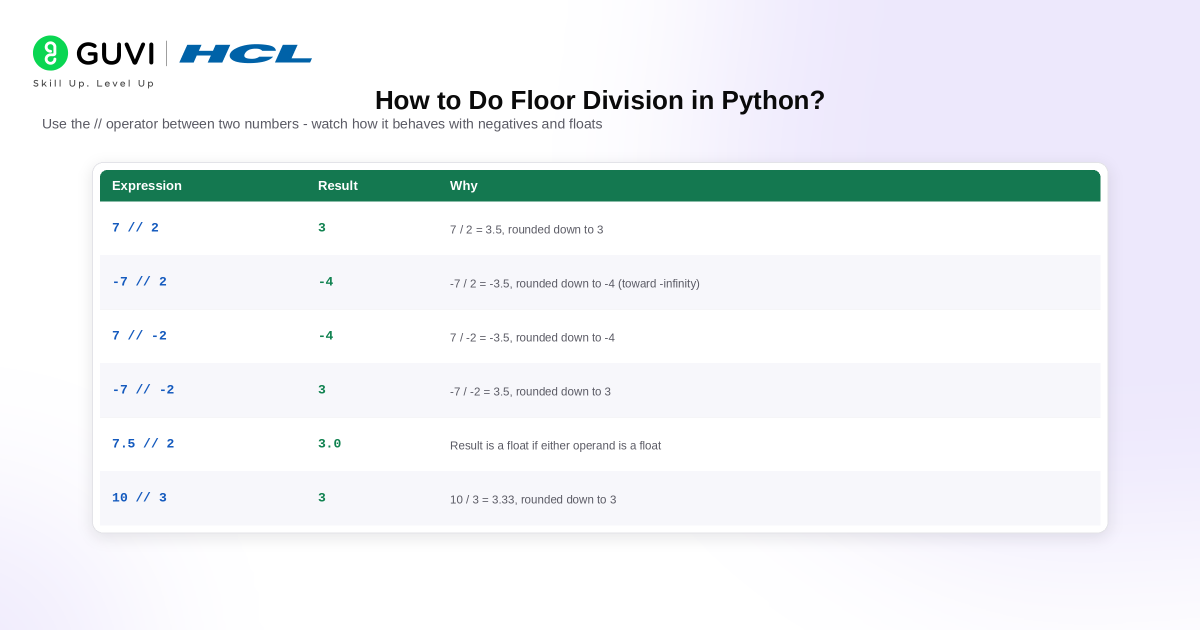
The double forward slash (//) is Python’s dedicated floor division operator. This straightforward operator divides two numbers and returns the largest integer less than or equal to the result:
print(10 // 3) # Output: 3
print(7.5 // 2) # Output: 3.0
Notice that when using floating-point numbers with //, the result remains floored yet returns as a float type. Furthermore, with negative numbers, the operator truly finds the floor by rounding toward negative infinity:
print(-10 // 3) # Output: -4
2) Using math.floor() with /
Another approach combines regular division with Python’s math.floor() function, which rounds down to the nearest integer:
import math
result = math.floor(10 / 3) # Output: 3
result = math.floor(-10 / 3) # Output: -4
A key distinction is that math.floor() always returns an integer regardless of input types, making it more consistent when working with mixed data types.
3) Using int() for Truncation
For a quick alternative, you can use int() to truncate division results toward zero:
print(int(10 / 3)) # Output: 3
print(int(-10 / 3)) # Output: -3
Unlike floor division, which rounds toward negative infinity, int() simply removes the decimal portion. Consequently, negative numbers behave differently with int() compared to the floor division operator.
4) Using divmod() for Quotient and Remainder
The built-in divmod() function efficiently returns both the quotient and remainder as a tuple:
quotient, remainder = divmod(10, 3)
print(quotient) # Output: 3
print(remainder) # Output: 1
This function proves particularly useful when you need both values simultaneously. For instance, when dividing 8 by 3, divmod(8, 3) returns (2, 2), representing quotient 2 and remainder 2.
Along with its convenience, divmod() works with both integers and floats, though the returned values will be floats if either input is a float.
To add a bit of context, here are a couple of interesting facts about floor division that many beginners don’t notice at first:
Floor division always follows mathematical flooring, not simple truncation: This means it rounds results down toward negative infinity, which is why expressions like -5 // 2 give -3 instead of -2.
The // operator was introduced to remove ambiguity: Python explicitly separates regular division (/) and floor division (//) so programmers can clearly signal whether they want precise decimals or clean integer results.
These details explain why floor division behaves consistently across positive and negative numbers, making it reliable for algorithms and real-world calculations.
Python Floor Division Code Examples
Python floor division works with integers, floating-point numbers, and negative values. The returned value depends on both the quotient and the data types used.
Integer Floor Division
Floor division between two integers returns an integer.
first_number = 17
second_number = 5

result = first_number // second_number

print(result)
print(type(result))
Output:
3
<class 'int'>
The exact quotient is 3.4. Floor division rounds it down and returns 3.
Float and Integer Floor Division
Floor division still rounds down when one value is a float. However, the returned result is also a float.
first_number = 17.0
second_number = 5

result = first_number // second_number

print(result)
print(type(result))
Output:
3.0
<class 'float'>
The mathematical result is floored to 3, but Python returns 3.0 because one operand is a floating-point number.
Floor Division With Negative Numbers
Negative values show the true difference between flooring and simply removing decimal digits.
print(-7 // 2)
print(7 // -2)
print(-7 // -2)
Output:
-4
-4
3
The result of -7 / 2 is -3.5. Since floor division moves toward negative infinity, Python returns -4, not -3.

Python Floor Division vs Regular Division
| Expression | // Result | / Result | math.floor() Result | Why Different? |
|---|---|---|---|---|
7 ÷ 2 | 3 | 3.5 | 3 | Floor division rounds the quotient down |
7.0 ÷ 2 | 3.0 | 3.5 | 3 | // returns a float because one operand is a float |
-7 ÷ 2 | -4 | -3.5 | -4 | Flooring moves toward negative infinity |
7 ÷ -2 | -4 | -3.5 | -4 | A negative quotient is rounded down |
-7 ÷ -2 | 3 | 3.5 | 3 | Two negative values produce a positive quotient |
8 ÷ 4 | 2 | 2.0 | 2 | The quotient is already a whole number |
The math.floor() column applies the function after regular division:
import math

print(math.floor(7 / 2))    # 3
print(math.floor(-7 / 2))   # -4
Both // and math.floor() round the quotient toward negative infinity. However, math.floor() always returns an integer, whereas // returns a float when either operand is a float.
Floor Division With Negative Numbers- The Common Interview Trap
Negative floor division is a common Python interview question because many programmers confuse flooring with truncation.
Consider this expression:
print(-7 // 2)
The exact quotient is:
-3.5
A common incorrect answer is -3, based on removing the decimal part. Python actually returns:
-4
Floor division always rounds toward negative infinity. On a number line, -4 is below -3.5, whereas -3 is above it.
print(-7 / 2)   # -3.5
print(-7 // 2)  # -4
Flooring and truncation therefore produce different results:
import math

value = -7 / 2

print(math.floor(value))  # -4
print(int(value))         # -3
math.floor() moves downward to the nearest integer. The int() function removes the decimal part and moves toward zero.
Interview Example
What does this expression return?
print(-15 // 4)
Regular division gives:
-3.75
The nearest lower integer is -4.
Output: -4
A simple method is to calculate the exact quotient first. Then select the greatest integer that is still less than or equal to that value.
Floor Division vs Integer Division- Are They the Same?
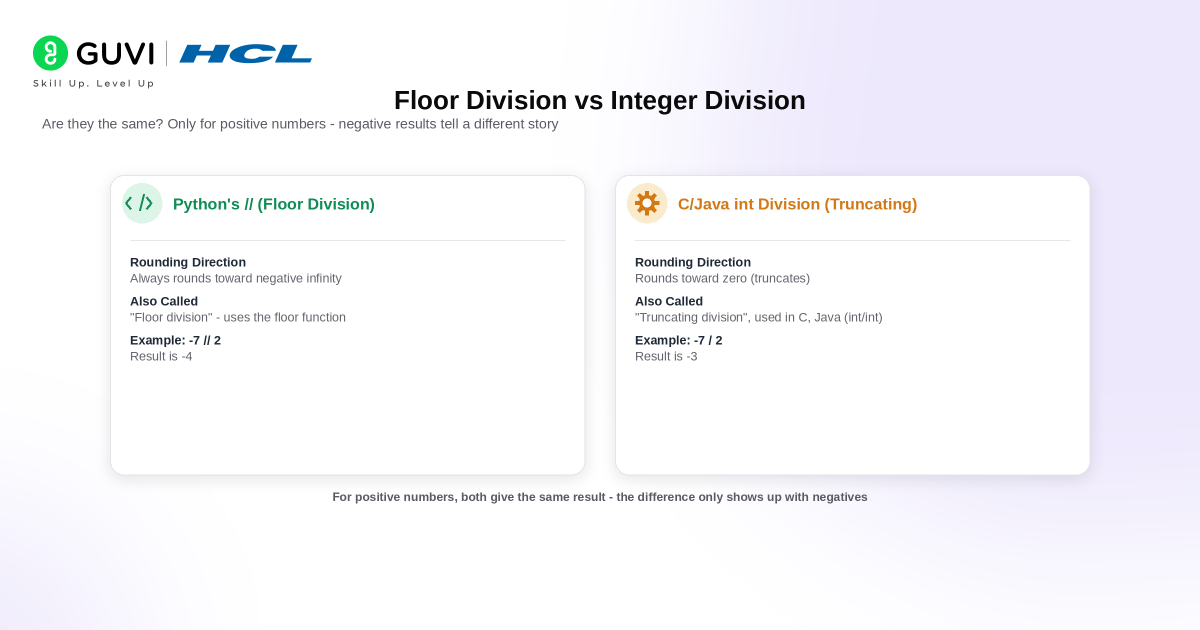
Floor division and integer division are often used as interchangeable terms. However, they are not always mathematically identical.
Python floor division rounds the quotient toward negative infinity:
print(-7 // 2) # -4
Truncating integer division moves the quotient toward zero:
print(int(-7 / 2)) # -3
Both methods produce the same result for positive numbers:
print(7 // 2)      # 3
print(int(7 / 2))  # 3
The difference appears when the quotient is negative.
| Operation | Result for -7 ÷ 2 | Direction |
|---|---|---|
Python floor division: -7 // 2 | -4 | Toward negative infinity |
Truncation: int(-7 / 2) | -3 | Toward zero |
Regular division: -7 / 2 | -3.5 | No whole-number rounding |
Some programming languages use “integer division” to describe truncation toward zero. Python’s // operator performs mathematical floor division instead.
Floor division and truncating integer division behave the same for positive quotients. They can return different results when negative numbers are involved.
When and Why to Use Floor Division
Floor division (//) offers elegant solutions to common programming challenges where whole numbers are essential. Below are four practical applications where this operation truly shines.
1) Splitting Items Evenly
Floor division python excels at dividing objects among groups while ensuring each recipient gets equal portions. For instance, when distributing 17 items into 5 groups:
std = 17
grp = 5
print(“Full groups:”, std // grp) # Output: 3
print(“Remaining students:”, std % grp) # Output: 2
This code immediately shows you can form 3 complete groups, with 2 items remaining.
2) Indexing in Lists or Arrays
Floor division proves invaluable for calculating indices in data structures, notably in finding midpoints for binary search algorithms:
left = 0
right = len(array) – 1
mid = (left + right) // 2
This ensures you always have a clean integer index, preventing bugs from floating-point rounding.
3) Pagination and Chunking
In web development, floor division helps determine how many pages are needed to display data:
total_records = 50
records_per_page = 10
pages = total_records // records_per_page # Output: 5
Moreover, when processing large datasets, chunking operations benefit from floor division to determine complete batch counts.
4) Time Calculations (e.g., seconds to minutes)
Perhaps the most intuitive use is converting time units:
sec = 130
mins = sec // 60
remain = sec % 60
print(mins, “minutes and”, remain, “seconds”) # Output: 2 minutes and 10 seconds
Floor division discards leftover seconds, giving only full minutes.
Master Python the right way with HCL GUVI’s Python Course, where complex concepts like decorators are broken down through real-world examples and hands-on practice. Perfect for beginners and intermediate learners, it helps you write cleaner, reusable, and production-ready Python code with confidence.
Concluding Thoughts…
Floor division stands as a powerful yet straightforward tool in your Python programming toolkit. Throughout this guide, you’ve seen how the // operator efficiently returns whole numbers by discarding decimal parts, making it distinctly different from regular division.
Additionally, you now understand why it’s called “floor” division – because it consistently rounds toward negative infinity rather than simply truncating values. This behavior proves especially important when handling negative numbers.
Therefore, mastering floor division gives you more control over your numeric calculations in Python. Though simple in concept, this operation serves as an essential building block for creating efficient, readable code that handles whole-number division exactly as you intend.
FAQs
Q1. What is the result of 7 // 2 in Python?
The result of 7 // 2 using floor division in Python is 3. Floor division returns the largest integer less than or equal to the result, discarding any fractional part.
Q2. How does floor division differ from regular division in Python?
Floor division (//) returns whole numbers by discarding the decimal part, while regular division (/) always returns a floating-point number. For example, 7 // 2 gives 3, whereas 7 / 2 results in 3.5.
Q3. Why is it called “floor” division?
It’s called “floor” division because it rounds the result down to the nearest integer, similar to the mathematical floor function. This is particularly noticeable with negative numbers, where it rounds towards negative infinity.
Q4. How does floor division handle negative numbers?
Floor division with negative numbers rounds towards negative infinity. For instance, -7 // 2 results in -4, not -3, because -3.5 rounded down is -4.
Q5. What are some practical uses of floor division in Python?
Floor division is useful for various tasks, including evenly splitting items among groups, calculating indices in lists or arrays, determining the number of pages needed for pagination, and performing time unit conversions (e.g., seconds to minutes).
Success Stories

About the Author
Vaishali
I'm a seasoned writer with four years of experience across technical, non-technical, and just about every genre or niche you can imagine. Adaptable and curious, I enjoy exploring new topics and making information engaging and easy to understand. Fueled by a steady stream of tea, I approach each project with creativity, reliability, and genuine enthusiasm for storytelling.
View all posts by Vaishali
Connect with me @














Did you enjoy this article?