


Java Articles
Kafka Streams Tutorial: Build Your First Data Pipeline
What is ArrayList in Java: A Complete Guide
What is HashMap in Java: How It Works, Methods, and Examples

Get In Touch For Details! Request More Information
Java Spring Boot in 2026: What You Need to Know to Get Hired
Jul 13, 2026 6 Min Read 12117 Views
(Last Updated)
Java Spring Boot is a backend development stack for building scalable, production-ready applications. It helps developers create APIs, microservices, and enterprise systems with less configuration and faster development.
Java Spring Boot remains a strong hiring choice in 2026 as companies continue investing in enterprise and cloud-based applications. Developers who understand industry expectations and practical skills stand out in interviews and hiring processes.
Table of contents
- TL;DR Summary
- Is Java Still Relevant in 2026?
- Why Is Spring Boot Non-Negotiable for Java Jobs?
- Applications of Java Spring Boot: What You Need to Know to Get Hired
- Banking and Financial Systems
- E-Commerce Platforms
- Microservices and Cloud Applications
- SaaS Products
- Healthcare and Enterprise Applications
- Top Java Spring Boot Career Paths in 2026
- Essential Java Skills for Job Readiness
- Technical Skills
- Soft Skills
- Essential Spring Boot Skills for Job Readiness
- Technical Skills
- Soft Skills
- Latest Advancements: Skills You Need to Get Hired in 2026
- Java Spring Boot Skills and Hiring Expectations in 2026
- Learning Roadmap to Get Job-Ready Faster: Java Spring Boot (Step-by-Step Guide)
- Step 1: Build a Strong Java Foundation
- Step 2: Understand Backend Development and Data Handling
- Step 3: Learn Spring Boot Core Concepts Thoroughly
- Step 4: Build REST APIs That Reflect Real Systems
- Step 5: Master Data Persistence and Transactions
- Step 6: Add Security and Access Control Knowledge
- Step 7: Learn Microservices and Service Communication
- Step 8: Gain Deployment and DevOps Awareness
- Job Search, Applications, and Tools in 2026
- What Java Spring Boot Projects Should Be in Your Portfolio?
- Top Resume Building Tips
- Conclusion
- FAQs
- Is Spring Boot still relevant in 2026?
- How much Java knowledge is required for Spring Boot?
- What skills do you need for Spring Boot?
- Is Spring Boot front end or backend?
- What is @Primary and @Qualifier in Spring Boot?
- Do certifications help in Java Spring Boot hiring?
TL;DR Summary
- Java Spring Boot remains one of the most in-demand backend technology stacks for enterprise and cloud development in 2026.
- Companies hiring for Java Spring Boot roles look for practical skills, real projects, and production-ready thinking rather than certifications alone.
- Learning APIs, databases, security, microservices, and deployment gives Java Spring Boot candidates a stronger competitive advantage in hiring.
- A portfolio containing business-focused projects helps Java Spring Boot developers stand out during interviews and resume screening.
- Developers who combine technical depth with communication and problem-solving skills improve their chances of succeeding in Java Spring Boot hiring processes.
- Java consistently ranks among the top three to five most widely used and in-demand programming languages across the global developer ecosystem.
- Around 30 percent of professional developers actively use Java in their daily work. The 2025 Stack Overflow Developer Survey reported that 29.4 percent of all respondents worked with Java.
- Spring Boot is currently used by more than 60 million live websites, which clearly reflects its widespread adoption and industry popularity.
Is Java Still Relevant in 2026?
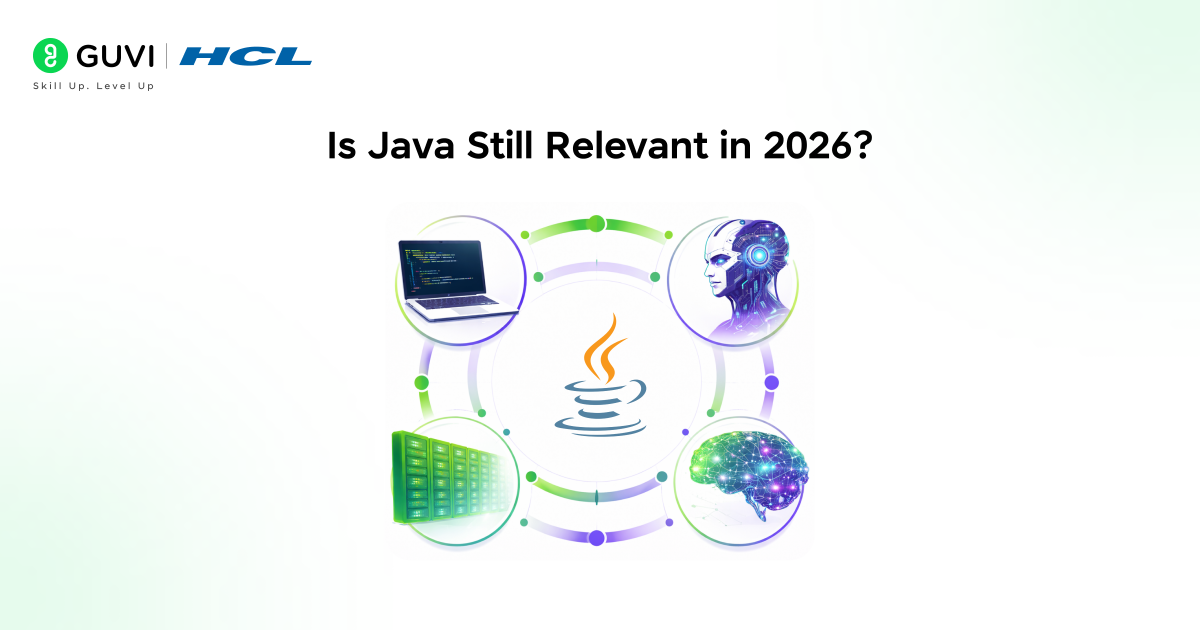
Java remains highly relevant in 2026 because large-scale systems continue to rely on predictable performance, strong type safety, and long-term maintainability.
Modern Java versions support high-throughput workloads through virtual threads, improved garbage collection, and optimized memory handling, which aligns well with cloud-native deployment models.
Hiring teams value Java developers who understand concurrency, API design, and JVM behavior since these skills translate directly into resilient production systems.
Turn Java skills into hiring power with HCL GUVI’s Java Course—learn, build, certify, and get interview-ready faster.
Why Is Spring Boot Non-Negotiable for Java Jobs?
Spring Boot has become essential for Java roles because it standardizes how production-grade applications are built, configured, and deployed. Teams expect developers to create REST APIs, integrate databases, manage configurations, and expose secure endpoints using Spring Boot conventions.
The framework simplifies dependency management and environment-specific configuration. It allows applications to move smoothly across development and cloud environments.
Spring Boot also aligns closely with microservice architecture through embedded servers and observability hooks that support modern DevOps workflows.
Ready to turn backend skills into job offers? HCL GUVI’s Java Spring Boot Course takes you from fundamentals to production-ready applications with hands-on projects, microservices, security, deployment, and a real banking capstone project. Build the skills companies hire for and create projects that stand out in interviews.
Applications of Java Spring Boot: What You Need to Know to Get Hired
Many companies hire based on practical business use cases rather than technology names alone. Understanding where this stack is used helps candidates connect their skills with real hiring demand across industries.
1. Banking and Financial Systems
Java Spring Boot powers secure transaction systems, payment platforms, and account management applications where reliability and scalability are critical.
2. E-Commerce Platforms
Java Spring Boot is widely used for product catalogs, order processing, inventory management, and customer management systems.
3. Microservices and Cloud Applications
Java Spring Boot helps organizations build independent services that are easier to deploy, scale, and maintain in cloud environments.
4. SaaS Products
Many companies use Java Spring Boot to develop subscription-based business software, internal tools, and customer-facing platforms.
5. Healthcare and Enterprise Applications
Java Spring Boot supports large-scale applications that manage records, workflows, compliance requirements, and business operations.
Top Java Spring Boot Career Paths in 2026
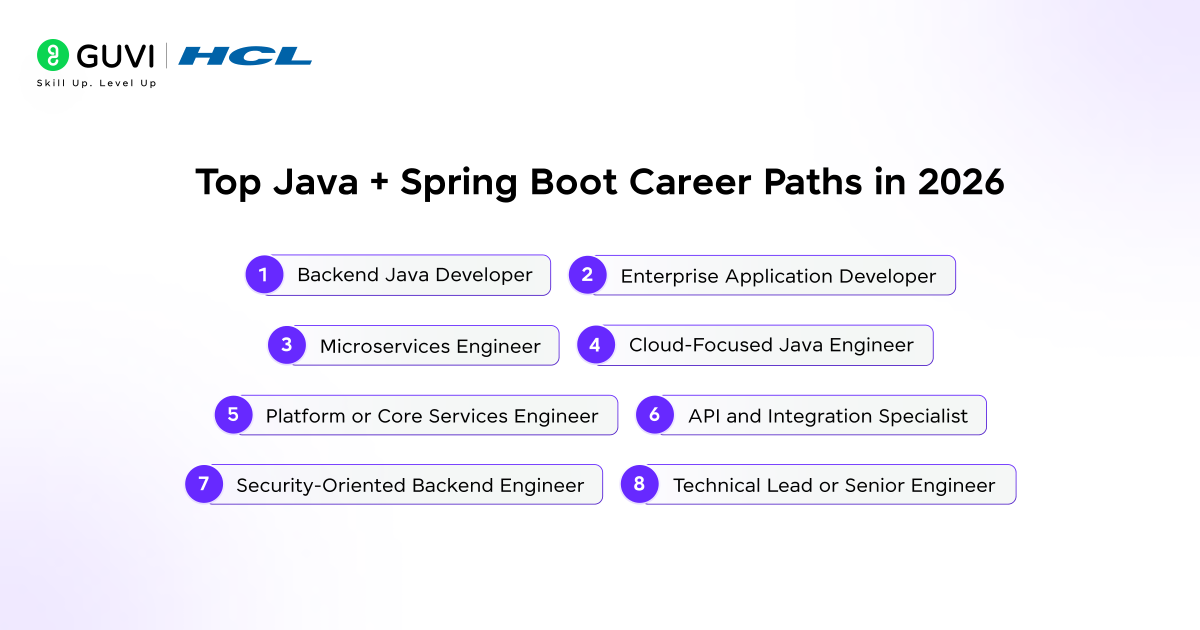
- Backend Java Developer: This role focuses on building APIs, handling business logic, and managing data persistence using Spring Boot. Daily work involves performance-aware coding and collaboration with frontend and DevOps teams.
- Enterprise Application Developer: This path centers on large, long-lived systems used by finance, healthcare, logistics, and government organizations. Responsibilities include maintaining stability, improving scalability, and supporting complex domain rules.
- Microservices Engineer: This role emphasizes service decomposition, inter-service communication, and configuration management. Experience with Spring Boot in distributed systems supports scalable and resilient architectures.
- Cloud-Focused Java Engineer: This career path combines Spring Boot development with cloud deployment knowledge. Work includes containerized services, environment configuration, and close coordination with platform teams.
- Platform or Core Services Engineer: This role involves building shared libraries, internal frameworks, and foundational services. Strong Java fundamentals and deep knowledge of Spring support consistency across multiple teams.
- API and Integration Specialist: This path focuses on designing and maintaining APIs that connect internal systems with external platforms. Clear contract design and error handling improve system reliability.
- Security-Oriented Backend Engineer: This role centers on access control, authentication flows, and secure service design. Spring Boot security experience supports compliance-driven applications.
- Technical Lead or Senior Engineer: This career direction adds design reviews, mentoring, and architectural decision-making to core development work. Strong expertise in Java Spring Boot supports leadership responsibilities.
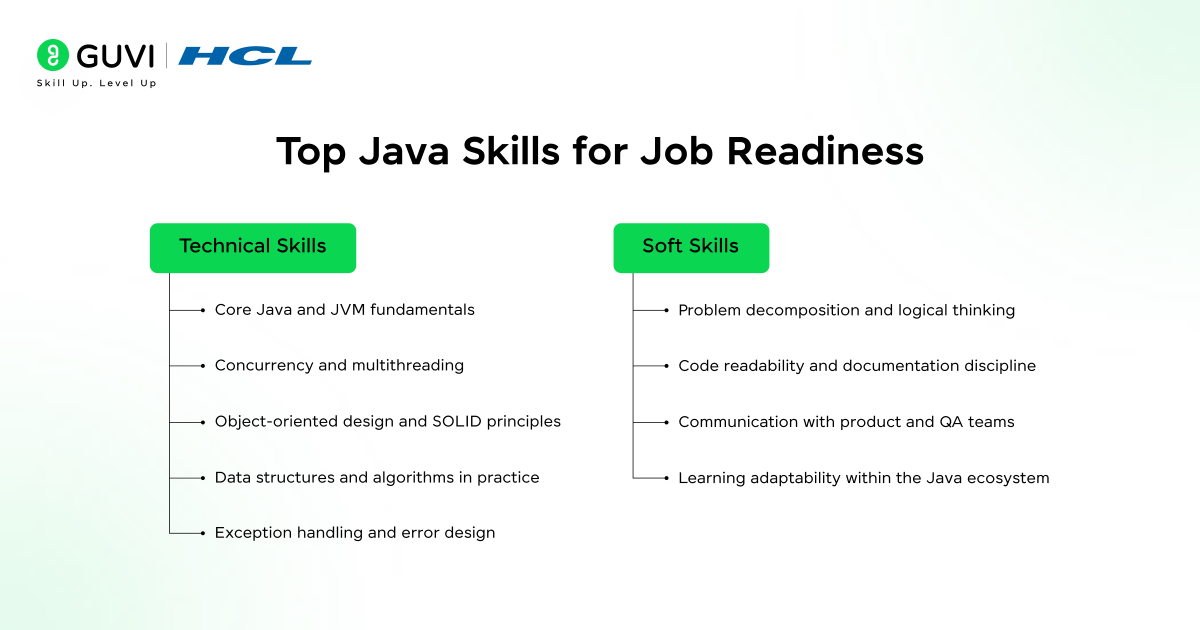
Essential Java Skills for Job Readiness
Technical Skills
- Core Java and JVM Fundamentals: Strong command over Java syntax, memory management, and JVM behavior supports writing predictable and efficient production code.
- Concurrency and Multithreading: Knowledge of threads, executors, and modern concurrency models helps applications handle parallel workloads without performance bottlenecks.
- Object-Oriented Design and SOLID Principles: Clear application of OOP concepts improves code structure and supports long-term maintainability in shared codebases.
- Data Structures and Algorithms in Practice: Practical understanding of collections, time complexity, and problem-solving strengthens backend logic and interview performance.
- Exception Handling and Error Design: Structured error handling improves system reliability and supports clearer debugging and monitoring in production environments.
Soft Skills
- Problem Decomposition and Logical Thinking: Ability to break complex requirements into manageable components improves development speed and code clarity.
- Code Readability and Documentation Discipline: Clear naming, comments, and documentation support collaboration across distributed engineering teams.
- Communication with Product and QA Teams: Clear technical explanations align development work with business requirements and testing workflows.
- Learning Adaptability within the Java Ecosystem: Openness to new Java releases and tooling keeps skills aligned with industry expectations.
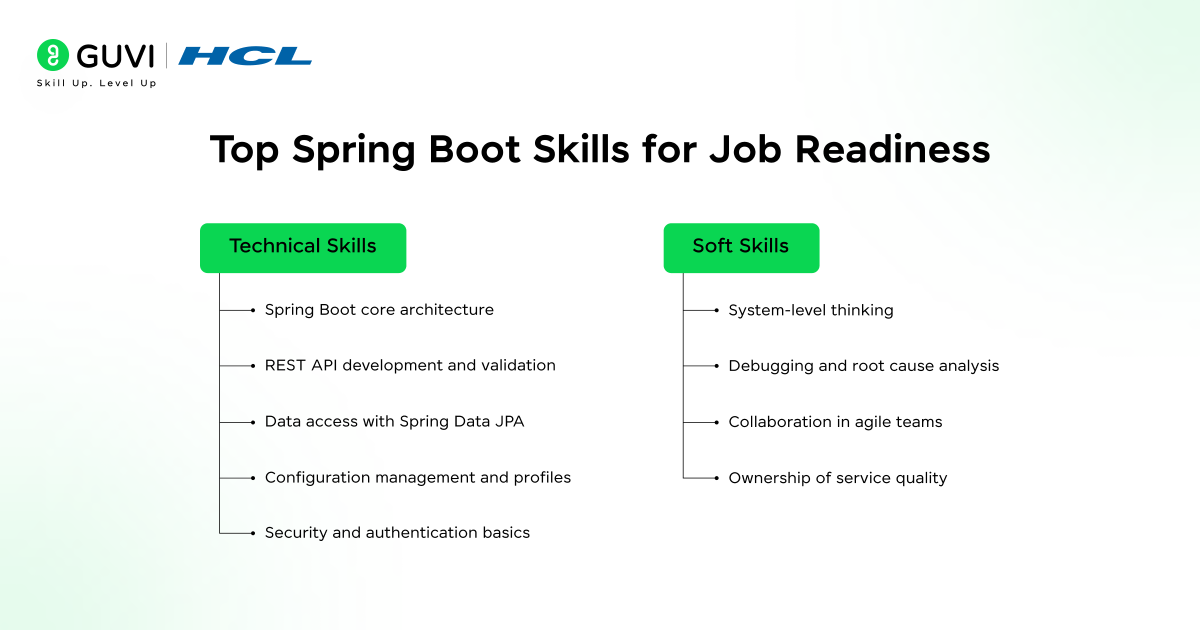
Essential Spring Boot Skills for Job Readiness
Technical Skills
- Spring Boot Core Architecture: Understanding of auto-configuration, dependency injection, and application context supports clean and scalable service design.
- REST API Development and Validation: Experience with controllers, request validation, and structured responses ensures reliable API behavior across clients.
- Data Access with Spring Data JPA: Knowledge of repositories, entity mapping, and transaction boundaries helps ensure consistent database interactions.
- Configuration Management and Profiles: Proper use of application properties and profiles supports smooth transitions across environments.
- Security and Authentication Basics: Familiarity with securing endpoints and managing access controls helps protect APIs and sensitive data.
Soft Skills
- System-Level Thinking: Awareness of how services interact within a larger architecture improves design decisions and reduces integration issues.
- Debugging and Root Cause Analysis: Structured troubleshooting improves system stability and reduces production downtime.
- Collaboration in Agile Teams: Clear coordination with frontend, DevOps, and QA teams supports faster delivery cycles.
- Ownership of Service Quality: Responsibility for performance and maintainability reflects readiness for real-world engineering roles.
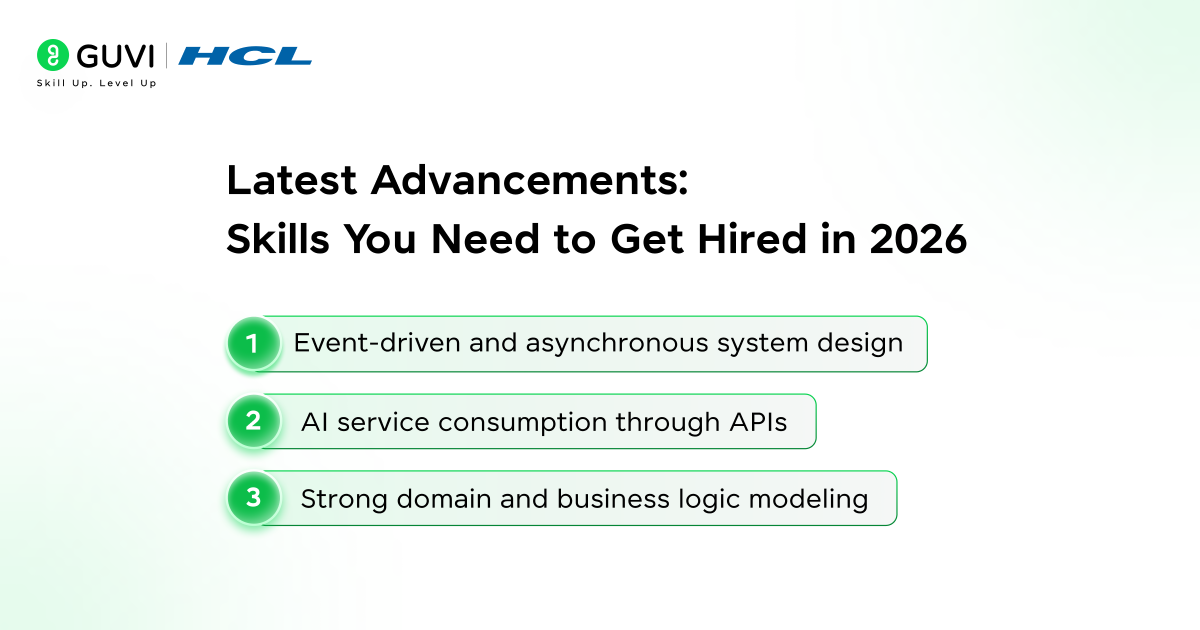
Latest Advancements: Skills You Need to Get Hired in 2026
- Event-Driven Architecture Advancements
Many enterprise systems rely on events and asynchronous processing to manage scale. Understanding message queues, background workers, and event streams improves system responsiveness. This advancement supports high-throughput and resilient backend design.
- AI Service Integration Advancements
Backend systems frequently consume AI services through APIs. Understanding of latency handling and fallback strategies improves reliability of Java developers.
- Domain and Business Logic Advancements
Strong backend developers understand business context alongside code. Translating requirements into stable domain logic improves system accuracy. This advancement differentiates contributors who build sustainable systems.
Java Spring Boot Skills and Hiring Expectations in 2026
| Hiring Area | What Most Beginners Learn | What Companies Actually Expect |
|---|---|---|
| Java Knowledge | Syntax, OOP, collections | Multithreading, streams, concurrency, JVM basics, and clean code practices |
| Spring Boot Skills | CRUD applications | Production-ready APIs, validation, exception handling, logging, and testing |
| Database Skills | Basic SQL queries | Query optimization, transactions, indexing, and database design |
| APIs | Building endpoints | API versioning, security, documentation, and scalability |
| Security | Basic authentication | JWT, OAuth2, role-based access control, and secure coding |
| Architecture | Monolithic projects | Microservices, event-driven design, and service communication |
| Deployment | Running locally | Docker, CI/CD pipelines, cloud deployment, and monitoring |
| Portfolio | Tutorial projects | Real-world projects solving business problems |
| Interviews | Coding questions only | Coding, system design, debugging, and communication skills |
| Resume | Technology lists | Measurable impact, projects, and production experience |

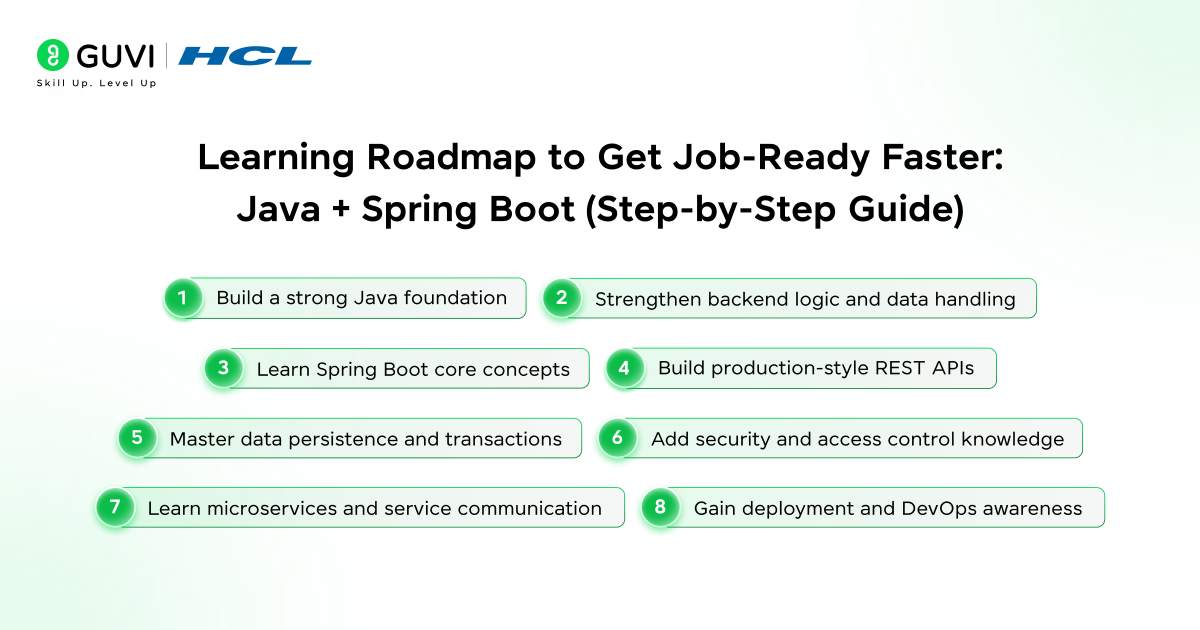
Learning Roadmap to Get Job-Ready Faster: Java Spring Boot (Step-by-Step Guide)
Step 1: Build a Strong Java Foundation
Java fundamentals form the base of every backend role, which makes clarity in syntax, object-oriented principles, and JVM behavior essential. Concepts such as memory management, collections, exception handling, and concurrency should be practiced through small programs that reflect real backend logic. Exposure to modern Java features strengthens confidence and aligns skills with current production standards.
Step 2: Understand Backend Development and Data Handling
Backend hiring focuses on how data flows through systems, which requires solid knowledge of data structures and algorithmic thinking. Practical problem-solving using collections, streams, and concurrency patterns improves logical clarity. Application-level thinking should replace theoretical problem solving, since hiring managers evaluate how solutions behave under real constraints.
Step 3: Learn Spring Boot Core Concepts Thoroughly
Spring Boot becomes relevant once Java basics feel natural, since framework abstraction depends on an understanding of the language. Knowledge of dependency injection, application context, auto-configuration, and starter dependencies helps developers reason about application behavior. Configuration management and environment handling prepare applications for multi-stage deployment.
Step 4: Build REST APIs That Reflect Real Systems
API development represents a core hiring requirement for backend roles. Skills around request handling, validation, error responses, and API structure demonstrate readiness for production work. Exposure to versioning strategies and consistent response models improves service reliability. This phase reinforces how backend services interact with frontend and external systems.
Step 5: Master Data Persistence and Transactions
Enterprise applications depend heavily on data accuracy and consistency, which makes persistence skills critical. Knowledge of Spring Data JPA, entity mapping, and transactional boundaries supports stable database interaction. Query performance awareness and pagination handling reflect real-world optimization needs. This step connects application logic with long-term data integrity.
Step 6: Add Security and Access Control Knowledge
Hiring teams expect backend developers to protect data and services through proper access control. Familiarity with authentication flows, role-based authorization, and secured endpoints improves trust in system design. Awareness of common security risks strengthens production readiness. This phase signals responsibility beyond feature delivery.
Step 7: Learn Microservices and Service Communication
Modern Java roles often involve distributed systems rather than monolithic applications. Understanding service communication patterns, centralized configuration, and fault handling supports scalable design. Knowledge of how Spring Boot fits into microservice ecosystems strengthens architectural discussions during interviews. This step prepares candidates for the expectations of mid-level and senior roles.
Step 8: Gain Deployment and DevOps Awareness
Production systems require more than local execution, which makes deployment knowledge valuable. Understanding build tools, environment configuration, and containerized deployment improves collaboration with DevOps teams. Awareness of CI pipelines and release workflows aligns development work with operational realities.
Job Search, Applications, and Tools in 2026
- Job Portals and Hiring Platforms: Use platforms like LinkedIn Jobs, Indeed, Wellfound, Naukri and company career pages to find Java Spring Boot roles. Enterprise hiring often occurs directly through company portals, making regular tracking important.
- Code Hosting and Portfolio Platforms: GitHub acts as a technical resume in 2026. Clean repositories, meaningful commit messages, and clear README files improve credibility.
- Resume and Application Tools: Tools like Resume Worded, Jobscan, and Teal help align resumes with job descriptions. These platforms improve keyword matching and formatting for automated screening systems.
- Interview Preparation Platforms: LeetCode, HackerRank, CodeSignal, and InterviewBit help prepare for coding rounds.
What Java Spring Boot Projects Should Be in Your Portfolio?
- Production-Ready REST API: This project demonstrates structured API design using controllers, service layers, and repositories. It reflects clear handling of requests, validation logic, and consistent response formats that align with real backend systems.
- Database-Centric Business Application: Another project that you should add must be related to database-centric business application. It focuses on relational data modeling, entity relationships, and transactional consistency. It highlights the practical use of JPA, query optimisation, and long-term data integrity in enterprise applications.
- Authentication and Role Management System: This one showcases secure access control through user roles and protected endpoints. It represents responsible backend design with attention to data protection and authorization flow.
- Microservice Architecture-Based Application: This project illustrates service separation, inter-service communication, and configuration management. It signals readiness to work with distributed systems and modern backend architectures.
- Business Logic Processing Service: This one highlights complex rule evaluation and domain-driven logic. It demonstrates the proficiency to convert requirements into maintainable Java code with clear validation paths.
- Testing-Oriented Backend Application: This project centers on unit and integration testing that validates critical flows. It shows ownership of code quality and confidence in system behavior.
- Deployment-Prepared Spring Boot Application: It focuses on build configuration, environment profiles, and container readiness. It reflects understanding of production deployment expectations and operational consistency.
Top Resume Building Tips
- Highlight Production-Relevant Skills: Resume content should focus on Java Spring Boot skills that map directly to backend job requirements. Clear mention of APIs, data handling, and system design improves relevance.
- Use Clear and Precise Technical Language: Skill descriptions should remain specific and accurate. Precise terminology reflects strong understanding and avoids vague impressions.
- Align Skills with Job Descriptions: Resume keywords should match the technical language used in job postings. Alignment improves the success of shortlisting in automated screenings.
- Include Testing and Quality Practices:
Mention of testing practices reflects maturity and reliability. Quality focus strengthens backend hiring confidence. - Avoid Overloading with Tools Listing too many Spring Boot or Java tools reduces clarity. Relevant and well-used technologies create stronger impressions.
- Update Regularly with Recent Experience
Resume content should reflect current skills and projects. Fresh experience signals active learning and job readiness.
Looking to strengthen your full-stack development skills? HCL GUVI’s IITM Pravartak-Certified Full Stack Development Course helps you build real-world projects, learn from industry mentors, and prepare for modern software development careers.
Conclusion
Java Spring Boot remains a strong hiring anchor in 2026 because companies continue to value stability, scalability, and production reliability. Developers who build a solid foundation in Java, apply Spring Boot correctly, and demonstrate real systems thinking stand out in interviews. Focused learning, practical projects, and clear resumes convert technical skills into consistent hiring outcomes across enterprise and cloud-driven roles.
FAQs
1. Is Spring Boot still relevant in 2026?
You need a solid understanding of Java basics such as OOP concepts, collections, exceptions, multithreading, and annotations. Advanced Java knowledge is helpful but not required to start with Spring Boot.
2. How much Java knowledge is required for Spring Boot?
Yes. Spring Boot remains one of the most widely used backend frameworks for enterprise applications, microservices, banking systems, and cloud-native development in 2026.
3. What skills do you need for Spring Boot?
Key skills include Java, Spring Boot fundamentals, REST APIs, databases, SQL, JPA, security, microservices, and version control tools such as Git.
4. Is Spring Boot front end or backend?
Spring Boot is a backend framework. It is mainly used to build APIs, business logic, authentication systems, and server-side applications.
5. What is @Primary and @Qualifier in Spring Boot?
@Primary tells Spring to use one bean by default when multiple beans of the same type exist. @Qualifier lets you specify exactly which bean should be injected.
6. Do certifications help in Java Spring Boot hiring?
Certifications add credibility, yet real projects and clean code carry more weight. Hiring managers rely more on demonstrated problem solving and production-style experience.
Success Stories





















Did you enjoy this article?