


Python Articles
Go vs Python for Forward Deployed Engineering Workloads
Python for Forward Deployed Engineers: What You Actually Need to Know
Freelancing as a Python Developer: Getting Your First Client


Get In Touch For Details! Request More Information

Type Hinting in Python: Why It Matters for Job Readiness
Mar 25, 2026 7 Min Read 1469 Views
(Last Updated)
Why do recruiters and technical interviewers increasingly ask Python candidates about type hinting? In a language known for flexibility, type hints have become the mark of structured and professional code. They help teams write software that is readable, reliable, and easier to maintain.
Python’s dynamic nature allows freedom, but that freedom can lead to unexpected errors in large systems. Type hinting introduces discipline by making data types explicit and predictable. Read on to learn how mastering type hinting improves your job readiness, coding precision, and confidence in handling large-scale Python projects.
Table of contents
- What is Type Hinting in Python?
- Why is Type Hinting Important in Modern Development?
- Early Detection of Runtime Errors
- Improved Readability and Collaboration
- Better Integration with Python IDEs and Static Analysis Tools
- Easier Debugging, Refactoring, and API Documentation
- How Type Hinting Enhances Job Readiness?
- Professional Discipline and Industry Alignment
- Collaboration and Code Transparency
- Framework Integration and Real-World Application
- Interview and Career Advantages
- Bridging Learning and Professional Practice
- Top Use Cases of Type Hinting in Modern Python Development
- Enterprise-Scale Applications
- Data Engineering and Machine Learning Pipelines
- API Development and Validation
- Collaborative Open-Source and Multi-Team Projects
- Refactoring and Legacy System Modernization
- Best Practices for Implementing Type Hinting
- Adopt Type Hints Early in Framework-Based Projects
- Common Challenges Developers Face Without Type Hinting
- Future of Type Hinting in Python Development
- Conclusion
- FAQs
- How does type hinting improve collaboration in Python projects?
- Does type hinting affect Python’s runtime performance?
- Why should beginners learn type hinting early in their Python journey?
What is Type Hinting in Python?
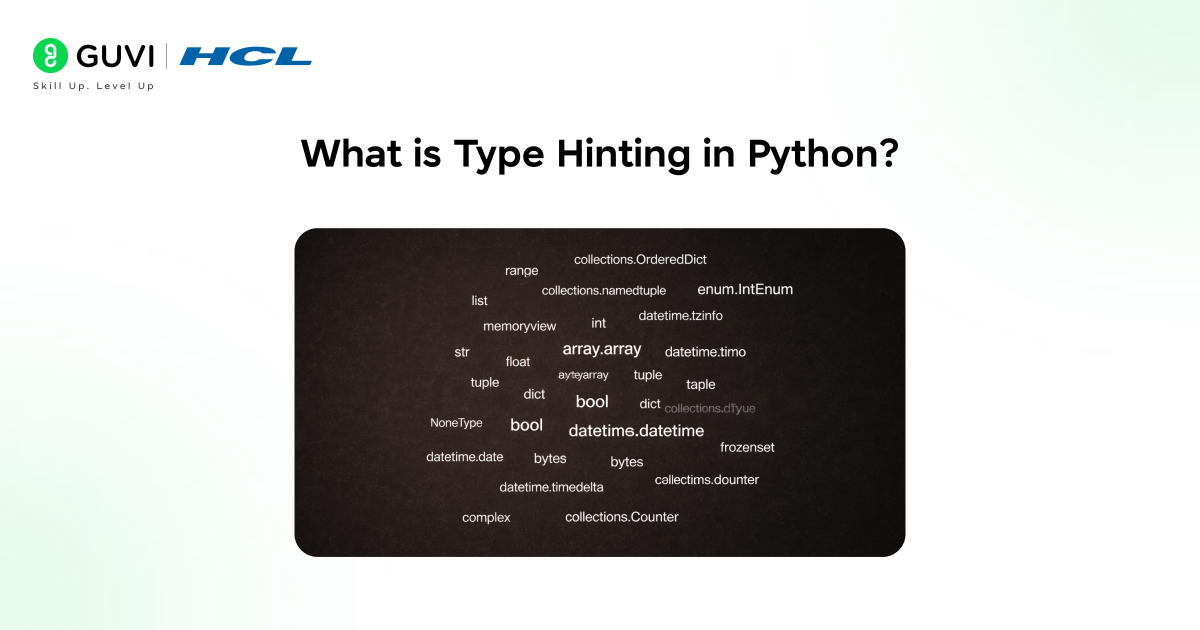
Type hinting in Python brings structure and predictability to a language known for its flexibility. It allows developers to explicitly define the expected data types of variables, function arguments, and return values. This clarity helps prevent logical errors that might otherwise appear during runtime. Type hints improve collaboration in multi-developer projects because they make function intentions clear without needing to trace through the entire code.
Why is Type Hinting Important in Modern Development?
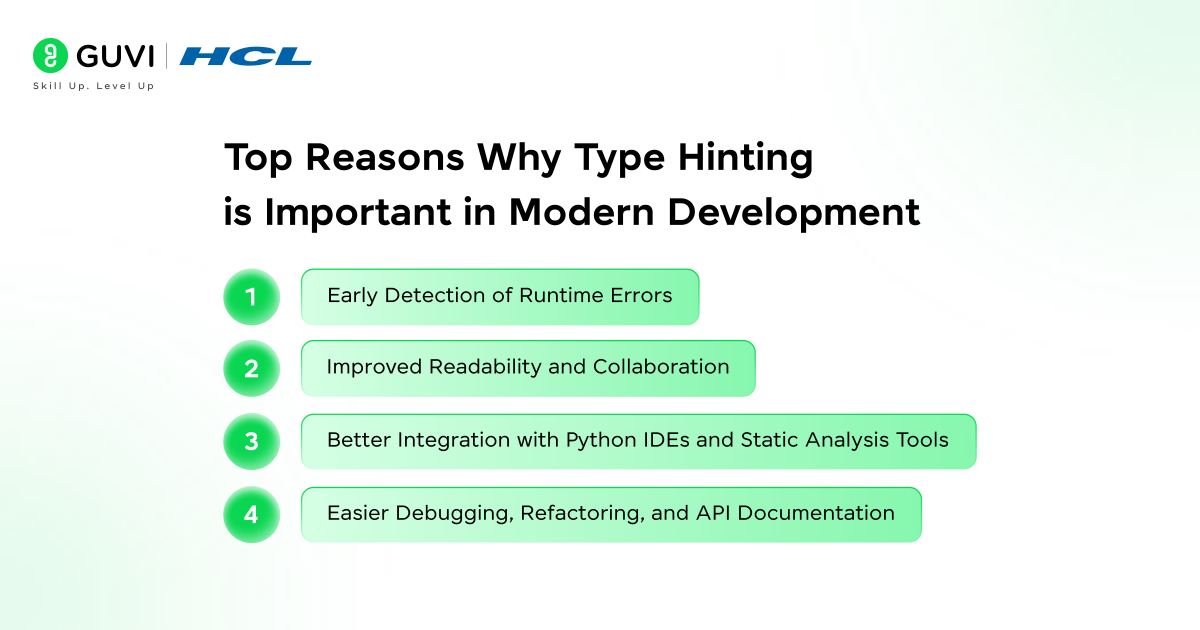
Type hinting has become a central part of writing reliable and maintainable Python frameworks. The following sections explain why it matters across multiple aspects of professional development.
1. Early Detection of Runtime Errors
Type hinting identifies mismatched or unexpected data types before the program runs. This early detection prevents errors that might otherwise appear during execution, which makes debugging less time-consuming. Static type checkers such as mypy or Pyright analyze code before runtime and highlight inconsistencies between variable definitions and function outputs.
2. Improved Readability and Collaboration
A clear understanding of what a function expects and returns builds stronger collaboration among teams. Type hints describe variable intent directly within the code, reducing the need to search through documentation or previous commits. Type annotations act as a shared language between contributors in large teams or open-source environments. They communicate assumptions clearly, which reduces confusion and misinterpretation during reviews or refactoring.
3. Better Integration with Python IDEs and Static Analysis Tools
Modern integrated development environments depend on type hints to provide intelligent assistance. Editors such as PyCharm and VS Code use these annotations to suggest autocompletions, detect possible bugs, and provide inline documentation. Static analysis tools also use type data to generate reports, which highlight weak areas in the code structure. This combination of tooling and annotation elevates the development experience to a professional standard consistent with large-scale software engineering practices.
4. Easier Debugging, Refactoring, and API Documentation
Debugging becomes faster when functions define explicit data types. Developers can trace errors through clearly defined type boundaries, which limits guesswork during troubleshooting. Refactoring also benefits from type hinting because changes in one part of the program can be validated automatically through type checkers. Frameworks such as FastAPI and Pydantic use these hints to auto-generate documentation and enforce data validation rules. This integration improves the reliability of APIs and provides transparency in how data moves across systems.
Boost your Python skills with our Free Python eBook, designed for beginners and aspiring developers. Learn core concepts, real-world examples, and interview-ready coding practices to accelerate your learning journey.
How Type Hinting Enhances Job Readiness?
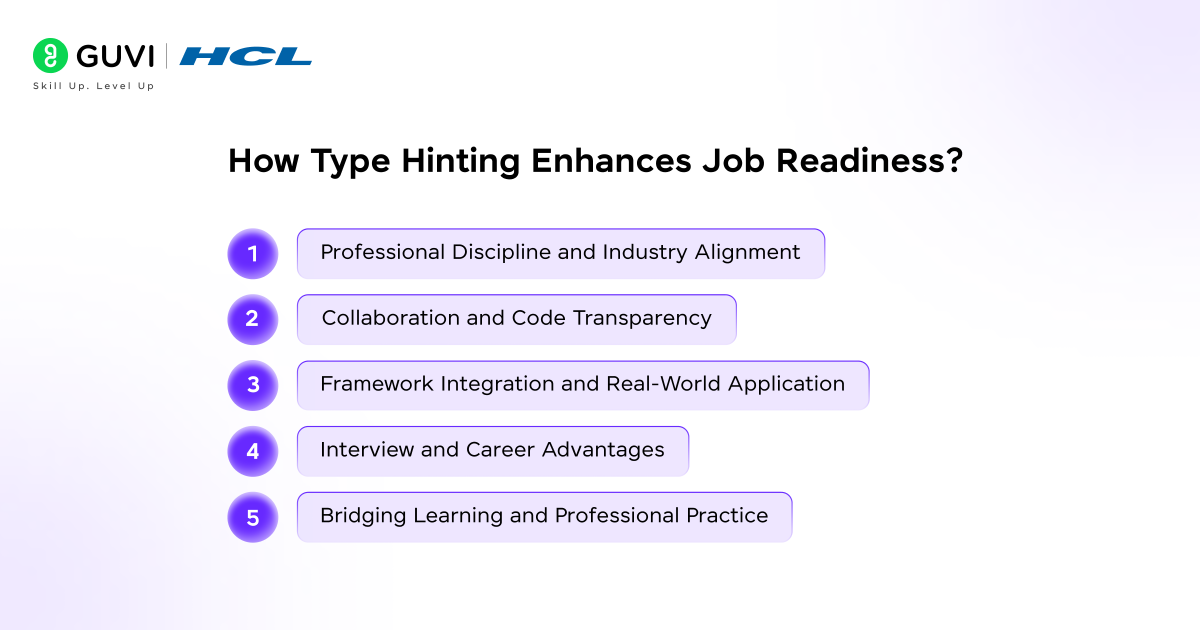
Type hinting serves as more than a code improvement tool. It reflects the mindset of a professional developer who writes structured and collaborative software. In modern recruitment, such attention to clarity and consistency often distinguishes candidates ready for production environments from those still learning core principles.
1. Professional Discipline and Industry Alignment
Modern software development depends on predictability and consistency. Companies build continuous integration and testing workflows around static analysis tools such as mypy, Pyright, and SonarQube. Type hints integrate seamlessly into these systems, allowing early detection of data mismatches and logic inconsistencies before deployment.
Software developers who adopt this approach demonstrate foresight in preventing issues rather than fixing them after release. This mirrors how engineering teams in professional environments maintain software stability through verification at every stage of development.
Type hinting also reflects attention to long-term maintainability. Structured typing provides clarity about how data moves through functions and APIs, which strengthens confidence during refactoring or feature expansion. Employers value this trait because it reduces technical debt and ensures that new functionality integrates safely into existing architectures.
2. Collaboration and Code Transparency
In modern teams, collaboration depends on clear communication through code. Type hints serve as an internal guide that defines what each function expects and produces, removing ambiguity across contributors. This transparency reduces the time needed for reviews and clarifications during pull requests.
In large organizations, developers frequently work on shared repositories or transition between projects. Typed code acts as built-in documentation, allowing new team members to understand existing logic without lengthy onboarding. Managers and senior engineers can evaluate correctness more efficiently, which accelerates both delivery and decision-making.
3. Framework Integration and Real-World Application
Contemporary frameworks such as FastAPI, Pydantic, and SQLModel depend heavily on type hints to manage data validation and schema generation. These frameworks use annotations to enforce strict contracts between client and server, improving reliability in distributed architectures. Developers experienced with typing find it easier to adapt to such tools and produce robust APIs that pass quality checks automatically.
Familiarity with type-driven frameworks demonstrates applied knowledge that extends beyond syntax memorization. It shows an understanding of scalability, system interaction, and structured data flow, qualities expected in backend and full-stack engineering roles.
4. Interview and Career Advantages
In technical interviews, candidates who understand type hinting often communicate logic more clearly and reason about system design with greater precision. Explaining how typing improves debugging, testing, and maintenance shows awareness of production-level practices.
Recruiters interpret this skill as an indicator of maturity and readiness for teamwork in structured environments. It reflects a mindset focused on clarity, documentation, and foresight, key traits for mid to senior-level developers who handle long-term project growth.
5. Bridging Learning and Professional Practice
Type hinting closes the gap between learning syntax and writing production-grade code. It trains developers to think systematically about data structures, dependencies, and application behavior. This discipline creates a foundation for continuous improvement, where every function carries both purpose and context.
Mastering type hinting signals readiness for professional collaboration and technical responsibility. Developers who apply it consistently write code that performs reliably, communicates intent clearly, and evolves with the demands of modern software engineering.
Level up your coding journey with HCL GUVI’s Python Tutorials. Learn Python from basics to advanced applications with hands-on projects, certifications, and mentor support to launch your tech career.
Top Use Cases of Type Hinting in Modern Python Development
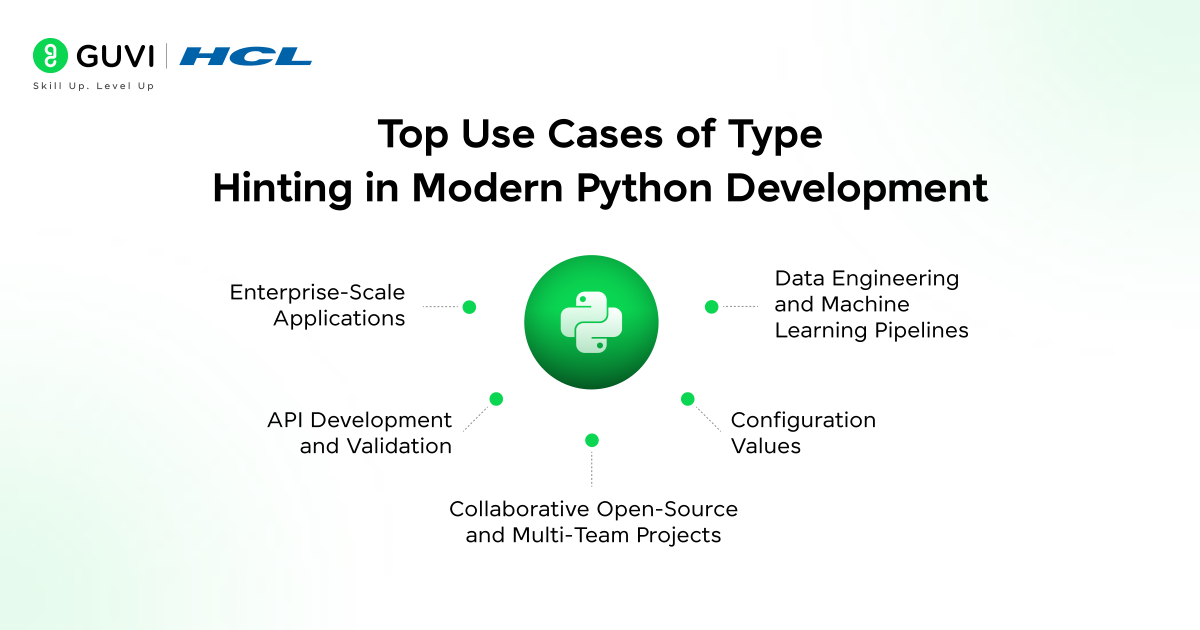
Type hinting extends far beyond readability. It serves as a structural foundation in production systems and modern web development frameworks that rely on predictable data flow. Its application can be seen across diverse domains of Python development where precision and maintainability are essential. Here are the main ones:
1. Enterprise-Scale Applications
Large organizations depend on stable and consistent codebases. In these environments, type hinting reduces ambiguity across thousands of interconnected modules. Teams working on the same project can define clear expectations between services, which minimizes integration errors.
Type annotations in backend logic, data validation layers, and APIs help maintain uniformity across distributed systems. Static type checking becomes part of the build process, which ensures that every update aligns with predefined contracts before deployment.
2. Data Engineering and Machine Learning Pipelines
Data-driven projects often involve complex transformations and unstructured inputs. Type hints create predictability in data flow between extraction, transformation, and model training stages. Python libraries such as pandas, NumPy, and Pydantic integrate type annotations to improve reliability when handling numerical arrays or JSON records.
This reduces type-related bugs that occur when merging datasets or processing real-time data streams. In ML pipelines, type safety improves compatibility between preprocessing scripts, model interfaces, and inference APIs.
3. API Development and Validation
Modern API frameworks rely on type hinting to generate accurate documentation and enforce data consistency. FastAPI, one of Python’s most popular frameworks, uses type annotations to validate request and response bodies automatically. This ensures that APIs reject incorrect input before it reaches the core logic.
Clear type definitions also allow automatic creation of OpenAPI documentation, which saves time and improves transparency for front-end and third-party developers. Type hinting, in this context, becomes a structural contract between client and server applications.
4. Collaborative Open-Source and Multi-Team Projects
In distributed teams, communication often happens through code rather than meetings. Type hints standardize expectations in Python web development without extensive external documentation. Contributors can understand a function’s purpose and output at a glance.
Open-source maintainers use static analysis tools to detect type mismatches across pull requests, which increases trust in contributions. This approach improves collaboration efficiency and reduces regression risks across evolving codebases.

5. Refactoring and Legacy System Modernization
Type hinting provides safety during modernization of older Python systems. Adding annotations to legacy code helps identify hidden dependencies and unexpected behaviors. Tools such as mypy and Pyre can flag inconsistencies that went unnoticed for years.
As teams refactor large monoliths into modular structures, type hints act as guides that prevent structural drift. Gradual adoption of typing also aligns legacy systems with modern frameworks that expect strong typing in their integrations.
Become a certified Python developer with HCL GUVI’s Python Course, powered by IIT-M Pravartak. Master Python from fundamentals to advanced concepts through mentor-led training, live projects, and job placement support, everything you need to kickstart a successful coding career.
Best Practices for Implementing Type Hinting
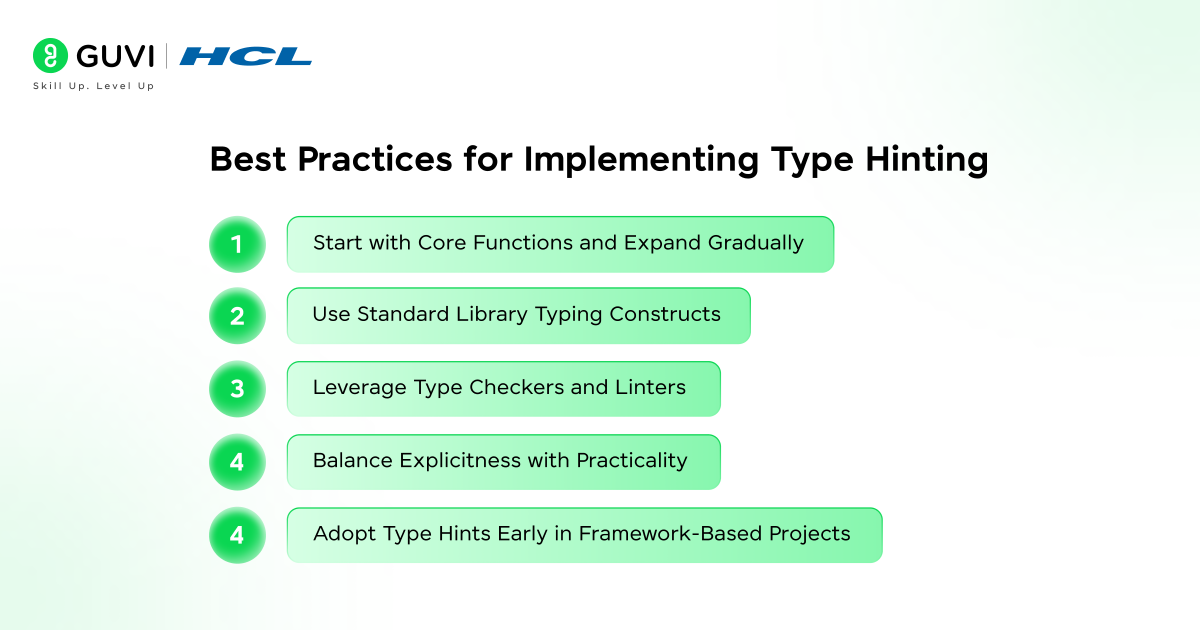
- Start with Core Functions and Expand Gradually
Introducing type hints across an entire project at once can be overwhelming, especially in legacy codebases. A gradual approach works better. Begin with frequently used functions such as data processors, utility modules, and API handlers. These components form the backbone of the application, and strong typing here quickly improves stability.
As confidence builds, extend typing to secondary layers like models and external integrations. This step-by-step strategy ensures consistent adoption without breaking existing functionality.
- Use Standard Library Typing Constructs
Python’s typing module provides built-in support for annotations such as List, Dict, Tuple, and Union. Using these consistently maintains readability and avoids ambiguity. For example, defining a function as def get_user(id: int) -> Dict[str, str]: conveys both intent and expected output. More advanced constructs, such as Optional, Any, and Callable, handle flexible situations where multiple input types are possible. Developers who apply these correctly create self-documenting code that can adapt to complex data patterns while maintaining precision.
- Leverage Type Checkers and Linters
Static analysis tools such as mypy, Pyright, and flake8 help validate annotations across a codebase. Running them as part of a continuous integration pipeline ensures that new commits maintain consistent typing standards. These tools identify mismatched arguments, missing annotations, and unnecessary complexity before deployment. Integrating them into everyday workflows builds discipline and keeps the codebase predictable even as it grows in scale.
- Balance Explicitness with Practicality
Over-annotation can clutter code, especially in small scripts or prototypes. Developers should focus on meaningful annotations that improve understanding rather than labeling every minor variable. For example, type-hinting function parameters and return values often provides enough clarity. Internal variables can remain unannotated unless they hold complex structures. This balance keeps the code readable while retaining the benefits of static type checking.
5. Adopt Type Hints Early in Framework-Based Projects
Frameworks such as FastAPI, Pydantic, and SQLAlchemy benefit directly from strong type definitions. FastAPI uses annotations to validate input data and generate documentation automatically. Pydantic models enforce data consistency by validating types at runtime. Integrating typing at the start of development aligns the project with framework conventions and prevents inconsistencies as the codebase expands. Early adoption saves refactoring time later and promotes long-term maintainability.
Common Challenges Developers Face Without Type Hinting
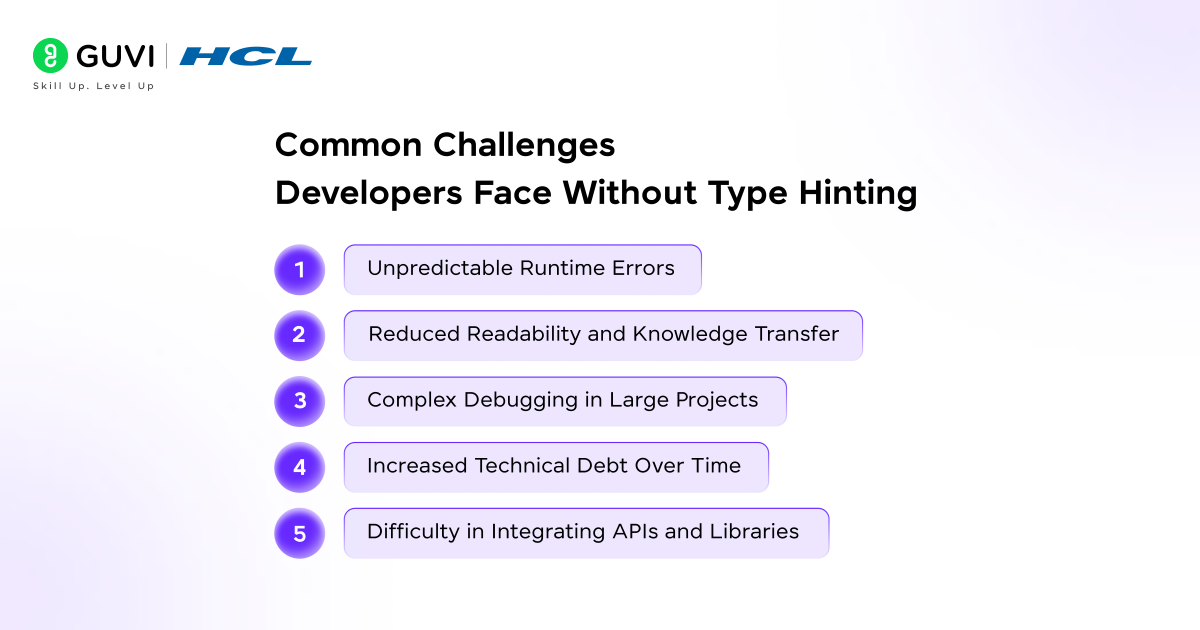
- Unpredictable Runtime Errors
Python’s flexibility allows developers to assign any data type to variables. This freedom helps beginners but can lead to silent type mismatches that trigger errors only during execution. A function may expect a string but receive an integer, causing the program to fail midway through processing. Such errors are difficult to trace because the interpreter detects them only after the faulty code path is executed. Type hinting addresses this by introducing static validation, which detects these mismatches before the program runs.
- Reduced Readability and Knowledge Transfer
In codebases lacking type hints, it becomes harder to infer what kind of data a function expects or returns. Developers reading unfamiliar modules often waste time deducing intent through trial and error. In team environments, this leads to slower onboarding and longer review cycles.
Type annotations serve as built-in documentation that conveys function’s purpose at a glance. This clarity supports both maintenance and knowledge transfer within growing teams.
- Complex Debugging in Large Projects
As projects expand, data passes through multiple layers such as APIs, database handlers, and business logic. Without type clarity, identifying where an incorrect data format enters the system becomes tedious. Debugging sessions grow longer as developers rely on print statements or runtime checks. Type hinting adds a safeguard that highlights type inconsistencies across layers, reducing debugging time and improving traceability across modules.
- Increased Technical Debt Over Time
Code written without type definitions tends to grow brittle as features evolve. Minor updates can introduce unexpected behavior because developers may unknowingly pass incompatible data structures between functions. Each new feature adds more risk to the system’s stability. Incorporating type hints enforces discipline and consistency, which allows developers to refactor confidently without fear of hidden side effects.
- Difficulty in Integrating APIs and Libraries
APIs and third-party libraries operate based on strict data expectations. Passing incorrect types, such as sending a list instead of a dictionary to a JSON endpoint, can cause failures that are hard to trace. Type hinting defines explicit boundaries for external integrations and prevents data inconsistencies during serialization or deserialization. This reliability is crucial in web, data, and microservice-based applications where data flow consistency determines stability.
Future of Type Hinting in Python Development
Since the introduction of type hints in PEP 484 (2015) and their refinement through PEP 563 and PEP 604, Python has gradually positioned typing as a first-class feature. Newer releases, such as Python 3.10 and 3.11 introduced native union types using the | operator and stricter runtime validation in libraries like typing and collections.abc. These refinements simplify annotation syntax and reduce dependency on external tools. Developers now write cleaner and more expressive type definitions that blend naturally with Python’s readability.
- Broader Adoption Across Industries
Type hinting aligns with the increasing demand for maintainable and auditable code in sectors like healthcare and cybersecurity. These industries require strict validation of software behavior, and type annotations provide a layer of clarity that supports compliance and traceability. Organizations integrating Python into large systems prefer typed codebases because they reduce ambiguity during audits, updates, and integrations.
As Python continues to dominate web, Artificial Intelligence, and automation ecosystems, type hinting strengthens its reputation as a language suitable for enterprise-scale development rather than small-scale scripting.
Conclusion
Type hinting has become a defining skill for Python developers preparing for professional roles. It bridges flexibility with structure and turns simple scripts into reliable, maintainable systems. Employers increasingly view it as a marker of disciplined programming and collaboration readiness. Mastering type hinting helps developers write code that communicates intent clearly, integrates seamlessly with modern frameworks, and meets the precision expected in enterprise-grade applications.
FAQs
1. How does type hinting improve collaboration in Python projects?
Type hinting makes team collaboration smoother by defining what each function expects and returns. Developers can understand code intent without reading every line, which reduces review time and confusion in shared repositories.
2. Does type hinting affect Python’s runtime performance?
Type hints do not slow down execution because Python ignores them at runtime. They exist for development-time validation through tools like mypy or Pyright, which analyze code before deployment.
3. Why should beginners learn type hinting early in their Python journey?
Learning type hinting early helps beginners write organized and maintainable code. It trains them to think clearly about data flow, reduces debugging complexity, and prepares them for frameworks like FastAPI and Django used in professional development.
Success Stories

About the Author
Vaishali
I'm a seasoned writer with four years of experience across technical, non-technical, and just about every genre or niche you can imagine. Adaptable and curious, I enjoy exploring new topics and making information engaging and easy to understand. Fueled by a steady stream of tea, I approach each project with creativity, reliability, and genuine enthusiasm for storytelling.
View all posts by Vaishali
Connect with me @













Did you enjoy this article?