


Career Articles
Finance Managers: Could Data Science Be Your Next Career Move?
Insurance Claims Executive to Data Analyst: Is It a Good Switch?
Banking Executive (Loans, KYC) to Data Analyst: Skills and Career Path
BPO Fresher: Switch to Data Analytics Now or Gain More Experience First?


Get In Touch For Details! Request More Information

How to Find Your Perfect Career Field (A Proven Method That Works)
Jan 27, 2026 5 Min Read 1807 Views
(Last Updated)
Identifying your potential fields of work is crucial, considering you’ll spend approximately 90,000 hours working in your lifetime. That’s a significant chunk of your life, which is why finding the right career path deserves careful thought and strategic planning.
What should I work on? This question often feels overwhelming when exploring career fields. The good news is that identifying your interests and skills, work values, and work style doesn’t have to be guesswork. In fact, engaged employees perform 20% better than disengaged ones, highlighting how important it is to find work that genuinely connects with who you are.
Your career is more than just a paycheck; it’s a major part of your identity and daily experience. With full-time employees working about 2,080 hours annually, choosing the right professional path isn’t about luck or random chance—it requires reflection, planning, and deliberate action. This guide offers a proven method to help you navigate these important decisions effectively.
Quick Answer:
The best way to find your perfect career field is to combine self-assessment, exploration of matching career paths, practical evaluation of job outlook and lifestyle fit, and real-world testing through internships, projects, or volunteering.
Table of contents
- How to Find Your Perfect Career Field: Step-by-Step
- Step 1) Understand Yourself First
- Step 2) Explore Career Fields That Match You
- Step 3) Evaluate and Narrow Down Your Options
- Step 4) Test and Take Action
- Concluding Thoughts…
- FAQs
- Q1. How can I identify the best career field for me?
- Q2. What are some high-paying jobs that don't require a degree?
- Q3. How important is work-life balance when choosing a career?
- Q4. What role do personality traits play in career selection?
How to Find Your Perfect Career Field: Step-by-Step
Now that you understand why choosing the right career matters, it’s time to move from awareness to action. This step-by-step guide walks you through a proven process to explore, evaluate, and confidently choose your ideal career field.

Step 1) Understand Yourself First
Before embarking on your career journey, take a step back to examine who you are. Self-assessment is essential since understanding your core traits provides the foundation for making informed career decisions.
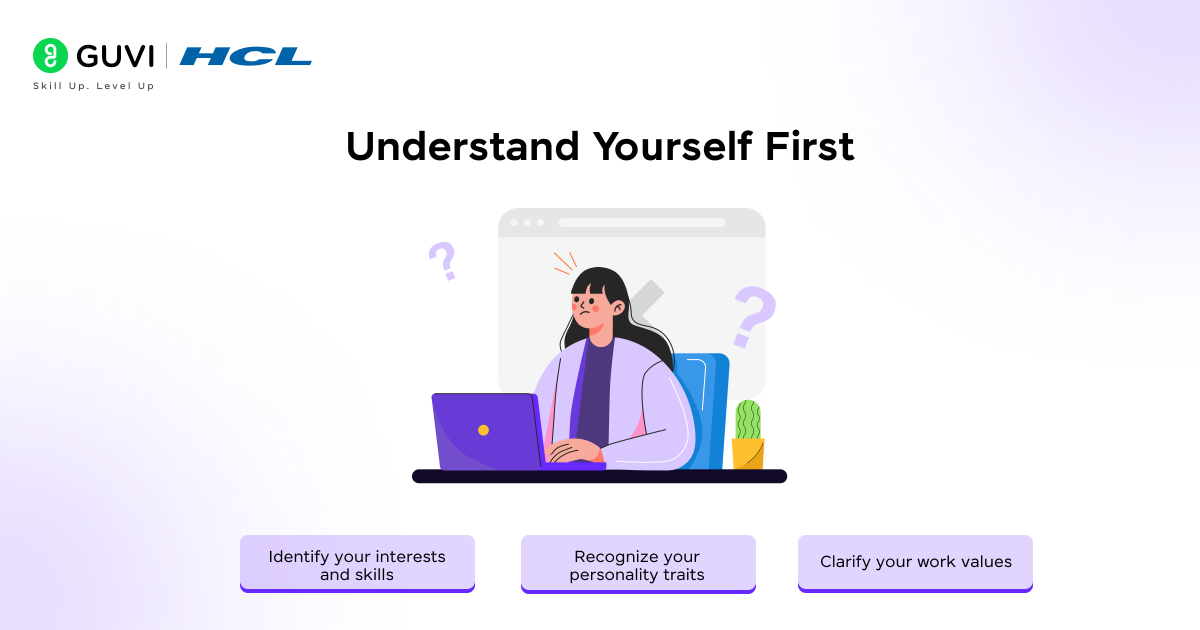
a) Identify your interests and skills
Self-assessment begins with recognizing what you enjoy doing and what you’re good at. Your interests are activities you lose track of time while doing, while skills are things you do well. Start by listing activities that energize you and abilities you’ve developed through education, experiences, and natural talents.
Several online tools can help with this process:
- Interest Profiler – Discovers what interests you and connects them to potential careers
- Skills Matcher – Identifies your skills and matches them to relevant occupations
- O*Net Interest Profiler – Helps find what your interests are and how they relate to the work world
b) Recognize your personality traits
Your personality significantly influences how you interact with environments and tasks. The Five-Factor Model (Big Five) measures traits including openness, conscientiousness, extraversion, agreeableness, and neuroticism.
Additionally, the Myers-Briggs Type Indicator assigns one of 16 personality types based on how you process information and make decisions. Research shows certain personality types naturally gravitate toward specific careers – creative jobs often attract people who score high on openness, while sales positions typically appeal to extroverts.
c) Clarify your work values
Work values are beliefs about what has worth and importance in your career. According to research, 70% of workers believe flexibility improves their productivity, highlighting a significant work value preference.
Core work values include:
- Achievement – Results-oriented work that utilizes your abilities
- Independence – Jobs allowing initiative and autonomous decisions
- Recognition – Opportunities for advancement and leadership
- Relationships – Workplaces with friendly environments
- Support – Organizations with competent management
- Working Conditions – Job security, variety, and fair compensation
d) Understand your work style
- Your work style describes your approach to day-to-day tasks. Consider whether you prefer working independently or collaboratively, structured or flexible environments, and fast-paced or steady work rhythms.
- Understanding your working style helps maximize productivity, communicate effectively with others, and find environments where you’ll thrive. There’s no right or wrong style – every workplace needs different types of workers to function efficiently.
- Ultimately, aligning your career choice with your interests, personality, values, and work style leads to greater job satisfaction and less likelihood of burnout. This self-knowledge creates the foundation for all career exploration that follows.
Step 2) Explore Career Fields That Match You
Now that you understand yourself better, it’s time to match those insights with potential career paths. The right tools and databases can help bridge the gap between self-knowledge and career possibilities.

a) Use career databases and interest profilers
O*NET OnLine provides comprehensive information about 900+ occupations, making it an excellent starting point for exploring career options. This database allows you to search based on your specific goals and needs.
The O*NET Interest Profiler helps you discover work activities and occupations that align with your preferences. It measures six types of occupational interests:
- Realistic
- Investigative
- Artistic
- Social
- Enterprising
- Conventional
These tools provide an accurate profile of your vocational interests, helping you identify work-related preferences and focus your career search effectively.
b) Look into different career fields
The National Career Clusters Framework organizes occupations into fields requiring similar skills. This approach helps you understand broad career categories rather than individual jobs.
Moreover, you can explore “Bright Outlook” occupations—careers expected to grow rapidly, have numerous job openings, or represent emerging fields. This information helps you target industries with promising futures.
c) Match your traits to potential fields of work
- Your personality profile can guide you toward compatible work environments. For instance:
- If you score high in openness, consider creative roles like tour guides or pilots. Conscientious individuals often excel in detail-oriented positions such as accounting or sales management. Extraverts typically thrive in people-centered careers like event planning or personal training.
- Those with strong agreeableness often find fulfillment in helping professions—elementary teaching or human resources. If you’re emotionally stable, consider careers requiring calm under pressure, such as social work or psychiatric nursing.
- Consequently, using these resources to identify potential career fields creates a bridge between who you are and where you might flourish professionally.
To add a little insight before diving deeper, here are a couple of surprising facts about career choice and work alignment:
Most People Don’t Choose the Right Career at First: Research shows that nearly 50% of employees end up changing their career field because their first choice didn’t align with their interests, values, or strengths.
Self-Assessment Improves Career Success: Studies indicate that individuals who assess their personality, skills, and values before choosing a field are significantly more likely to experience higher job satisfaction and long-term career stability.
These insights show that career clarity isn’t accidental—it comes from understanding yourself and making informed decisions.
Step 3) Evaluate and Narrow Down Your Options
After exploring potential career paths, it’s time to narrow your choices by examining practical considerations. This filtering step helps you focus on viable options that align with both your preferences and real-world factors.
a) Check job outlook and salary expectations
- The demand for your chosen field directly impacts your job security. The Bureau of Labor Statistics provides wage data for over 800 occupations nationwide, including regions, states, and metropolitan areas. Furthermore, you can research specific industries using resources like the Occupational Employment Statistics Survey.
- Essentially, a career with higher demand offers more opportunities and stability. Although salary shouldn’t be your only consideration, it remains important for meeting your financial goals. Specifically, tools like cost-of-living and salary calculators help evaluate whether potential careers align with your economic needs.
b) Consider education and training requirements
BLS classifies occupations into several education categories:

- Doctoral or professional degree
- Master’s degree
- Bachelor’s degree
- Associate’s degree
- Postsecondary nondegree award
- High school diploma or equivalent
The system also indicates whether work experience or on-the-job training is typically required. Most education-related occupations require at least a bachelor’s degree, while other fields have different pathways. Understanding these requirements helps you plan your educational journey realistically.
c) Think about lifestyle and work-life balance
Surprisingly, work-life balance outranks pay as the top consideration when choosing jobs, with approximately 74% of people prioritizing balance compared to 68% who prioritize compensation. Poor work-life balance has become the primary reason employees leave companies—even above salary considerations.
When evaluating potential fields, consider:
- Company policies on flexible hours and remote work
- Expectations regarding overtime
- Support for mental health and personal time
Remember that achieving balance requires setting clear boundaries between work and personal life. Prioritize tasks effectively and communicate your needs openly with employers.
By thoroughly evaluating these practical aspects, you’ll be better positioned to identify your ideal career field among the options that match your personal attributes.
Step 4) Test and Take Action
Moving from research to real-world testing marks the crucial final step in identifying your ideal field of work. The practical experience you gain provides clarity no assessment can match.
a) Try internships or volunteer roles
Gaining hands-on experience through internships or volunteering significantly increases your employability. Indeed, candidates with volunteer experience have a 27% better chance of finding employment than non-volunteers. These opportunities allow you to:
- Test potential career paths without full-time commitment
- Develop relevant skills for your resume
- Build connections in your field of interest
Volunteering doesn’t just mean picking up trash—many organizations need specialized help with graphic design, financial operations, or communication strategies. Meanwhile, internships offer valuable mentorship alongside practical experience.
b) Talk to professionals in your field of interest
Informational interviews (20-30 minute conversations with professionals) provide insider perspectives you won’t find elsewhere. During these discussions:
- Ask about education requirements and daily responsibilities
- Inquire about industry trends and challenges
- Request recommendations for networking opportunities
Remember to send a thank-you note afterward to maintain the connection.
c) Create a career action plan
Develop a structured plan using SMART goals (Specific, Measurable, Attainable, Relevant, Time-based). Your plan should include:
- Clear steps toward your career objective
- Realistic timelines for completion
- Resources needed for each step
- Methods to track your progress
This systematic approach transforms career exploration from overwhelming to manageable.
Ready to land your ideal career? Dive into the AI Software Development Course by HCL GUVI (in partnership with IIT M Pravartak & MongoDB) — a cutting-edge, 300+ hour program designed to equip you with in-demand software and Gen AI skills, take you through real-world projects, and set you up for SDE roles at top product-based companies.
Concluding Thoughts…
Finding your ideal career field requires a thoughtful, strategic approach rather than leaving such an important decision to chance. Throughout this process, you’ve learned how self-assessment forms the foundation of career exploration. Your interests, skills, personality traits, work values, and work style all point toward career fields where you’ll likely thrive.
Remember that finding your perfect career field isn’t a one-time decision but rather an ongoing journey. As you grow and change, your career preferences might evolve accordingly. The method outlined here works because it combines self-reflection with practical research and real-world testing. By following these steps, you significantly increase your chances of finding fulfilling work that aligns with both your personal attributes and practical needs. Good Luck!
FAQs
Q1. How can I identify the best career field for me?
To identify the best career field, start by understanding yourself through self-assessment. Identify your interests, skills, personality traits, and work values. Then, use career databases and interest profilers to match these attributes with potential career fields. Consider practical factors like job outlook, salary expectations, and education requirements. Finally, gain hands-on experience through internships or volunteering to test your choices in real-world settings.
Q2. What are some high-paying jobs that don’t require a degree?
While many high-paying jobs require degrees, there are options that can potentially earn around $3000 a month without one. These include roles such as dental assistant, medical assistant, electrician, HVAC technician, delivery driver, office administrator, security guard, and real estate agent. However, keep in mind that these roles may still require specific training or certifications.
Q3. How important is work-life balance when choosing a career?
Work-life balance is extremely important when choosing a career. In fact, it often outranks pay as the top consideration for job seekers, with about 74% of people prioritizing balance compared to 68% who prioritize compensation. Poor work-life balance has become a primary reason for employee turnover. When evaluating potential fields, consider factors like flexible hours, remote work options, overtime expectations, and support for personal time and mental health.
Q4. What role do personality traits play in career selection?
Personality traits play a significant role in career selection. Different careers often attract and suit different personality types. For example, creative roles might be ideal for those high in openness, while detail-oriented positions could suit conscientious individuals. Extroverts often thrive in people-centered careers, agreeable individuals may find fulfillment in helping professions, and emotionally stable people might excel in high-pressure roles. Understanding your personality can guide you towards compatible work environments.
Success Stories

About the Author
Jaishree Tomar
A recent CS Graduate with a quirk for writing and coding, a Data Science and Machine Learning enthusiast trying to pave my own way with tech. I have worked as a freelancer with a UK-based Digital Marketing firm writing various tech blogs, articles, and code snippets. Now, working as a Technical Writer at GUVI writing to my heart’s content!
View all posts by Jaishree Tomar
Connect with me @
















Did you enjoy this article?