


Career Articles
Accountant vs Data Analyst Salary in India After Switching Careers - Best Guide
Finance Managers: Could Data Science Be Your Next Career Move?
Insurance Claims Executive to Data Analyst: Is It a Good Switch?
Banking Executive (Loans, KYC) to Data Analyst: Skills and Career Path


Get In Touch For Details! Request More Information

10 Recession-Proof Industries and Jobs for Long-Term Security (2026)
Sep 19, 2026 7 Min Read 4450 Views
(Last Updated)
Recession-proof industries and jobs are the ones that stay stable no matter how the economy is doing—think healthcare, government roles, and everyday essentials people can’t stop buying or need. When companies cut costs and layoffs spread elsewhere, these sectors barely feel the shift.
This guide breaks down 10 such industries and jobs, why they hold up, and how you can actually switch into one if your current field doesn’t feel as secure anymore.
Table of contents
- TL;DR Summary
- Meaning of “recession-proof”?
- Recession-Proof Industries and Jobs: Quick Overview
- 10 Recession-Proof Industries and Jobs
- Healthcare and Pharmaceuticals
- Information Technology and Cybersecurity
- Education and EdTech
- Finance, Accounting, and Legal Services
- Consumer Staples and FMCG
- Utilities and Public Services
- Maintenance and Repair Services
- Logistics, Delivery, and E-commerce
- Insurance and Financial Planning
- Government and Public Sector
- Common Misconceptions of Recession-proof Industries and Jobs
- “Recession-proof” means guaranteed security
- Only big corporations matter
- You must abandon your current career
- How to Build a Recession-Resilient Career
- How to Switch to a Recession-Proof Career in India
- Conclusion
- FAQs
- Which industry is most recession-proof?
- Which jobs are the most recession-proof?
- Are we heading into a recession in 2026?
- Who benefits most in a recession?
- Will India face a recession soon?
TL;DR Summary
- Recession-proof industries and jobs are ones tied to essential needs — healthcare, government, everyday essentials — that stay stable even when the economy slows down.
- Ten sectors genuinely hold up well in India, from IT and finance to FMCG and public services, each for a different, practical reason.
- “Recession-proof” doesn’t mean 100% guaranteed security — it just means lower risk, not zero risk, so it’s worth knowing what the term actually promises.
- Building a resilient career isn’t only about switching fields — it’s also about upskilling and staying flexible within your current one.
- Switching careers is doable with the right approach — pick a sector, start upskilling early, and treat government exams or certifications as a real long-term plan, not a last resort.
Meaning of “recession-proof”?
The term “recession-proof jobs” sounds like it means you’re totally safe. In reality, no job is completely immune to an economic slump. What you’re aiming for instead is a job or industry that tends to hold up better when the economy takes a hit.
For example, to describe simply, recession-proof jobs are those that:
- Provide essential services or products,
- They are based on specific in-demand skills, or
- Serve a broad, stable customer base.
If you’re thinking about your next role, upskilling, or career move, understanding which industries have better resilience gives you a strategic advantage. It’s not just about “what’s hot now” but “what will remain needed when the tide goes out”.
Recession-Proof Industries and Jobs: Quick Overview
Here are the following recession-proof industries and jobs, ranked by what actually makes each one stable:
| Industry | Why It’s Stable | Jobs to Consider |
|---|---|---|
| Healthcare & Pharmaceuticals | People need medical care regardless of the economy; spending often rises during downturns | Doctor, Nurse, Pharmacist, Lab Technician, Healthcare Administrator |
| IT & Cybersecurity | Businesses keep systems running and outsource for cost-cutting; security spending doesn’t stop | Software Engineer, IT Support Specialist, Cybersecurity Analyst, Cloud Architect |
| Education & EdTech | Learning continues, and people often upskill more during job scarcity | Teacher, Corporate Trainer, EdTech Developer, Content Creator |
| Finance, Accounting & Legal | Companies still need budgeting, tax filing, audits, and legal compliance | Accountant, Tax Consultant, Financial Analyst, Lawyer |
| Consumer Staples & FMCG | Everyday essentials like food and hygiene products stay in demand no matter what | Retail Staff, Supply Chain Manager, Food Processing Technician |
| Utilities & Public Services | Power, water, and waste management are non-negotiable, often government-backed | Power Plant Engineer, Water Resource Manager, Municipal Worker |
| Maintenance & Repair Services | People repair instead of replace during tough times | Mechanic, Electrician, Plumber, HVAC Technician |
| Logistics, Delivery & E-commerce | Online shopping and home delivery keep growing, even in downturns | Warehouse Manager, Delivery Driver, Supply Chain Analyst |
| Insurance & Financial Planning | Insurance premiums and financial services are contractual and ongoing | Insurance Advisor, Financial Planner, Loan Officer |
| Government & Public Sector | Government hiring continues through recruitment drives; jobs come with strong security | Civil Servant (IAS/IPS), Public School Teacher, PSU Engineer, Bank Officer |
10 Recession-Proof Industries and Jobs
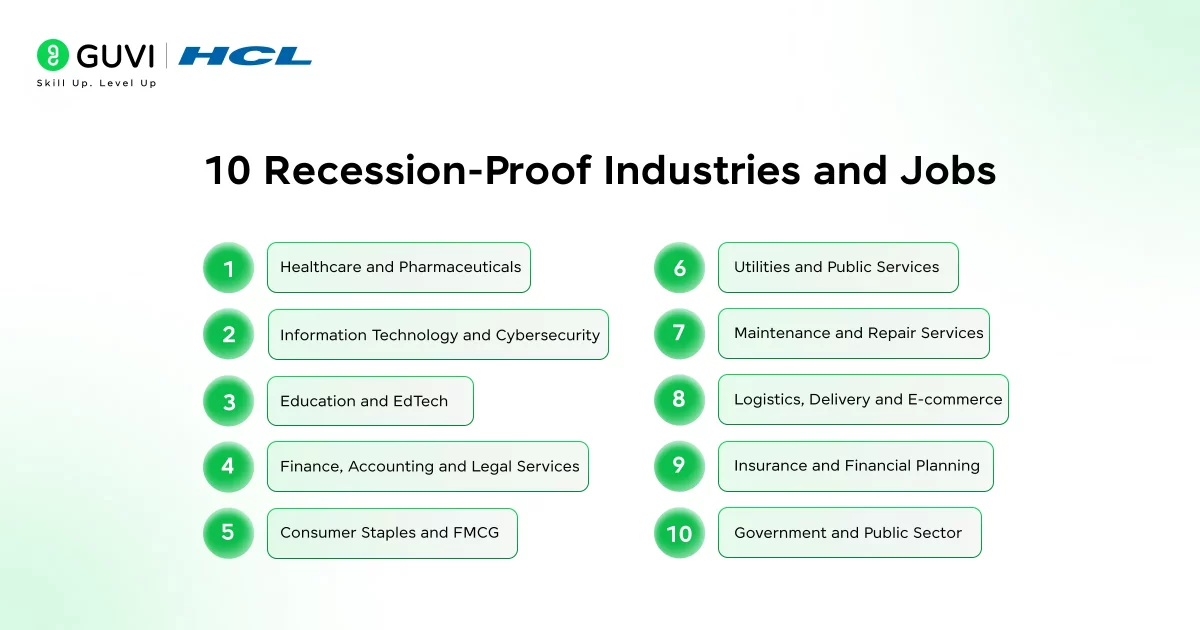
Thinking about job security in uncertain times? It’s smart to know which industries and roles are likely to weather downturns.
A recession is simply a sustained economic slowdown, often marked by lower GDP and higher unemployment. But even in those times, these 10 recession-proof industries and jobs will sustain. Let’s have a look at them:
1. Healthcare and Pharmaceuticals
People always get sick or need medical check-ups, so healthcare is famously stable. In fact, global healthcare spending often increases during recessions as individuals focus on their well-being. In India, the healthcare sector is growing with our aging population and rising health awareness.
Jobs here include:
- Doctors
- Nurses,
- Pharmacists,
- Medical Technologists
- Lab Technicians.
- Allied roles like Healthcare Administrators
- Medical Device Specialists.
During COVID-19, telemedicine and home healthcare also expanded, creating new career paths.
Roles to consider: Hospital staff (doctors, nurses, pharmacists), medical lab and radiology technicians, healthcare administration, physiotherapists, and telemedicine support.
2. Information Technology and Cybersecurity
India’s IT industry is globally renowned for its resilience. Even if tech giants slim down, companies still need computer systems running. In recessions, many businesses outsource IT and software projects to cut costs. Plus, cybersecurity is a nonstop need: firms spend on security even when budgets are tight.
The Times of India notes that areas like cloud computing, IT support, and data analysis remain “hot” because organizations keep investing in digital infrastructure. As a result, software developers, system administrators, data analysts, cloud engineers, and cybersecurity experts remain hireable.
Roles to consider: Software engineers (full-stack, backend, frontend), IT support specialists, network administrators, cybersecurity analysts, data scientists, cloud architects.
3. Education and EdTech
Learning never stops, even during downturns. Schools, colleges, and training centers continue to operate. In fact, students may even pursue more education or skill training when jobs are scarce.
Teachers, tutors, professors, and curriculum developers are needed consistently. India’s growing edtech industry adds jobs in online tutoring, instructional design, and content creation.
Roles to consider: School and college teachers, coaching center instructors, corporate trainers, educational content creators (e-learning), edtech software developers, and childcare providers.
4. Finance, Accounting, and Legal Services
When money is tight, companies need experts to manage budgets, taxes, and compliance. Fields like accounting, auditing, banking, and financial analysis are often recession-resistant because businesses must manage cash flows and cut costs wisely.
For example, Chartered Accountants (CAs) and tax consultants in India stay in demand as firms still file taxes and do audits. Even law services hold up: legal issues (contracts, bankruptcies, divorces) continue regardless of the economy.
Roles to consider: Accountants and auditors, financial analysts, tax professionals, banking officers, insurance underwriters, lawyers, and legal assistants.
5. Consumer Staples and FMCG
Everyone needs everyday products no matter what. Groceries, food, cleaning supplies, and personal care items are consumer staples that stay in demand. Indian FMCG giants (like Hindustan Unilever, Nestlé) have historically grown steadily through recessions.
The consumer still buys soap, rice, milk, and medicine. That keeps manufacturers, supply-chain managers, and store employees busy. So jobs in grocery retail, food processing, pharmaceuticals, and household goods often feel less of a recession’s bite.
Roles to consider: Grocery store and supermarket staff, supply chain/logistics for food and FMCG, food processing plant technicians, retail managers for essentials.
6. Utilities and Public Services
Utilities (electricity, water, sanitation) and public infrastructure are non-negotiable services. People still need power, clean water, and waste management. Government and municipal agencies must keep running these systems.
Therefore, careers in power plants, water treatment facilities, waste management, and public transportation tend to be stable. For example, metro systems or bus services run daily because commuters depend on them. In India, many utility companies are public or government-backed, which adds job security.
Roles to consider: Electrical and mechanical engineers for power plants, water resource managers, municipal service workers (water/waste), transport engineers, and civil service roles related to infrastructure.
7. Maintenance and Repair Services
If buying new items slows down, maintenance picks up. People fix rather than replace during tough times. That keeps auto mechanics, electricians, plumbers, and handymen in steady demand.
For instance, cars still need oil changes, batteries, and repairs, and homes can’t wait on a broken pipe or fuse. Vocational trades like construction maintenance (HVAC, carpentry) also stay busy fixing urgent problems.
Roles to consider: Automotive technicians and mechanics, plumbers and electricians, HVAC and appliance repair specialists, and general maintenance technicians.
8. Logistics, Delivery, and E-commerce
Recessions often accelerate digital trends. With more people shopping online, logistics and delivery services become crucial. Even during economic slowdowns, consumers rely on home delivery of essentials.
The pandemic proved how important couriers and warehouses are, and that has not fully reversed. In India’s booming e-commerce market, jobs in warehouse operations, inventory management and last-mile delivery remain necessary. For companies, ensuring products move through the supply chain efficiently is a must-have, making these roles comparatively stable.
Roles to consider: Supply chain analysts, warehouse managers, truck and delivery drivers, e-commerce operations (order fulfillment, inventory control), and online marketplace support.
9. Insurance and Financial Planning
Some services are contractual or time-bound. For example, car and health insurance premiums must be paid on schedule regardless of the economy. This reality keeps insurance agents and brokers working.

People still renew policies to protect against medical costs or car damage, so insurance is surprisingly stable. Likewise, financial planners and loan officers help families manage budgets or secure loans during hard times. While not as obvious, these fields often retain business because they tie into life’s essentials (health, vehicles, mortgages).
Roles to consider: Insurance advisors (life, health, vehicle), financial planners, credit counselors, bank loan officers.
10. Government and Public Sector
In India, government jobs are often seen as the ultimate safety net. Civil services (like IAS, IPS) and public sector units (railways, national banks) continue to hire through exams and recruitment drives even in recessions.
Fresh graduates find that government roles come with job security, benefits, and pensions. Education and health sectors under government schemes also hire teachers and doctors. If you have the patience for competitive exams, public sector careers (defense services, administrative services, public banking, etc.) remain among the most recession-resistant in India.
Roles to consider: Civil servants (IAS/IPS/IFS/etc), public school teachers, national healthcare workers, PSU engineers (power grids, railways), public sector bank officers.
Common Misconceptions of Recession-proof Industries and Jobs
“Recession-proof” means guaranteed security
No. Even industries that fare better still face pressure. Companies may downsize or shift strategies. You’re just choosing to be biased toward more resilient territory.
Only big corporations matter
Not true. Small organisations in resilient industries may still hire, especially if they focus on essential services or niche skills.
You must abandon your current career
Not necessarily. Often, you can pivot within your current industry: shift into more resilient roles, or diversify your skill set rather than a full career change.
How to Build a Recession-Resilient Career
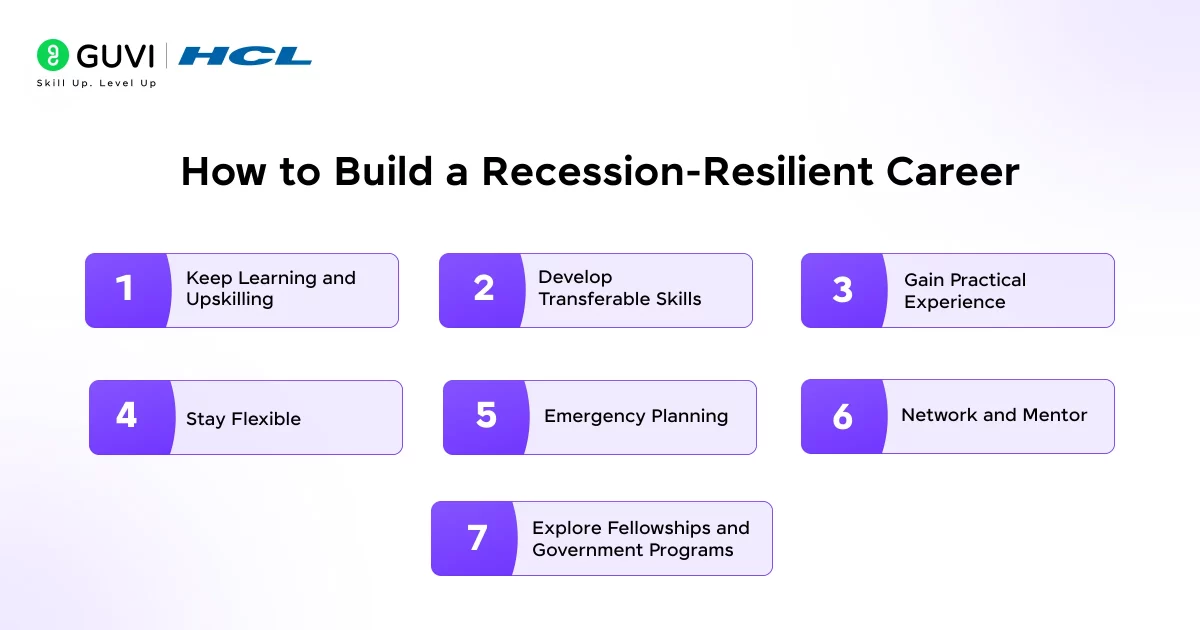
Knowing which fields fare well is only half the battle. You still need the right skills and strategy. Here are some tips:
- Keep Learning and Upskilling: Even during a downturn, online learning platforms (HCL GUVI, Google Career Certificates, SWAYAM, Coursera) offer short courses in high-demand areas. Instead of a long degree, focus on certifications in IT support, analytics, digital marketing, or UI/UX design. This builds job-ready skills quickly.
- Develop Transferable Skills: The ability to adapt is key. Strong communication, problem-solving, teamwork, and leadership skills are valuable everywhere. For example, a project manager or content strategist can move from tech to healthcare or finance. Work on soft skills like time management and critical thinking, too.
- Gain Practical Experience: Internships or part-time projects in stable industries (like an IT internship, volunteer teaching, or assisting in a hospital) give you real-world exposure. They also help you network and find mentors.
- Stay Flexible: Be open to roles outside your dream job. For instance, if you’re a coder, consider IT support or QA roles as stepping stones. You can always pivot later.
- Emergency Planning: Build a financial cushion (even a few months of expenses) as a buffer. Being prepared reduces stress if the job search takes longer. Also, keep your resume and LinkedIn updated with quantifiable achievements.
- Network and Mentor: Connect with alumni, professors or professionals on platforms like LinkedIn. Talking to people in healthcare, education or finance will keep you informed about hiring trends and opportunities.
- Explore Fellowships and Government Programs: India has many government schemes that hire graduates in education, policy, and tech (e.g., YUVA for media, or positions in NGOs). These can be stepping stones with good security.
Remember, even if you target a “safe” field, no career is foolproof. Industries change over time. The goal is to stack the odds in your favor: choose fields with steady demand and continuously sharpen your skills so you stay competitive.
How to Switch to a Recession-Proof Career in India
Switching careers feels risky, especially when you’re already worried about job security. But if you’re deliberate about it, the transition doesn’t have to be a leap of faith.
Here’s a practical way to approach it:
Start with what you already have: Look at your current skills and see where they overlap with stable sectors. An accountant doesn’t need to become a doctor — finance skills already transfer well into banking, insurance, or corporate roles.
A developer doesn’t need to start over either — the same skills apply directly to IT, fintech, or healthcare tech.
Pick a sector, not just a job: Don’t chase a single job title. Pick an industry (healthcare, IT, government, FMCG) and explore the range of roles inside it. This gives you more flexibility if one specific role isn’t hiring at a given time.
Upskill before you need to, not afterL Most people start upskilling only after losing a job — that’s the worst time to learn something new. Certifications in cybersecurity, healthcare administration, or government exam prep (like SSC, banking exams) are worth starting early, while you’re still employed.
Use government and PSU exams as a real backup plan: Roles like IAS, banking POs, and PSU engineering jobs come with serious job security, but they need long-term prep. If this interests you, start studying early instead of treating it as a last resort during tough times.
Network inside the industry before you switch: Talk to people already working in the field you’re targeting. They’ll tell you what the job actually looks like day-to-day, and often help you skip months of guesswork.
Here’s a quick breakdown of common switch paths:
| Current Background | Recession-Proof Path to Consider | What Helps You Get There |
|---|---|---|
| Sales/Marketing | Healthcare admin, Insurance advisory | Certification courses, industry networking |
| Software/Tech | Cybersecurity, Healthcare tech, Fintech | Specialized certifications, portfolio projects |
| Finance/Commerce | Banking, Accounting, Government finance roles | CA/CS prep, banking exam prep (IBPS, SBI PO) |
| Teaching/Training | Corporate training, EdTech content | Building an online presence, edtech platforms |
| General graduate | Government/PSU jobs | Competitive exam prep (SSC, UPSC, PSU exams) |
Switching careers takes time, usually 6 months to 2 years depending on the field. It’s not an overnight fix — but starting now, while things are stable, puts you in a much stronger position than trying to make the switch during an actual downturn.
Conclusion
In conclusion, focus your career planning on essentials: healthcare, education, IT, finance, utilities and essential services. These fields consistently have work because they meet basic societal needs.
Stay proactive: keep learning (especially digital skills), earn relevant certifications, and build flexibility into your resume. Even if no job is completely “recession-proof”, choosing a stable industry plus honing your skills can give you peace of mind. By preparing now, you’ll be better equipped to weather economic storms and seize opportunities that others might miss.
Your future career doesn’t have to stall just because the economy does. Armed with knowledge of these industries and a plan for continuous growth, you can build a resilient career path – even in uncertain times.
FAQs
1. Which industry is most recession-proof?
Healthcare tends to top the list, since people need medical care no matter how the economy is doing.
2. Which jobs are the most recession-proof?
Roles tied to essential needs — doctors, nurses, accountants, and government jobs — hold up best, since demand for them doesn’t disappear during a downturn.
3. Are we heading into a recession in 2026?
No major economy, including the US, is officially in a recession right now, though global growth has slowed due to tariffs and trade tensions.
4. Who benefits most in a recession?
Essential industries (healthcare, utilities, discount retail) and cash-rich investors who can buy assets at lower prices tend to come out ahead.
5. Will India face a recession soon?
Unlikely — India’s economy is still growing fast, with GDP growth expected around 6.5–7.5%, backed by strong domestic demand.
Success Stories
















Did you enjoy this article?