


Data Science Articles
Can a Deputy Manager in Finance Switch to Data Analytics Mid-Career?
What Skills Do Finance Team Leads Need for Finance Analytics Leadership?


Get In Touch For Details! Request More Information
Calculus for Data Science: Concepts, Examples & Applications
Oct 14, 2026 6 Min Read 2860 Views
(Last Updated)
Calculus for data science is the branch of math that helps you understand how models actually learn from data. It might sound intimidating at first, but once you see it in action, it starts making a lot more sense.
Think of it as the engine running quietly behind every prediction or optimization your model makes. Without derivatives and gradients, algorithms wouldn’t know how to adjust and improve, they’d just be guessing blindly.
Table of contents
- TL;DR Summary
- Importance of Calculus in Data Science
- Beginner Topics in Calculus for Data Science
- Derivatives – Understanding Change
- Integrals – Accumulating Data
- Multivariable Calculus – Working with Complex Data
- Optimization Using Calculus
- Advanced Topics in Calculus for Data Science
- Partial Derivatives
- Chain Rule & Higher-Order Derivatives
- Vector Calculus
- Jacobian and Hessian Matrices
- Differential Equations (Intro Level)
- Real-World Applications
- Calculus Concepts and Their Applications in Data Science: Reference Table
- Conclusion
- FAQs
- How is calculus used in data science?
- Is calculus necessary for data science?
- Which calculus topics matter most for data science?
- How is calculus used in machine learning specifically?
- Do I need to solve calculus by hand for data science?
TL;DR Summary
- Calculus for data science quantifies how values change, how outcomes get optimized, and how continuous data gets interpreted.
- Derivatives measure change and drive gradient descent, the process that updates model weights to minimize error.
- Integrals calculate accumulation, useful for totals like revenue and for evaluating model performance.
- Advanced tools like partial derivatives and Jacobian and Hessian matrices help complex models, like neural networks, optimize efficiently.
- From finance to healthcare to robotics, calculus for data science powers modeling, forecasting, and optimization across industries.
Importance of Calculus in Data Science
Calculus for data science plays a foundational role in how machine learning models learn, adjust, and make accurate predictions. It helps quantify how values change, how outcomes can be optimized, and how continuous data can be interpreted.
Without calculus, many core algorithms used in data science would not function effectively. In this section, we’ll explore the core and most important features of calculus for data science and how they are applied in real-world scenarios.
- Derivatives in Calculus for Data Science – Measure how one variable changes with respect to another, helping detect trends and understand rates of change in data.
- Gradient Calculation – In machine learning, derivatives guide gradient descent, updating model weights to minimize prediction error.
- Integrals for Accumulation – Integrals calculate total accumulation in data, such as total revenue, continuous probability, or area under curves.
- Optimization with Calculus – Finds minimum or maximum values in models, improving prediction accuracy and performance.
- Neural Networks & Backpropagation – Calculus enables computing gradients layer by layer, helping deep learning models learn efficiently.
- Probability and Statistics – Integrals and continuous functions rely on calculus for probability modeling and statistical inference.
Theory only gets you so far; real projects get you hired. The HCL GUVI Advanced Data Science Course turns concepts like calculus and machine learning into hands-on skills through live projects, expert mentorship, and an IITM Pravartak certification, backed by placement support with 1000+ hiring partners. Enroll today and start building your data science career!
Beginner Topics in Calculus for Data Science
1. Derivatives – Understanding Change
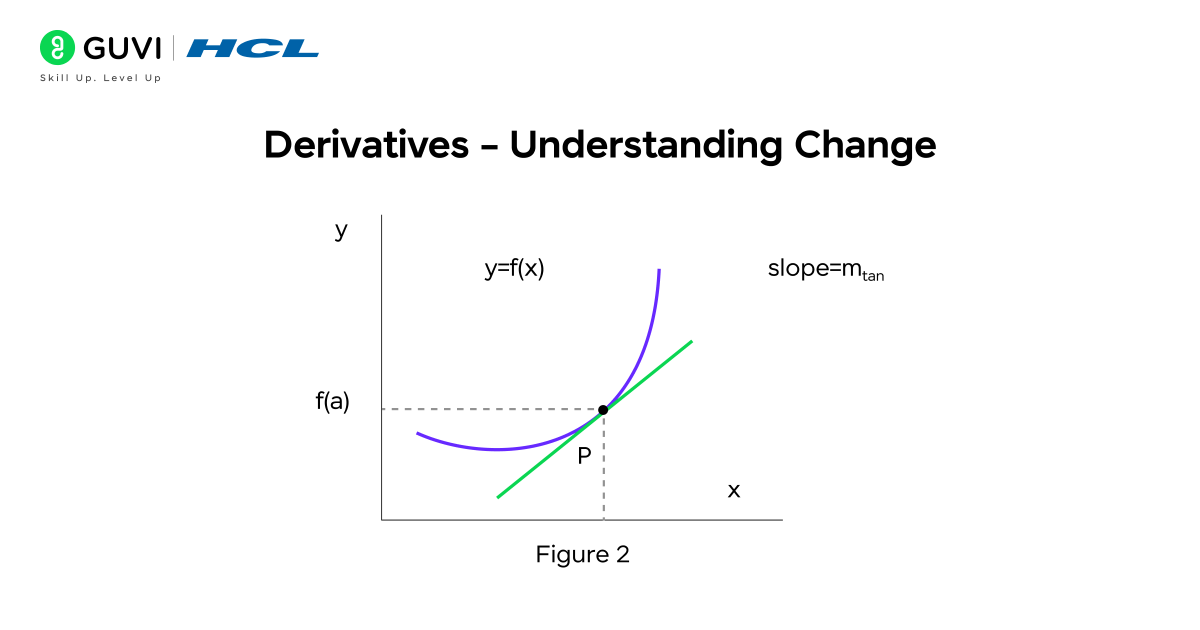
Derivatives are one of the most important calculus concepts for data science. A derivative measures how one quantity changes with respect to another. In simple terms, it’s like checking the speed of change at a particular moment.
For example, if you track a company’s revenue over time, the derivative tells you how fast the revenue is increasing or decreasing at any given point. This helps data scientists identify trends, understand patterns, and make accurate predictions.
- Example: If you have a stock price graph, the derivative shows how fast the price is moving up or down at a specific time. A positive derivative indicates a rapid increase, while a negative derivative shows a decrease.
- Advanced Application: In machine learning, derivatives are used in gradient descent to train models. The derivative of the error with respect to model parameters is calculated, and parameters are updated step by step to minimize the error. This is how models learn from data and improve predictions.
Derivatives are a core part of calculus for data science because they allow precise measurement of change, enable optimization of models, and provide insights into real-world data patterns. Mastering derivatives helps data scientists interpret complex datasets and make informed, data-driven decisions.
Get instant access to HCL GUVI’s free Data Science eBook and learn everything from foundational concepts to real-world applications, download now.
2. Integrals – Accumulating Data
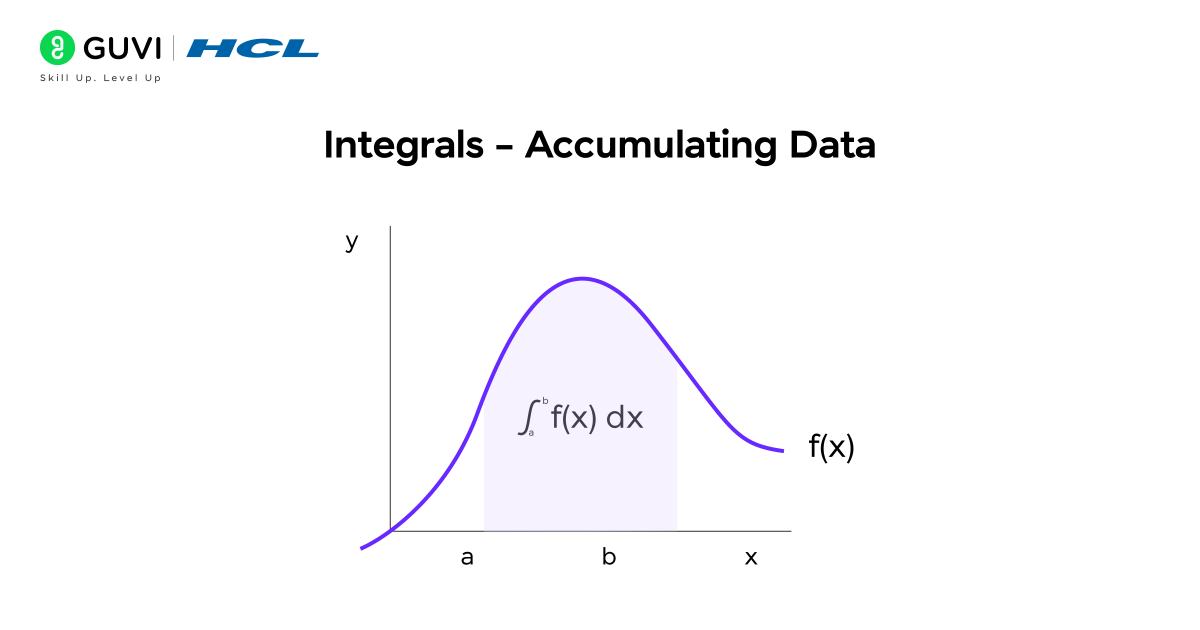
Integrals are a key concept in calculus for data science. They help calculate the total accumulation of a quantity over time or across a range of values. In simple terms, if derivatives measure the rate of change, integrals measure the total amount accumulated.
This is especially useful when analyzing cumulative metrics, such as total revenue, total clicks, or continuous probabilities. Understanding integrals allows data scientists to work with continuous data and evaluate totals over a period or range.
- Example: If a company tracks daily sales, the integral of sales over a month shows the total revenue generated during that period. Similarly, in statistics, integrals calculate the probability of continuous events, like the chance of a sensor reading falling within a certain range.
- Advanced Application: In machine learning, integrals are used in probability theory, continuous loss functions, and evaluating areas under curves, such as in ROC-AUC analysis for model performance. They also help in determining total error over a dataset, which is critical for optimizing models.
Integrals are a foundational part of calculus for data science because they allow the accumulation of data, the calculation of totals, and the evaluation of probabilities in continuous systems, making them essential for both analysis and modeling.
3. Multivariable Calculus – Working with Complex Data
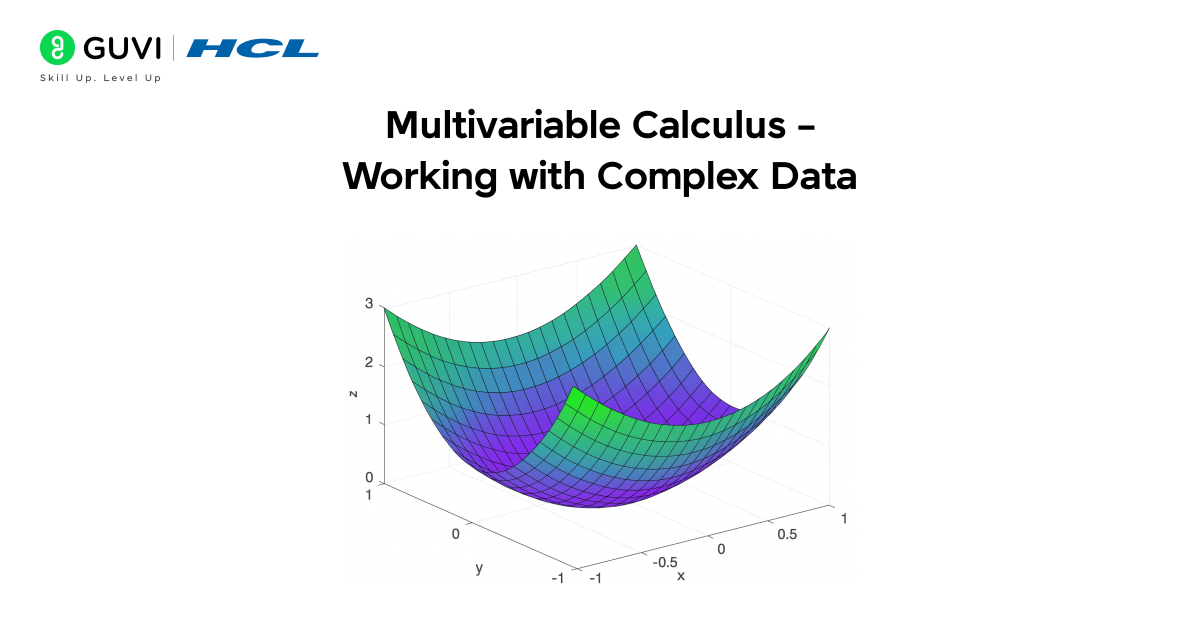
Multivariable calculus is an extension of basic calculus used when more than one variable affects an outcome. In data science, most real-world datasets have multiple interacting features, such as size, location, and number of rooms, that affect housing prices.
Multivariable calculus helps measure how changes in one variable affect the outcome while keeping other variables constant, allowing data scientists to understand complex relationships in data.
- Example: In a housing price prediction model, multivariable calculus helps determine how changing the number of rooms affects the price while keeping the area and location fixed.
- Advanced Application: Gradient computation in machine learning uses multivariable calculus to optimize models with multiple parameters, such as weights in neural networks, allowing the model to learn efficiently from data.
4. Optimization Using Calculus
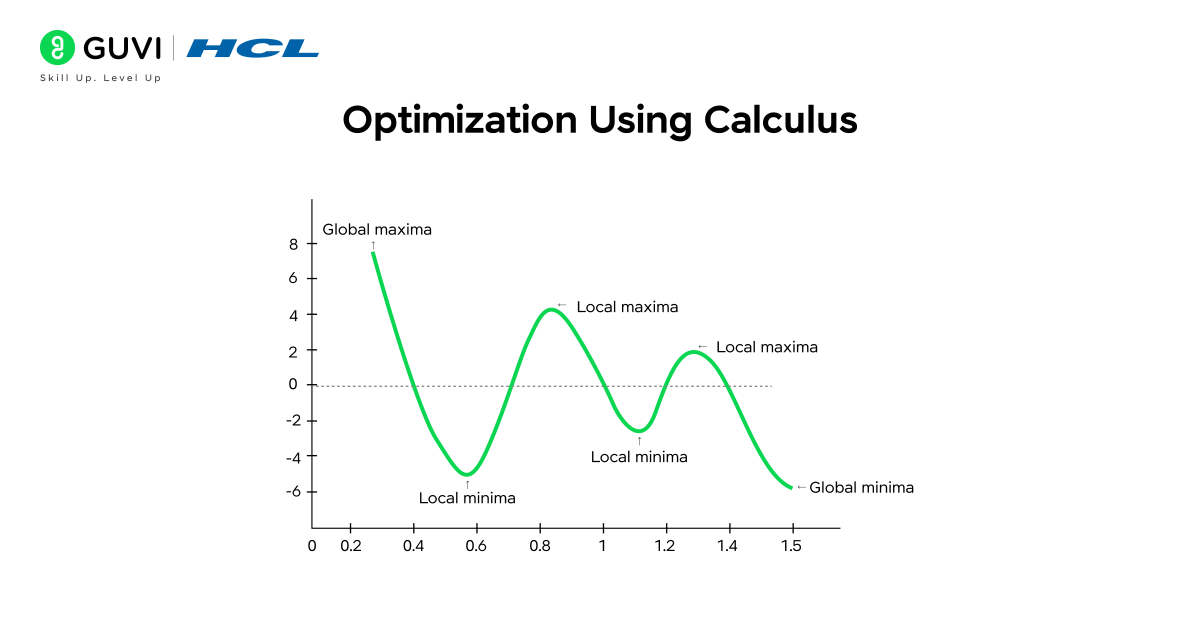
Optimization is a central concept in calculus for data science. It involves finding the best possible solution by maximizing or minimizing a function, such as profit, accuracy, or efficiency.
Calculus provides tools to locate these maximum or minimum points by analyzing derivatives, making it easier to optimize models and processes.
- Example: A marketing team may want to maximize return on investment. By modeling ROI as a function of advertising spend and applying calculus, they can determine the optimal spend to achieve the highest returns.
- Advanced Application: In machine learning, optimization is used to minimize the error of a model. Techniques like gradient descent rely on derivatives to iteratively adjust parameters and find the minimum error, improving model performance.
Advanced Topics in Calculus for Data Science
1. Partial Derivatives
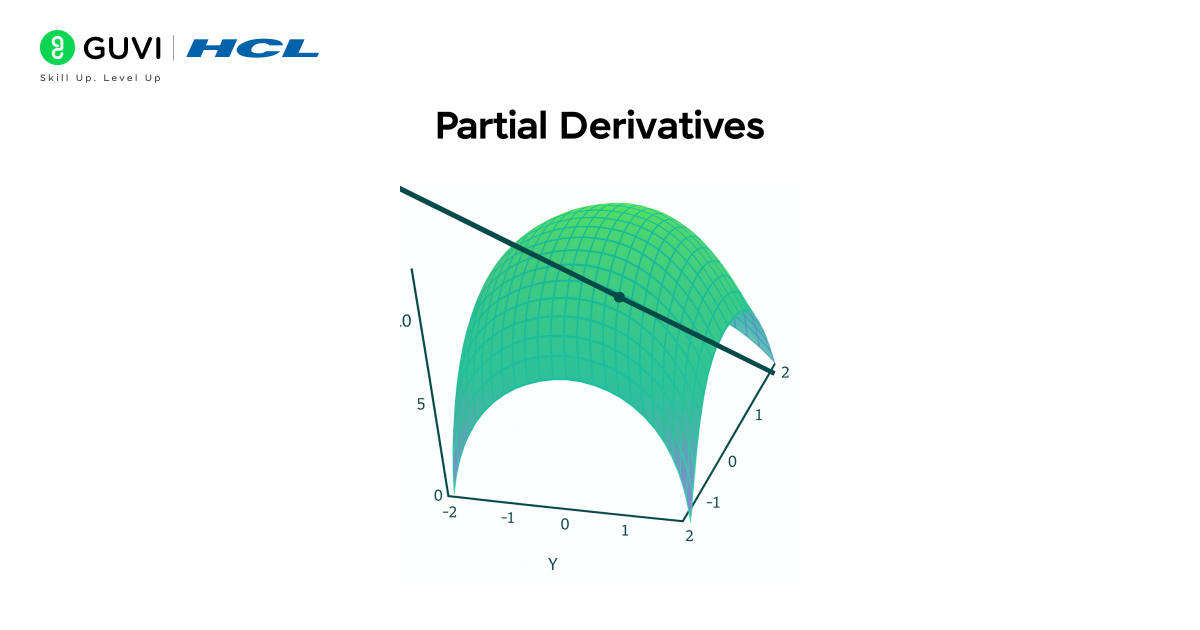
Partial derivatives are used when a function depends on multiple variables. They measure how the function changes with respect to one variable while keeping the other variables constant. In data science, this is essential for understanding each feature’s individual impact on a prediction.
- Example: In a housing price model, the partial derivative shows how the price changes if only the number of rooms changes while keeping the area and location fixed.
- Advanced Application: Partial derivatives are fundamental in gradient descent for multi-variable models, helping optimize parameters in neural networks and other machine learning algorithms.
2. Chain Rule & Higher-Order Derivatives
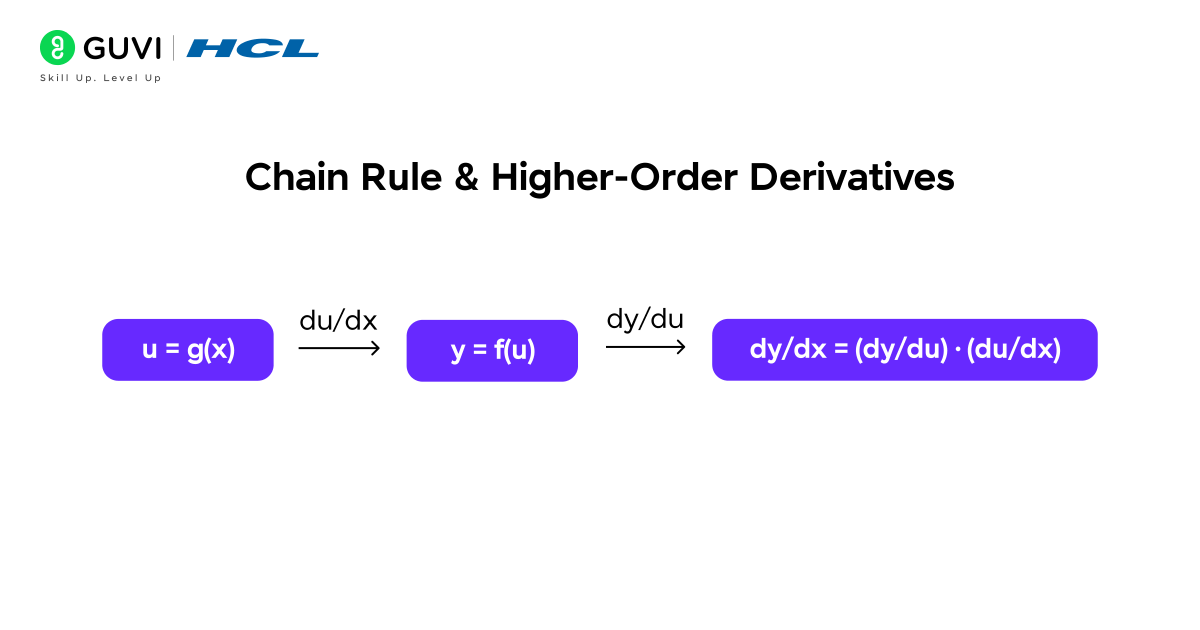
The chain rule allows differentiation of composite functions, which is common when one variable depends on another that, in turn, depends on a third.

Higher-order derivatives provide information about curvature and how the rate of change itself changes, which is useful for more precise optimization and understanding complex relationships.
- Example: In neural networks, the chain rule is used during backpropagation to calculate how changes in weights affect the final output. Without it, models couldn’t learn from errors efficiently.
- Advanced Application: Second-order derivatives, including the Hessian matrix, help in optimization by showing how steep or flat the error surface is. This helps algorithms converge faster and avoid local minima, improving the accuracy and efficiency of machine learning models.
3. Vector Calculus
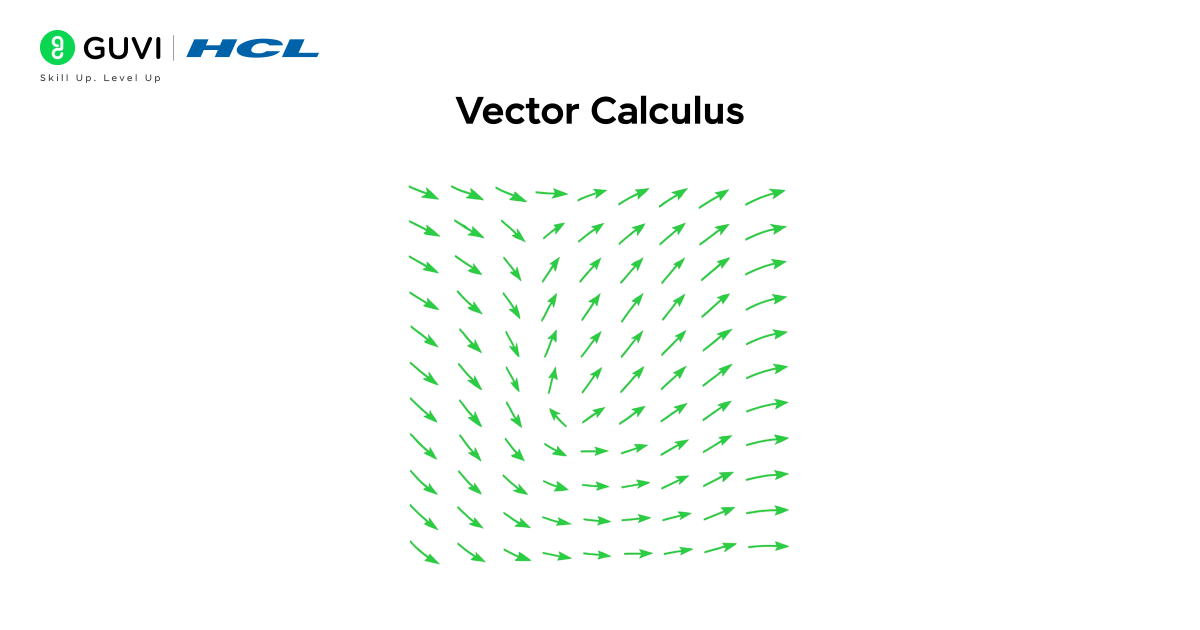
Vector calculus deals with functions that have vector inputs or outputs, which is common in high-dimensional datasets. It is crucial for understanding interactions between multiple variables at once. In data science, vector calculus is used to compute gradients across many features simultaneously, enabling more effective optimization.
- Example: When training a deep learning model, the gradient of a loss function with respect to all features is calculated as a vector. This tells the model how to adjust all parameters at once to minimize error.
- Advanced Application: Vector calculus is widely used in deep learning and advanced machine learning algorithms, allowing models to handle complex, high-dimensional data efficiently and optimize multiple parameters simultaneously.
4. Jacobian and Hessian Matrices
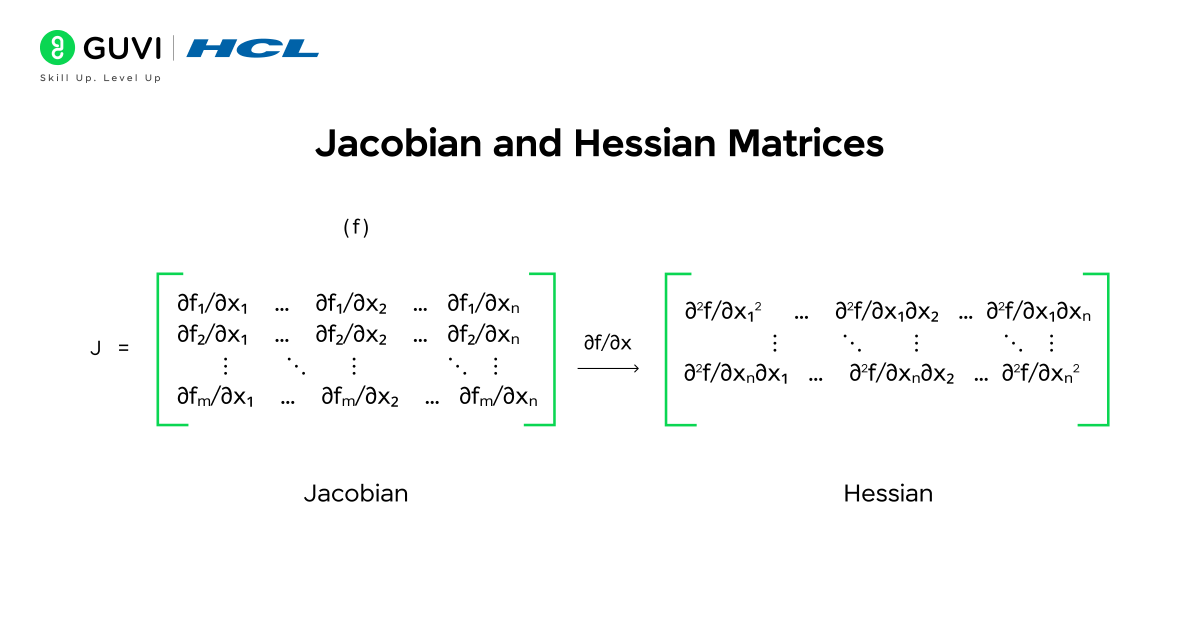
Jacobian and Hessian matrices are advanced tools in multivariable calculus that summarize derivatives in a structured way:
- Jacobian: Shows how each output variable changes with respect to each input variable. It is crucial in understanding relationships in multi-output systems.
- Hessian: Captures the curvature of multivariable functions, providing insight into maxima, minima, and saddle points. This is useful in optimization problems
- Example: In a neural network with multiple layers, the Jacobian helps understand how changes in input affect each output, while the Hessian shows how the loss function curves, guiding optimization.
- Advanced Application: Jacobian and Hessian matrices are used in second-order optimization methods, improving training efficiency and convergence in complex machine learning models.
5. Differential Equations (Intro Level)
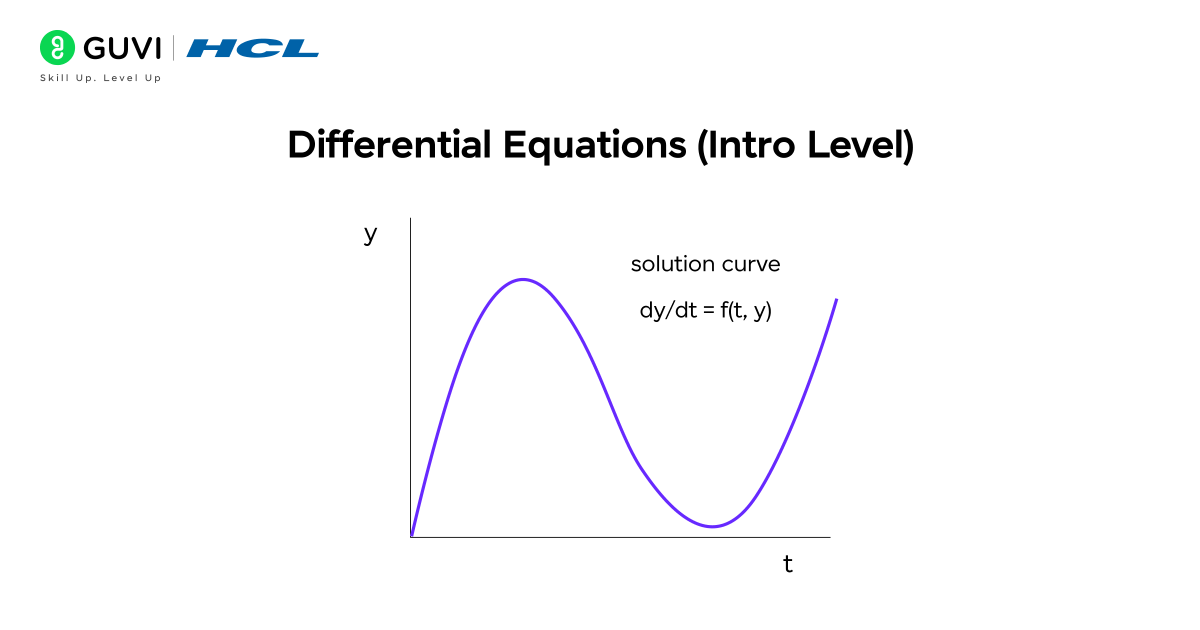
Differential equations describe how quantities change continuously over time and model dynamic systems.
In data science, they are particularly useful for understanding trends in time-series data, such as stock prices, sensor readings, or population growth. By modeling the rate of change and how it evolves, differential equations allow more accurate forecasting and analysis.
- Example: Predicting population growth over years can be modeled with a differential equation, showing not just total numbers but how quickly the population is increasing or decreasing at each moment.
- Advanced Application: Differential equations are used in time-series forecasting, physics-informed machine learning, and dynamic simulations. They enable models to capture continuous patterns and provide more precise predictions for evolving datasets.
Real-World Applications
Calculus for data science is applied across many industries to optimize processes, make accurate predictions, and gain insights from complex data. Here’s how different sectors use it:
1. Finance and Banking
Concepts Used: Derivatives, integrals, optimization
Applications:
- Modeling stock prices and financial risk
- Calculating cumulative investment returns using integrals
- Using optimization to maximize portfolio returns or minimize losses
2. Healthcare and Life Sciences
Concepts Used: Differential equations, derivatives, integrals
Applications:
- Modeling disease spread and patient vital sign changes
- Calculating total drug dosage over time
- Understanding rates of change in patient conditions with derivatives
3. Technology and AI
Concepts Used: Derivatives, multivariable calculus, gradient descent, Jacobians
Applications:
- Training machine learning models using gradient descent
- Optimizing multiple parameters simultaneously with multivariable calculus
- Understanding input-output relationships in neural networks using Jacobians
4. Marketing and E-commerce
Concepts Used: Derivatives, integrals, optimization
Applications:
- Analyzing customer engagement trends using derivatives
- Calculating total sales or website interactions with integrals
- Optimizing pricing, campaigns, and ROI
5. Engineering and Robotics
Concepts Used: Vector calculus, differential equations, partial derivatives
Applications:
- Computing motion and trajectories in robotics with vector calculus
- Predicting system behavior over time using differential equations
- Optimizing control parameters using partial derivatives
6. Energy and Environment
Concepts Used: Integrals, derivatives, differential equations
Applications:
- Modeling energy consumption and efficiency
- Forecasting climate and environmental changes
- Calculating total energy output and monitoring rates of change
These examples highlight how calculus for data science is essential across industries, enabling accurate modeling, predictions, and optimization in real-world scenarios.
Calculus Concepts and Their Applications in Data Science: Reference Table
| Concept | What It Measures | Application in Data Science |
|---|---|---|
| Derivatives | Rate of change of one variable with respect to another | Powers gradient descent to update model weights and minimize error |
| Integrals | Total accumulation of a quantity over a range | Calculates totals like revenue, and evaluates model performance metrics like ROC-AUC |
| Multivariable Calculus | How one variable affects an outcome while others stay constant | Optimizes models with multiple features, like housing price prediction |
| Optimization Using Calculus | Maximum or minimum points of a function | Minimizes model error and finds the best possible outcome, like maximizing ROI |
| Partial Derivatives | Impact of a single variable while holding others fixed | Used in gradient descent for multi-variable models like neural networks |
| Chain Rule | Differentiation of composite, interdependent functions | Enables backpropagation to calculate how weight changes affect output |
| Vector Calculus | Gradients across multiple features simultaneously | Adjusts all parameters at once in deep learning models |
| Jacobian & Hessian Matrices | Output-input relationships and curvature of functions | Used in second-order optimization to improve training efficiency |
| Differential Equations | How quantities change continuously over time | Models time-series data like stock prices and population growth |
Also Read: Time Series Forecasting with Prophet
Conclusion
Calculus for data science explains how models learn, adjust, and improve with every piece of data they see. Concepts like derivatives and gradients aren’t just theory; they show up directly in how algorithms minimize error and get better over time. That’s the core mechanic driving nearly every machine learning model in use today.
FAQs
1. How is calculus used in data science?
It helps train models through gradient descent, optimize parameters, and understand how algorithms learn from data.
2. Is calculus necessary for data science?
Not to start, but understanding derivatives and gradients helps you grasp how models are trained and optimized.
3. Which calculus topics matter most for data science?
Derivatives, gradients, partial derivatives, the chain rule, and integrals are the most relevant.
4. How is calculus used in machine learning specifically?
Gradient descent uses derivatives to minimize loss, and backpropagation applies the chain rule to train neural networks.
5. Do I need to solve calculus by hand for data science?
No, most libraries handle the computation. The goal is to understand the concepts, not to do manual calculations.
Success Stories











Did you enjoy this article?