


Artificial Intelligence and Machine Learning Articles
Finance Manager to Data Analytics: Career Growth, Salary and Seniority
How to Evaluate LLM Outputs in Production Deployments
AI/ML Skills Gap 2026: Why Companies Can't Find Job-Ready Talent
20 AI/ML Interview Questions Recruiters Can Use Without a Tech Background - Best Guide


Get In Touch For Details! Request More Information
Top 10 Machine Learning Regression Projects For All Levels [With Source Code]
Jul 21, 2026 7 Min Read 11028 Views
(Last Updated)
Have you ever wondered how companies predict house prices, forecast sales, or estimate medical costs with surprising accuracy? The secret behind many of those predictions isn’t some mysterious deep learning network – it’s regression.
Regression is one of the most fundamental techniques in machine learning, used to model and understand the relationship between variables. It’s where you start turning data into real, measurable insights.
In this article, we’ll explore nine machine learning regression projects, categorized by beginner, intermediate, and advanced levels, with a bonus project. Each project includes its objectives, techniques, datasets, and learning outcomes, helping you gain hands-on experience step by step.
Table of contents
- Top Machine Learning Regression Projects for Beginners
- Advertising Spend and Sales Prediction
- House Price Prediction
- Medical Insurance Cost Prediction
- Intermediate Machine Learning Regression Projects
- Vehicle Fuel Efficiency Prediction (MPG Prediction)
- Retail Sales Forecasting
- Student Performance Prediction
- Advanced Machine Learning Regression Projects
- Building Energy Efficiency Prediction
- Stock Market Price / Return Prediction
- Healthcare Outcome Prediction (Disease Progression Modeling)
- Bonus Project: Airbnb Rental Price Prediction
- Conclusion
- FAQs
- What are regression projects in machine learning?
- Which regression algorithms are best for beginners?
- What are some common datasets for regression projects?
- How do you evaluate regression model performance?
- Why is regression still important in machine learning?
Top Machine Learning Regression Projects for Beginners
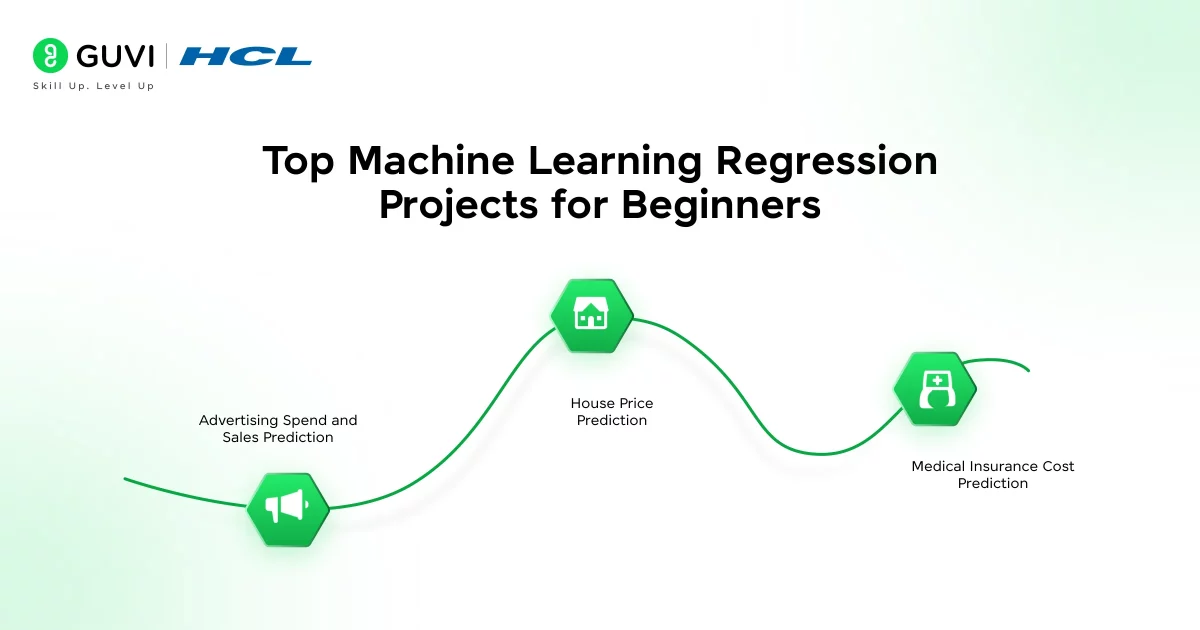
If you’re just getting started with regression in machine learning, these beginner-level projects are perfect to bridge theory and practice. Each one uses simple, well-known datasets and focuses on building core skills: understanding relationships between variables, checking model assumptions, and learning how to interpret coefficients and errors.
Let’s explore three projects that’ll help you get hands-on experience with regression in a structured and practical way.
1. Advertising Spend and Sales Prediction
This classic project is one of the simplest yet most effective ways to understand the relationship between input features and a continuous target. You’ll analyze how different types of advertising (TV, radio, and newspaper) affect product sales, and build a regression model to quantify their impact.
Duration: 1–2 days
Project Complexity: Beginner
Techniques: Simple Linear Regression, Multiple Linear Regression, Correlation Analysis, Residual Diagnostics
Dataset/Source: The “Advertising” dataset (available in the ISLR book or multiple GitHub repositories)
Learning Outcomes:
- Understand how linear regression quantifies relationships between numeric features.
- Learn to perform exploratory data analysis (EDA) and visualize feature-target correlations.
- Check regression assumptions: linearity, normality of residuals, and homoscedasticity.
- Evaluate model performance using R², MAE, and RMSE.
Project Breakdown:
- Load and explore the dataset (using Pandas, Matplotlib, or Seaborn).
- Visualize how each advertising channel affects sales individually.
- Fit a multiple linear regression model and interpret coefficients.
- Identify multicollinearity (using VIF) and refine features if needed.
- Plot residuals to check for randomness (a sign of good model fit).
Source Code: Advertising Spend and Sales Prediction
2. House Price Prediction
Predicting housing prices is one of the most popular machine learning projects, and for good reason, it teaches you how to handle multiple feature types, detect outliers, and interpret model coefficients in a real-world context.
Duration: 2–4 days
Project Complexity: Beginner
Techniques: Multiple Linear Regression, Polynomial Regression, Regularization (Ridge/Lasso), Feature Encoding
Dataset/Source:
- Boston Housing Dataset (available via scikit-learn)
- Or the “House Prices: Advanced Regression Techniques” dataset from Kaggle
Learning Outcomes:
- Learn to preprocess and clean structured, real-world data.
- Handle categorical variables (location, condition, style) using one-hot encoding.
- Detecting and mitigating outliers and skewed data distributions.
- Build, train, and evaluate regression models with regularization.
- Compare model performance using cross-validation and error metrics.
Project Breakdown:
- Perform EDA to understand how features like the number of rooms, area, and location affect prices.
- Handle missing values and encode categorical features.
- Split the dataset into training and testing sets.
- Train a multiple regression model and evaluate results using R² and RMSE.
- Experiment with Ridge and Lasso regression to reduce overfitting.
Source Code: House Price Prediction
3. Medical Insurance Cost Prediction
This project focuses on predicting medical insurance costs based on personal and lifestyle factors like age, BMI, smoking status, and region. It’s a great way to practice working with both numerical and categorical data while learning how to interpret feature importance in a regression model.
Duration: 2–3 days
Project Complexity: Beginner
Techniques: Multiple Linear Regression, One-Hot Encoding, Interaction Terms, Outlier Handling
Dataset/Source:
- “Medical Cost Personal Dataset” (available on Kaggle)
Learning Outcomes:
- Understand how categorical variables (e.g., smoker vs. non-smoker) impact regression outcomes.
- Learn to preprocess mixed data types (numerical + categorical).
- Identify and handle outliers (especially high-cost claims).
- Visualize model coefficients to interpret the impact of each feature.
- Evaluate regression performance and adjust the model with interaction terms.
Project Breakdown:
- Load and inspect the dataset — check for missing values and distributions.
- Encode categorical variables such as gender, region, and smoker status.
- Build a baseline multiple regression model.
- Analyze coefficients — notice how smoker status dominates others.
- Test adding interaction terms (e.g., smoker × BMI) to improve prediction.
- Evaluate performance using RMSE, MAE, and residual analysis.
Source Code: Medical Insurance Cost Prediction
The “Medical Insurance Cost” dataset is one of the most used examples for demonstrating multicollinearity, because age, BMI, and smoker status often interact in surprising ways. Understanding these relationships not only improves model accuracy but also builds your intuition for causal effects in data.
These three beginner-friendly regression projects form a solid foundation for any aspiring machine learning practitioner.
Intermediate Machine Learning Regression Projects
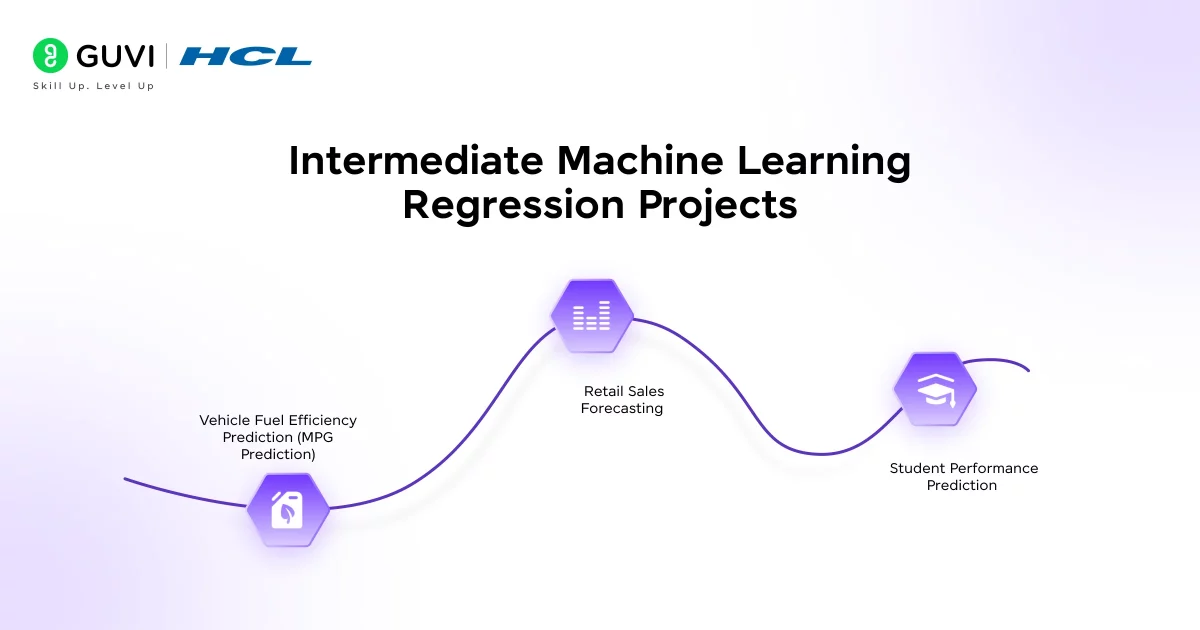
If you’ve already mastered simple regression concepts and completed beginner projects, it’s time to level up. These intermediate machine learning regression projects are designed to expose you to slightly larger datasets, non-linear patterns, regularization, and time-based features.
4. Vehicle Fuel Efficiency Prediction (MPG Prediction)
Predicting a car’s fuel efficiency (measured as miles per gallon) is a classic regression problem that introduces you to non-linear relationships and feature selection. It’s an excellent next step after linear regression because it makes you think carefully about which features actually matter.
Duration: 3–4 days
Project Complexity: Intermediate
Techniques: Polynomial Regression, Feature Selection, Regularization (Ridge, Lasso, ElasticNet), Cross-Validation
Dataset/Source:
- “Auto MPG Dataset” from the UCI Machine Learning Repository
Learning Outcomes:
- Learn to detect and model non-linear relationships in data.
- Understand how to choose relevant features and drop redundant ones.
- Implement Ridge and Lasso regression for improved generalization.
- Practice cross-validation to evaluate model performance reliably.
Project Breakdown:
- Load the Auto MPG dataset and explore correlations between variables (e.g., horsepower, weight, displacement).
- Handle missing values and encode categorical features like car origin.
- Build a baseline linear regression model and analyze results.
- Experiment with polynomial features to capture non-linear trends.
- Apply regularization (Ridge/Lasso) to control model complexity.
- Use cross-validation (e.g., K-Fold) to check model stability and avoid overfitting.
Source Code: Vehicle Fuel Efficiency Prediction (MPG Prediction)
5. Retail Sales Forecasting
This project combines regression with time-aware data, a crucial skill for anyone interested in data science for business or supply chain analytics. You’ll predict future product sales based on past data, promotions, store information, and seasonal patterns.
Duration: 4–5 days
Project Complexity: Intermediate
Techniques: Linear Regression, Regularization, Feature Engineering for Time Series, Rolling Window Validation
Dataset/Source:
- “BigMart Sales Dataset” or “Rossmann Store Sales Dataset” (both available on Kaggle)
Learning Outcomes:
- Learn how to engineer time-based and lag features.
- Understand temporal validation (why you shouldn’t shuffle time data).
- Explore the impact of store-related factors and promotions on sales.
- Evaluate model drift and stability over time.
Project Breakdown:
- Explore and clean the dataset, handle missing values and inconsistent entries.
- Create lag features (previous week/month sales), moving averages, and holiday indicators.
- Train a multiple regression model using these engineered features.
- Validate your model using time-based splits instead of random shuffling.
- Plot actual vs. predicted sales to visualize temporal performance.
- Tune your model using Ridge/Lasso regression to avoid overfitting.
Source Code: Retail Sales Forecasting
6. Student Performance Prediction
This project focuses on predicting students’ academic performance (final exam scores or GPA) based on factors like study hours, attendance, and prior grades. It’s a great introduction to mixed data types and feature interpretation, especially for educational analytics applications.
Duration: 2–4 days
Project Complexity: Intermediate
Techniques: Multiple Linear Regression, Feature Engineering, Regularization, Categorical Encoding
Dataset/Source:
- “Student Performance Dataset” from the UCI Machine Learning Repository
Learning Outcomes:
- Understand how behavioral and demographic factors influence academic outcomes.
- Learn to preprocess and encode mixed data types (categorical + numerical).
- Apply regularization and interpret which features affect performance the most.
- Evaluate regression models using RMSE and cross-validation.
Project Breakdown:
- Perform EDA to visualize how attendance, study hours, and prior grades affect scores.
- Handle missing or inconsistent data entries.
- Encode categorical variables like school type or parental education level.
- Fit a multiple linear regression model and interpret coefficient values.
- Experiment with Ridge/Lasso regression to identify the most impactful features.
- Compare regression results with classification models (predict grade categories).
Source Code: Student Performance Regression Analysis
The intermediate regression projects take you beyond basic line fitting and into real-world data complexity, non-linear patterns, mixed features, and time dependencies.

Advanced Machine Learning Regression Projects
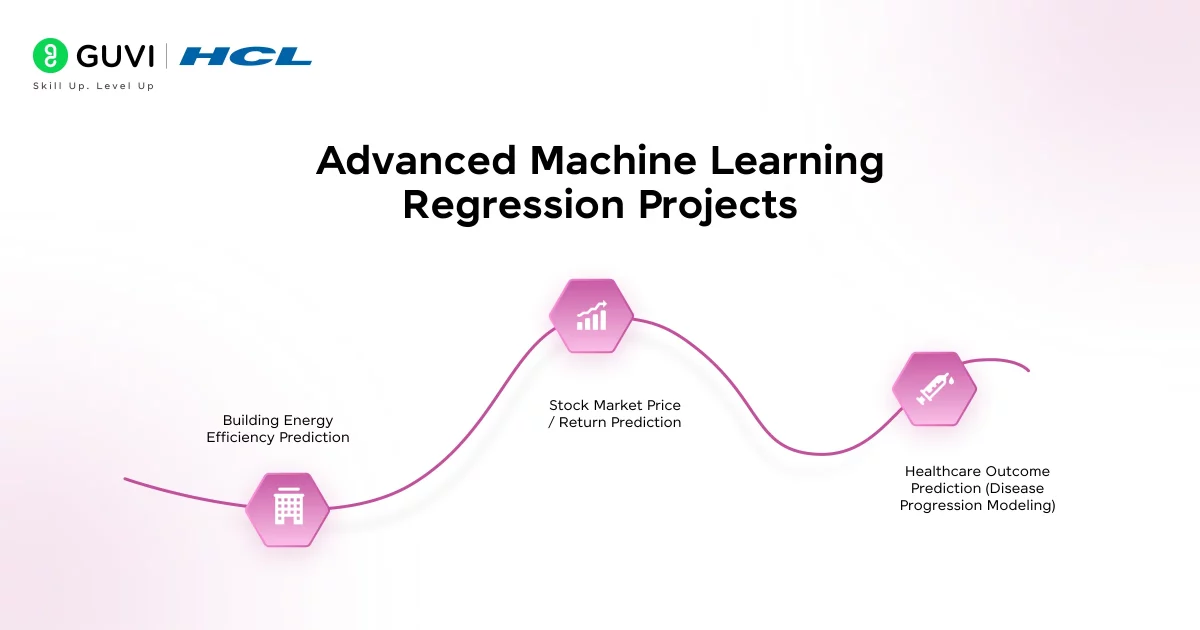
At this stage, you’ve mastered the fundamentals and built solid intuition around regression modeling. Now it’s time to work on projects that mimic real-world, high-impact use cases, where data is complex, relationships are non-linear, and interpretability matters just as much as accuracy.
7. Building Energy Efficiency Prediction
Predicting the energy efficiency of buildings is one of the most practical use cases of regression in the sustainability and construction industries. The goal is to predict heating and cooling loads based on architectural parameters like wall area, glazing, roof design, and building orientation.
Duration: 4–5 days
Project Complexity: Advanced
Techniques: Regularized Regression, Ensemble Regression (Random Forest, XGBoost), Feature Scaling, Model Interpretation (SHAP)
Dataset/Source:
- “Energy Efficiency Dataset” from the UCI Machine Learning Repository
Learning Outcomes:
- Work with domain-specific continuous variables.
- Learn to compare multiple regression algorithms (linear vs ensemble).
- Apply feature scaling and normalization for better model stability.
- Use SHAP or feature importance plots to interpret model behavior.
Project Breakdown:
- Load and explore the dataset, note correlations between wall area, glazing, and load.
- Split data into training and testing sets, and standardize numerical features.
- Train linear, ridge, and lasso regression models to build a baseline.
- Experiment with ensemble methods like Random Forest and XGBoost regressors.
- Visualize feature importances, e.g., which building parameters most affect efficiency.
- Use SHAP values for model interpretation and explain predictions.
Source Code: Building Energy Efficiency Prediction
8. Stock Market Price / Return Prediction
Financial data is one of the most challenging domains for regression because it’s noisy, volatile, and non-stationary. This project helps you predict future stock prices or daily returns based on historical prices, technical indicators, and macroeconomic data.
Duration: 5–7 days
Project Complexity: Advanced
Techniques: Time Series Regression, Regularization, Feature Engineering (Technical Indicators), Ensemble Models, Rolling Forecast Validation
Dataset/Source:
- Yahoo Finance (for open, high, low, close data)
- Kaggle datasets like “Stock Market Data” or “Historical S&P 500 Prices”
Learning Outcomes:
- Understand how to prepare time-series data for regression tasks.
- Engineer lag features and rolling statistics (moving averages, RSI, volatility).
- Build regression models for short-term stock return prediction.
- Learn to validate on temporal splits to avoid data leakage.
Project Breakdown:
- Collect and preprocess stock data (use yfinance or csv exports).
- Engineer features: moving averages, RSI, rolling mean, and volatility.
- Split data chronologically into training and test sets.
- Train Ridge and Lasso regression models for baseline results.
- Compare with Gradient Boosting Regressor or XGBoost.
- Evaluate performance using RMSE and direction accuracy (did the model predict up/down correctly?).
Source Code: Stock Market Price / Return Prediction
9. Healthcare Outcome Prediction (Disease Progression Modeling)
Healthcare datasets are complex, often with missing values, mixed data types, and sensitive variables. In this project, you’ll use regression to predict continuous medical outcomes like disease severity, recovery time, or treatment response based on patient attributes and lab results.
Duration: 5–6 days
Project Complexity: Advanced
Techniques: Regularized Regression (ElasticNet), Ensemble Regression (XGBoost, Gradient Boosting), Missing Data Imputation, Model Interpretability (LIME, SHAP)
Dataset/Source:
- “Diabetes Progression Dataset” (available in scikit-learn)
- Open healthcare datasets on Kaggle, such as “Heart Disease UCI” (for continuous outcomes)
Learning Outcomes:
- Learn to handle missing and noisy data in medical contexts.
- Apply interpretability tools (LIME, SHAP) to understand model decisions.
- Compare performance between linear and ensemble models.
- Evaluate fairness and subgroup consistency in healthcare predictions.
Project Breakdown:
- Load and clean the dataset, and impute missing lab or demographic values.
- Explore relationships between predictors (age, BMI, blood pressure) and the target variable.
- Train an ElasticNet regression model to balance feature selection and regularization.
- Compare with ensemble regressors like Gradient Boosting and XGBoost.
- Use SHAP plots to visualize which medical factors drive predictions.
- Evaluate performance using RMSE, MAE, and R², and check subgroup biases.
Source Code: Healthcare Outcome Prediction (Disease Progression Modeling)
These advanced regression projects push you to think like a professional data scientist, balancing performance, interpretability, and real-world constraints.
Bonus Project: Airbnb Rental Price Prediction
Predicting Airbnb rental prices is one of the most practical regression projects for anyone interested in combining data science with real-world business impact. The goal is to estimate nightly rental prices based on property features, location, seasonality, and host attributes.
Duration: 4–6 days
Project Complexity: Advanced
Techniques: Multiple Linear Regression, Regularization (Ridge/Lasso), Feature Engineering (Text + Numeric), Geospatial Analysis, Ensemble Regression
Dataset/Source:
- “Airbnb Open Data” (available on Kaggle for multiple cities)
Learning Outcomes:
- Learn how to work with a mix of structured (numerical) and unstructured (textual) data.
- Engineer features like amenities count, number of reviews, location coordinates, and availability.
- Apply regularization and ensemble regressors to improve model accuracy.
- Understand how external factors (seasonality, neighborhood) influence pricing.
Project Breakdown:
- Load Airbnb listings data and explore correlations between features and price.
- Clean the data – remove inactive or extreme listings and handle missing values.
- Engineer new features: total amenities, review sentiment, distance to city center.
- Build baseline regression models (Linear, Ridge, Lasso).
- Experiment with Random Forest or Gradient Boosting Regressor for comparison.
- Evaluate model performance using RMSE and visualize predictions across neighborhoods.
Source Code: Airbnb Rental Price Prediction
Some modern diagnostic tools use regression models inside deep learning pipelines. For example, regression layers in CNNs help estimate tumor sizes, blood oxygen levels, or organ volumes, proving that regression still plays a vital role even in complex medical AI systems.
If you’re serious about mastering machine learning and want to apply it in real-world scenarios, don’t miss the chance to enroll in HCL GUVI’s Intel & IITM Pravartak Certified Artificial Intelligence & Machine Learning course. Endorsed with Intel certification, this course adds a globally recognized credential to your resume, a powerful edge that sets you apart in the competitive AI job market.
Conclusion
In conclusion, regression is often the first real bridge between statistical thinking and applied machine learning. The projects we’ve explored, from predicting insurance costs to modeling energy efficiency, prove how flexible and powerful this technique can be.
By working through these beginner, intermediate, and advanced projects, you don’t just learn how to code models; you learn how to think like a data scientist, questioning data quality, validating assumptions, interpreting results, and communicating insights clearly.
So pick a project, grab a dataset, and start experimenting. The best way to understand regression isn’t by reading about it, it’s by building it.
FAQs
1. What are regression projects in machine learning?
Regression projects focus on predicting continuous values, like prices, sales, or performance scores, using statistical models that learn relationships between features and a numeric target.
2. Which regression algorithms are best for beginners?
Start with Linear Regression and Multiple Linear Regression, then move to Polynomial, Ridge, and Lasso Regression as you gain confidence.
3. What are some common datasets for regression projects?
Popular ones include the Boston Housing, Advertising, Auto MPG, and Medical Insurance Cost datasets, all widely available on Kaggle or UCI.
4. How do you evaluate regression model performance?
Use metrics like R², RMSE, and MAE to measure how well your model predicts unseen data.
5. Why is regression still important in machine learning?
Regression remains vital because it’s interpretable, efficient, and forms the foundation for many advanced ML and deep learning techniques.
Success Stories

About the Author
Lukesh S
A professional content writer who has experience in freelancing and now working as a Technical Content Writer at HCL GUVI having sound knowledge in Blog Writing and Creative Writing!
View all posts by Lukesh S
Connect with me @
















Did you enjoy this article?