


Artificial Intelligence and Machine Learning Articles
Finance Manager to Data Analytics: Career Growth, Salary and Seniority
How to Evaluate LLM Outputs in Production Deployments
AI/ML Skills Gap 2026: Why Companies Can't Find Job-Ready Talent
20 AI/ML Interview Questions Recruiters Can Use Without a Tech Background - Best Guide


Get In Touch For Details! Request More Information
Mathematics for Machine Learning: Beginners Guide (2026)
Sep 19, 2026 8 Min Read 4642 Views
(Last Updated)
Mathematics for machine learning is the set of core math topics, linear algebra, calculus, probability, and statistics, that power how models learn from data. Together, they explain what happens inside every algorithm, from a simple regression line to a deep neural network.
You don’t need to be a math expert to use it well. You just need to know what each piece does, why gradients guide learning, why probability helps models make good guesses, and why matrices organise data efficiently. This guide breaks down each concept in plain terms, so you build real understanding instead of memorizing formulas.
Table of contents
- TL;DR Summary
- Why Math Matters in Machine Learning
- How math powers ML algorithms
- The role of math in model accuracy and tuning
- Mathematics for Machine Learning: Step-by-Step Guide
- Step 1) Linear Algebra
- Step 2) Statistics You Need to Know
- Step 3) Probability and Its Role in ML
- Step 4) Calculus and Optimization Basics
- Stages of Learning Mathematics for Machine Learning
- Stage 1: Build Intuition with the Basics
- Stage 2: Add Probability & Statistics to the Mix
- Stage 3: Explore Calculus & Optimization
- Stage 4: Practice with Real Applications
- Stage 5: Expand into Advanced Topics
- Real Examples of Math Powering Machine Learning Models
- Conclusion
- FAQs
- Is mathematics for machine learning hard to learn?
- How much math do I need for machine learning?
- What are the core topics in mathematics for machine learning?
- Can I learn machine learning without math?
- Why is calculus important in machine learning?
TL;DR Summary
- Mathematics for machine learning breaks down into four core areas: linear algebra, statistics, probability, and calculus.
- This blog covers how each math field powers a different part of ML, from organizing data to reducing errors.
- Want to know why models improve over time? Explore how gradient descent and calculus drive that learning.
- Fine-tuning isn’t magic, it’s math. A small tuned model beating GPT-5.2 proves the point.
- This guide helps you learn math step by step, moving from basics to advanced topics like PCA and information theory.
Why Math Matters in Machine Learning
Mathematics for machine learning is the reason machines can learn from data instead of just following fixed rules. It gives every algorithm its logic, from how a model makes predictions to how it corrects its own mistakes.
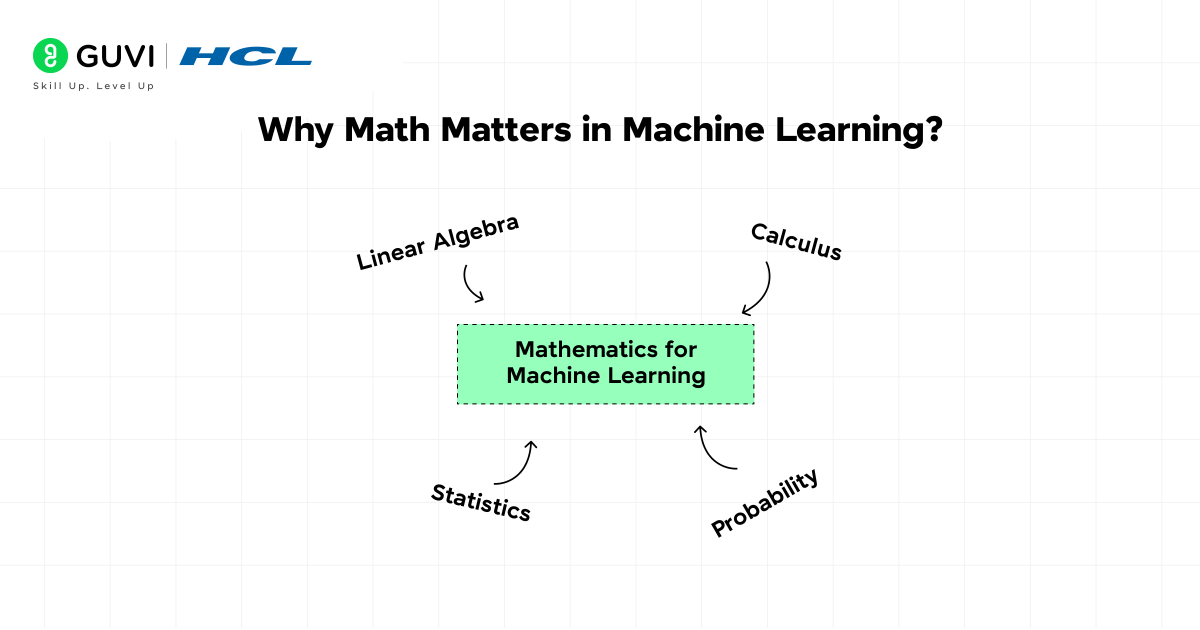
Without math, machine learning is just code with no direction. Linear algebra organizes the data. Calculus tells the model how to improve. Probability helps it handle uncertainty. Statistics helps it judge what patterns actually matter. Together, these fields turn raw numbers into real learning.
How math powers ML algorithms
Mathematics is the backbone of machine learning algorithms, allowing them to process information and improve accuracy over time. Here’s how math powers these systems:
- Data representation and manipulation: Linear algebra helps organize large datasets into vectors, matrices, and tensors, making data storage and processing more efficient.
- Pattern recognition: Mathematical concepts enable algorithms to identify trends, recognize outliers, and compare information from various sources.
- Decision making: Even with incomplete information, math allows systems to calculate confidence levels and make decisions based on probabilities.
Feature scaling, a concept rooted in linear algebra, ensures each aspect of your data contributes proportionally to model outputs. Furthermore, cost functions—mathematical expressions that measure model performance—help algorithms improve during training by quantifying errors.
The role of math in model accuracy and tuning
Understanding mathematics for machine learning significantly improves your ability to fine-tune models for better performance. In fact, model tuning based on mathematical principles can deliver impressive results.
In 2026, a fine-tuned GPT-OSS 120B model outperformed GPT-5.2 while running 15 times cheaper and 14 times faster.
Mathematical optimization plays a crucial role in this process:
- Calculus enables continuous adjustments that minimize errors and improve accuracy.
- Gradient descent, a calculus-based concept, helps models learn by adjusting parameters in directions that reduce errors most effectively.
- Parameter tuning based on mathematical principles helps identify optimal configurations for specific tasks.
As Andrew Ng often says, “It’s only when studying machine learning—specifically gradient descent and other optimization algorithms—that I appreciated how useful calculus is”.
Learn AI Machine Learning with HCL GUVI’s Intel & IITM Pravartak Certified AI ML Course. Get a 9-month, Intel-powered curriculum covering Python, ML, deep learning, and Generative AI, along with 1:1 doubt sessions and placement guidance from 1000+ hiring partners. Talk to an expert and start your AI career today!
Mathematics for Machine Learning: Step-by-Step Guide
Now that you’ve gotten a gist of how important it is, let’s discuss what and how you must learn mathematics for machine learning step-by-step:
Step 1) Linear Algebra
Linear algebra forms the mathematical language that enables machines to process and learn from data. It provides the essential tools for representing data points, manipulating them through transformations, and extracting meaningful patterns—all crucial operations in machine learning systems.
1.1) Scalars, vectors, and matrices explained
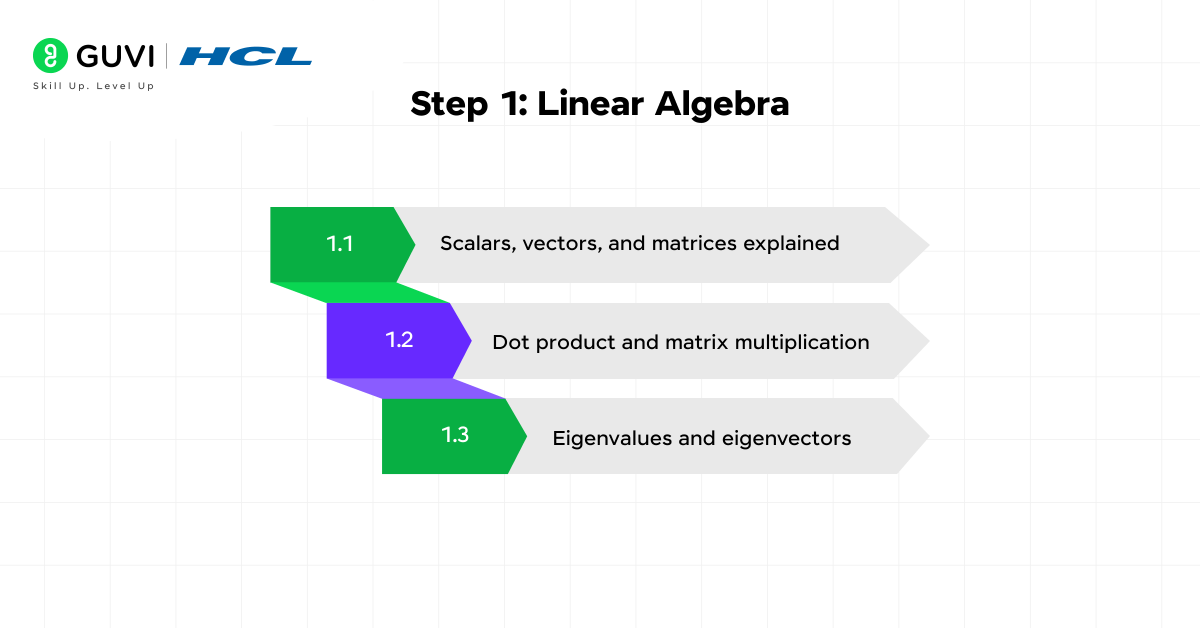
The building blocks of linear algebra begin with three fundamental mathematical entities:
- Scalars are single numbers without direction, representing only magnitude. In machine learning, scalars often denote constants, error metrics, or model accuracy values. For instance, a scalar might represent the accuracy percentage of your classification model.
- Vectors are ordered arrays of numbers that possess both magnitude and direction. Unlike scalars, vectors can represent multiple features simultaneously. They serve as the backbone for feature representation, where each dimension corresponds to a distinct attribute in your dataset. For example, a three-dimensional vector [height, weight, age] might represent a patient in a healthcare dataset.
- Matrices expand on vectors by organizing numbers into rectangular grids with rows and columns. Essentially, they’re two-dimensional arrays that can store and process complex data efficiently. In practical terms, machine learning datasets are typically represented as matrices, with rows representing observations and columns representing features or variables.
1.2) Dot product and matrix multiplication
These operations are fundamental to understanding how machine learning algorithms process information:
- The dot product takes two equal-length vectors and outputs a single scalar value. It’s calculated by multiplying corresponding elements and summing the results. This operation reveals how similar two vectors are, making it essential for calculating correlations and measuring vector similarity.
The formula looks like: A⋅B = A₁B₁ + A₂B₂ + … + AₙBₙ
- Matrix multiplication builds upon dot product operations. When multiplying matrices, each element in the resulting matrix is the dot product of a row from the first matrix and a column from the second matrix. This operation requires that the number of columns in the first matrix equals the number of rows in the second.
This operation is foundational because:
- It enables data transformations
- It allows for feature scaling and normalization
- It’s used extensively in neural network computations
1.3) Eigenvalues and eigenvectors
Among the most powerful concepts in linear algebra are eigenvalues and eigenvectors:
- Eigenvectors are special vectors that, when transformed by a matrix, only change in scale but not in direction (except possibly reversing). They represent the directions in which a linear transformation stretches or compresses space.
- Eigenvalues are the scaling factors associated with eigenvectors, telling us how much the eigenvector is stretched or compressed during the transformation. To find them, we solve the equation: det(A – λI) = 0, where A is our matrix, λ is an eigenvalue, and I is the identity matrix.
These concepts are particularly valuable in dimensionality reduction techniques like Principal Component Analysis (PCA), where they help identify the directions of maximum variance in data.
Step 2) Statistics You Need to Know
Statistical knowledge empowers machine learning practitioners to understand data distributions, detect patterns, and make accurate predictions. These mathematical tools help you extract meaningful insights from data before feeding it into your algorithms.
2.1) Descriptive vs inferential statistics
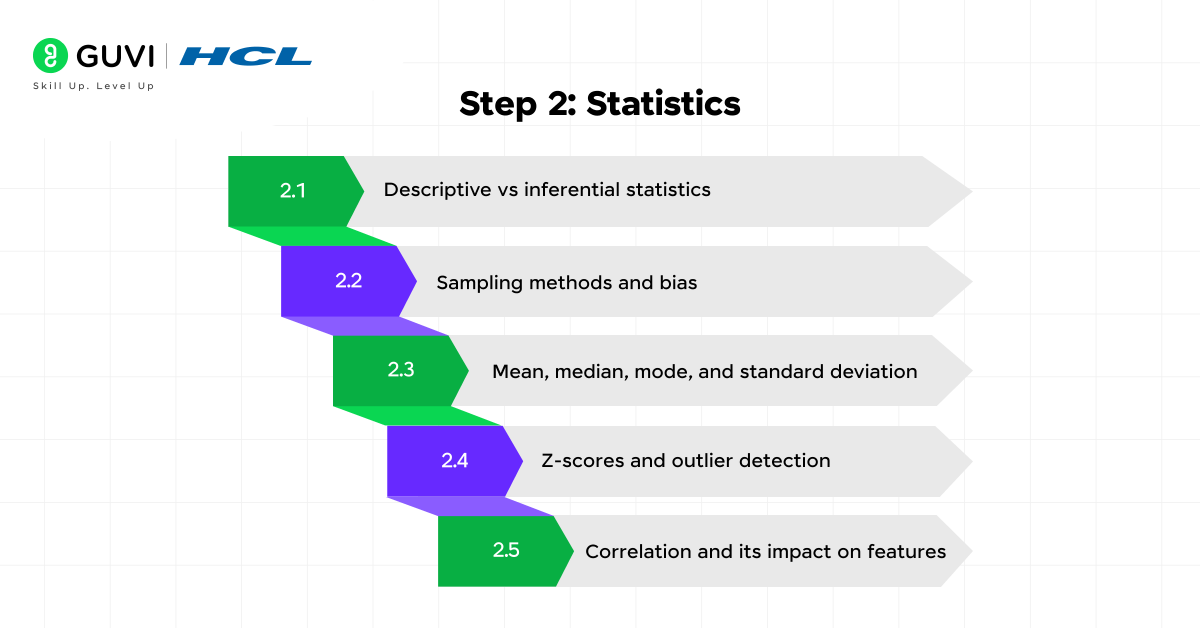
Statistics is broadly categorized into two main types:
- Descriptive statistics summarize and organize data in a meaningful way through charts, graphs, and numerical measures. It simply describes what’s already known without making predictions. This approach helps you understand your dataset’s characteristics before building a model.
- Inferential statistics, conversely, uses sample data to conclude larger populations. In machine learning, this allows you to make predictions and generalizations beyond your training data. Through techniques like hypothesis testing and confidence intervals, you can validate your models and assess their reliability.
2.2) Sampling methods and bias
Sampling bias occurs when your data collection introduces systematic errors, leading to non-representative samples. This creates a significant problem in machine learning—models trained on biased data will produce inaccurate and unreliable predictions.
To minimize sampling bias:
- Use diverse data sources to gain comprehensive population views
- Apply techniques like stratified sampling and data augmentation
- Carefully preprocess data to handle missing values and outliers
2.3) Mean, median, mode, and standard deviation
These measures form the foundation of data analysis in machine learning:
- Mean is the average of all values, calculated by summing data points and dividing by their count. While useful, it’s sensitive to outliers.
- Median represents the middle value in sorted data, effectively dividing the dataset into equal halves. It’s more robust against outliers than the mean.
- Mode is simply the most frequently occurring value in your dataset.
- Standard deviation measures how data points spread from the mean. Lower values indicate data clustering close to the mean, while higher values suggest greater dispersion.
2.4) Z-scores and outlier detection
- Z-score is a standardization technique that tells you how many standard deviations a data point sits from the mean. This helps in both feature scaling and outlier detection.
- For outlier detection, data points with Z-scores greater than 3 or less than -3 are typically considered outliers, as they fall outside 99.7% of normally distributed data.
- This is because approximately 68% of data falls within ±1 standard deviation, 95% within ±2, and 99.7% within ±3 standard deviations.
2.5) Correlation and its impact on features
Correlation measures relationships between variables, indicating how changes in one variable relate to changes in another. In machine learning, feature correlation significantly impacts model performance.
When features are highly correlated, they essentially provide redundant information. This can lead to several issues:
- Decreased feature importance for correlated variables
- Creation of unrealistic data points during permutation feature importance calculations
- Potential model overfitting to correlated features
Nevertheless, understanding feature correlations helps you select relevant variables and improve model accuracy and interpretability.
Step 3) Probability and Its Role in ML
Probability theory provides the mathematical foundation for handling uncertainty in machine learning systems. It lets algorithms make informed decisions even when dealing with incomplete or noisy data.
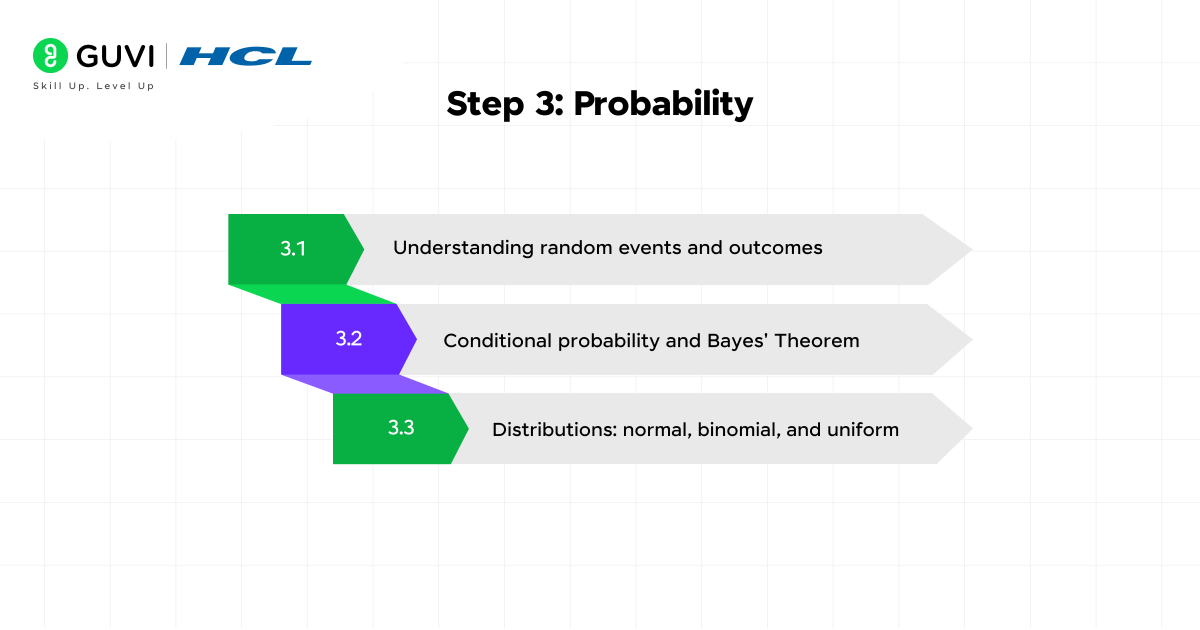
3.1) Understanding random events and outcomes
- Initially, probability helps quantify how likely events are to occur, assigning values between 0 (impossible) and 1 (certain). In ML, a random experiment might be analyzing user behavior or predicting stock prices—situations where outcomes aren’t completely predictable.
- The sample space represents all possible outcomes of an experiment, while an event is a subset of this space. For instance, when building a recommendation system, you need to calculate the probabilities of users selecting different items based on historical data.
3.2) Conditional Probability and Bayes’ Theorem
Conditional probability measures the likelihood of an event occurring given that another event has already happened. This concept is crucial when working with dependent features in your dataset.

Bayes’ Theorem, a cornerstone of probabilistic ML, is expressed as:
P(A|B) = [P(B|A) × P(A)] / P(B)
Where:
- P(A|B) is the posterior probability
- P(B|A) is the likelihood
- P(A) is the prior probability
- P(B) is the evidence
This theorem enables machines to update beliefs based on new evidence, forming the basis for algorithms like Naive Bayes classifiers.
3.3) Distributions: normal, binomial, and uniform
Different probability distributions model various types of data patterns:
- Normal (Gaussian): Bell-shaped curve ideal for modeling continuous variables like height or temperature
- Binomial: Represents events with two possible outcomes (success/failure) with the same probability across trials
- Bernoulli: Special case of binomial with a single trial; useful for binary outcomes in logistic regression
Step 4) Calculus and Optimization Basics
At the heart of machine learning’s learning process lies calculus, the mathematics of change and optimization. Calculus enables algorithms to learn from data by making incremental improvements to their predictions.
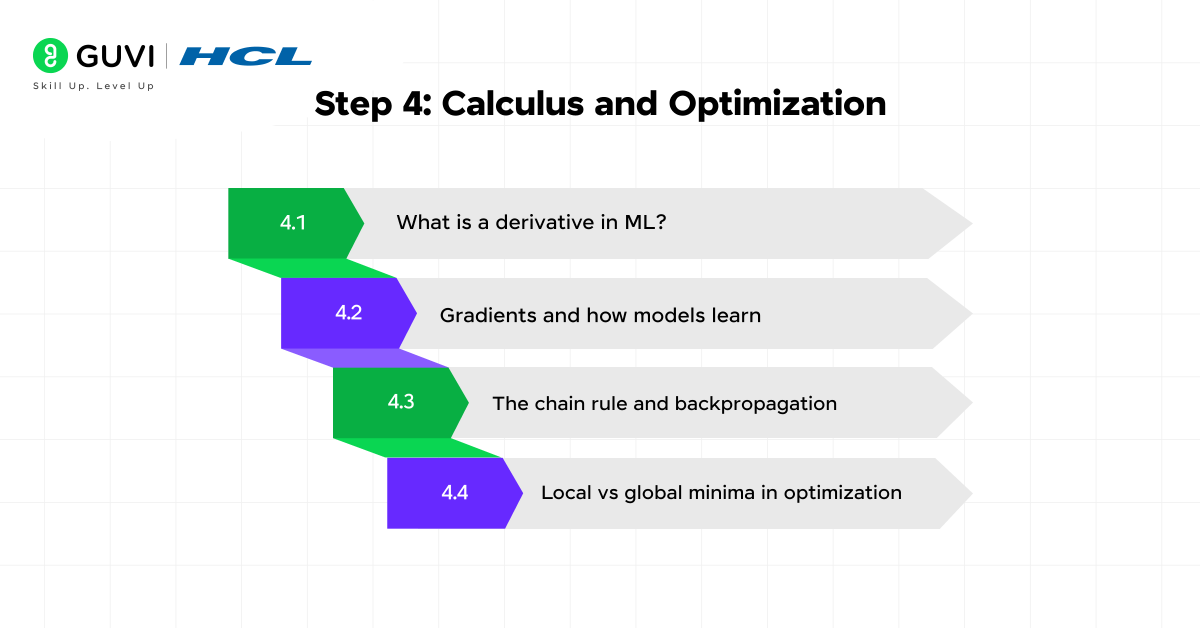
4.1) What is a derivative in ML?
A derivative measures the rate of change of a function at a specific point. In machine learning, derivatives help algorithms understand how changes in parameters affect model performance. Essentially, a derivative indicates the slope or steepness of a function, showing whether a slight parameter adjustment will increase or decrease the error.
Positive derivative: Function is increasing at that point, suggesting parameter adjustment in the opposite direction. Negative derivative: Function is decreasing at that point, indicating potential improvement in that direction.
4.2) Gradients and how models learn
The gradient is simply a derivative extended to functions with multiple input variables—it’s a vector of partial derivatives pointing in the direction of steepest ascent. During training, models use gradients to:
- Calculate the loss with current parameters
- Determine which direction reduces loss fastest
- Move the parameters a small amount in that direction
- Repeat until convergence
This process, known as gradient descent, adjusts weights and biases iteratively to minimize error between predicted and actual results.
4.3) The chain rule and backpropagation
The chain rule lets us find derivatives of composite functions, which is crucial because neural networks represent massive nested composite functions. Backpropagation applies this rule efficiently by:
- Computing the output through forward propagation
- Calculating error at the output layer
- Working backward through the network, computing gradients layer by layer
This approach avoids redundant calculations, making deep learning computationally feasible.
4.4) Local vs global minima in optimization
- Optimization algorithms generally find the nearest minimum (local minimum)—a point where the function value is smaller than nearby points. Yet this might not be the best possible solution (global minimum).
- Local minima can trick optimization algorithms, particularly in complex functions with multiple valleys. A model caught in a local minimum performs suboptimally compared to one reaching the global minimum. Nonetheless, in deep learning, we often accept good local minima if they yield sufficiently low error values.
Origin of Gradient Descent: The popular optimization technique used in machine learning today was first introduced way back in 1847 by French mathematician Augustin-Louis Cauchy.
Eigenfaces in Facial Recognition: Modern facial recognition systems use linear algebra concepts like eigenvectors and eigenvalues to mathematically represent faces—these are called “eigenfaces.”
Stages of Learning Mathematics for Machine Learning
Learning math for Machine Learning can feel overwhelming, but breaking it down into clear stages makes the journey smooth and practical. Here’s a roadmap you can follow step by step:
Stage 1: Build Intuition with the Basics
Start with linear algebra essentials—vectors, matrices, dot products, and matrix multiplication. Don’t rush the formulas; instead, use visualizations and geometric interpretations to understand what these operations mean (e.g., a dot product as a projection).
- Why it matters: These concepts form the foundation of ML models like linear regression, PCA, and neural networks.
Stage 2: Add Probability & Statistics to the Mix
Learn probability rules (independence, conditional probability, Bayes’ theorem) and basic statistics (mean, variance, standard deviation, distributions). Practice by solving small data problems like computing probabilities or modeling random variables.
- Why it matters: Probability explains uncertainty in data, while statistics helps in making decisions from sample datasets—core to every ML task.
Stage 3: Explore Calculus & Optimization
Move into differentiation, gradients, and partial derivatives. Learn how gradient descent works by coding a simple linear regression from scratch. Once comfortable, explore convex functions and why they guarantee a global minimum.
- Why it matters: Almost every ML algorithm—from logistic regression to deep learning—relies on optimization through calculus.
Stage 4: Practice with Real Applications
Start applying math directly in ML workflows. Use small projects like:
- Building a regression model with gradient descent
- Implementing k-means clustering with distance metrics
- Visualizing probability distributions with real datasets
This hands-on phase helps solidify math concepts by connecting them to real outcomes.
Stage 5: Expand into Advanced Topics
Once your basics are strong, dive into more advanced fields:
- Convex optimization → deeper understanding of model training stability
- Information theory → concepts like entropy and KL divergence, vital for ML interpretability
- Linear algebra in depth → eigenvalues/eigenvectors, singular value decomposition, etc. for dimensionality reduction
- Metric spaces & norms → crucial for distance-based learning and embeddings
This staged roadmap ensures you progress from intuition → application → mastery, making math feel less like abstract theory and more like a practical toolkit for building intelligent systems.
Real Examples of Math Powering Machine Learning Models
You’ve seen the theory. Now here’s where it actually plays out, in apps and tools you probably use every single day without realizing the math running underneath.
1. Your Netflix or Spotify recommendations
Ever wonder how Netflix always seems to know what you’d want to watch next? That’s linear algebra at work. Every show and every user gets represented as a vector, and the platform uses matrix operations to compare your viewing patterns with millions of others. Two vectors pointing in a similar direction mean similar taste. That’s the dot product doing its job quietly in the background.
2. Face unlock on your phone
When you unlock your phone with your face, the system isn’t storing a picture of you. It breaks your face down into key mathematical features using eigenvectors, the same concept covered earlier as “eigenfaces.” These features get compared each time you unlock, and if the math lines up closely enough, you’re in.
3. Spam filters catching junk mail before you see it
Ever noticed how spam rarely makes it to your inbox anymore? That’s probability, specifically Bayes’ Theorem. Every email gets scored based on how likely certain words or patterns are to appear in spam versus real messages, and the system updates that likelihood with every new email it sees.
4. Ride-hailing apps predicting your fare and ETA
When Uber or Ola tells you your ride is “6 minutes away” or your fare just went up, statistics is doing the heavy lifting. These apps constantly analyze traffic patterns, demand spikes, and historical trip data to estimate both time and price, adjusting predictions as new data comes in.
Note: ETA stands for “Estimated Time of Arrival”
5. Self-driving cars correcting themselves in real time
Every time a self-driving car adjusts its steering or braking, calculus is involved. The car is continuously calculating error, how far off its current path is from the ideal one, and using gradients to correct itself in real time. This is the same gradient descent process explained earlier, just applied at high speed with real consequences.
Conclusion
Mathematics for machine learning matters because it doesn’t stop being useful once you know the basics. Every model, from a simple regression to a fine-tuned system, still runs on linear algebra to handle data, calculus to reduce errors, and probability and statistics to make sense of uncertainty.
Knowing mathematics means you can actually troubleshoot a model instead of just running it, and that difference matters more as the models you work with get bigger.
FAQs
1. Is mathematics for machine learning hard to learn?
It can feel overwhelming at first. Breaking it into stages, starting with linear algebra, then statistics and probability, then calculus, makes it manageable.
2. How much math do I need for machine learning?
You need to understand linear algebra, statistics, probability, and calculus, not master each one; just know what they do.
3. What are the core topics in mathematics for machine learning?
Linear algebra, statistics, probability, and calculus. Each one handles a different part of how models process data and learn.
4. Can I learn machine learning without math?
Not fully. Without math, you can use ML tools but you won’t understand why models predict or improve the way they do.
5. Why is calculus important in machine learning?
Calculus powers gradient descent, the method models use to reduce errors and improve accuracy during training.
Success Stories

















Did you enjoy this article?